Do Electric Cars Stop Suddenly? The Essential Facts
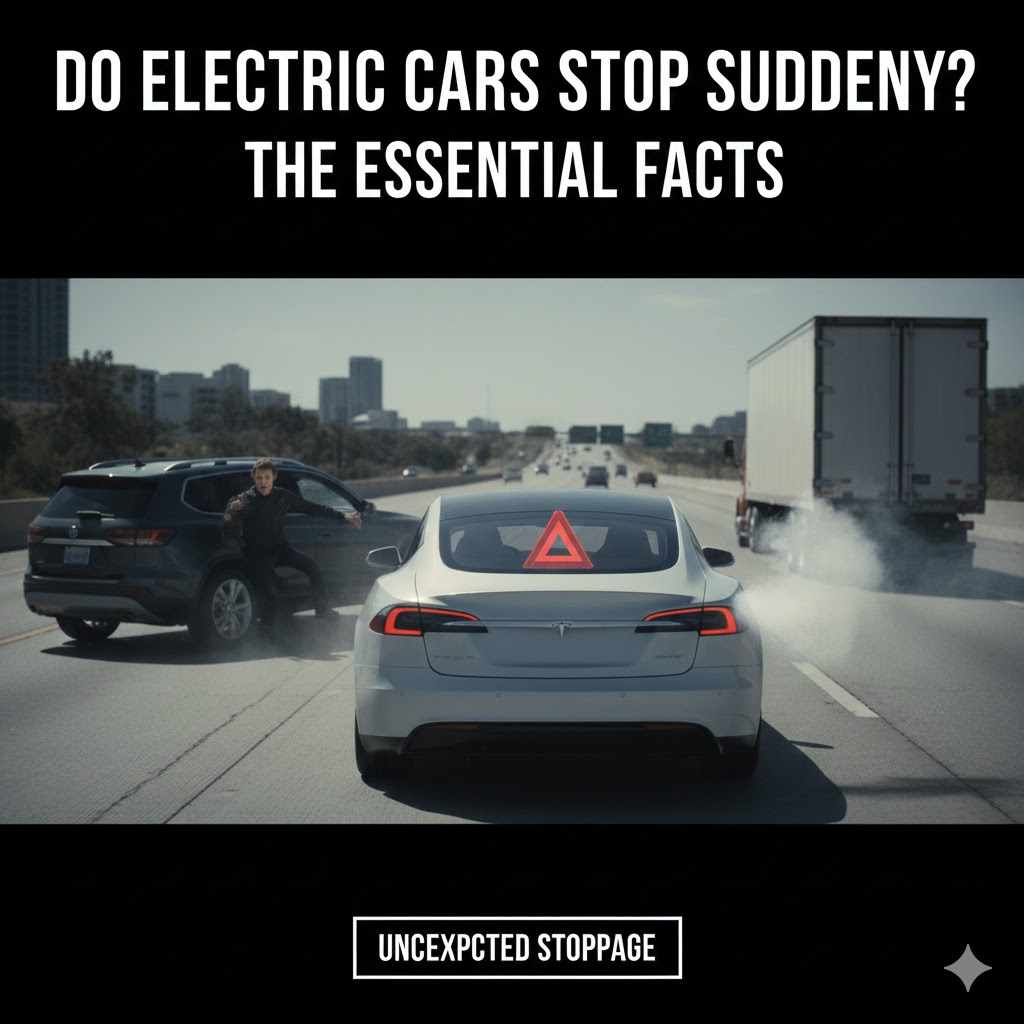
No, electric cars do not stop suddenly when the battery runs out. They are designed with multiple safety features that give you clear, escalating warnings long before the car loses power. This includes reduced power modes and dashboard alerts, giving you plenty of time to find a charger and pull over safely.
Hello, I’m Md Meraj. If you’re thinking about switching to an electric car (EV), you might have a nagging fear: what if it just stops dead in the middle of the highway? It’s a common worry, but I’m here to put your mind at ease. This fear comes from how our phones or other small gadgets die, but a car is much, much smarter.
Electric cars are built with your safety as the top priority. They won’t leave you stranded without plenty of notice. In this guide, we’ll walk through exactly what happens when an EV battery gets low, step by step. You’ll see that it’s a gentle, predictable process designed to help you, not scare you.
Why People Worry About EVs Stopping Suddenly
The idea of a car just dying without warning is frightening. For many drivers considering an electric vehicle, this is a major concern. But where does this fear come from? It’s usually a mix of a few common anxieties and misunderstandings.
Range Anxiety: The Core Fear
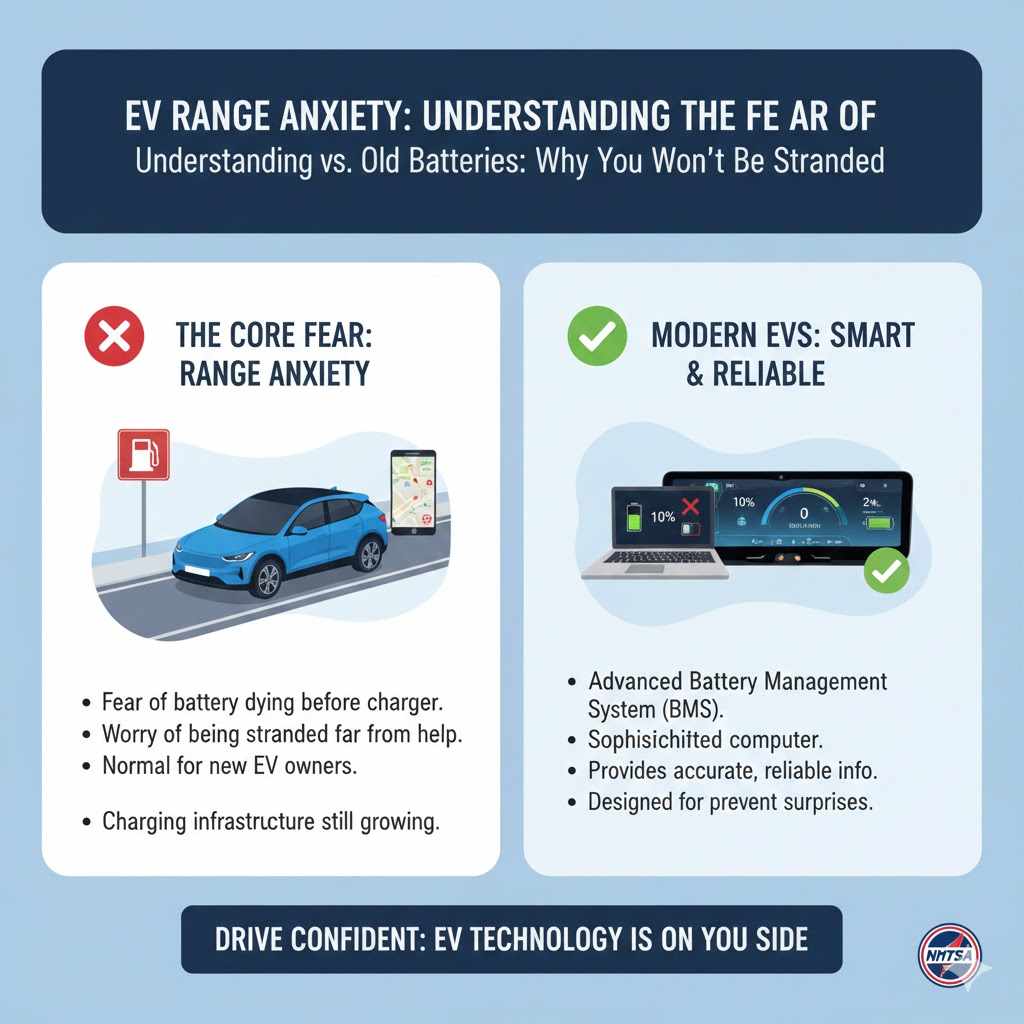
The biggest worry is “range anxiety.” This is the fear that your EV will run out of battery before you can reach a charging station, leaving you stranded. It’s the electric equivalent of watching your gas light blink for miles on an empty stretch of road.
This feeling is completely normal, especially when you’re new to EVs. We’re all used to seeing gas stations on every corner. The charging infrastructure is still growing, and it’s natural to feel a little uncertain at first. However, modern EVs have impressive ranges, and charging stations are becoming more common every day.
Misconceptions from Old Technology
Part of the fear also comes from our experience with other battery-powered devices. Think about an old laptop or smartphone. One minute it shows 10% battery, and the next, it shuts down completely. It’s easy to assume a giant, car-sized battery might do the same thing.
Fortunately, EV technology is far more advanced. Your car’s battery management system is an incredibly sophisticated computer. Its job is to protect the battery, monitor its health, and give you accurate, reliable information so you are never caught by surprise.
What Really Happens When an EV’s Battery Gets Low?
Instead of an abrupt stop, an electric car goes through a series of clear, predictable stages when its battery level drops. Think of it as your car communicating with you, telling you exactly what it needs. This process is designed to be safe, gentle, and give you maximum time to react.
Stage 1: The First Warnings (The Gentle Nudge)
The first sign that your battery is getting low is a gentle and calm notification. This usually happens when your battery’s state of charge (SoC) drops to around 15% or 20%.
- A Dashboard Alert: A message will pop up on your dashboard or main screen, often with an amber or yellow battery icon. It will clearly state that the battery is low and that you should find a place to charge soon.
- Navigation Suggestions: Many modern EVs are smart enough to help you out. When the low battery warning appears, the car’s navigation system will often automatically ask if you want to find nearby charging stations. It can even route you to the closest one.
At this stage, the car still drives perfectly normally. There is no change in performance. This is simply a friendly heads-up to start planning your next charge.
Stage 2: Power Limitation Mode (The “Turtle Mode”)
If you continue driving and ignore the initial warnings, the car will enter the next phase as the battery level becomes critical, typically below 10%. This is often called “Turtle Mode,” “Limp Mode,” or a reduced power mode. You’ll know you’re in it because a turtle icon might appear on your dashboard.
This is a crucial safety feature. The car isn’t failing; it’s intelligently conserving its remaining energy to extend your range as much as possible, giving you a better chance to reach a charger. Here’s what you’ll notice:
- Reduced Acceleration: The car will feel less peppy. It won’t accelerate as quickly, encouraging a smoother, more efficient driving style.
- Limited Top Speed: Your maximum speed may be capped, often to around 50-55 mph. This is more than enough for surface streets and safe enough for the right lane of a highway.
- Less Power for Accessories: The car will divert power away from non-essential systems. Your climate control might not blow as hard, or the heated seats might turn off. The focus is on getting the wheels to turn.
Turtle Mode is your car’s way of saying, “I’m doing everything I can to get you to safety, but we need to charge now.”
Stage 3: The Final Warnings (The Last Call)
If you keep driving even in Turtle Mode, the warnings will become much more urgent. The car is now using its last reserves of energy. You can expect:
- Loud Audible Chimes: You’ll hear repeating beeps or chimes that are hard to ignore.
- Flashing Dashboard Lights: The battery icon will likely flash red, and messages will become more prominent.
- Drastic Power Reduction: Acceleration will become very slow, making it clear that the car is about to stop.
At this point, your only goal should be to pull over to a safe location immediately. The car is giving you its final few moments of mobility to get off the road.
Stage 4: Coming to a Gentle Stop
When the main high-voltage battery is completely depleted, the car will not just lock up or shut down in a dangerous way. The electric motor will stop providing power, and the car will gently coast to a stop.
Critically, your essential safety systems will still work for a short time. EVs have a separate, smaller 12-volt battery (just like a gas car) that powers things like:
- Hazard lights
- Power steering
- Brakes
- Door locks and windows
This ensures you can safely steer to the shoulder, turn on your hazard lights, and wait for assistance. The car is designed to fail safely and predictably, not suddenly.
Comparing EV “Empty” to a Gas Car Running Out of Fuel
While both scenarios are inconvenient, the process an EV follows is arguably safer and gives the driver more control than a gas car that sputters and dies.
| Feature | Electric Vehicle (EV) | Gasoline Car |
|---|---|---|
| Warning System | Multiple stages: initial warning, reduced power mode (“turtle mode”), final audible/visual alerts. Navigation often suggests chargers. | A single low fuel light, sometimes with a “miles to empty” estimate that can be inaccurate. |
| Reduced Power Mode | Yes, intelligently limits acceleration and speed to conserve energy and maximize the distance you can travel to find a charger. | No. The car runs normally until the engine starts sputtering from fuel starvation, leading to a jerky and unpredictable stop. |
| Final Moments | A smooth, predictable coast to a stop as the motor disengages. | Engine sputters, jerks, and then dies, which can be jarring and harder to control. |
| Safety Systems After Stop | The 12-volt battery keeps hazard lights, power steering, and brakes working for a period after the main battery is depleted. | Power steering and power brakes are lost once the engine dies, making the car very difficult to maneuver. |
| Getting Going Again | Requires a tow to a charger or a visit from a mobile charging service. | Can be refilled with a can of gasoline on the roadside. |
What is Regenerative Braking and How Does it Help?
One of an EV’s best features for preventing an empty battery is regenerative braking. It’s a clever system that helps you regain a little bit of energy every time you slow down.
In a gas car, when you press the brake pedal, brake pads clamp down on discs, and all that forward motion is wasted as heat. In an EV, lifting your foot off the accelerator or pressing the brake pedal tells the electric motor to run in reverse. It acts like a mini-generator, using the wheels’ momentum to create electricity and send it back to the battery.
This has two benefits:
- It Extends Your Range: In stop-and-go city traffic, regenerative braking can significantly boost your efficiency, adding miles back to your range over the course of a drive.
- It Enables “One-Pedal Driving”: Many EVs have a strong regenerative braking setting that allows you to speed up and slow down using only the accelerator pedal. It makes driving smoother and even more efficient.
While it won’t save you if the battery is already at zero, it constantly works in the background to help you get the most out of every charge.
Key Factors That Affect Your EV’s Range
Your car’s estimated range is just that—an estimate. Real-world driving can change that number. Understanding what affects your range helps you plan better and avoid low-battery situations altogether. For more detailed information, the U.S. Department of Energy provides excellent resources on factors affecting electric car efficiency.
Driving Style
How you drive is the biggest factor. Aggressive driving with rapid acceleration and hard braking uses a lot of energy. A smooth, gentle driving style that anticipates stops and maximizes regenerative braking will always give you more range.
Weather and Temperature
Batteries are like people: they’re happiest at a comfortable room temperature.
- Cold Weather: In winter, the chemical reactions inside the battery slow down, reducing its efficiency. Additionally, running the cabin heater, which is a big energy draw, can reduce your range by up to 30% or more.
- Hot Weather: Extreme heat can also affect battery performance, and running the air conditioner will consume energy and reduce your range, though typically not as much as the heater.
Terrain and Speed
Physics plays a big role. Driving uphill requires a lot more energy than driving on a flat road. Likewise, wind resistance increases exponentially with speed. Driving at 75 mph will use significantly more energy than driving at 60 mph.
Tire Pressure and Vehicle Load
Just like in a gas car, simple maintenance matters. Underinflated tires increase rolling resistance and force the motor to work harder. Carrying heavy loads in your car also requires more energy to move. Keeping your tires properly inflated is one of the easiest ways to maximize your range.
Practical Tips to Avoid Running Out of Charge
With a little bit of planning, running out of charge in an EV is extremely rare. Here are some simple habits to build.
- Plan Your Trips: For long journeys, use an app like A Better Routeplanner (ABRP) or your car’s built-in trip planner. These tools will map out your route, including necessary charging stops, and tell you how long you need to charge at each one.
- Understand Your “Real-World” Range: Pay attention to how your range changes with the seasons and your driving style. Don’t rely solely on the official EPA estimate. Knowing your car’s typical summer and winter range will make you a much more confident driver.
- Charge Smartly: The “ABCs of charging” is a great rule to follow: Always Be Charging. If you have a charger at home, plug your car in every night. You’ll wake up with a “full tank” every morning. When you’re out, top up your charge while you’re shopping or eating if a charger is available.
- Don’t Push It: Treat 20% battery like you would treat the low fuel light in a gas car. It’s not an emergency, but it’s your signal to find a charger. Don’t try to drive the car all the way to 1%.
- Know Your Roadside Assistance Options: Check if your car’s manufacturer offers complimentary roadside assistance. Also, services like AAA are increasingly offering mobile EV charging in many areas. Knowing who to call provides great peace of mind.
What to Do If You Actually Run Out of Charge
Even with the best planning, things can happen. If you find yourself in a situation where the battery is completely depleted, don’t panic. The process is straightforward.
Safety First: Pull Over
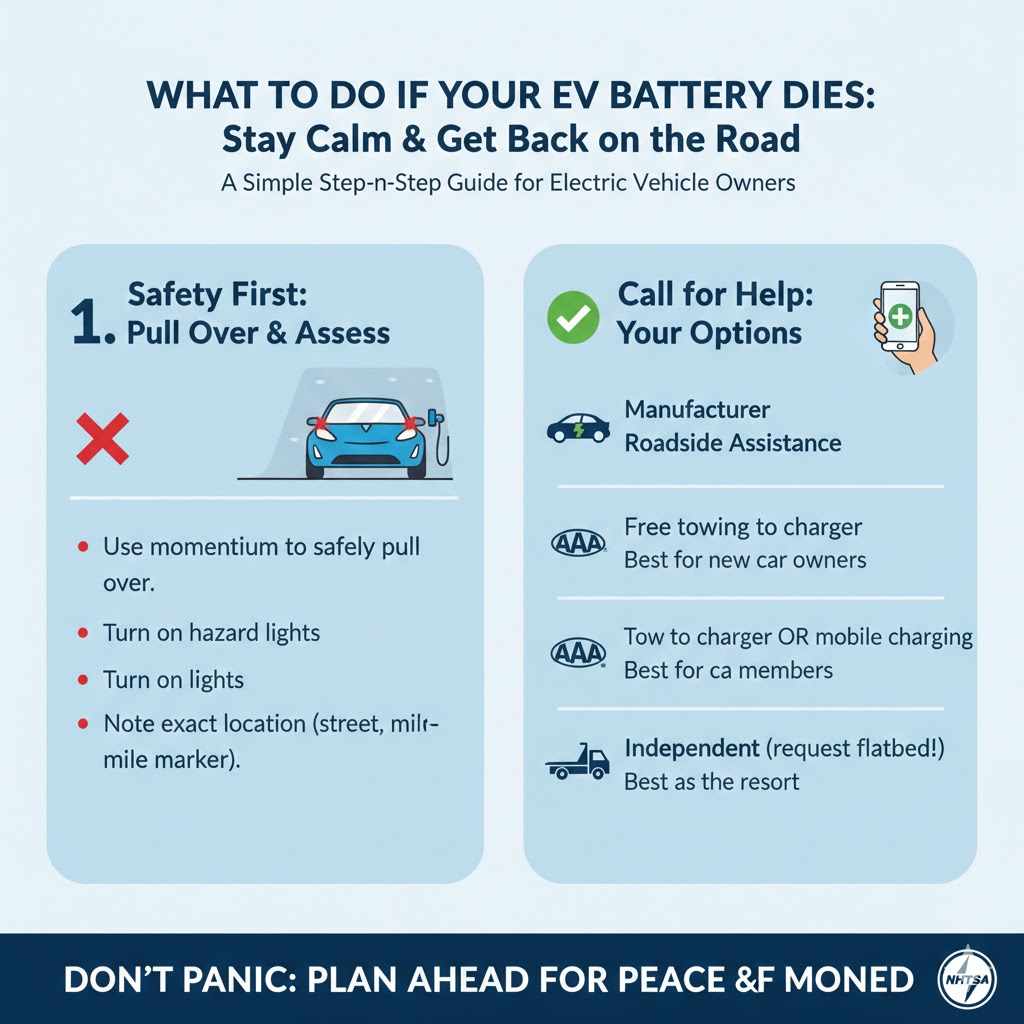
As soon as you realize you won’t make it to a charger, your priority is safety. Use the car’s final moments of momentum to pull over to a safe location, like the shoulder of the road, a parking lot, or a side street. Turn on your hazard lights immediately.
Assess Your Location
Check your phone’s map. Are you in a populated area? Note your exact location, including the nearest cross street or mile marker, to make it easy for help to find you.
Call for Help
You have a few options for getting assistance. You won’t be stranded for long.
| Service Provider | What They Offer | Best For… |
|---|---|---|
| Manufacturer Roadside Assistance | Most EV manufacturers (Tesla, Ford, Hyundai, etc.) include a few years of free roadside assistance. They will typically tow you to the nearest compatible charging station for free. | New car owners, as this service is often included with the vehicle purchase. It’s usually your first and best call. |
| AAA (or similar auto club) | AAA offers EV-specific services. Depending on your location, they may be able to provide a tow to a charger or bring a mobile charging truck to give you enough range to get to a station yourself. | Members of an auto club. The mobile charging option can be faster than getting a tow. |
| Independent Towing Service | Any towing company can help, but make sure to tell them you have an electric vehicle. EVs often need to be towed on a flatbed truck to avoid damaging the electric motors. | A last resort if other options are not available. Be very clear about the type of vehicle you have. |
Frequently Asked Questions (FAQ)
Do electric cars just die without warning?
Absolutely not. EVs give a series of escalating warnings, starting with a gentle notification around 20% battery, followed by a reduced power “turtle mode,” and finally, more urgent audible and visual alerts before coasting to a safe stop.
What is “turtle mode” in an electric car?
Turtle mode is a safety feature that activates when the battery is critically low. It limits your car’s acceleration and top speed to conserve the last bit of energy, helping you travel a few extra miles to reach a safe location or charging station.
Can an EV battery be damaged by running it to zero?
While it’s not ideal to do it often, modern EV battery management systems are designed to protect the battery. The car shuts down before the battery is truly at absolute zero, leaving a small buffer to prevent damage. However, it’s best to avoid this situation for the long-term health of your battery.
How long can I drive after the first low battery warning?
This depends entirely on the car, the weather, and how you’re driving. When the first warning appears (usually around 15-20%), you likely still have 20 to 50 miles of range. The car’s range estimator will give you the best idea, but you should treat the warning as a signal to charge as soon as possible.
Will my brakes and steering still work if the main battery dies?
Yes. Electric cars have a separate 12-volt battery that powers essential safety systems like power steering, brakes, hazard lights, and door locks for a period of time after the main high-voltage battery is depleted. This allows you to safely control the car as you pull over.
Is it expensive to get an EV towed if it runs out of battery?
It can be, but it’s often covered. Most new EVs come with complimentary roadside assistance that includes towing to a charging station. If you have a membership with an auto club like AAA, towing is usually included as part of your plan. If you have to pay out of pocket, ensure the tow company uses a flatbed.
Does cold weather make my EV more likely to stop suddenly?
Cold weather will significantly reduce your driving range, sometimes by 30% or more. However, it does not make the car stop suddenly. All the same warning systems will function perfectly. You’ll simply see your range drop faster, so you’ll need to plan for more frequent charging stops in the winter.
Conclusion: Driving an EV with Confidence
The fear of an electric car stopping suddenly is one of the biggest hurdles for people considering the switch, but it’s a fear based on myth, not reality. Modern EVs are engineered with sophisticated, multi-stage warning systems designed to keep you safe and informed. They communicate clearly, conserve energy when needed, and always prioritize a safe, controlled stop over an abrupt one.
By understanding how your EV works and adopting a few simple charging habits, you can eliminate range anxiety entirely. Instead of worrying about being stranded, you can enjoy all the benefits of electric driving—the smooth, quiet ride, the instant acceleration, and the freedom from the gas station. So drive with confidence, knowing your car has your back every mile of the way.