Do Magsafe Cases Work With Magnetic Car Mounts? Find Out
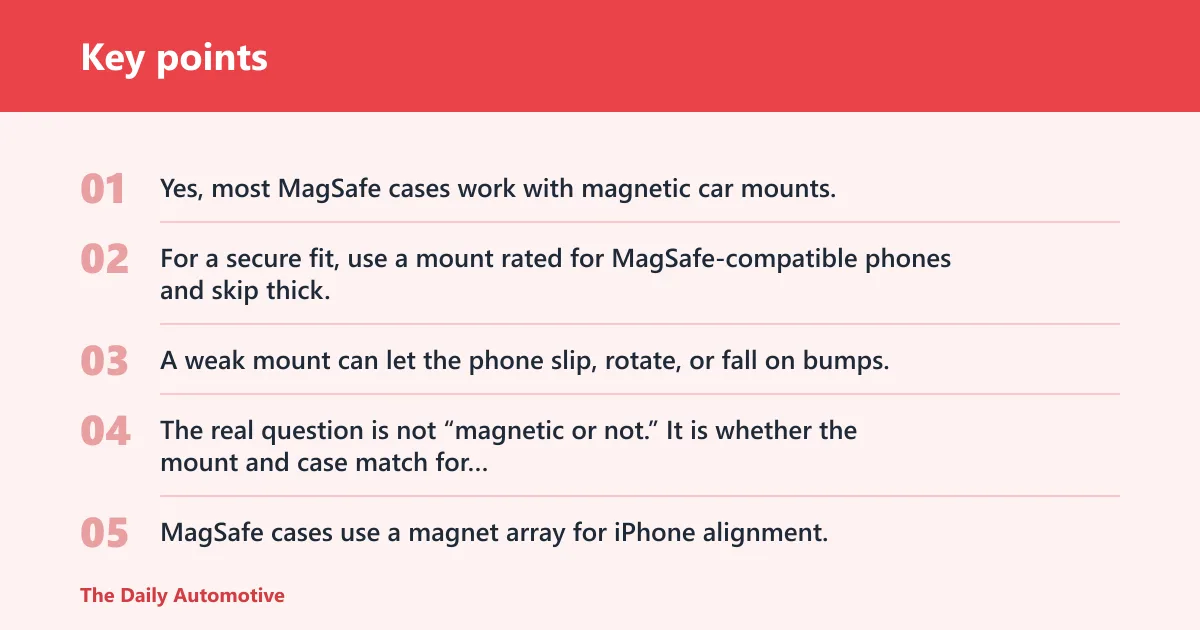
Yes, most MagSafe cases work with magnetic car mounts, but hold strength depends on the mount, the case’s magnet ring, and the phone’s weight. For a secure fit, use a mount rated for MagSafe-compatible phones and skip thick, non-magnetic cases. A weak mount can let the phone slip, rotate, or fall on bumps, which is distracting and expensive.
The real question is not “magnetic or not.” It is whether the mount and case match for alignment, load, and movement. MagSafe cases use a magnet array for iPhone alignment, and that helps with one-handed attachment and wireless charging alignment when the accessory is built for it.
Why case and mount alignment affects grip

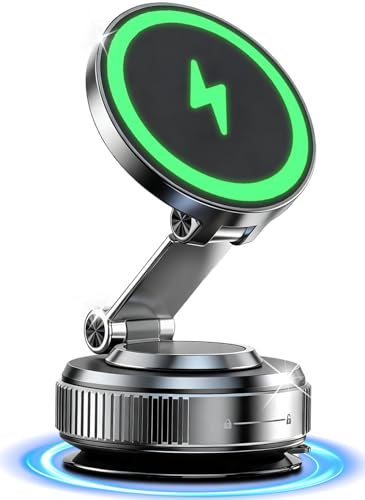
MagSafe-compatible mounts are the safest bet because they are built around the ring pattern on the back of the phone or case. A generic magnetic mount may still hold, but retention can change a lot with case thickness, magnet quality, and the amount of vibration reaching the mount base.
What has to match for the hold to work?
The magnet pattern has to line up with the case, the phone has to sit flat on the mount face, and the base has to stay planted under vibration. If any one of those parts is weak, the phone can twist, slide, or pop free when the car hits potholes or a sharp expansion joint.
Why the mount matters as much as the case
A strong case cannot fix a shaky mount. Suction, adhesive, vent clip, and dash pad bases each fail in different ways, so the best setup is the one that keeps the magnet face steady and the base from moving on heat-soaked dashboards or under repeated one-handed grabs.
ESR states that MagSafe cases are compatible with magnetic car mounts, and EaseHolder says MagSafe cases are designed to work with magnetic car mounts. That is the baseline. It does not mean every mount will behave the same on rough roads.
What makes a MagSafe case stick or slip
A MagSafe case sticks when its magnet array lines up cleanly with the mount and the case is thin enough for the magnetic field to do its job. It slips when the case is thick, the phone is heavy, the mount face is small, or the base lets the whole assembly wobble under vibration.
Built-in magnet array and alignment
MagSafe uses magnets to attach accessories to the back of an iPhone, and the case keeps that ring centered. That alignment helps charging accessories and magnetic mounts seat correctly. If the phone lands off-center, the mount may still grab, but the grip can feel soft or crooked.
How case thickness changes magnetic hold
Thin MagSafe cases usually give the cleanest grab. Thick MagSafe cases add distance between the mount and the phone’s magnet array, which reduces holding power. Extra-thick rugged cases create the biggest risk because they can soften the pull enough that bumps or quick turns break the connection.
Why heavier phones and accessories raise the risk of drop
Weight acts like a lever. A larger iPhone, a heavy case, or an attached wallet pushes harder on the mount when the car moves. The magnet may hold at idle and still fail when the road gets rough, especially on vent mounts that flex or on suction bases that were not seated well.
Say your MagSafe case is slim and your mount is a MagSafe-specific suction model on a level dash. The phone may stay secure for daily commuting, because the magnet ring and base both work in your favor. Swap that same phone into a thick rugged case, and the hold may drop fast on the first set of speed bumps.
MagSafe case and mount compatibility matrix
This matrix gives you a fast read on hold risk, likely use cases, and the failure points that matter most. “Low risk” means the setup is usually the easiest to trust; “medium risk” means it can work but needs the right conditions; “high risk” means failure is more likely under bumps, heat, or repeated repositioning.
| Case type | Vent mount | Dash mount | Windshield mount | Suction mount |
|---|---|---|---|---|
| Slim MagSafe | Medium risk; best for light phones and smooth roads; common failure points are vent flex and side-to-side sway | Low risk; best for daily commuting; common failure points are dust, heat-softened pads, and poor surface prep | Low to medium risk; best when visibility and reach work well; common failure points are heat and glass angle | Low risk; best all-around hold for a slim case; common failure points are weak suction prep and repeated removal |
| Thick MagSafe | High risk; best only for short trips; common failure points are reduced magnetic pull and vent vibration | Medium to high risk; best if the pad is wide and clean; common failure points are heat and twisting under load | Medium risk; best if the mount arm is short and the glass is cool; common failure points are sag and rotation | Medium risk; best when the suction cup is strong and the base is rigid; common failure points are arm droop and slip on hot glass |
| Rugged MagSafe | High risk; best avoided for rough roads; common failure points are weak vent clips and the case’s extra thickness | Medium to high risk; best if the dash pad is large and stable; common failure points are case mass and adhesive fatigue | Medium to high risk; best only with a short arm and strong suction; common failure points are heat and bounce | Medium risk; best option among common mounts, but still sensitive to case bulk; common failure points are suction fatigue and rotation |
| Non-MagSafe with metal ring adapter | Medium to high risk; best for older cases with moderate use; common failure points are ring placement and weaker alignment | Medium risk; best for light phones and stable dashboards; common failure points are adhesive failure on the ring and heat | Medium risk; best where reach matters more than hard cornering; common failure points are rotation and glass heat | Medium risk; best if the ring is centered well; common failure points are extra weight and ring peel over time |
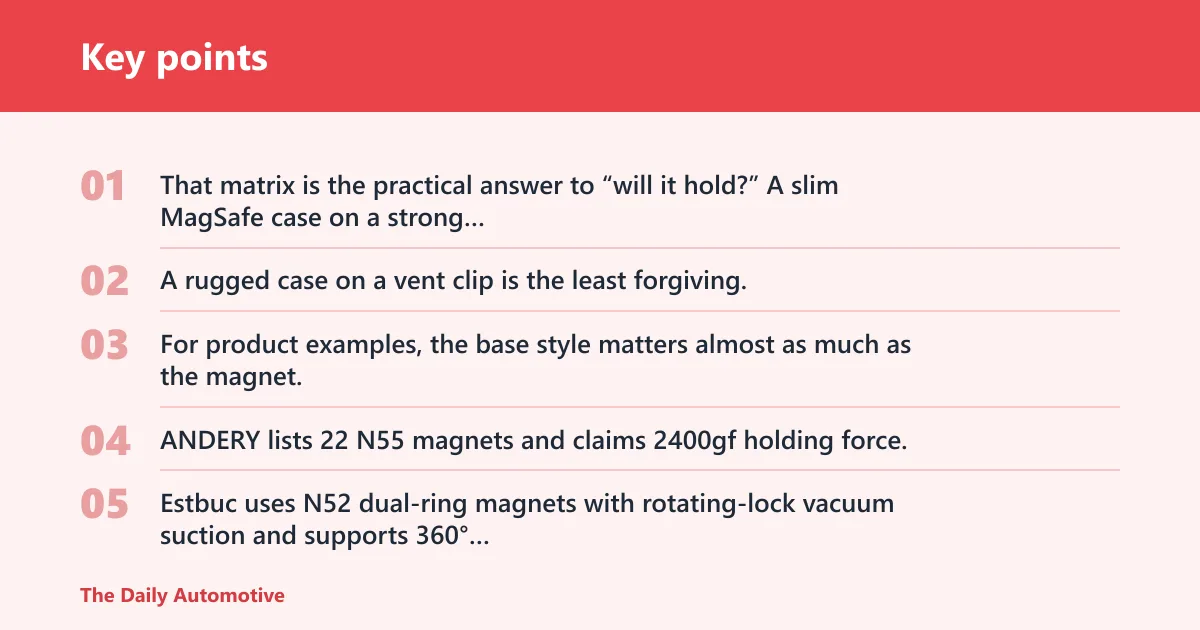
That matrix is the practical answer to “will it hold?” A slim MagSafe case on a strong suction mount is the most forgiving setup. A rugged case on a vent clip is the least forgiving, especially on rough pavement or in hot weather.
For product examples, the base style matters almost as much as the magnet. ANDERY lists 22 N55 magnets and claims 2400gf holding force, and its base uses adhesive plus vacuum suction. Estbuc uses N52 dual-ring magnets with rotating-lock vacuum suction and supports 360° adjustment. Peerock claims 3000gf magnetic force and 108+ lb suction strength. Those numbers can point you toward stronger hardware, but they are not a guarantee on every dash, phone, or road surface.
Which mount style holds best on real roads?
Suction mounts usually give the best all-around retention because the base can be rigid and the contact area is broad. Dash mounts can be excellent if the surface is clean and the adhesive or pad is heat-resistant. Vent mounts are quick and convenient, but they are the most likely to wiggle on rough roads.
Vent mounts: quick access, mixed stability
Vent mounts are easy to reach and easy to remove. They also move with the vent blades, so a heavier MagSafe case can bounce and rotate more than it would on a fixed base. They work best for slim cases, short trips, and cars with sturdy vent slats.
Dash mounts: better support, surface prep matters
Dash pads can be very stable when the surface is flat, clean, and heat-friendly. The tradeoff is prep. Dust, texture, and summer heat can reduce adhesion. VICSEED offers a 3-in-1 setup with suction cup, vent clip, and dashboard pad, plus 360° rotation for positioning flexibility. Romuto offers suction, vent hook, and a VHB dashboard pad, and its suction cup is washable.
Windshield mounts: strong placement, visibility and heat tradeoffs
Windshield mounts can hold well because glass is usually smoother than a textured dash. The tradeoffs are glare, legal visibility limits, and heat buildup near the glass in direct sun. Keep the mount out of the driver’s view and out of any airbag zone, and check local rules before placing it on the windshield.
Suction mounts: often the best all-around choice for retention
Suction mounts often win because they combine a stable base with flexible placement. ANDERY uses adhesive plus vacuum suction for its base. VANMASS is described as a 2025 anti-vibration car phone holder and fits phones from 4 to 7 inches. That kind of anti-vibration focus matters when the road surface is bad and the case is thicker than average.
Picture a highway drive with repeated expansion joints. A slim MagSafe case on a suction mount may stay put, while the same phone on a vent clip can start to sway with each joint. The magnet did not change; the base did.
What magnet strength should you look for?
Look for strong magnets, but do not treat the rating as a promise. N52 magnets generally signal a stronger magnet grade than weaker arrays, and gf ratings such as 2400gf or 3000gf suggest a stronger pull on paper. Real-world retention still depends on the mount face, case thickness, and how much vibration the base allows.
N52 magnets and what they usually signal
N52 is commonly used as a shorthand for stronger permanent magnets. That can help with heavier phones and thicker cases, especially when the magnet ring is wide and the mount face is flat. It does not cancel out a bad base or a case that sits too far from the mount.
2400gf versus 3000gf: what those numbers do and do not mean
2400gf and 3000gf can be useful comparison points, but only within the same general setup. A mount with a higher stated holding force may still slip if the suction weakens, the vent clip flexes, or the dashboard pad softens in heat. Use the rating as one filter, not the final answer.
When stronger magnets still fail
Even strong magnets can fail when the phone is heavier, the case is bulky, or the road is rough. Repeated one-handed attachment and removal can also move the phone a little each time, which slowly exposes any weakness in the mount base or the magnet alignment.
Will a MagSafe case work with wireless charging?
Yes, a MagSafe case is generally compatible with wireless charging, though alignment matters. The case’s magnet ring helps the charger seat in the right spot, which improves charging contact and reduces fumbling. Thick cases can slow charging or add heat, so MagSafe-compatible charging accessories are the better match.
MagSafe alignment and charging efficiency
Proper alignment keeps the charger centered on the phone’s coil. If the case is too thick or the mount lets the phone sit crooked, charging can become slower or less stable. That is why MagSafe-compatible accessories are preferred over generic magnetic holders when charging is part of the plan.
Charging mounts versus magnetic-only mounts
Charging mounts add another job for the hardware, so they need better alignment and better heat control than magnetic-only mounts. If you only need retention, a magnetic-only mount can be simpler. If you want power on the road, choose a MagSafe-compatible charging mount rather than assuming any magnet will do.
When a thick case slows charging or heat control
Thicker cases can trap more heat and increase the distance between the phone and the charger. That can reduce charging speed and make warm-weather use less consistent. If the phone runs hot in the car, check the case first before blaming the charger.
When should you use a metal ring adapter?
Use a metal ring adapter when you need magnetic compatibility for an older phone or a non-MagSafe case. It is a practical bridge, not a perfect fix. On lighter phones and slimmer cases, it can work well enough for short commutes and simple mounting needs.
Best use cases for older or non-MagSafe cases
A ring adapter makes the most sense when you already like the case and only need a magnetic interface. It can also help if you are using a car mount that expects a centered magnetic target. For basic mounting, that is often cheaper than replacing the whole case right away.
Limits of ring adapters on heavier phones
Ring adapters can help, but they do not turn a bulky case into a true MagSafe case. On a heavy phone or a rugged shell, the added mass and offset can still pull the phone out of alignment on bumps. If that setup already feels marginal, replacing the case is the better fix.
When buying a MagSafe case is the better fix
If you want wireless charging, easy one-handed attachment, and better long-term compatibility, a real MagSafe case is usually the cleaner answer. It is the more direct choice when you drive on rough roads, use the mount daily, or want to avoid troubleshooting ring placement later.
A common first-timer mistake is buying a strong mount and assuming it will cure a thick case. It usually does not. If the case is extra bulky, the better move is to reduce the distance and weight at the phone, then pick the mount style that can actually support the load.
Frequently asked questions
Will a MagSafe case stick to any magnetic car mount?
No. A MagSafe case can stick to many magnetic mounts, but not all of them will hold equally well. The mount face, magnet strength, base style, and case thickness all affect retention. A MagSafe-specific mount is the safer choice if you want predictable alignment and fewer drops.
Do thick MagSafe cases affect car mount strength?
Yes. Thick MagSafe cases usually reduce magnetic pull because they increase the gap between the mount and the phone’s magnet ring. That can be fine on a strong suction base, but it is far more likely to slip on a vent mount or any mount that already flexes.
Can a MagSafe case work with a non-MagSafe car mount?
Sometimes, yes, but the results are less predictable. A non-MagSafe magnetic mount may grab the case, yet alignment and retention can be weaker than with a MagSafe-compatible mount. If the mount is meant for a bare metal plate, the hold may be inconsistent on bumps and turns.
Do magnetic car mounts work with phone cases?
Yes, many do, but the case has to be thin enough and magnetic enough for the mount to engage properly. Slim MagSafe cases are the easiest fit. Thick rugged cases and non-magnetic shells are more likely to slide, tilt, or detach under vibration.
Will a MagSafe case stay put on bumpy roads?
It can, if the mount base is stable and the magnet array is strong enough for the phone and case weight. Bumpy roads expose weak vent clips, soft pads, and poor suction more than they expose MagSafe itself. Stronger mounts and shorter arms help most.
Should I choose a suction mount, vent mount, or dash mount for MagSafe?
If retention is the priority, start with suction. If you want a clean cabin layout and the dash surface is suitable, a dash mount is a solid second choice. Vent mounts are convenient, but they are the most sensitive to flex, heat, and rough-road movement.
Products related to this article
Sponsored / affiliate links. As an Amazon Associate I earn from qualifying purchases. I may earn additional commission from eligible campaigns.