Magnetic Car Mount vs Clamp Car Mount: Which Holds Best?
A clamp car mount is often the safer default for heavier phones and rough roads; a magnetic mount can be a good choice if your phone is lighter, your roads are smoother, and you want faster one-hand placement. Pick the wrong mount and the phone can slip, block charging, or turn into a distraction at the worst time. This guide compares failure modes, phone weight, charging access, and real-world use for commuting, rideshare, and road trips.
This guide is part of our Car accessories for comfort and convenience series.
Magnetic car mount vs clamp car mount: the real trade-off

The choice is simple. Magnetic mounts are often quicker to use and easier to remove, while clamp mounts may hold better when the phone is heavy, the road is rough, or the dash surface makes adhesion less reliable. The failure point matters more than the product copy.
| Decision factor | Magnetic Car Mount | Clamp Car Mount | Winner |
|---|---|---|---|
| Heavy phone with large camera bump | More sensitive to center-of-gravity shift and shock | Mechanical retention handles weight better | Clamp Car Mount |
| One-hand placement and removal | Fast drop-in and lift-off | Slower because jaws or arms must open and close | Magnetic Car Mount |
| Rough roads and sudden braking | Can slip if the magnetic interface is weak or the phone is heavy | Usually holds better under shock | Clamp Car Mount |
| Wireless charging and cable access | Can interfere if a metal plate is placed badly | Often leaves the back of the phone clearer, but jaws can block ports | Tie |
| Dash fit on curved or textured surfaces | Depends heavily on adhesion and surface quality | Also depends on base quality, but grip is less dependent on phone-side alignment | Clamp Car Mount |
Heavy phone with large camera bump
Clamp retention wins here because the load is carried by the frame, not by magnetic pull alone. A heavy phone with a raised camera module shifts weight outward, and that makes a magnetic setup more likely to rotate, sag, or detach when the car hits sharp bumps.
One-hand placement and removal
Magnetic mounts win this clearly. A neodymium magnet can give strong pull in a compact holder, so the phone can often be placed quickly and lifted away without dealing with jaws, button clearance, or arm spread.
Rough roads and sudden braking
Clamp mounts usually resist vibration and road shock better because they use a clamp/grip mechanism with mechanical retention. On potholes, washboard pavement, and abrupt braking, the weak point in a magnetic setup is often not the magnet itself but the interface between the phone, case, and plate.
Wireless charging and cable access
This row ends in a tie because each type can create a different problem. Magnetic mounts may interfere with wireless charging or NFC if a metal plate is placed poorly, while clamp mounts can block the charging port or make cable routing awkward.
Dash fit on curved or textured surfaces
Clamp mounts tend to win because they depend less on a perfect phone-side magnetic interface. A dashboard surface still matters for both, especially on heat-exposed, curved, or slippery trims, but magnetic mounts punish poor surface prep faster.
According to Manufacture Magnetic Car Mount — Magnetic car mount product copy says it has a 63mm diameter.
Comparison table: which mount fits which setup?
Use the setup, not the label, to decide. A smooth dashboard, a light phone, and daily commuting often point toward magnetic. A thick case, a rough route, or a heavy device usually points toward clamp retention.
| Setup | Magnetic Car Mount | Clamp Car Mount | Safer choice |
|---|---|---|---|
| Small phone, thin case, smooth dash, city commute | Strong fit if the mount base is stable | Works, but may be more than needed | Magnetic Car Mount |
| Large phone, thick case, camera bump, rough roads | Higher slip risk | Better retention | Clamp Car Mount |
| Rideshare or delivery use with frequent pickup and drop-off | Faster to place and remove | More secure, slower in use | Depends on road roughness; clamp for rough routes, magnetic for smoother routes |
| Dash with texture, curve, or heat-softened adhesive area | More sensitive to base failure | Still depends on the base, but phone retention is more forgiving | Clamp Car Mount |
Will a magnetic car mount hold on rough roads?
Sometimes, but not always. A magnetic car mount can hold a light phone on moderate pavement, yet potholes, vibration, and sudden braking raise the slip risk fast. The safest use is a compact phone, a thin case, and a magnetic interface that is centered and clean.
Neodymium magnet strength and phone weight
Neodymium magnet strength helps a magnetic holder support compact phone holders well, but the force of a magnet drops with distance. Add a thick case, a camera bump, or a misaligned plate, and the holding margin falls faster than most buyers expect.
Vibration, potholes, and sudden braking
Driving vibration and road shock are the main test. On broken pavement, repeated jolts can walk a phone out of a weak magnetic position, especially if the dash base flexes or the swivel joint loosens over time.
When a metal plate or magnetic interface becomes the weak link
The magnet is only one part of the chain. If the metal plate is off-center, too close to wireless charging coils, or stuck to a case that flexes, the connection can fail even if the mount itself feels strong in hand.
Can a clamp mount block buttons or charging ports?
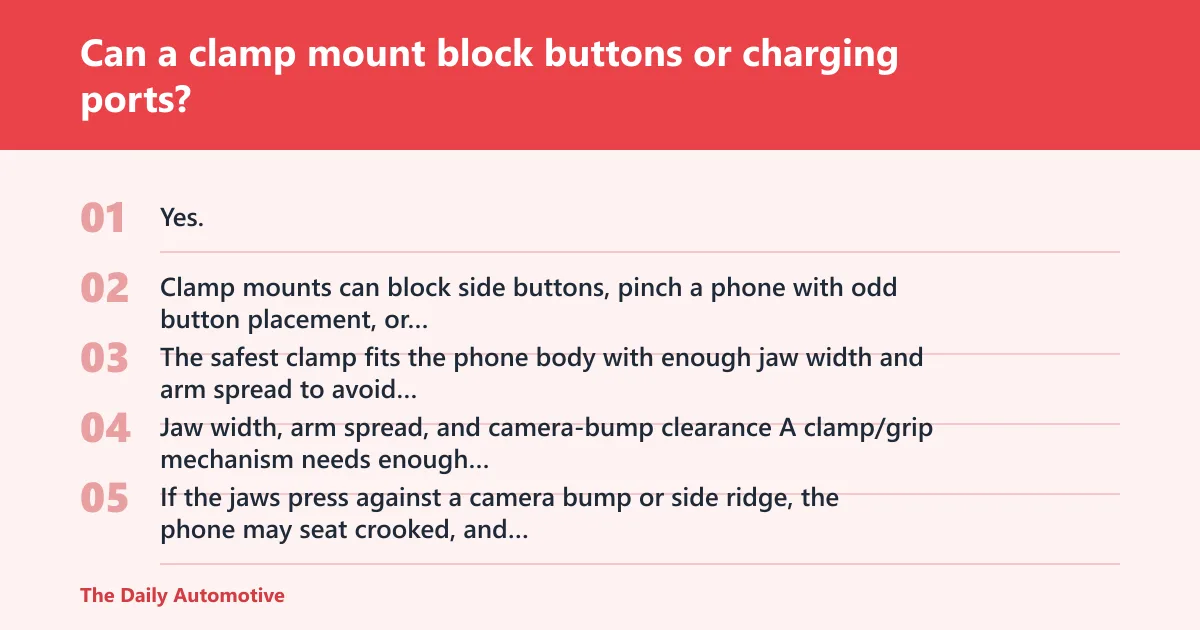
Yes. Clamp mounts can block side buttons, pinch a phone with odd button placement, or interfere with the charging port if the lower arms sit too close. The safest clamp fits the phone body with enough jaw width and arm spread to avoid camera bumps and cable strain.
Jaw width, arm spread, and camera-bump clearance
A clamp/grip mechanism needs enough opening room for the phone size and case thickness. If the jaws press against a camera bump or side ridge, the phone may seat crooked, and that can make the mount harder to use with one hand.
Button clearance and one-hand insertion
One-handed insertion works only when the cradle is shaped correctly. If the side buttons are pressed every time the phone enters the mount, the driver starts fighting the hardware instead of simply dropping the phone into place.
Cable routing and charging port access
Charging matters on long drives. A clamp can leave the back of the phone open, but the lower support arms sometimes crowd the cable path. A magnetic mount usually leaves the port clearer, though a badly placed metal plate can interfere with wireless charging.
Do magnetic car mounts work with MagSafe phones and cases?
They do, when the case and mount are actually aligned for it. A MagSafe-compatible phone case helps the magnetic alignment, but case thickness still matters, and a plate placed in the wrong spot can weaken hold or interfere with wireless charging and NFC.
MagSafe-compatible case fit and alignment
A MagSafe-compatible phone case is built for magnetic alignment, which helps the phone center itself on the mount. That does not cancel physics, though. Better alignment still needs a good base and a phone that is not too heavy for the drive conditions.
Case thickness and grip loss
Thicker cases can add separation between the magnet and the phone, which may reduce how well it holds. Because magnet force drops with distance, even a good magnetic holder can feel less secure once the case gets bulky or the phone carries a large camera module.
Wireless charging and NFC interference
Magnetic mounts can interfere with wireless charging if the metal plate sits over the coil area. NFC performance can also suffer when the magnetic interface or plate is placed where the phone expects a clean signal path.
What phone holders are safest for GPS navigation and daily commuting?
For daily commuting, the safest choice is the mount that keeps the phone steady without constant correction. On smooth roads with a light phone, a magnetic holder is efficient. For heavier phones, rougher routes, or frequent braking, a clamp holder is safer for GPS use.
Windshield or instrument panel mount base
Base location matters for visibility and stability. Windshield or instrument panel mount base placement can improve line of sight, but local regulations may restrict windshield placement, and some dashboards have textures or curvature that weaken adhesion.
Rotation and swivel joint behavior
A good swivel joint should allow about 180 degrees of rotation and then stay put. If the tightening mechanism is weak, the phone may drift from portrait to landscape during cornering or over rough pavement.
Single-hand operation and distraction risk
Single-hand operation is helpful only when the motion is simple. Magnetic mounts reduce pickup time, but that speed should not tempt the driver into adjusting the phone while moving. Clamp mounts are slower, yet their firmer hold can mean fewer mid-drive corrections.
Do magnetic mounts work on dashboards and other smooth surfaces?
Yes, but only when the surface is truly cooperative. A smooth dashboard surface helps adhesive compatibility, while texture, heat, and curvature can weaken the base. That is why a mount that feels solid on one car can fail on another with different trim.
Dashboard surface requirements
Magnetic mounts are especially sensitive to a clean, smooth mounting zone. Heat can soften adhesive, and textured plastics or curved panels can reduce contact area, which makes the base the first failure point before the magnet ever gets blamed.
Mounting location and legal placement concerns
Keep visibility in mind. A windshield or instrument panel mount base should not block the road view or controls, and it should stay within local placement rules. A solid hold is not useful if the mount sits where it should never have been installed.
How do I keep my phone from falling off a car mount?
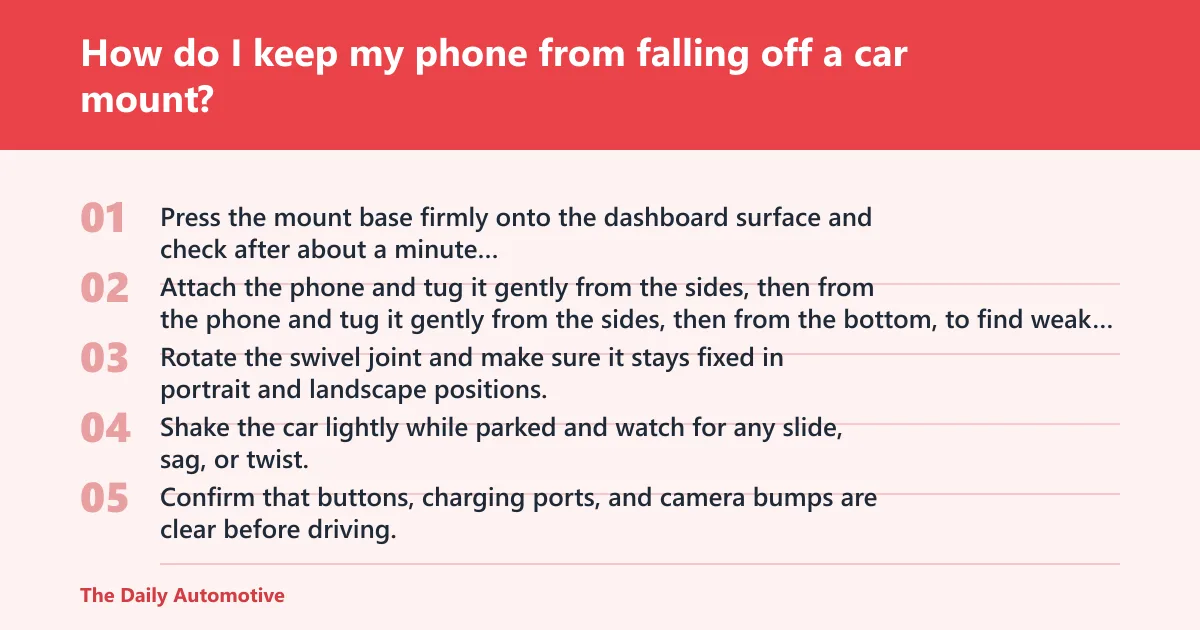
Match the mount to the phone, the case, the dash, and the road. Light phones can work well on magnets, but heavy phones and rough roads call for clamp retention. The fastest fix is usually better alignment, better surface prep, and a shorter, cleaner cable path.
Failure-mode decision table and hold-strength test checklist
| Phone size | Case type | Dash texture | Commute roughness | Charging needs | Safer mount choice |
|---|---|---|---|---|---|
| Small | Thin | Smooth | Low | Wireless charging | Magnetic Car Mount, if the plate is placed outside the coil zone |
| Large | Thick | Slightly textured | Moderate to high | Frequent cable charging | Clamp Car Mount |
| Large | MagSafe-compatible | Smooth | Low | Wireless charging | Magnetic Car Mount if alignment is centered and the base is firm |
| Any size | Thick rugged case | Curved or heat-softened | High | Frequent charging | Clamp Car Mount |
- Press the mount base firmly onto the dashboard surface and check after about a minute for any edge lift.
- Attach the phone and tug it gently from the sides, then from the bottom, to find weak points.
- Rotate the swivel joint and make sure it stays fixed in portrait and landscape positions.
- Shake the car lightly while parked and watch for any slide, sag, or twist.
- Confirm that buttons, charging ports, and camera bumps are clear before driving.
Choose Magnetic Car Mount if… / Choose Clamp Car Mount if…
Choose a magnetic mount if your phone is light, your case is thin or MagSafe-compatible, your dashboard is smooth, and your commute is mostly calm pavement. Choose a clamp mount if your phone is heavy, your case is thick, your roads are rough, or you need the best retention under vibration and braking.
- Choose Magnetic Car Mount if: you want the fastest one-hand pickup, you use a compact phone, you charge by cable without crowding the port, and your mount base sits on a smooth, stable dashboard area.
- Choose Clamp Car Mount if: you drive on rough roads, use a large phone with a heavy case, rely on constant GPS, or need the phone to stay put through potholes, braking, and long shifts.
- Choose Magnetic Car Mount if: you have a MagSafe-compatible case and can keep the metal plate or magnetic interface away from wireless charging coils.
- Choose Clamp Car Mount if: you want the safer default and can accept slower insertion in exchange for stronger retention.
Frequently asked questions
Which is better, a magnetic car mount or a clamp car mount?
A clamp car mount is better for heavy phones, rough roads, and long drives where retention matters most. A magnetic car mount is better when speed and one-hand placement matter more, especially with a light phone and a smooth dashboard. The right answer changes with the failure mode.
Will a magnetic phone mount hold my phone on rough roads?
It can, but only in the right setup. A light phone, a thin case, and a centered magnetic interface improve the odds. Once the road gets rough, the force of a magnet can be outrun by vibration, potholes, and a heavy camera bump.
Do magnetic car mounts work with MagSafe phones and cases?
Yes, if the case is actually MagSafe-compatible and the fit is clean. Alignment helps, but thickness still matters, and a metal plate placed over the wrong area can weaken charging or NFC performance. Good alignment makes the difference between stable and annoying.
Can a clamp mount block buttons or charging ports?
Yes. Clamp mounts can press side buttons, crowd the charging port, or interfere with a cable if the jaw width and arm spread do not match the phone. They are usually safer for retention, but fit still has to be checked before a daily route.
Which mount is easier to use with one hand while driving?
A magnetic mount is often easier because the phone can be dropped into place and removed quickly. That ease is useful, but it should not come at the cost of stability. On rough routes, the extra second needed for a clamp is often worth it.
Do magnetic mounts work on dashboards and other smooth surfaces?
Yes, when the dashboard surface is smooth, flat enough, and compatible with the adhesive or base. Heat, curvature, and texture can weaken the mount base, so the same magnetic holder may feel secure in one vehicle and unreliable in another.
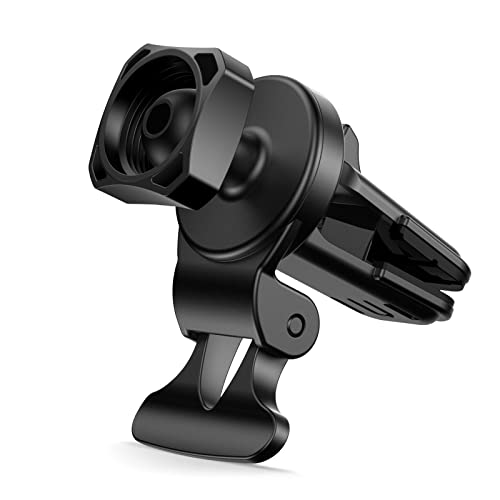
Products related to this article
Sponsored / affiliate links. As an Amazon Associate I earn from qualifying purchases. I may earn additional commission from eligible campaigns.