Best Car Interior Steamers for Interiors (2026): We Compared
The best car interior steamer is usually a handheld for quick spot cleaning, but pick a canister model if you need longer runtime, steadier steam, and better control on larger interior jobs. Choose the wrong format and you waste time, over-wet upholstery, or damage trim with excess heat and pressure. This guide compares the top 2 picks and shows when handheld versus canister is the better buy.
Quick comparison
| Product | Badge | Best for | Price | ||
|---|---|---|---|---|---|
 |
Steam Cleaner, Portable Steamer for Cleaning with 16pcsWSRYYCC | Our pick | Portable · 16 accessories · 6-level adjustable | $49.99
Price as of 21 Oct 2026
|
View |
 |
Heavy-Duty Steam Cleaner for Home, 1500W High Pressure withGOATCLEAN | Upgrade pick | 1500W · 22 accessories · 1.5L tank | $119.98
Price as of 21 Oct 2026
|
View |
The Bissell Steam Shot OmniReach fits fast touchups in vents, seams, and cupholders. The McCulloch MC1375 is the better match when the job grows to seats, carpets, and heavier buildup.
📊 The Bissell Steam Shot had a 10 oz max capacity. Source: Caranddriver.
How we chose
We compared the units by job size, not steam pressure alone. That matters because a compact steamer can be the right tool for tight interior work, while a canister is better when you need longer runtime and fewer refills.
We also weighed heating time, tank capacity, attachments, portability, and surface-risk control. Those factors decide whether a tool is convenient for a five-minute cleanup or useful for a deeper cabin detail.
Steam can lift dirt, grime, and buildup without harsh chemicals, but it is not safe for every surface. Leather, dashboards, screens, adhesives, and delicate trim need caution, lower exposure, or a different tool entirely.
Car steamer decision matrix
This matrix turns interior tasks into a format choice. Use it to match the tool to the job before you buy.
| Task | Best format | Minimum heat-up target | Tank-size range | Must-have attachment | Surfaces to avoid |
|---|---|---|---|---|---|
| Vents, seams, cupholders, buttons | Handheld | Under 5 minutes | Small tank, about 10 oz to 16 oz | Detail nozzle | Screens, unsealed leather, adhesive labels |
| Spot-cleaning upholstery stains | Handheld | Under 5 minutes | Small to mid-size tank | Brush or fabric tool | Perforated leather, delicate stitching, touchscreens |
| Full front seats and floor mats | Canister | 5 to 10 minutes | Mid-size to large tank | Hose with brush and extension tool | Foam-backed trim, glued emblems, display screens |
| Heavy grime in a full cabin detail | Canister | 5 to 10 minutes | Large tank for fewer refills | Hose, detail brush, and crevice nozzle | Loose trim, adhesives, thin plastic, airbags |
| Fast touchups between washes | Handheld | Under 5 minutes | Small tank | Crevice tool | Leather with finish damage, screen coatings |
Think in refill frequency, not just tank size. A small reservoir can still work if you only clean vents and the console, but it becomes inconvenient when you move to seats and carpets.
Bissell Steam Shot OmniReach: best for quick spot cleaning
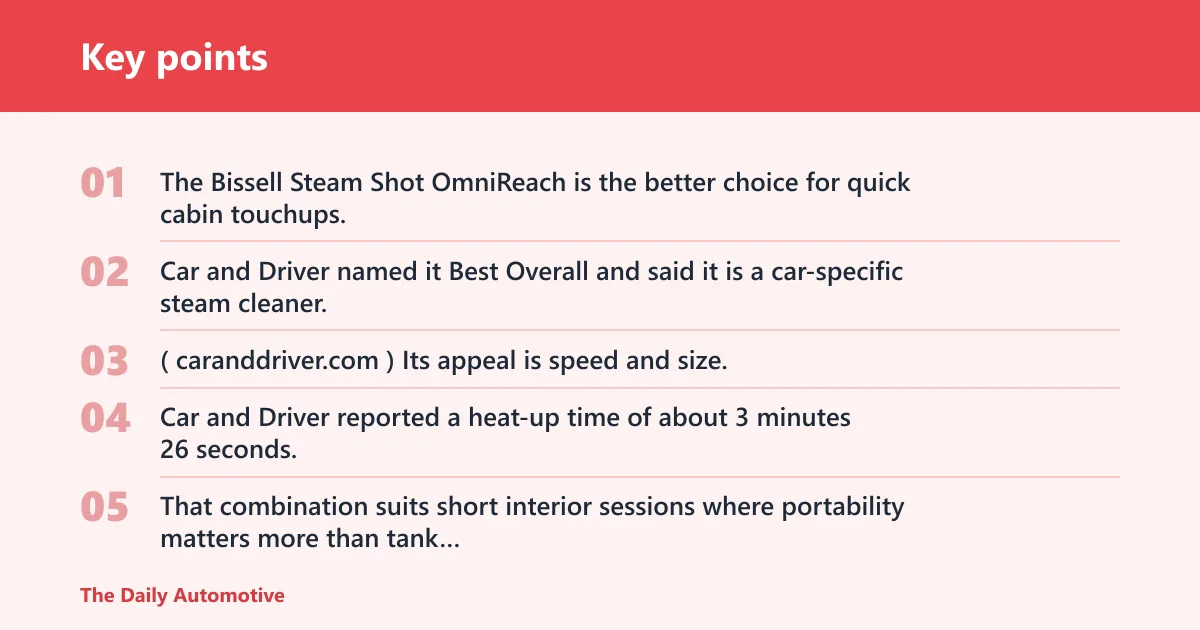
The Bissell Steam Shot OmniReach is the better choice for quick cabin touchups. Car and Driver named it Best Overall and said it is a car-specific steam cleaner, which fits the use case for vents, seams, cupholders, and other tight spaces that need precise cleaning rather than long runtime. (Caranddriver)
Its appeal is speed and size. Car and Driver reported a heat-up time of about 3 minutes 26 seconds, a 10 oz max capacity, and described it as very light and easy to maneuver. That combination suits short interior sessions where portability matters more than tank size.
The tradeoff is simple: the small tank means more refills, and the compact format is not the right answer for whole-seat or whole-cabin work. Car and Driver also noted a recall in July 2024, so verify the recall status and safety guidance before buying or using one.
Why this format works in a cabin
A handheld steamer is useful when you need to move quickly around the dash, center console, and door pockets. The small body is easier to angle into seams, vents, and cupholders than a larger canister unit with hose management.
Say your steering wheel buttons and cupholders have grime, but the seats are otherwise clean. A handheld with a detail nozzle can focus on those narrow zones without forcing you to drag a bigger machine through the cabin.
What the small tank means in practice
A 10 oz tank is enough for short jobs, but it also means you should plan around refill frequency. For quick spot cleaning, that is acceptable. For a full interior pass, it becomes the bottleneck.
Heating time matters here because a fast start reduces the friction of small tasks. If you only need a few minutes of steam, a machine that reaches readiness quickly is more convenient than a larger unit that takes longer to warm up.
Safety checks before you buy
The recall note is not a footnote. Check the exact unit and recall status before purchase or use, then inspect the nozzle, cap, and seals for wear. Steam burns quickly, so let the tool cool down fully before refilling or storing it.
Keep it away from delicate screens, soft-touch coatings, and adhesive-backed trim. Steam can help lift grime, but it can also cause trouble if you linger on a sensitive surface.
McCulloch MC1375: best for heavier cleaning
The McCulloch MC1375 is the better match when the job is larger and dirtier. Car and Driver listed it as Best Runner Up, and its canister style makes sense for owners who want steadier steam delivery and a setup built for longer interior sessions.
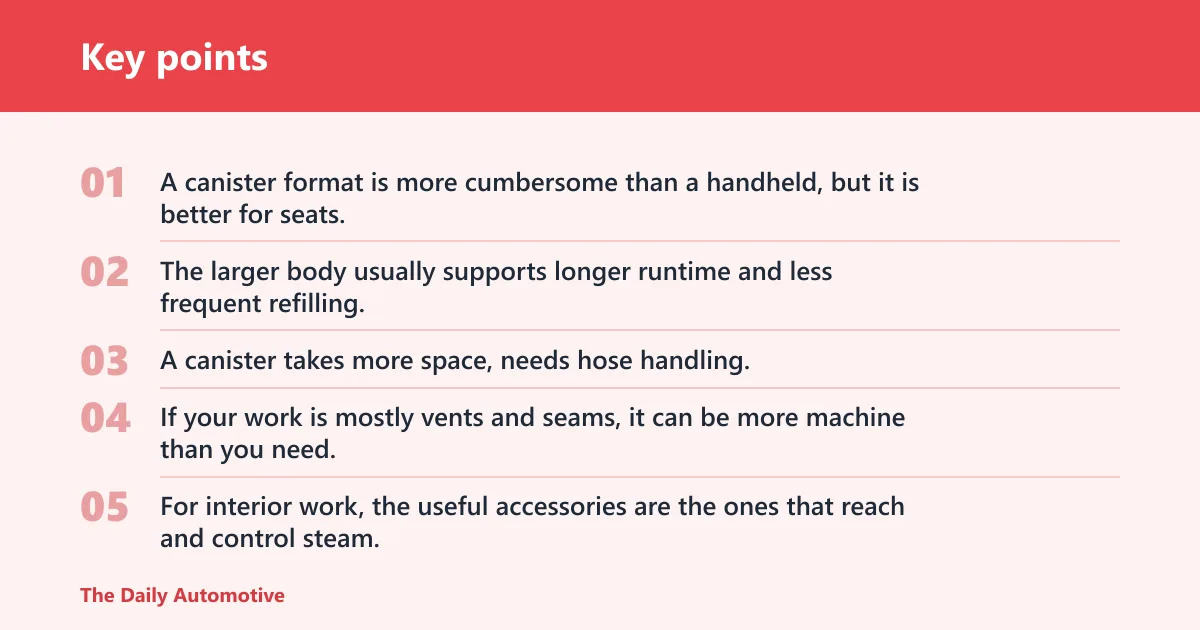
A canister format is more cumbersome than a handheld, but it is better for seats, floor mats, and heavier buildup. The larger body usually supports longer runtime and less frequent refilling, which is a real advantage during a full cabin detail.
The drawback is portability. A canister takes more space, needs hose handling, and is less convenient for a quick five-minute wipe-down. If your work is mostly vents and seams, it can be more machine than you need.
Attachments that matter most
For interior work, the useful accessories are the ones that reach and control steam, not the ones that look impressive in a box. A hose, extension tool, crevice nozzle, and brush heads matter most when you are cleaning seat tracks, carpet edges, and console gaps.
Canister models usually make better use of those tools because the hose gives you reach while the base stays parked outside the cabin. That makes it easier to move from one surface to another without lifting the entire machine.
Where the larger format wins
When a cabin has buildup across multiple surfaces, the larger tank and steadier runtime save time. You spend less effort stopping to refill and more time cleaning the actual surfaces.
Picture a family SUV with stained floor mats, dirty door pockets, and sticky console edges. That is the kind of job where a canister usually makes more sense than a compact handheld.
Which one should you buy?
Choose the Bissell Steam Shot OmniReach if you want the fastest route to vents, seams, cupholders, and other small interior targets. It is the cleaner pick for quick spot work, but only if you are comfortable with its small tank and the recall note tied to this model.
Choose the McCulloch MC1375 if you want a deeper cabin-cleaning tool with more runtime and better support for larger jobs. It is the safer format choice when your work includes seats, carpets, and heavier grime rather than just touchups.
Choose the Wagner Spraytech 915e if budget is the main concern and you want a steam cleaner that appears on top car steam cleaner lists. It is a more affordable route, but the lower-cost option usually means you should pay closer attention to runtime, attachments, and how well it fits your interior task.
Choose the Vapamore MR-100 if you need a pro-oriented cleaner for heavy-duty use. Car and Driver listed it as Best for Pros, which points to a tool better suited to frequent, larger cleaning jobs than to occasional spot detail work.
A common first-timer mistake is choosing a steamer based only on max pressure and overlooking tank size, nozzle attachments, and cord length for cabin cleaning. Pressure helps with stubborn grime and buildup, but a unit with the wrong tank size or awkward design can still be a poor match for the work you actually do.
Buying guide for car interior steamers
The best steamer for a car interior is the one that matches the job, not the loudest spec sheet. Pressure matters for grime, but runtime, heat-up time, attachments, and risk control decide whether the tool saves time or creates new problems.
Steam pressure
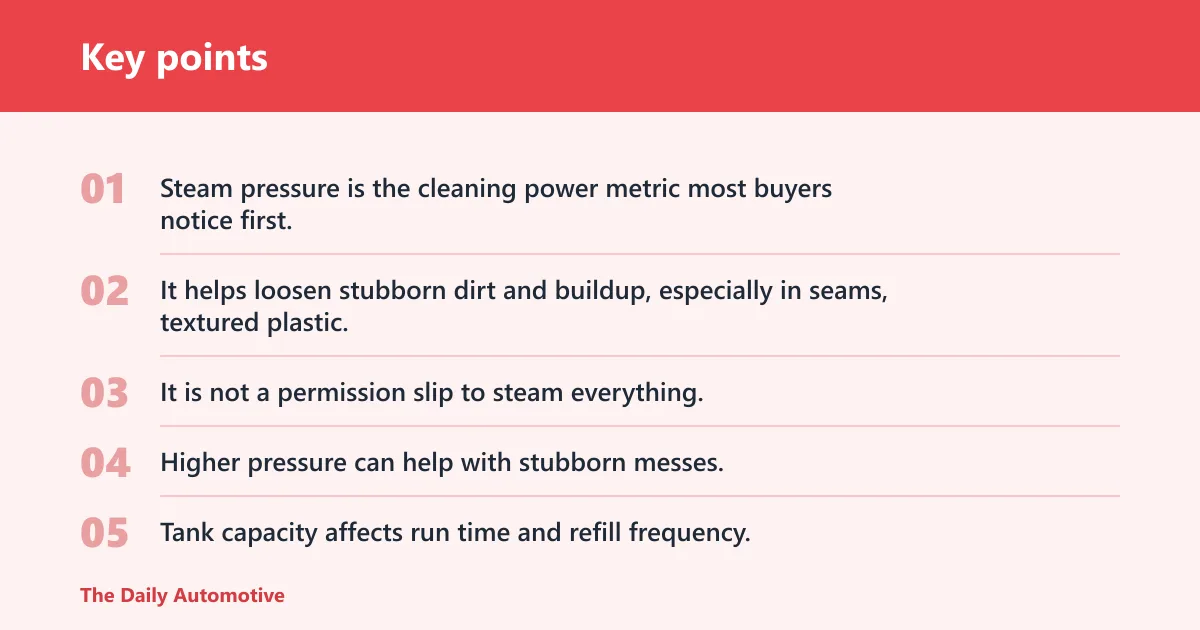
Steam pressure is the cleaning power metric most buyers notice first. It helps loosen stubborn dirt and buildup, especially in seams, textured plastic, and older grime that has settled into tight areas.
It is not a permission slip to steam everything. Higher pressure can help with stubborn messes, but it can also be too aggressive for delicate surfaces if you linger too long or use the wrong attachment.
Water tank capacity
Tank capacity affects run time and refill frequency. A small tank is fine for spot jobs; a larger tank is more practical when you are moving across seats, mats, and multiple interior panels.
For car detailing, think in tasks. If the steamer is mostly for vents and consoles, a small reservoir is fine. If you want to cover a whole cabin, a larger tank saves time and interruption.
Heating time
Heating time is the wait from start-up to steam readiness. For quick detailing sessions, shorter heating time is more valuable than an extra layer of raw power you may never need.
A handheld that heats quickly is better when you only have a short window to clean a few spots. A canister that takes longer to warm can still be worth it if the job is larger and the runtime pays you back.
Attachments and accessories
Nozzles, brushes, hose attachments, and extension tools are what make the steamer useful inside a car. Tight spaces need narrow tools, and fabric needs the right contact so you are not blasting one area too hard.
The most useful accessory set is the one that gives you control. A crevice tool reaches seams. A brush helps loosen grime. A hose makes it easier to work around the cabin without moving the machine constantly.
Portability and design
Weight and maneuverability matter more in a cabin than in a garage floor plan. A lighter handheld is easy to move around the dash and center console, while a canister works better when the body stays outside the vehicle and the hose does the reaching.
That difference matters for comfort and control. If the machine is awkward, you are less likely to use it carefully around trim and more likely to rush the job.
Safety features
Steam carries burn risk, so safe handling is part of the buying decision. Look for a design that cools down predictably, seals well, and lets you manage pressure without fighting the tool.
Surface compatibility matters too. Be careful around leather seats, dashboards, screens, adhesives, and thin trim pieces. Steam is a cleaning aid, not a cure-all.
Suppose your car only needs a 10-minute clean of vents, cupholders, and the gear selector area. A handheld makes sense because you do not need to fill a large tank or haul a canister for a small job.
Suppose the cabin has stained floor mats, dirty seat tracks, and buildup on multiple panels. A canister is the better choice because you are more likely to need repeated passes and steadier runtime.
Frequently asked questions
What is the best steam cleaner for car interiors?
The best steam cleaner for car interiors is usually the one that matches the size of the job. For quick spot cleaning, a handheld like the Bissell Steam Shot OmniReach is a strong fit. For heavier cabin work, a canister such as the McCulloch MC1375 is the better match.
Are handheld steamers safe for leather seats and dashboards?
They can be used with caution, but they are not automatically safe for every leather seat or dashboard surface. Keep steam moving, use a light touch, and avoid prolonged heat on delicate finishes, screens, adhesives, and trim with soft coatings.
How much water tank capacity do I need for car detailing?
For vents, seams, and quick touchups, a small tank can be enough. For fuller interior work, a larger tank is better because it reduces refill frequency and helps you stay focused on cleaning instead of stopping to refill.
How long does a car steam cleaner take to heat up?
Heat-up time varies by model and format. For quick detailing, shorter readiness time is better. Car and Driver reported the Bissell Steam Shot reached steam in 3 minutes 26 seconds, which suits fast interior touchups better than longer cleaning sessions.
What attachments matter most for interior steam cleaning?
The most useful attachments are a detail nozzle, a brush, and a hose or extension tool. Those pieces let you reach seams, vents, seat tracks, and tight console spaces without forcing the machine into awkward positions inside the cabin.
Can a steam cleaner remove stains from car upholstery?
Yes, steam can help lift some upholstery stains, especially on fabric and light buildup. It is less reliable on old, set-in stains and should be used carefully on leather, perforated surfaces, and materials that can be damaged by too much heat or moisture.
Should I choose a handheld or canister steam cleaner for a car interior?
Choose a handheld if your work is mostly quick touchups, vents, seams, and cupholders. Choose a canister if you need longer runtime, steadier steam, and better support for seats, carpets, and bigger cleanup jobs. The right format depends on task size, not brand alone.
Which steam cleaner is best for quick spot cleaning in a car?
The Bissell Steam Shot OmniReach is the better pick for quick spot cleaning because it is compact, car-specific, and fast to heat. Its small tank is the tradeoff, so it works best when you need brief, precise cleaning rather than a full interior pass.
Products related to this article
Sponsored / affiliate links. As an Amazon Associate I earn from qualifying purchases. I may earn additional commission from eligible campaigns.