3 Best Car Battery Voltage Monitors in 2026
Three strong picks cover most drivers: a plug-in dashboard voltage monitor for quick checks, a Bluetooth monitor for parked vehicles, and a shunt-based monitor for the most accurate long-term readout. Ignore voltage trends and a weak battery can leave you stranded, or push you into buying a replacement too early. Below, you’ll see the 3 best car battery voltage monitors in 2026 and which type fits a daily driver, parked vehicle, or multi-vehicle setup.
Quick picks

Top pick for most daily drivers: ANCEL BM200. It gives you Bluetooth alerts, stored voltage history, and charging and cranking checks without putting a display in the dash.
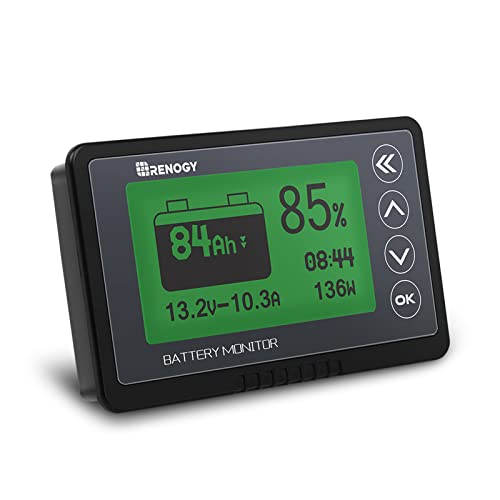
Best accuracy pick: Renogy 500A Battery Monitor with Shunt. It is the right fit when you want current-aware monitoring and programmable alarms with a remote display.
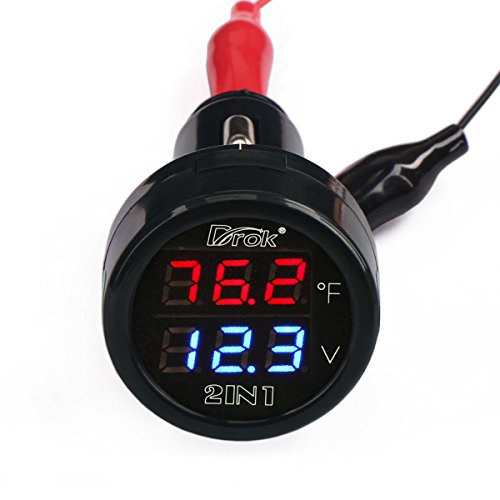
Best simple display pick: DaierTek Waterproof LED Battery Voltage Meter. It is the easiest choice if you want a permanent panel readout with no app dependence.
Battery voltage monitor decision matrix
| Buyer criterion | ANCEL BM200 | Renogy 500A Battery Monitor with Shunt | DaierTek Waterproof LED Battery Voltage Meter |
|---|---|---|---|
| Voltage range | 12V systems | Up to 500A shunt-based monitoring for larger electrical loads | 12V, 24V, and 36V systems |
| Installation complexity | Low to moderate; app pairing and battery connection | Highest; shunt wiring plus display placement | Low; panel-mount wiring |
| Alert type | App alerts | Programmable high and low voltage alarms | No smart alerts; visual readout only |
| History tracking | Voltage history storage; BM200-US records data every two minutes and stores up to 70 days of history | Depends on setup and display model; better for live monitoring than trend logging | No history logging |
| Battery chemistry support | 12V lead-acid use in cars and similar setups | Depends on system setup and battery bank use | Voltage display only; chemistry-agnostic in practice |
| Display style | Phone app | Remote display mounting | Bright blue LED panel display |
| Best vehicle type | Cars, RVs, motorcycles, trucks, and boats | Vehicles or battery banks where current and voltage both matter | Cars, trucks, boats, and accessory panels that need a permanent readout |
| Failure-risk coverage | Good for low-voltage warning and charging trend changes | Best for deeper battery-bank monitoring and alarmed voltage limits | Good for quick visual checks, weaker for trending and remote warning |
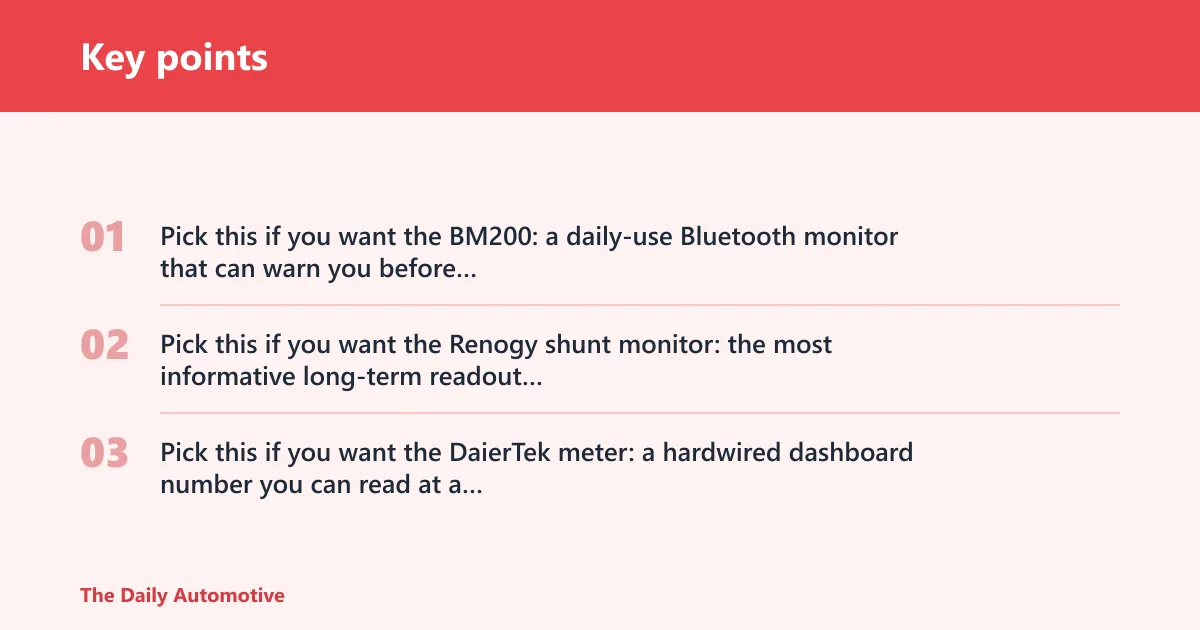
Pick this if you want the BM200: a daily-use Bluetooth monitor that can warn you before a parked battery slips too low.
Pick this if you want the Renogy shunt monitor: the most informative long-term readout among these three and you do not mind extra wiring.
Pick this if you want the DaierTek meter: a hardwired dashboard number you can read at a glance without opening an app.
What the three monitors do differently
These products solve different problems. A plug-in voltmeter gives you instant visibility, a Bluetooth monitor adds history and alerts, and a shunt monitor tracks the battery more completely by measuring current flow through a shunt. A battery tester such as the TOPDON BT100 is different again; it checks state of health, state of charge, cranking, and charging, but it is not a live voltage monitor.
A common first-timer mistake is buying a tester when the real need is a monitor. If the goal is to catch a battery that slowly weakens over several days of sitting, a monitor is the better fit. If the goal is to verify whether a battery and charging system can still pass a stress check, a tester belongs in the toolbox too.
Why the ANCEL BM200 is the best Bluetooth pick
The ANCEL BM200 is the best fit for most daily drivers because it balances simple setup, phone-based visibility, and useful warning features. It supports 12V systems, stores voltage history, and adds cranking and charging tests that help you spot patterns before the engine fails to start.
Who should buy it?
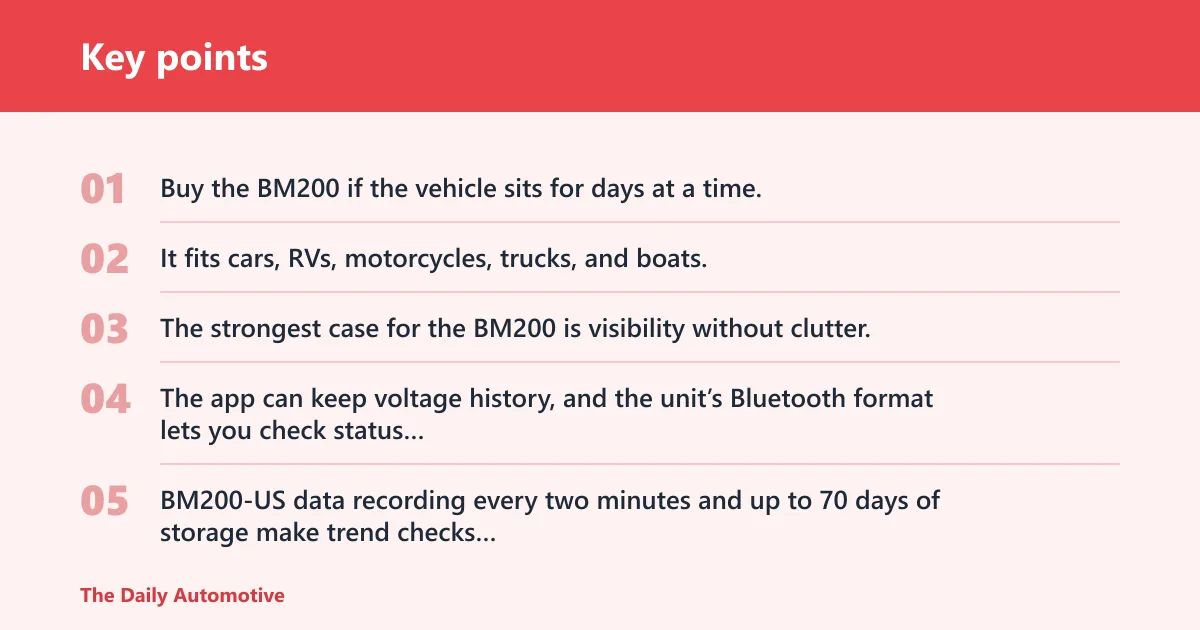
Buy the BM200 if the vehicle sits for days at a time, if the battery is hard to inspect under the hood, or if you want phone alerts rather than a fixed dashboard display. It fits cars, RVs, motorcycles, trucks, and boats, so it also works well for owners who track more than one vehicle.
Strengths and limits
The strongest case for the BM200 is visibility without clutter. The app can keep voltage history, and the unit’s Bluetooth format lets you check status from the driver’s seat or nearby. BM200-US data recording every two minutes and up to 70 days of storage make trend checks practical, not theoretical.
The limit is that it remains a 12V Bluetooth monitor. It does not replace a current-clamp style test for parasitic draw, and Bluetooth range will never beat a fixed display when you want instant visibility from across the cabin.
Pick this if… you want one monitor for a daily driver or a stored vehicle and care more about alerts and history than about wiring a display into the dash.
Fit for cars, RVs, motorcycles, trucks, and boats
That broad vehicle fit matters because many parked-vehicle problems are not car-only problems. A motorcycle that sits for a week, an RV with an auxiliary battery, or a boat with seasonal storage all benefit from trend tracking. The BM200 is the easiest of the three main picks to move between vehicle types.
Why the Renogy 500A shunt monitor is the accuracy pick
The Renogy 500A Battery Monitor with Shunt is the right choice when you need more than voltage alone. Shunt-based measurement tracks current flow through the monitor path, so it gives a fuller picture of what the battery bank is doing under load, during charging, and at rest. It supports up to 500A.
What shunt monitoring changes
Shunt monitoring is better when the battery bank powers inverters, fridges, winches, or other heavier loads. Voltage by itself can look “okay” while the battery is being pulled down hard. A shunt-based setup makes the picture clearer because it tracks the electrical behavior that simple voltage monitors miss.
It also supports programmable high and low voltage alarms, which is useful if you want the monitor to warn you before a battery bank drops outside a safe range.
Install complexity and display placement
This is the least plug-and-play option in the top three. You need room for the shunt, proper wiring, and a plan for the remote display. Renogy includes a 20ft shielded cable, which helps with flexible display mounting, but it also means the install takes more planning than a panel voltmeter.
Pick this if… you are monitoring a larger electrical system and want the clearest long-term readout, even if the install is more involved.
When 500A support matters
500A support matters when your system can see real load swings or when you want the monitor to stay relevant as the vehicle or battery bank gets more demanding. It is overkill for a simple commuter car. It makes more sense for RVs, marine setups, and other battery banks where voltage alone tells only part of the story.
Why the DaierTek LED meter is the simplest pick
The DaierTek Waterproof LED Battery Voltage Meter is the simplest option here because it gives you a permanent number on the dash or panel. It supports 12V, 24V, and 36V systems, so it works beyond the standard car battery use case.
Best for fast visual checks
This is the pick for drivers who want instant visibility and no app. The bright blue LED is easy to read, and the panel-mount design makes it useful in accessory bays, boats, trucks, and other setups where a fixed display is more practical than a phone screen.
The tradeoff is obvious. You get a number, not a record. You do not get the history, alarms, or charging diagnostics that the ANCEL BM200 or Renogy monitor can provide.
Pick this if… you want the cheapest mental overhead: a hardwired display that shows live voltage and stays visible every time you turn the key or switch on the panel.
12V, 24V, and 36V support
That wider voltage support is the reason this meter appears on a shortlist for mixed-vehicle households or accessory systems. It is a useful fit when one owner needs to monitor different platforms without buying a separate display type for each one.
What the 0.1V reading means
DaierTek claims 0.1V accuracy, but the practical takeaway is simpler: it gives a fine enough reading for everyday voltage checks. That still does not make it a diagnostic tester. It is a display first, and its value comes from speed and clarity rather than advanced analysis.
Start with the use case, not the feature list. A daily driver needs fast warning and easy setup. A parked vehicle benefits from Bluetooth history and alerts. A battery bank or heavier electrical setup benefits from shunt monitoring. If you need a live number only, a panel voltmeter is enough.
Do you need Bluetooth?
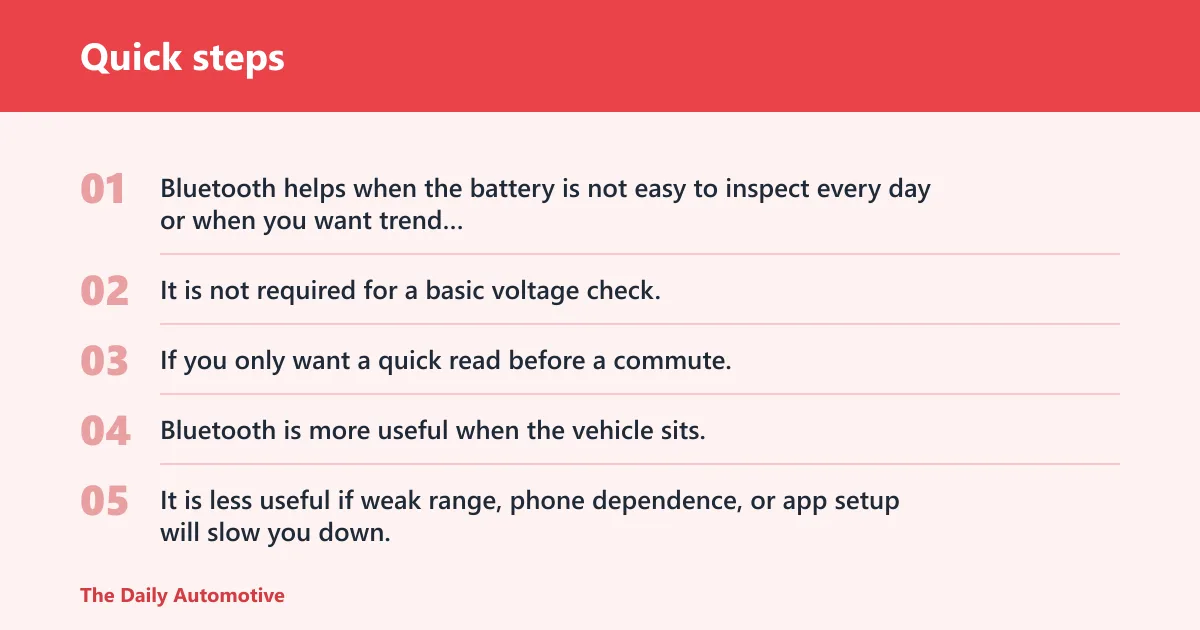
Bluetooth helps when the battery is not easy to inspect every day or when you want trend data without adding a screen to the dash. It is not required for a basic voltage check. If you only want a quick read before a commute, a plug-in or panel display is usually simpler.
Bluetooth is more useful when the vehicle sits, when multiple vehicles need periodic checks, or when you want alert history. It is less useful if weak range, phone dependence, or app setup will slow you down.
Plug-in display or shunt-based monitoring?
Choose a plug-in or panel display if you want the simplest path to voltage visibility. Choose shunt-based monitoring if you need more complete electrical data and can handle the install. Shunt systems cost more effort up front, but they answer more questions once installed.
What healthy 12V voltage looks like by battery type
A healthy resting 12V battery is often around 12.6V to 12.8V for many lead-acid setups, but chemistry matters. AGM, GEL, and EFB batteries can sit at slightly different resting values, and temperature affects the reading too. Use the monitor as a trend tool, not a single-point verdict.
Say your car has sat overnight and the monitor shows 12.2V before start-up. That reading does not prove failure by itself, but it does tell you the battery is not sitting in the healthy resting range many drivers expect. If the next morning repeats the same pattern, the trend matters more than one number.
When alarms and history tracking matter
Alarms matter most when the vehicle is parked far from daily view. History matters most when you want to separate a weak battery from a charging problem that only shows up after repeated short trips. The BM200 is the strongest of the three on that point because it combines alerts with stored history.
Suppose a truck starts fine after a long drive but struggles after two short errands and a night outside in winter. A history-capable monitor can show whether voltage is sagging over time instead of leaving you with one misleading snapshot.
What features matter most in a battery voltage monitor?
Prioritize installation fit, alert type, and how often you will actually look at it. After that, choose display style and history. Voltage range matters when your vehicle is not a plain 12V car. Accuracy matters, but a monitor that is easy to read and easy to keep installed often ends up more useful.
Frequently asked questions
What is the best car battery voltage monitor for a daily driver?
The ANCEL BM200 is the strongest daily-driver pick because it combines Bluetooth alerts, stored history, and charging and cranking checks without a complicated install. If you want a fixed number on the dash instead of an app, the DaierTek meter is the simpler fit, but it gives less diagnostic context.
Do I need Bluetooth for a car battery voltage monitor?
No. Bluetooth is helpful for history, alerts, and vehicles that sit often, but it is not required for basic voltage visibility. If you only want to confirm that the battery is reading normally before a trip, a panel voltmeter can be enough. Bluetooth becomes useful when you want trend data and remote checking.
What voltage should a healthy 12V car battery read?
A common resting range for many lead-acid 12V batteries is about 12.6V to 12.8V, but chemistry and temperature change that baseline. AGM, GEL, and EFB batteries can vary, so a single reading should not be treated as a universal pass-or-fail number. Watch the trend and how the battery behaves at start-up.
Can a battery voltage monitor detect a bad alternator or charging problem?
It can hint at one. If voltage stays low while driving, fails to rise after start-up, or drifts strangely with accessories on, the charging system deserves a closer look. A voltage monitor does not prove alternator failure on its own, but it can flag a pattern worth testing further.
Are car battery monitors compatible with trucks, RVs, and boats?
Yes, but the best match depends on system type. The BM200 fits cars, RVs, motorcycles, trucks, and boats. The DaierTek supports 12V, 24V, and 36V systems, which helps in mixed-platform setups. For larger loads or battery banks, the Renogy shunt monitor is usually the better fit.
What is the difference between a plug-in voltmeter and a shunt battery monitor?
A plug-in voltmeter shows voltage only, usually with very little setup. A shunt battery monitor measures current through a shunt and can give a more complete view of charging and discharge behavior. If you only want quick visibility, choose the voltmeter. If you need deeper system data, choose the shunt monitor.
Do battery monitors store voltage history?
Some do, and that is one of the biggest reasons to buy Bluetooth. The ANCEL BM200 stores voltage history, including up to 70 days of data, which helps reveal slow decline instead of one-off dips. Simple LED panel meters do not store history, so they only show the present reading.
Products related to this article
Sponsored / affiliate links. As an Amazon Associate I earn from qualifying purchases. I may earn additional commission from eligible campaigns.