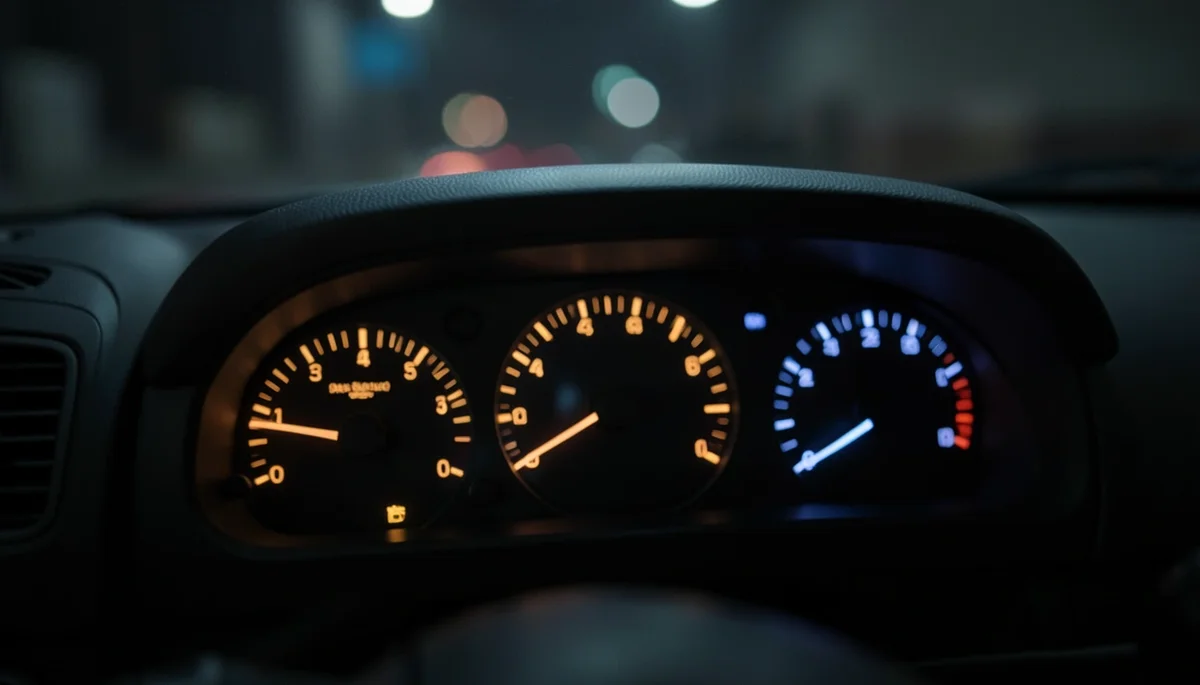
Car Battery Voltage Gauges: Best Waterproof Monitors Compared
A car battery voltage gauge lets you see your battery’s condition at a glance — 12.6 volts or higher at rest means a full charge, while a reading under 12 volts means it’s time to act before you get stranded.
Most drivers only find out their battery is weak when the engine cranks slowly or refuses to start at all. A plug-in or hardwired voltage gauge removes the guesswork by showing the real number in real time, so a slow decline shows up on the display days or weeks before it leaves you stuck. Below are three well-reviewed gauges — one hardwired waterproof monitor, one round panel meter, and one plug-in cigarette-lighter model — plus a quick guide to reading the numbers and picking the right one for your vehicle.
What Your Battery Voltage Reading Actually Means
A standard 12-volt lead-acid car battery doesn’t actually sit at “12 volts” when it’s healthy. Here’s what the number on a gauge is telling you, whether the engine is off or running:
| Gauge Reading | What It Means |
|---|---|
| 12.6V or higher (engine off) | Fully charged, healthy battery |
| 12.2V–12.4V (engine off) | Roughly 50–75% charged; charge it soon |
| Below 12.0V (engine off) | Discharged; may struggle to start the car |
| 13.7V–14.7V (engine running) | Alternator is charging normally |
| Below 13.5V or above 15V (running) | Possible alternator or charging-system fault |
A dedicated gauge is what makes this kind of tracking possible day to day, since most factory dashboards don’t display a live voltage number at all. If your battery keeps coming up weak between checks, it’s also worth reading up on why does my car battery keep dying for the common causes behind repeat failures, or how to start a car with a dead battery if you’re dealing with one right now.
Top Car Battery Voltage Gauges to Buy
IPX7 Waterproof Battery Monitor With Bracket
MOST RUGGED PICK
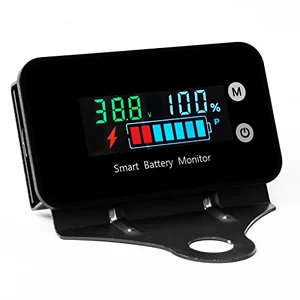 |
IPX7 Waterproof Battery Monitor with Bracket – $19.99 Covers a wide 7-100V range with a mounting bracket, so it works on a car battery, a boat’s 12V/24V bank, or a 48-60V electric setup without buying a second gauge.
|
Because it’s rated IPX7 — meaning it can survive brief submersion in up to one meter of water — this monitor holds up well mounted under a hood, in a boat’s battery compartment, or anywhere else it might get splashed. The percentage readout and buzzer alarm mean you don’t have to remember to check it; it flags a problem before the battery gets critically low.
DaierTek Battery Voltage Meter
BEST VALUE PANEL METER
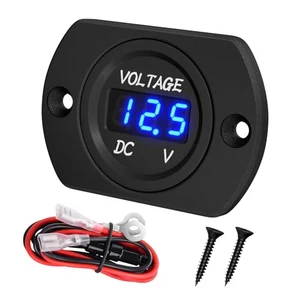 |
DaierTek Battery Voltage Meter – $9.99 A small round panel gauge that mounts permanently into a dash or accessory panel, built for 12V and 24V systems in cars, boats, and motorcycles.
|
Because this one is built to be wired directly into a circuit rather than plugged in, it’s the pick for anyone who wants a voltage readout permanently visible on the dash rather than something they plug in only when checking. The round shape fits standard gauge-panel cutouts, and the blue display stays readable in daylight or at night.
Suvnie 2-Pack Cigarette Lighter Voltmeter
EASIEST PLUG-IN INSTALL
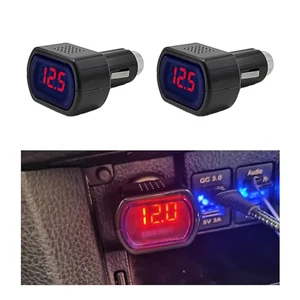 |
Suvnie 2-Pack Cigarette Lighter Voltmeter – $7.99 Plugs straight into a 12V/24V cigarette lighter socket with no wiring or drilling, so it’s ready to use in under a minute and easy to move between vehicles.
|
Because it needs no wiring at all, this is the fastest option to test out if you’ve never used a voltage gauge before. Pull it out and move it to another car, truck, or motorcycle whenever you need it, and the two-pack means you can keep one in each vehicle.
How to Choose the Right Battery Gauge for Your Car
Hardwired vs. plug-in: A hardwired gauge (like the IPX7 monitor or the DaierTek panel meter above) reads voltage continuously, even with the engine off, which makes it better for catching a slow parasitic drain. A plug-in model only reads while it’s plugged into a powered socket, so it’s really a check-in tool rather than a 24/7 monitor — fine for a quick health check, less useful for diagnosing why a battery keeps dying overnight.
Voltage range: Every standard car, truck, or motorcycle battery is a 12V system, so any gauge rated for at least 8-16V will cover it. If you’re also monitoring a boat’s house battery bank, an RV, or a golf cart, check that the gauge’s range extends to 24V or higher before buying, since not every model does.
Waterproofing: A gauge mounted under the hood, in an engine bay, or anywhere near a boat’s bilge should carry an IPX6 or IPX7 rating. A gauge that only lives inside a dry cabin or on a dashboard doesn’t need it, so you can save a little money on an indoor-only model.
Frequently Asked Questions
What Is an IPX7 Waterproof Battery Monitor?
An IPX7 waterproof battery monitor is rated to survive temporary submersion in up to one meter of water for about 30 minutes. That makes it suitable for engine bays, boats, and other spots exposed to rain or splashing, while it still accurately reports battery voltage and remaining capacity.
How Does a Digital Battery Voltage Gauge Work?
A digital battery voltage gauge measures the electrical potential across the battery terminals and converts that reading into a number on a digital or LED display. Many models also include a percentage estimate of remaining capacity, and some add a buzzer or flashing alert when voltage drops below a safe threshold.
Why Add a Voltmeter Gauge to a Car That Already Has One?
Most factory dashboards only show a battery warning light, not a live voltage number, so by the time the light comes on the battery may already be in trouble. A dedicated voltmeter shows the actual number continuously, which lets you catch a slow decline — from a bad alternator, a parasitic drain, or an aging battery — well before it leaves you stranded.
Can a Cigarette Lighter Voltmeter Really Replace a Hardwired Gauge?
Not entirely. A plug-in cigarette lighter voltmeter is convenient and needs no installation, but it only reads voltage while the socket is powered, so it can’t track a battery draining overnight with the engine off. For that kind of continuous monitoring, a hardwired gauge is the better choice.
Are Battery Voltage Gauges Suitable for Motorcycles?
Yes. Motorcycle batteries are more prone to slow drains and vibration-related connection issues than car batteries, so a compact, waterproof gauge rated for 12V systems works well for spotting problems early. Look for a model built to handle vibration, since some panel meters are not rated for it.
What Voltage Should a Car Battery Read When the Engine Is Running?
With the engine running and the alternator charging normally, a healthy 12V system should read between roughly 13.7 and 14.7 volts. A reading below 13.5 volts or above 15 volts while driving usually points to a charging-system problem — most often a failing alternator or voltage regulator — rather than the battery itself.
Conclusion
A car battery voltage gauge turns a guessing game into a quick glance at a number. The IPX7 monitor above is the most versatile pick if you want one gauge to cover a car, a boat, or a second vehicle, the DaierTek panel meter is a solid low-cost option for a permanent dash install, and the Suvnie plug-in voltmeter is the fastest way to start monitoring with zero wiring.
Whichever one you choose, checking it regularly is the real habit that pays off — catching a battery at 12.2 volts instead of 11.5 volts is the difference between a routine charge and a tow truck.
Products related to this article
Sponsored / affiliate links. As an Amazon Associate I earn from qualifying purchases. I may earn additional commission from eligible campaigns.