3 Best Voltage Meters for Cars (2026): We Compared
The best voltage meter for a car is a plug-in 12V socket meter for daily checks, a flush-mount LED meter for tight installs, and a digital multimeter for diagnostics. Pick the wrong one, and you can miss a weak battery, chase charging problems too late, or wire an accessory without useful feedback. This guide compares the three picks by use case, fit, and the signal each one gives you.
Quick comparison
| Product | Badge | Best for | Price | ||
|---|---|---|---|---|---|
 |
Extech MN35 Digital Mini Multimeter, Autoranging,Extech | Our pick | $28.99
Price as of 23 Oct 2026
|
View | |
 |
Fluke 87V/IMSK Industrial Digital Multimeter with FlukeFluke | Also great | $588.99
Price as of 23 Oct 2026
|
View | |
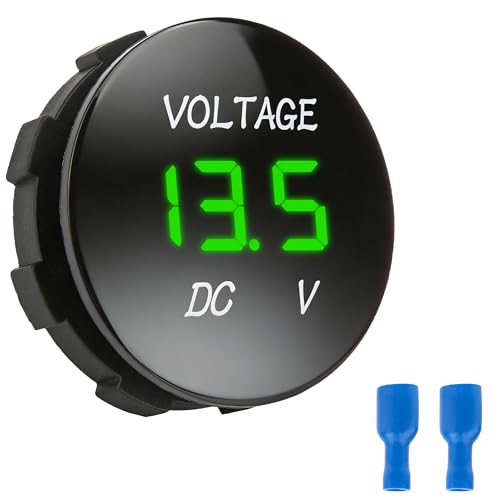 |
DC 12V 24V Volt Meter, Car LED Digital Voltmeter Gauge,ecocstm | Budget pick | Round panel · mini waterproof · green LED | $6.99
Price as of 23 Oct 2026
|
View |
 |
DC12V Voltmeter Blue Digital LED Volt Gauge Voltage MeterWATERWICH | Also great | 2-inch round panel · blue LED · 8–18V | $22.79
Price as of 23 Oct 2026
|
View |
 |
BYYOUIV 2" Voltage Gauge 8-16V Digital Voltmeter Meter forBYYOUIV | Also great | 2-inch round panel · white LED · 8–16V | $11.99
Price as of 23 Oct 2026
|
View |
The real trade-off is not voltage range alone. It is installation effort, how fast you can read the display, and how much fault-finding detail you need when the battery or charging system starts acting up.
How we chose
We compared meters on four points: installation effort, display readability, voltage range for 12V and mixed-voltage systems, and how useful the reading is when you are chasing battery or charging issues. We also weighed waterproof housing, reverse-polarity protection, and whether the meter fits daily-driver use or deeper diagnostics.
One more filter mattered: the meter had to match a real use case. A simple dash gauge is not the same tool as a multimeter, and a waterproof panel meter is not the same thing as a battery tester with plug-and-test operation.
Ecocstm panel meter: best for daily-driver monitoring
If you want a small, always-on readout for a car, truck, or boat accessory circuit, this is the simplest fit. The ecocstm unit is a mini waterproof round panel gauge with 12V-24V compatibility, so it suits basic system monitoring without taking much space.
Its strengths are practical, not flashy. The compact round format suits dash or panel installs, and the waterproof housing makes it a better choice than a bare indoor-style meter for wet or splash-prone locations.
The drawback is depth. Like most simple panel voltmeters, it tells you system voltage, not alternator current, battery capacity, or parasitic drain. It is a monitoring tool, not a diagnosis tool.
Why it fits daily use
For a daily driver, the key question is whether the battery sits near healthy resting voltage and whether the charging system moves into its normal charging range after startup. A straightforward panel meter makes that easy to check during normal driving.
What to expect from the install
Panel meters like this usually need a dash or panel cutout and simple nut-and-screw hardware. That makes them more permanent than a plug-in socket gauge, but it also means cleaner placement once installed.
BYYOUIV panel meter: best for tight installs
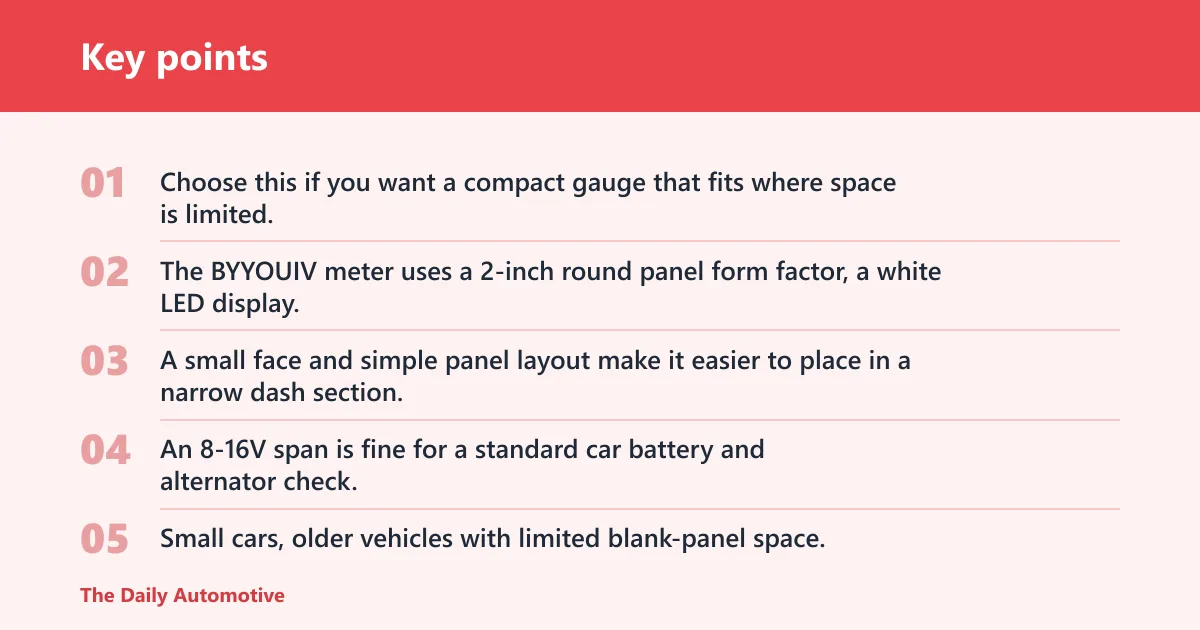
Choose this if you want a compact gauge that fits where space is limited. The BYYOUIV meter uses a 2-inch round panel form factor, a white LED display, and an 8-16V range that matches standard 12V passenger-car systems.
The tight-install advantage is obvious. A small face and simple panel layout make it easier to place in a narrow dash section, switch panel, or custom interior where a larger gauge would look crowded.
The downside is range. An 8-16V span is fine for a standard car battery and alternator check, but it leaves less headroom than wider-range meters if you want one gauge that can also cover other electrical setups.
Why it works in cramped dashboards
Small cars, older vehicles with limited blank-panel space, and custom audio builds often need a meter that does not dominate the dash. This style is better for that job than a bulky diagnostic tool.
Display visibility matters here
White LED and LED readouts in general are easy to place in cabin lighting, but display size and angle still matter more than color. A compact gauge can be readable from the driver seat and still avoid crowding the panel.
Extech MN35 multimeter: best for diagnostics
If you are sorting out starting issues, charging complaints, or an odd electrical symptom, a multimeter is the right tool. The Extech MN35 is an autoranging digital multimeter with AC/DC voltage measurement, continuity, resistance, and diode checks, so it gives you far more than a dashboard gauge can.
That extra depth matters when the problem is not obvious. A voltmeter can show that the battery looks low, but a multimeter lets you verify the circuit, test at different points, and move beyond a simple live reading.
The drawback is convenience. This is not a flush dash meter, and it is not meant for permanent in-cabin monitoring. It is the stronger choice for diagnosis, not for constant display.
Why diagnostics need more than voltage alone
A simple voltage meter can tell you that the system looks weak. It cannot confirm parasitic drain by itself. Parasitic draw is normally diagnosed with a current test method, not a basic voltage meter alone, so a multimeter or proper current setup is the better path.
When a multimeter beats a dash gauge
Use a multimeter when the symptom is intermittent, when a battery keeps going flat overnight, or when you need to separate battery health from charging behavior. That is where measurement depth matters more than an always-visible display.
Voltage meter decision matrix
This matrix maps the meter type to the job, the install effort, and the kind of feedback you get. It is the fastest way to avoid buying a gauge that looks right but solves the wrong problem.
| Meter type | Use case | Install effort | Display visibility | Diagnostic depth | Best for |
|---|---|---|---|---|---|
| Ecocstm panel meter | Daily-driver voltage monitoring | Moderate; dash or panel mount with hardware | Good in a fixed location | Basic system monitoring only | Owners who want a clean always-on readout |
| BYYOUIV panel meter | Tight installs and compact dashboards | Moderate; small panel fit helps | Good in a small opening | Basic monitoring only | Small cabins, custom panels, car audio spaces |
| Extech MN35 multimeter | Diagnostics and troubleshooting | Low for use, none for permanent install | Excellent at the work point | High; voltage, continuity, resistance, diode | Fault-finding and repair work |
Use case matters more than specs
A meter with a wider range is not automatically the better buy. For a daily commuter, readable voltage and simple install are usually more valuable than extra measurement functions that will never get used.
For a repair-minded driver, the opposite is true. A dash gauge that only shows voltage can leave you guessing when the issue is actually wiring, connection quality, or a charging fault.
Readability versus depth
Digital LED and LCD displays can both work well. The difference is not that one is always better; it is whether you want the simplest glance-read display or a tool that trades some permanence for more diagnostic information.
Waterproof voltmeter: best for wet locations
A waterproof voltage meter is worth it when the install sits near spray, condensation, or regular wash-downs. That includes boats, motorcycles, open cab setups, and exposed accessories where a plain indoor gauge would age badly.
DaierTek is described as waterproof for marine and automotive use, which is the right kind of claim to look for in this category. If the meter lives where moisture is expected, IP65 or IP67-style protection is a real advantage, not a cosmetic one.
Where waterproofing helps
Wet-environment use cases include marine panels, off-road rigs, and anything mounted near an open cockpit or exposed trim. In those places, the housing matters as much as the display.
Where it does not matter much
If the meter will sit inside a dry cabin or under a protected dash, waterproofing is nice to have, not a deciding factor. In that case, display fit and electrical range usually matter more.
Which one should you buy?
Pick the meter based on the problem you are trying to solve. If you want an easy daily readout, buy the panel gauge that fits your dash and gives you a clear display. If you need actual troubleshooting, start with a multimeter. If the install is going into a wet location, make waterproofing part of the decision.
Do not buy a simple voltage meter expecting it to diagnose parasitic battery drain on its own. That job needs a current test method. Do not buy a diagnostic multimeter expecting it to replace a clean in-dash monitor either.
- Choose a panel voltmeter if you want to track battery and charging voltage during normal driving.
- Choose a waterproof panel meter if the install will face moisture, spray, or marine conditions.
- Choose a multimeter if you need to test circuits, verify charging behavior, or troubleshoot a no-start problem.
Say your commuter starts fine in the morning but the dash lights look dim after a short stop. A panel meter can show whether system voltage is sagging during cranking or whether the alternator never brings charging voltage up after startup.
Suppose your custom audio truck has almost no spare dash space left. A small round panel meter can fit into a narrow blank area where a larger test tool would be awkward and easy to ignore.
Do I need a 12V or 24V voltmeter for my car?
For most passenger cars, a 12V voltmeter is the right choice. A 24V meter makes sense for trucks, buses, and other vehicles that actually run a 24V electrical system. If you want one meter that can cover more than one setup, look for a wider range such as 3V to 48V or a meter that clearly lists 12V/24V compatibility.
Some meters are built for standard car systems only. Others, like DaierTek, support 12V, 24V, and 36V systems, while WINAMOO works across a 3V to 48V range and offers 0.1V resolution. Those wider spans help when the same meter may move between vehicles or accessories.
What is the difference between a voltmeter and a battery tester?
A voltmeter shows electrical potential at the terminals or circuit point you are measuring. A battery tester is more specialized for quick battery health checks, and many models include plug-and-test operation, reverse polarity protection, and charging or alternator checks. Use the tester when you want faster battery-focused feedback.
That difference matters if you are deciding between a dashboard gauge and a tool for troubleshooting. A voltmeter is a monitor. A battery tester is a quick assessment tool, and the better buy when the question is battery condition rather than just live voltage.
Which car voltage meter is easiest to install?
The easiest install is usually a plug-in socket meter, because it needs no panel cutout and no permanent wiring. Among hardwired options, a compact round panel gauge is next easiest because it only needs a mounting hole, basic hardware, and a short wiring run. A multimeter is easiest to use, but not easiest to mount because it is not meant for permanent installation.
Panel-mount meters typically use a cutout and nut-and-screw hardware. That makes them more secure than loose accessories, but also more involved than a simple plug-in checker. If you want the cleanest permanent look, the extra effort is worth it.
Are waterproof voltage meters worth it for cars?
Yes, if the meter will live in a damp or exposed place. Waterproof housing matters in marine installations, open-cockpit vehicles, and off-road setups that see spray or wash water. In a dry cabin, waterproofing is a bonus rather than a must-have.
DaierTek is described as waterproof for marine and automotive use, and Linkstyle is listed with IP65 waterproof protection. Those are the kinds of details that matter when moisture is part of the job, not just when a listing says “durable.”
Can I use a voltage meter to test alternator output?
Yes, a voltmeter can tell you whether charging voltage rises after the engine starts. That is one of its most useful jobs. A healthy 12V automotive electrical system usually sits around battery resting voltage with the engine off, then moves into a charging range once the alternator is working.
A practical cheat sheet: resting battery voltage is commonly around 12.6V to 12.8V for a fully charged lead-acid battery, cranking voltage should stay above about 9.6V during start, and charging voltage is often about 13.7V to 14.7V with the engine running. If voltage never leaves the resting zone, the charging system deserves a closer look.
What accuracy should a car voltage meter have?
For a simple car gauge, readability and repeatability matter more than lab-grade precision. A display resolution of 0.1V is usually enough for quick charging checks, while finer readouts like 0.01V are more useful on a multimeter or diagnostic tool. Do not confuse display resolution with actual measurement accuracy.
That difference is easy to miss. A meter can show 0.01V steps without being more accurate than a simpler display. For most drivers, what matters is whether the reading clearly separates resting voltage, cranking behavior, and charging voltage.
Which voltage meter is best for car audio setups?
For car audio, the best choice is usually a small panel voltmeter with a compact footprint and easy remote power monitoring. Audio builds often have tight dashboard space, so a small round gauge or slim display is easier to place near the head unit or switch panel than a larger diagnostic tool.
WINAMOO’s 3V to 48V range and 0.1V resolution suit broader monitoring needs, while Linkstyle’s 8 to 26V range and 3-digit LED display fit common automotive use. A simple dash meter is usually enough for watching voltage sag during bass load; a multimeter is better if you need to trace a wiring fault or verify the alternator under test conditions.
Frequently asked questions
What is the best voltage meter for a car battery?
The best choice depends on what you want to know. For routine checking, a panel voltmeter is enough to watch resting and charging voltage. For battery health and charging-system checks in one tool, a battery tester is better. For full troubleshooting, a multimeter gives the most useful diagnostic reach.
Products related to this article
Sponsored / affiliate links. As an Amazon Associate I earn from qualifying purchases. I may earn additional commission from eligible campaigns.