3 Best Car Window Shades for Kids (2026): We Compared
The 3 best car window shades for kids in 2026 are the one that blocks the most UV for rear seats, the one that keeps outward visibility, and the one that works with rolled-down windows. Pick the wrong one and you get hotter seats, glare, and a shade kids tear off or cannot use when windows move. This guide ranks the best picks by the child-specific problem each solves best.
Quick comparison
| Product | Badge | Best for | Price | ||
|---|---|---|---|---|---|
 |
Car Window Shades, [Upgraded] 8 Strong Magnets MagneticPEMOTech | Our pick | 2-pack · 8-magnet · dual-layer blackout | $15.99
Price as of 21 Oct 2026
|
View |
 |
EcoNour Car Shades for Side Windows (4 Pack) WindowEcoNour | Also great | $25.99
Price as of 21 Oct 2026
|
View | |
 |
Car Window Shades, 2 Pack Car Window Shade for Baby withLSTRAGY | Rear-seat visibility | 2-pack · 17.3×14.2" · see-through mesh | $8.99
Price as of 21 Oct 2026
|
View |
 |
IC ICLOVER Car Sun Shade, Folding Auto Rear WindowIC ICLOVER | Budget pick | 1-pack · 39×20" · rear window mesh | $9.99
Price as of 21 Oct 2026
|
View |
 |
4-Pack Car Window Shades with Insect Screen, UV Blocking &Lezpoaze | Our pick | $29.99
Price as of 1 Nov 2026
|
View |
The best pick changes with the child’s seat position and your routine. A rear-facing infant, a school-run toddler, and an older child in a third-row seat need different shade behavior.
Use the table below to match attachment style, UV claim, visibility, and likely failure points to your vehicle before you buy.
How we chose
We compared these shades on four things families care about most: how clearly the product states UV protection, how well it balances glare control with rear-seat visibility, how practical it is for daily use, and whether it fits common sedan, SUV, and truck window shapes.
We also weighed failure modes that many product pages skip. That means adhesion on dirty glass, heat-related sliding, weak suction, magnet mismatch, and whether the shade still works when the window needs to move.
One more filter mattered: child use case. A shade that is ideal for babies may be wrong for an older kid who wants to see out, and a shade that installs fast may not suit a vehicle with unusually shaped rear doors.
PEMOTech magnetic side shade: best for rolled-down windows
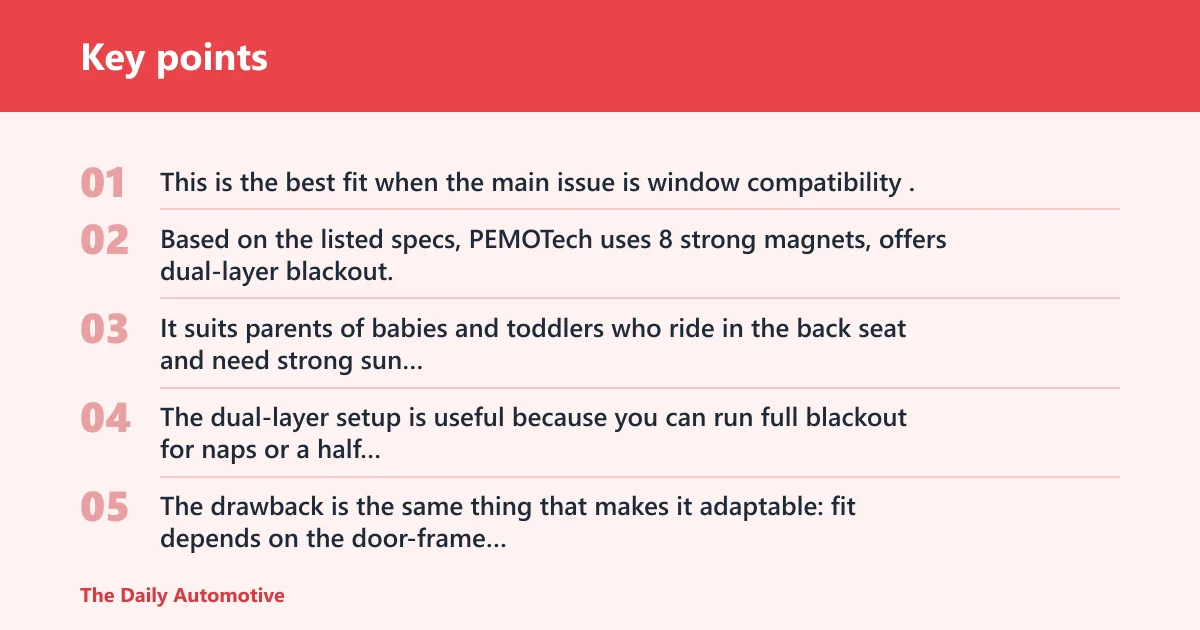
This is the best fit when the main issue is window compatibility. Based on the listed specs, PEMOTech uses 8 strong magnets, offers dual-layer blackout, and claims 99% UV ray protection, which makes it the most relevant pick for families that want side-window coverage without giving up the option to lower the window in some vehicles.
It suits parents of babies and toddlers who ride in the back seat and need strong sun control at the door frame, especially in SUVs, sedans, and trucks. The dual-layer setup is useful because you can run full blackout for naps or a half shade when a child still wants some view out.
The drawback is the same thing that makes it adaptable: fit depends on the door-frame design. Magnetic stretch-to-fit shades do not work on every car, and a magnet mismatch can leave gaps or a weak hold. They also depend on a door frame rather than glass alone, so you need to check the shape before buying.
Why it solves the right problem
For children, the main benefit is strong side-window coverage that can cut glare and block a large share of UV exposure while still leaving some flexibility for daily use.
That matters most in seats where the sun hits from the side and the family still needs the window to move sometimes. The tradeoff is visibility: the darker the blackout layer, the less the child sees out.
EcoNour side window shade: best for daily on-off use
This is the best choice for families that want quick use and straightforward storage. EcoNour’s side-window shade is listed as a 4-pack in the product title, while related product coverage describes EcoNour side-window shades as a retractable roller sunshade in a two-pack style, so the key point here is fast deployment rather than permanent install.
It suits school runs, daycare drop-offs, and short errands where the shade may go on and off often. That kind of routine favors a lighter, easier-to-stash design more than a heavy blackout panel.
The drawback is that retractable or roller-style shades can be limited by window shape and may not cover as much area as larger mesh panels. They also tend to be less forgiving if the window frame or track is odd-shaped, so fit checks matter more than the package makes obvious.
LSTRAGY suction cup mesh shade: best for visibility
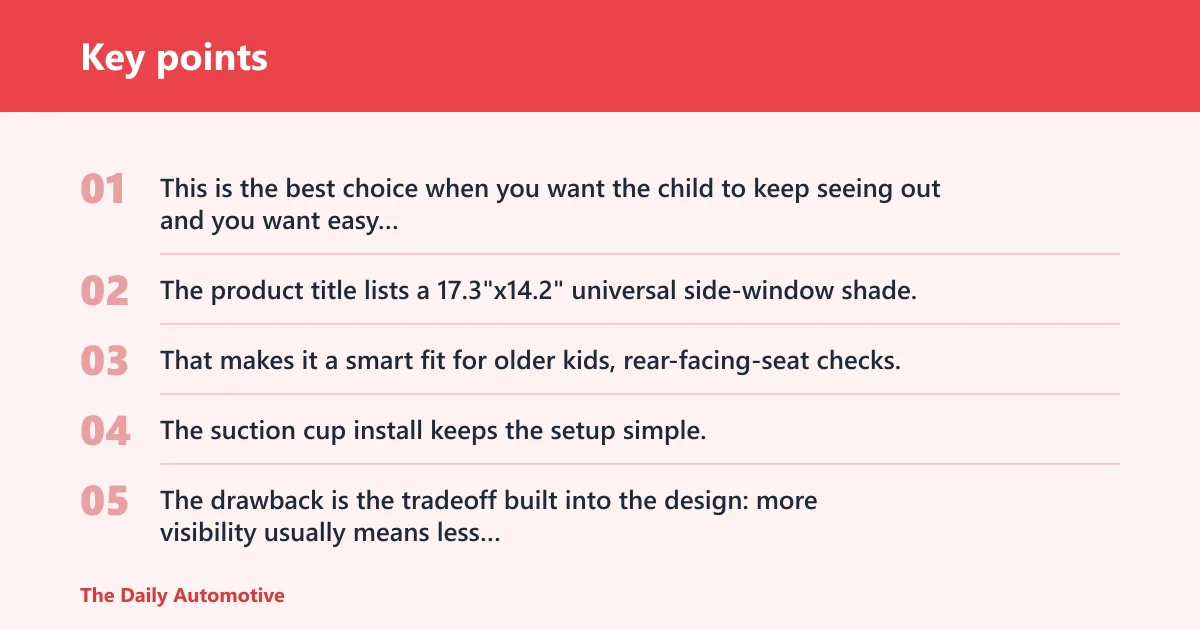
This is the best choice when you want the child to keep seeing out and you want easy rear-seat monitoring. The product title lists a 17.3"x14.2" universal side-window shade, and the product blurb says the see-through mesh lets you see children through the shade while blocking direct sunlight and UV rays.
That makes it a smart fit for older kids, rear-facing-seat checks, and families who do not want the back seat to feel closed in. The suction cup install keeps the setup simple, and the lightweight mesh is easier to handle than a thicker blackout screen.
The drawback is the tradeoff built into the design: more visibility usually means less privacy and less blackout. Suction cups can also be less consistent over time, especially in heat or on glass that is not perfectly clean.
Car window shade buyer’s matrix
This matrix is the practical part most product pages skip. It ties each pick to the child’s age, the window position, the attachment method, and the likely failure modes so you can match the shade to the use case instead of the branding.
| Pick | Child age group | Attachment type | Roll-down compatibility | UV claim | Visibility level | Likely failure modes |
|---|---|---|---|---|---|---|
| PEMOTech magnetic side shade | Babies, toddlers, and older kids in side seats | 8-magnet stretch-to-fit door-frame attachment | Sometimes, depending on door-frame design and window track | 99% UV ray protection claimed | Medium to low, depending on blackout setting | Magnet mismatch, gaps on unusual frames, reduced fit on some vehicles |
| EcoNour side window shade | Toddlers and school-age kids on short trips | Retractable roller-style shade | Usually better suited to quick up/down routines, but still vehicle dependent | UV protection is the main goal, but published claim detail varies by listing | Medium | Track or fit limits, less coverage than larger panels, storage wear |
| LSTRAGY suction cup mesh shade | Babies in rear-facing seats and older kids who want to see out | Suction cups on glass | Typically not the best choice for a partially lowered window | Blocks direct sunlight and UV rays | High | Weak suction, slipping in heat, dirty glass, smaller coverage area |
What the matrix means in practice
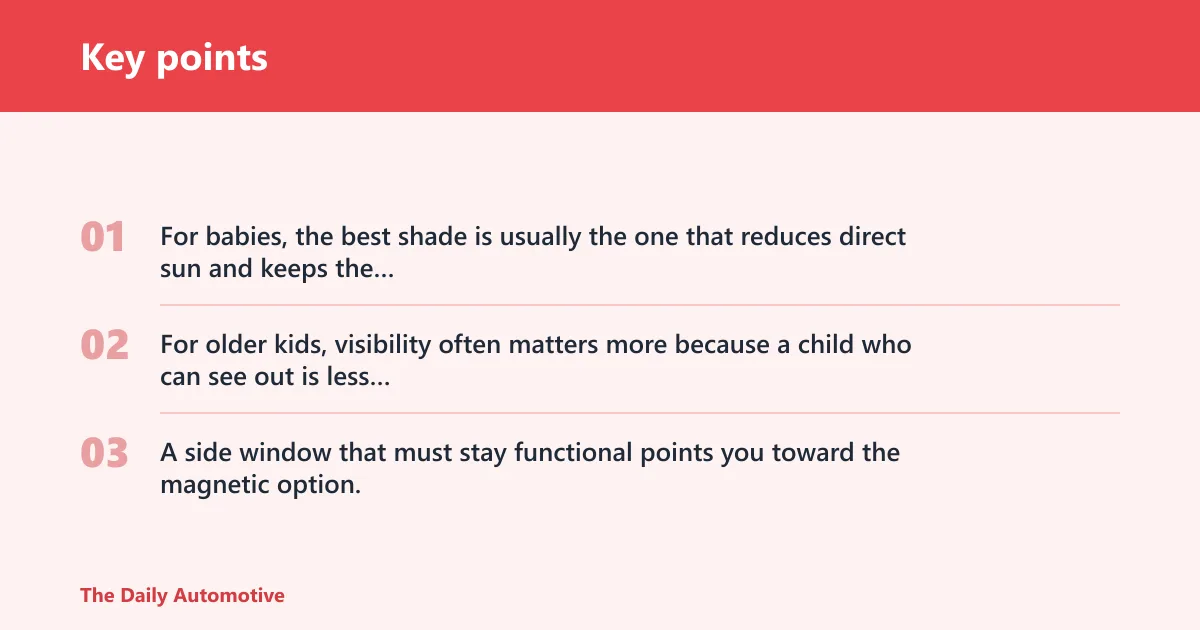
For babies, the best shade is usually the one that reduces direct sun and keeps the cabin calmer without making rear-seat monitoring hard. For older kids, visibility often matters more because a child who can see out is less likely to peel the shade away.
Window position matters too. A side window that must stay functional points you toward the magnetic option, while a window that stays closed most of the time gives you more freedom to choose a higher-coverage mesh or blackout design.
Which one should you buy?
Buy the PEMOTech magnetic side shade if you want the strongest mix of UV protection and window flexibility. It is the best fit for families that may lower the window at least partway and still want a shaded back seat.
Buy the EcoNour side window shade if your routine is frequent, short, and repetitive. School runs and daycare handoffs reward a shade that comes off quickly and stores without much fuss.
Buy the LSTRAGY suction cup mesh shade if your priority is visibility. It is the better option for rear-seat monitoring and for children who get frustrated by a fully darkened window.
A common first-timer mistake is buying the darkest shade available for a toddler who hates being blocked from the world. That usually backfires. A semi-transparent mesh can be the better family choice even when the UV claim is slightly less aggressive.
Suppose your child rides in a 15 x 19 inch rear side window and you want the window to stay usable on warm days. A stretch-to-fit magnetic shade is usually the first thing to check, because fixed glass-only panels can be awkward once the window moves.
For bigger openings, dimension matters as much as brand. Product pages may list sizes such as 15 x 19 inches, 17.3"x14.2", or larger coverage claims like 18 x 34 inches on similar products, and the right match depends on whether the vehicle is a sedan, SUV, or truck.
Static-cling shade: best for maximum UV blocking
Static-cling shades are usually the strongest answer when your top goal is UV blocking for a baby in a rear-facing seat. Competitor examples commonly advertise claims such as blocks up to 97% of UV rays, and some listings use UPF 50+ language or separate UVA and UVB percentages to show how the shade handles different kinds of radiation.
Why it suits babies and rear-facing seats
A rear-facing infant gets direct sun on the side glass more often than an older child does, so UV control matters more than privacy. A good static-cling shade can provide broad glass coverage with little hardware.
That said, percentage claims are not all the same. UVA and UVB blocking are not interchangeable, and a shade that gives a strong percentage claim without saying which rays it addresses is less informative than one that names both.
Fit and glass-prep limits
Static-cling shades work best on clean glass. Dust, film, and leftover moisture are common reasons they fail early or bubble at the edges.
They can also limit how the window rolls down, depending on the design. If your back seat needs regular ventilation or you open the window frequently, that tradeoff needs attention before you buy.
Visibility and roll-down tradeoff
Static-cling shades often sit closer to a blackout style than a mesh style, so they can reduce glare well but also cut down outside visibility. That is useful for naps and hot afternoons, but less ideal for a child who wants to look out and stay calm.
For rear-seat monitoring, the more opaque the shade, the less easy it is to check on a child without leaning closer to the glass.
Retractable shade: best for daily on-off use
Retractable shades are the easiest to live with when the same window gets used every day. The big win is simple: fast deployment, fast storage, and less clutter when the shade is not needed.
Compact storage and fast deployment
EcoNour’s side-window shade is the closest fit here, and related product coverage describes EcoNour as a 2-pack retractable roller sunshade. That style works for caregivers who want a quick routine rather than a full-time window covering.
It is especially practical for school runs and stop-and-go days because you can put it up without turning the back seat into a project. A compact roller is also easier to stash than a rigid screen.
Window compatibility limits
The drawback is fit. Roller shades can be less adaptable to nonstandard window tracks, and they are usually not the first choice if you need large side-window coverage.
If the vehicle is a truck or a larger SUV, measure carefully. A shade that is easy to use is still the wrong pick if it leaves too much glass uncovered.
Magnetic stretch-to-fit shade: best for larger side windows
Magnetic stretch-to-fit shades are most useful when the window opening is large and the door-frame shape is compatible. The PEMOTech pick is the clearest example here because the listed design uses 8 strong magnets and a dual-layer layout for side-window coverage.
When door-frame fit matters
These shades depend on the structure around the window, not just the glass itself. That gives them strong coverage potential, but it also means the wrong vehicle can ruin the fit.
The best cases are cars with a predictable metal frame around the window and enough door shape to hold the shade flat. The worst cases are frames that are too irregular or too shallow for the magnets to sit properly.
Roll-down compatibility and mismatch risks
Some magnetic shades can work with a partially lowered window, but only when the shape and placement allow it. That is why compatibility is a feature, not a guarantee.
Magnet mismatch is the failure mode to watch. If the magnets do not align with the frame, the shade can gap, sag, or shift under vibration.
Coverage, visibility, and rear-seat monitoring
This style can cover a large side window well, which makes it valuable for older kids who sit beside a broad pane of glass. The tradeoff is that larger coverage usually means less outside view.
That matters for rear-seat monitoring too. If the shade is too dark, checking on a baby through the side window becomes harder even if the UV protection is strong.
Frequently asked questions
What are the best car window shades for kids in 2026?
The best three depend on the child’s need: PEMOTech for stronger UV blocking and window flexibility, EcoNour for quick daily use, and LSTRAGY for visibility. If you shop by problem instead of format, you are more likely to end up with a shade your family will actually keep using.
Which car window shade blocks the most UV for babies?
For babies, look first for the strongest UV claim and the best glass coverage. Among the featured picks, PEMOTech lists 99% UV ray protection, while static-cling competitors often advertise claims such as up to 97% UV blocking or separate UVA and UVB percentages. The better choice is the one that also fits your window.
Are static cling or retractable car window shades better for kids?
Static-cling shades are usually better for maximum coverage and stronger UV blocking, while retractable shades are better for daily convenience. If the window stays closed most of the time, static-cling is often the stronger sun-control choice. If the shade comes on and off every day, retractable is easier to live with.
Can you roll down the window with car shades for kids installed?
Sometimes, but not always. Magnetic stretch-to-fit designs are the most likely to allow some window movement, while static-cling and suction-based shades are more likely to interfere with a partially lowered window. Always check the product fit and your vehicle’s door-frame shape before assuming the window will still move normally.
What size car window shade do I need for rear windows?
Measure the visible glass area, then compare it with the product’s listed dimensions and your body style. Common side-window sizes in product listings include 15 x 19 inches, 17.3"x14.2", and larger coverage claims such as 18 x 34 inches. Sedans, SUVs, and trucks do not all share the same rear-window shape.
Are car window shades safe for babies and toddlers?
Yes, when they fit securely and do not block the driver’s view. The practical safety issue is not the shade material itself; it is whether the shade comes loose, interferes with window movement, or makes it too hard to monitor the child. Visibility and secure attachment matter as much as UV protection.
Products related to this article
Sponsored / affiliate links. As an Amazon Associate I earn from qualifying purchases. I may earn additional commission from eligible campaigns.