3 Best Sun Protection for Car (2026): Based on Specs and Reviews
The best sun protection for a car depends on how you park it. Choose a reflective windshield shade for cabin heat, a full car cover for paint and exterior exposure, or a custom-fit shade for the easiest daily use. Poor protection leaves interiors hotter, trim faded, dashboards cracked, and paint and plastics exposed to more UV wear. This guide compares three car sun-protection types by fit, convenience, and parking scenario so you can buy the right one.
Quick comparison
| Product | Badge | Best for | Price | ||
|---|---|---|---|---|---|
 |
2026 Windshield Sun Shade Umbrella, Foldable Car Sunshade,JASVIC | Our pick | 57" x 33" · Foldable · Black | $13.99
Price as of 25 Oct 2026
|
View |
 |
Benass 12×20 Heavy Duty Metal Carport, All-Weather EnclosedBenass | Upgrade pick | 12×20 ft · Steel · Enclosed | $699.99
Price as of 25 Oct 2026
|
View |
 |
Kayme 6 Layers Car Cover Waterproof All Weather forkayme | Also great | 194-208" · 6-Layer · Sedan | $74.96
Price as of 25 Oct 2026
|
View |
These three products solve different problems, so the “best” one changes with where the car sits and what you want to protect. Heat control, paint protection, and daily convenience do not earn the same score.
How we chose
This comparison focuses on fit, coverage, material type, setup speed, storage bulk, and wind resistance. It also splits cabin heat control from exterior paint protection, because those are different jobs.
Only products with clear size or construction details made the cut. Where a brand claim matters, it is noted as a claim, not as a measured result.
For the table and rankings, the most useful details were the ones a buyer can check before ordering: windshield dimensions, cover length range, strap systems, zipper access, and material layers.
Windshield sun shade: best for cabin heat
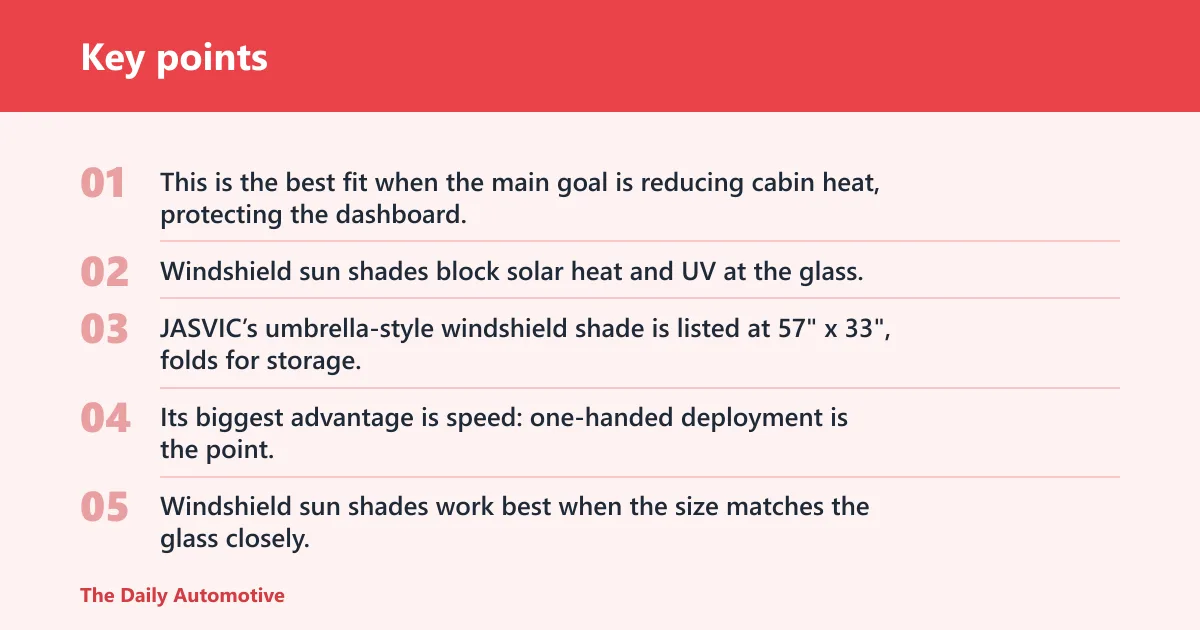
This is the best fit when the main goal is reducing cabin heat, protecting the dashboard, and making the front seats less punishing to touch after parking. Windshield sun shades block solar heat and UV at the glass, where a parked car takes in a large share of direct sun.
JASVIC’s umbrella-style windshield shade is listed at 57" x 33", folds for storage, and is marketed as a fast daily-use option for cars, sedans, and SUVs. Its biggest advantage is speed: one-handed deployment is the point, so it suits drivers who park and leave often.
The trade-off is fit. Windshield sun shades work best when the size matches the glass closely. A loose shade can leave edge gaps that let more light in, while an oversized one may be awkward to position around mirrors, sensors, or deep dashboards.
Because this is a windshield-only solution, it helps cabin heat more than paint. It does not cover the roof, hood, doors, or mirrors, so it is the weaker pick when exterior UV exposure is the real concern.
What stands out
It blocks 99% of UV with UPF 50+ certified material, and it opens and closes in seconds like an umbrella. That makes it a strong daily pick for commuters, curbside parkers, and anyone who wants a small routine with little setup.
Honest drawback
The folded shape is bulkier than a flat panel shade, and fit still depends on windshield size. It also does nothing for paint, trim, or side glass.
Reflective car cover: best for paint protection
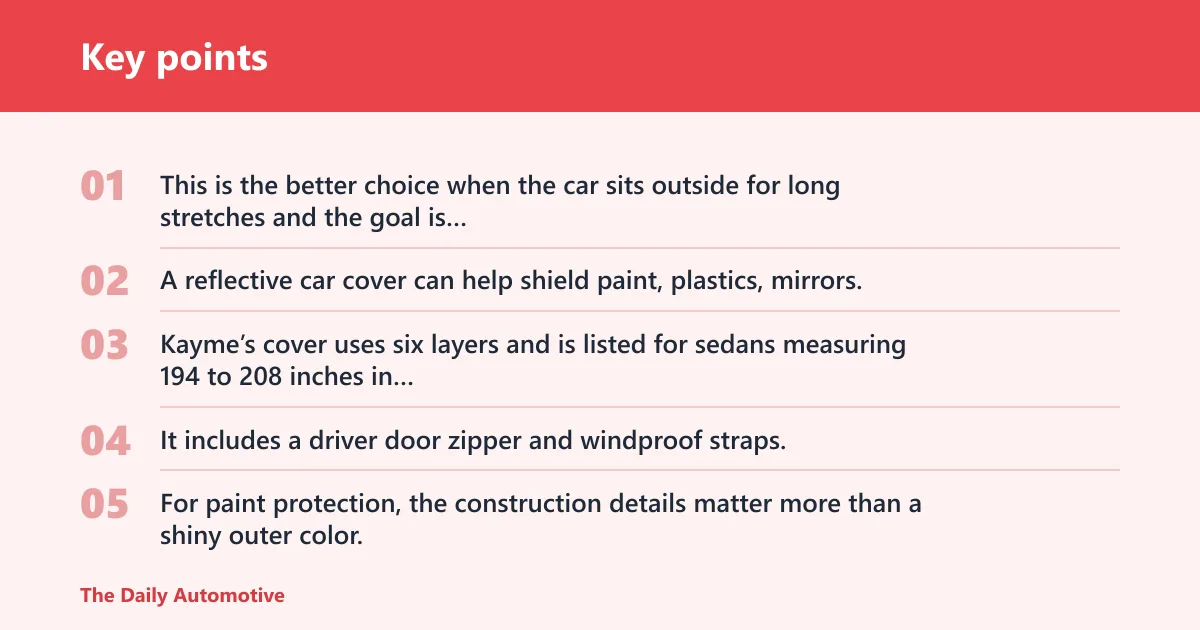
This is the better choice when the car sits outside for long stretches and the goal is full-vehicle protection rather than just a cooler cabin. A reflective car cover can help shield paint, plastics, mirrors, and glass from UV exposure while also reducing surface heat.
Kayme’s cover uses six layers and is listed for sedans measuring 194 to 208 inches in length. It includes a driver door zipper and windproof straps, which matters if the car is parked outside in regular wind rather than tucked into a garage.
For paint protection, the construction details matter more than a shiny outer color. Multi-layer builds, reflective aluminum or PEVA outer layers, and UV-resistant fabric are all aimed at reducing fading and cracking. Performance still depends on thickness and weave density, so fabric alone is not a guarantee.
This type is less convenient than a windshield shade. It takes longer to install, and storage is larger. It also needs a good fit. A universal cover that is too loose can flap, collect dirt, and shift in wind, which reduces coverage and raises the chance of rubbing.
Honest drawback: it is not the fastest
It is not the fastest choice for daily errands. It also fits only sedans in the listed 194 to 208 inch range, so size checking matters before you buy.
Umbrella-style sun shade: best for daily use
This style is worth it when speed matters more than full coverage. Umbrella-style shades use one-handed spring deployment, so they are easier to throw up and stow than a rigid panel in a busy parking routine.
The JASVIC shade is a clear example of the category: foldable, compact enough for front-seat storage, and sized at 57" x 33" for common passenger vehicles. That makes it useful for daily commuters, school runs, and short stops where the driver wants quick cabin heat control without fuss.
The main compromise is folded bulk. An umbrella mechanism stores more awkwardly than a flat shade, and the fit still has to match the windshield. If the car has a tall, wide, or unusually shaped windshield, a fixed panel or vehicle-specific shade may seal better at the edges.
It is also aimed at cabin heat, not paint. If the vehicle spends long hours in direct sun, a cover still does more for the exterior surfaces.
Honest drawback: it is bulkier
It is bulkier when folded, and convenience can come at the cost of edge coverage. If wind is strong or the windshield is unusually shaped, the seal may be less tidy than with a custom-cut option.
Car sun protection decision matrix
Use the matrix below to match the product type to the actual parking problem. That is the fastest way to avoid buying a shade that solves the wrong job.
| Sun protection type | Best parking scenario | Climate fit | Vehicle shape fit | Daily setup tolerance | Main downside |
|---|---|---|---|---|---|
| Windshield sun shade | Daily street parking, office lots, short stops | Hot sun, strong cabin heat, moderate wind | Cars with a standard front glass shape | Low to medium | Only protects the cabin side of the car |
| Reflective car cover | Outdoor parking for days or weeks | Intense UV, rain-prone, dusty lots | Sedan or SUV sizing, or vehicle-specific fit | Medium to high | Slower to install and store |
| Umbrella-style sun shade | Frequent errands, fast repeat parking | Hot climates where quick cabin cooling matters | Most common passenger-car windshields | High | Bulkier folded storage |
Sun protection scorecard
| Type | Heat reduction | Paint protection | Ease of use | Storage bulk | Wind resistance |
|---|---|---|---|---|---|
| Windshield sun shade | High for cabin heat | Low | High | Low to medium | Medium, depending on fit |
| Reflective car cover | Medium to high, depending on coverage | High | Medium | High | High when straps and hem fit well |
| Umbrella-style sun shade | High for quick cabin relief | Low | Very high | Medium to high | Medium |
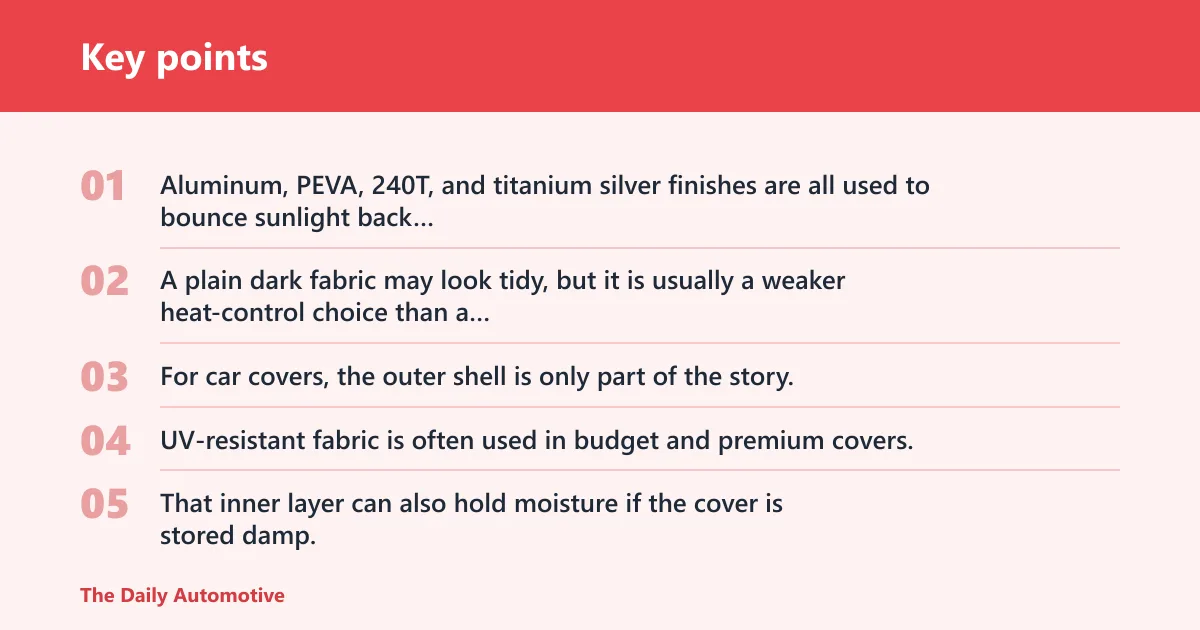
Reflective material matters more than color. Aluminum, PEVA, 240T, and titanium silver finishes are all used to bounce sunlight back rather than absorb it. A plain dark fabric may look tidy, but it is usually a weaker heat-control choice than a reflective layer.
For car covers, the outer shell is only part of the story. UV-resistant fabric is often used in budget and premium covers, and a cotton inner lining can soften contact with paint. That inner layer can also hold moisture if the cover is stored damp, which is a real downside for owners who pack it away after rain.
Wind strap systems matter most in open lots and windy streets. Three-strap or buckle systems help keep a cover from lifting, which reduces flapping noise and the loss of coverage that comes with a loose fit. Elastic hems and mirror pockets help too, but they are not a substitute for proper sizing.
Picture a sedan parked under full afternoon sun on a city street. A windshield shade helps the cabin. A reflective cover helps the paint and the cabin together, but only if the driver is willing to spend the extra time putting it on and taking it off.
Suppose an SUV sits at the airport for five days. The better choice is usually a reflective car cover, because long exposure makes paint and plastic protection more valuable than quick setup. If the same SUV is moved every few hours, the cover may become too much work for the job.
Choose a windshield shade if…
Choose a windshield shade if your main problem is a hot cabin, your parking routine is daily, and you want fast deployment. It is the best fit for drivers who care most about steering wheel heat, seat comfort, and dashboard protection.
Choose a reflective car cover if…
Choose a reflective car cover if the car lives outside, paint protection matters, or the vehicle will sit still for long periods. It is the stronger choice when UV, dust, rain, and exterior wear all matter at once.
Choose an umbrella-style shade if…
Choose an umbrella-style shade if speed is the priority and you want better cabin heat control than a bare windshield. It is a good middle ground for drivers who want quick use without a full cover routine.
Which one should you buy?
If you want the simplest answer, start with a windshield sun shade for most daily drivers. It gives the best cabin-heat payoff for the least effort, and it is the easiest way to keep the front of the car usable after parking in the sun.
If your car stays outdoors for long stretches, move up to a reflective car cover. That is the better pick when you care about paint, trim, and overall UV exposure, especially on vehicles that sit in open lots or on the street.
If setup speed matters more than everything else, pick an umbrella-style shade. It is worth it for frequent errands and quick stops, but the bulkier folded shape is the trade-off.
Size checking comes first in every case. Windshield sun shades vary by glass size, and common dimensions include 56 x 31 inches, 63 x 33.8 inches, and 64 x 32 inches. For covers, check the vehicle length range and body style before ordering.
Budget and premium choices split on fit and materials. Budget products can work well when dimensions are right, while premium covers usually add more layers, stronger straps, vehicle-specific sizing, and finer materials such as a cotton inner lining or improved reflective outer shell.
One common mistake is buying a reflective cover for a daily stop-and-go commute. Another is buying a windshield shade for a car that spends weeks in open sun and needs paint protection more than cabin relief.
Frequently asked questions
What is the best sun protection for a car?
The best sun protection depends on the job. For cabin heat, a reflective windshield shade is usually the right answer. For paint and full-vehicle UV exposure, a reflective car cover is better. For the fastest daily setup, an umbrella-style shade is the most convenient option.
Are car covers better than windshield sun shades for heat?
Not always. A car cover can reduce overall surface heating and protect paint, but a windshield shade targets the glass area where the cabin takes in much of its direct solar load. For cabin comfort after parking, a good windshield shade is usually the more direct tool.
Which car sun shade blocks the most heat?
For the cabin, a well-fitting reflective windshield shade is usually the strongest choice because it targets the front glass directly. For exterior exposure, a reflective car cover can cut more total sun load because it covers the whole vehicle. The best result depends on what you are trying to keep cool.
Do reflective car covers actually keep the car cooler?
Yes, they can help, especially when the car sits outside for long periods. Reflective layers such as aluminum or PEVA aim to bounce sunlight away, while UV-resistant fabric helps limit fading and cracking. Fit matters, though, because a loose cover can flap and lose effectiveness.
What size windshield sun shade fits my car?
Check the windshield dimensions before buying. Common sizes include 56 x 31 inches, 63 x 33.8 inches, and 64 x 32 inches. A closer fit usually blocks more light at the edges, while a poor fit can leave gaps or make installation awkward around mirrors and sensors.
Is an umbrella-style sun shade worth it?
It is worth it if speed is your top priority. The one-handed spring deployment is handy for daily use, but folded storage is bulkier than some other shades. If you want the fastest possible cabin setup and can live with the storage trade-off, it makes sense.
How do I choose between budget and premium sun protection?
Start with fit and material, not price. Budget shades can work well if the dimensions match, while premium covers often add more layers, stronger straps, better wind control, and more exact sizing. If you park outside often, pay extra for better coverage and more secure retention.
Can a car cover protect paint from UV damage?
Yes, a properly fitted cover can help protect paint from UV exposure and reduce fading or cracking over time. Look for UV-resistant fabric, a reflective outer layer, and a secure fit with straps or elastic hems. Avoid storing the cover damp, since moisture can create its own problem.
Products related to this article
Sponsored / affiliate links. As an Amazon Associate I earn from qualifying purchases. I may earn additional commission from eligible campaigns.