Best Car Sun Shades for Front Windshields (2026): we compared
The best car sun shade for front windshields is one that matches the glass shape closely; for daily use, a custom-fit foldable shade that installs quickly and stores flat can be a practical choice. Pick badly, and you get light leaks, a hot cabin, and a shade that ends up left at home. This guide compares front windshield sun shades by fit, install speed, storage size, and real heat control.
This guide is part of our Car accessories for comfort and convenience series.
Quick comparison
| Product | Badge | Best for | Price | ||
|---|---|---|---|---|---|
 |
Muamos Car Windshield Sunshield Foldable Front WindshieldMuamos | Our pick | Muamos foldable titanium silver shade | $14.99
Price as of 30 Sep 2026
|
View |
 |
Upgraded Retractable Car Windshield Sun Shade, ProtectCanvcle | Upgrade pick | Canvcle one-hand retractable windscreen cover | $59.50
Price as of 30 Sep 2026
|
View |
 |
Rayhui Front Windshield Sunshade for 2024-2026 Tesla ModelRayhui | Also great | Rayhui Tesla Model 3 Highland fit | $19.99
Price as of 30 Sep 2026
|
View |
 |
Heavy Duty Silver Accordion Car Sunshade, FoldableGeneric | Budget pick | Generic 63-inch heavy duty accordion shade | $9.99
Price as of 30 Sep 2026
|
View |
The fastest way to sort these is by windshield shape, not by heat-blocking language on the box. A shade that clears the mirror and sits flat against the glass usually beats a larger but sloppy one in day-to-day use.
How we chose
The shortlist is based on fit and friction first. That means windshield width and height, edge coverage, mirror and sensor clearance, folded size, and how quickly the shade goes up and comes down.
We also weighed construction details that matter after the first week: reflective aluminized material, single-layer versus multi-layer build, stiffness, and whether the shade is likely to stay convenient enough for daily use.
Where the spec sheet gave concrete fit clues, those mattered more than broad heat claims. A shade that fits cleanly and stores easily is usually the one that gets used every day.

Fit-and-friction decision table
| Windshield and daily-use situation | Best shade type | Why it fits the use case | Main tradeoff |
|---|---|---|---|
| Standard-width car windshield, average top curve, modest dash-to-glass gap | Custom-fit foldable shade | Best edge coverage and fewer light leaks; usually easier to live with every day | Costs more than universal options |
| Tall windshield with a strong top curve or deeper glass area | Accordion shade with a long width and stiff panels | Handles broad glass better and usually holds shape across a tall opening | Can be bulky when folded |
| Rearview mirror sits low or the car has a stem-mounted sensor cluster | Custom-fit shade with mirror cutout and sensor-specific shaping | Clears hardware without forcing a sagging fit | Less universal between vehicles |
| Limited storage, small glove box, door pocket only | Foldable shade with the shortest collapsed length | Easier to keep in the car instead of leaving it at home | May lose stiffness after repeated folding |
| Wide truck or van windshield, outdoor parking all day | Large accordion shade or oversized universal shade | More likely to cover the full width and block edge light leaks | Setup takes a little more room at the glass |
| Budget buy for occasional use | Universal shade with trim-to-fit sizing | Lower cost and broad size range | Coverage gaps and poorer retention are common |
Custom-fit accordion shade: best for daily drivers
The custom-fit choice is for drivers who want the cleanest coverage and the least daily hassle. Based on the spec sheet and owner feedback, the Rayhui Tesla Model 3 Highland shade is built for a specific windshield shape, includes a rearview mirror cutout, and uses dual-layer foil construction for stronger UV blocking than a simple single-sheet blanket.
What stands out is the geometry. Custom-fit shades can cover the upper corners, work around the mirror stem, and avoid the droop that shows up when a universal panel is pushed into a shaped windshield. That matters when the cabin has cameras, sensors, or a dash that sits close to the glass.
The honest drawback is obvious: this kind of shade only makes sense for the exact vehicle it was designed for. A precise fit is great, but it is useless outside that model family, and the cutout can slightly reduce top-center coverage compared with a full uninterrupted panel.
Why vehicle-specific coverage reduces light leaks
Front windshield sun shades work best when they sit close to the glass from edge to edge. A vehicle-specific shape reduces gaps around the A-pillars and top corners, which are common leak points on universal panels. Less daylight sneaking in usually means less radiant heating on the dash and steering wheel.
When mirror cutouts and sensor clearance matter
A rearview mirror cutout helps when the mirror stem sits deep in the windshield field. The tradeoff is a small opening around that area, but it is better than forcing the shade to buckle or sag. For cars with rain sensors, forward cameras, or upper glass modules, correct clearance matters more than extra surface area.
Universal foldable shade: best for budget buyers
The Muamos foldable front windshield shade is the broadest fit-first budget pick here. Based on its listed 55 x 31.5-inch size, memory metal frame, and wrapped edges, it aims at standard windshields where easy folding and a smaller price matter more than exact edge shaping.
Its main strength is practicality. A foldable design that keeps its shape after repeated use is easier to grab, spread out, and remove without fiddling, which makes it more realistic for commuters who do not want a long setup every morning.
The drawback is the same one most universal shades face: broad size compatibility does not guarantee perfect coverage. On taller windshields, or glass with a strong top curve, there can still be light leaks near the edges or around the mirror area.
Size range and trim-to-fit options
Universal shades usually come in a stated width and height, then rely on spring tension, suction, or a loose edge seal to stay in place. That works best when the windshield is close to the listed size. Trim-to-fit versions can help, but cut edges often reduce the clean fit and may fray sooner if the material is thin.
Where universal coverage gaps usually show up
The weak points are predictable: upper corners, the area behind the mirror, and the lower edge where the dash rises close to the glass. If the shade is too short, it leaves a bright strip that heats the cabin anyway. If it is too tall, it may wrinkle or push against sensors.
Accordion shade: best for quick setup and easier storage
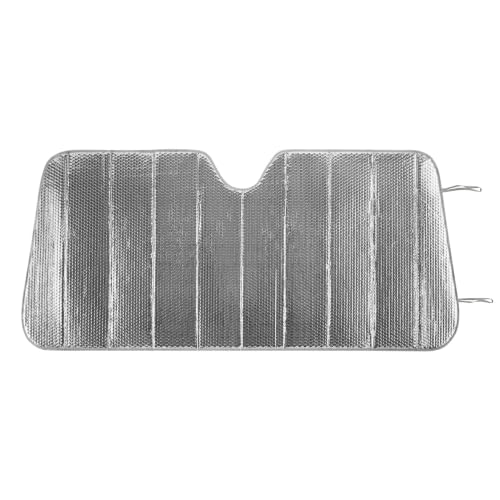
The Generic heavy duty silver accordion shade is aimed at drivers who want fast deployment and a large working width. Its listed 63 x 28.5-inch size suits bigger glass areas, and the accordion fold makes it easier to open and close than a floppy sheet that needs constant reshaping.
What stands out is the size-to-use ratio. For trucks and vans, a wide accordion panel can cover more glass with less drama than a small foldable shade that has to be stretched to its limit. The stiffer build can also help it hold shape against a tall windshield better than a soft single-layer panel.
The drawback is storage. Accordion shades are efficient on the glass, but they can still feel bulky in a glove box, and repeated folding can wear the creases or make the panels less crisp over time.
Panel count, stiffness, and fold size
Accordion shades vary by panel count, and the count changes both the folded size and the way the shade sits against curved glass. More panels can help it contour, but they also add bulk. A stiffer shade often resists sagging better, which helps on tall windshields and in hot parking lots where the material softens.
How storage pouch size affects daily use
Storage is not a side issue. If the folded shade fits a door pocket or glove box, it stays in the car. If it needs a cargo bin or back seat, daily use falls off fast. Collapsed length matters more than marketing language because it decides whether the shade is carried every day or left behind.
Which one should you buy?
For hot climates and outdoor parking, the custom-fit choice is the cleanest buy when a matching vehicle version exists. It gives the best balance of edge coverage, mirror clearance, and daily convenience, which matters more than a few extra reflective claims on the packaging.
For small cars with tight storage, the Muamos foldable shade is the practical pick if the windshield dimensions are near its listed size. It is easier to stash than a bulky retractable system and less likely to be abandoned because it is annoying to put away.
For trucks, SUVs, and tall windshields, the Generic accordion shade is the safer fit-first option. The wider panel size and stiffer construction help with broad glass, though the folded bulk is the price of getting better coverage across a large opening.
The Canvcle retractable shade is the convenience outlier. It is useful for drivers who value one-hand deployment and no loose storage pouch, but the note about not fitting high-curve dashboards means it should be treated as a shape-sensitive purchase, not a universal fix.
Quick picks
- Best overall for daily drivers: custom-fit foldable shade with mirror and sensor clearance
- Best budget buy: standard universal foldable shade with memory-frame support
- Best for large vehicles: wide accordion shade with stiff panels
- Best for no-storage convenience: retractable shade, if the windshield shape is compatible
What size sun shade fits my windshield best?
The right size is the one that covers the full glass width and height without forcing the shade to bow around the mirror or dash. Measure the widest point, the tallest point, and the top curve. If the windshield is tall or strongly curved, choose a shape-specific shade rather than a generic size match.
Quick measuring checklist before buying
- Measure the windshield width at the widest point.
- Measure the height from the dash line to the top edge.
- Note the top curve and whether the glass narrows near the roof.
- Check rearview mirror stem position and sensor locations.
- Measure dash-to-glass clearance near the lower edge.
- Compare the folded length to glove box or door pocket space.
Are foldable or accordion sun shades better for daily use?
Foldable shades are usually better for small-car storage and simple carry, while accordion shades are often better for larger windshields that need a stiffer shape. For daily use, the winner is the one that goes up quickly and goes back into the car without fuss. Convenience decides habit.
Setup time and fit retention
Foldable shades usually open faster and collapse flatter. Accordion shades often hold their shape better once in place, which helps on wide or tall glass. If the windshield is large or curved, the accordion style may stay put more reliably even if it takes a little more room when stored.
Do reflective shades work better than blackout shades?
Reflective shades usually do a better job with direct solar load because they send more light away from the windshield before it becomes cabin heat. Blackout shades can reduce visible light, but they do not always reflect heat as effectively. For front windshields, a reflective aluminized surface is usually the more practical choice.
Single-layer versus multi-layer construction
Single-layer reflective material is lighter and folds smaller, but it can crease faster. Multi-layer construction often resists heat better and may hold up longer under repeated folding, though it adds bulk. If UV protection is stated, that rating is useful; if it is not listed, do not assume more than basic sun blocking.
Will a custom-fit sun shade block more heat than a universal one?
Usually yes, but mostly because it fits the windshield better. A custom-fit shade blocks more heat by reducing edge leaks, sagging, and gaps around the mirror or sensor area. The material matters, but fit usually decides how much sunlight still reaches the dash and seats.
Why fit beats broad heat claims
A universal shade can look reflective and still leave bright slivers at the corners. Those openings let in light that keeps heating the cabin. A custom-fit shade that lies flatter across the glass can keep the whole windshield more evenly covered, which is the real reason it often performs better.
How do I measure my windshield for the right size?
Measure width, height, top curve, and hardware placement before buying. The windshield should be treated as a shape problem, not just a numbers problem. A shade can match the width and still fail if the mirror stem, camera module, or top curve gets in the way.
Simple measurement steps
- Use a tape measure across the widest visible glass.
- Measure from the dash to the top edge at center.
- Check how much the glass narrows near the roofline.
- Mark the mirror stem position and sensor cluster area.
- Compare those numbers with the shade’s stated dimensions and cutouts.
Which sun shade is easiest to store in a small car?
The easiest shade to store in a small car is usually the one that collapses the shortest and lies flat. Foldable designs tend to win here, especially when the shade can fit a glove box or door pocket. Retractable designs also store well, but only if the vehicle shape actually suits them.
Storage pouch and carry convenience
A good storage pouch keeps the folded shade from snagging trim, leaving residue, or bouncing around in the cabin. Collapsed length matters more than width once the shade is in hand. If it fits in a door pocket, it is more likely to stay in the car every day.
Do sun shades damage tint or sensors?
Properly used sun shades should not damage tint, but rough edges, repeated scraping, or forcing a badly sized shade into place can be a problem. For sensors and cameras, the issue is fit, not the shade material itself. Clearance matters more than any broad warning on the package.
What to check around mirror and sensor areas
Look for a mirror cutout, note whether the shade sits away from the sensor cluster, and avoid anything that presses hard against the glass. If the windshield has a large camera module or rain sensor, a custom-fit design is usually safer than a universal sheet that bunches up.
What features matter most for hot climates and parking outside?
For hot climates and all-day outdoor parking, edge coverage, reflective surface quality, and repeatable fit matter most. A shade that blocks the top corners, clears the mirror, and stays flat against the glass will usually do more useful work than a bigger shade that leaves gaps or becomes annoying to handle.
Best priorities for extreme heat
Choose a reflective aluminized material, prefer multi-layer construction if bulk is acceptable, and favor a shape that matches the windshield exactly. UV protection is worth paying attention to when it is actually stated, because it helps explain interior fade resistance, not just glare reduction.
Daily commuter versus long-term outdoor parking
Commuters should bias toward speed and storage ease. Long-term outdoor parking calls for the most complete coverage possible, even if the shade is slightly bulkier. In both cases, the best shade is the one that gets used consistently, because the perfect fit left in the trunk helps nobody.
Products related to this article
Sponsored / affiliate links. As an Amazon Associate I earn from qualifying purchases. I may earn additional commission from eligible campaigns.
 Yidcidu Car Windshield Sun Strip Tint, PET Anti-Glare Windshield Window Tint Film, 51.2" x 8.27" Cuttable Sun Visor Decorative Decals, for Cars Trucks SUVs (Black)
 Tunrisy 51.18"× 7.87" Car Windshield Sun Strip Tint, Waterproof Matte Front Windshield Banner Tint Strip, Vehicle Sun Visor Film Decals, Universal for Cars Trucks SUVs (Black)