Lithium vs AGM Car Battery for Car Audio
For car audio, choose Lithium if your system has sustained high current draw and you can support proper charging and low-temperature protection; choose AGM Car Battery for Car Audio if you need colder-weather reliability, simpler charging, or a starter battery that tolerates abuse better. Pick the wrong chemistry, and you can get voltage sag, BMS cutoffs, weak cranking, or an overworked alternator. This guide compares Lithium vs AGM Car Battery for Car Audio by load, climate, and install role.
| Decision factor | Lithium | AGM Car Battery for Car Audio | Winner |
|---|---|---|---|
| Weight | 20–30 lb range | 40–60 lb range | Lithium |
| Charge recovery | 1–2 hours | 4–8 hours | Lithium |
| Cycle life | 2000–5000 cycles | 300–500 cycles | Lithium |
| Cold-weather use | Performance drops below freezing; charging below freezing needs care | Generally better cold-weather tolerance | AGM Car Battery for Car Audio |
| System complexity | Needs a BMS and voltage settings that match the pack | Less sensitive to charging setup | AGM Car Battery for Car Audio |
| Best fit | High-power, weight-sensitive, supported installs | Daily driving, starter role, colder climates | Tie |
Core performance trade-offs and cold weather limits
The trade-off is direct. Lithium gives you faster recharge, lower weight, and far more cycle life. AGM Car Battery for Car Audio is easier to live with in cold weather and usually simpler to fit into a stock-style charging setup. Current draw matters more than brand hype. If the amplifier bank is pulling hard on bass hits, battery behavior under burst load matters more than the chemistry label alone.
Weight and service life
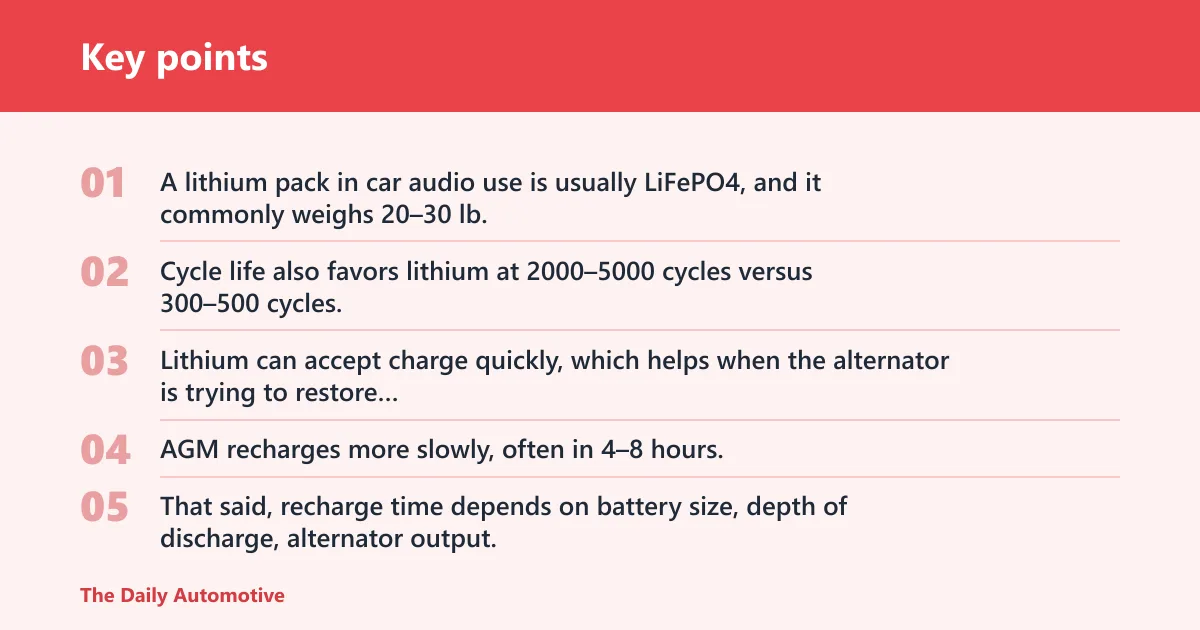
Lithium wins on mass and cycle count. A lithium pack in car audio use is usually LiFePO4, and it commonly weighs 20–30 lb; AGM batteries are typically 40–60 lb. Cycle life also favors lithium at 2000–5000 cycles versus 300–500 cycles, though depth of discharge and charging conditions still affect real service life.
Recharge behavior
Lithium can accept charge quickly, which helps when the alternator is trying to restore voltage after repeated bass hits. AGM recharges more slowly, often in 4–8 hours, while lithium is often described at 1–2 hours. That said, recharge time depends on battery size, depth of discharge, alternator output, and the voltage profile the charging system can actually supply.
Cold-weather tolerance
AGM Car Battery for Car Audio is the safer year-round choice in cold climates. Lithium, especially LiFePO4, does not like charging below freezing; the battery may still discharge, but charging below 32°F / 0°C is the main concern. Below freezing, a pack can hit protection limits or accept charge poorly unless the pack and BMS are built for that condition.
Voltage sag and bass hits
Voltage sag is the symptom that matters most in car audio. The amplifier asks for a burst of current on a heavy bass hit, system voltage drops, lights dim, and the amp can clip or shut down if reserve and charging support are weak. A stronger battery helps, but wiring, alternator output, and fuse placement decide how much of that reserve reaches the amp.
What the amp is really asking
High-power car audio amplifiers create short, sharp current spikes. A system rated at about 2000W RMS or more can stress the charging system if the alternator output and cabling are not sized for the load. The battery is not a magic fix for an undersized alternator; it is part of the supply chain.
Say your trunk setup runs a monoblock amp and a sub stage that hits hard at idle. If the headlights dip every time the bass drops, the issue is not only battery chemistry. The first check is total system current draw, then alternator output, then cable loss, then battery reserve.
Why reserve and wiring matter
A higher-reserve battery can reduce sag during bursts, but only if the install path supports the current. Long cable runs, undersized wire, weak grounds, and bad fuse placement can wipe out the benefit of a better battery. If the voltage is falling because of resistance in the path, chemistry alone will not fix it.
What the install must support?
The install has to match the battery. Lithium needs a compatible charge profile, a BMS, and a charging system that stays inside the pack’s allowed voltage range. AGM Car Battery for Car Audio is more forgiving, but it still needs correct mounting, fused cabling, and an alternator that can keep up with demand.
Alternator output and charge acceptance
Alternator output affects how fast the system recovers after a burst and how steady the voltage stays while the music plays. A strong battery with weak alternator support only delays the problem. Lithium’s fast acceptance can help when the alternator is sized correctly, but that same speed can expose voltage-control issues if the charging setup is wrong.
Wire gauge, fuse sizing, and mounting
Trunk banks and under-hood batteries need proper cable routing, secure mounting, and fuse protection close to the power source. Lithium’s lighter weight does not reduce the need for restraint or protection. AGM is heavier, so mounting hardware matters even more when the battery sits in a trunk or a cargo area.
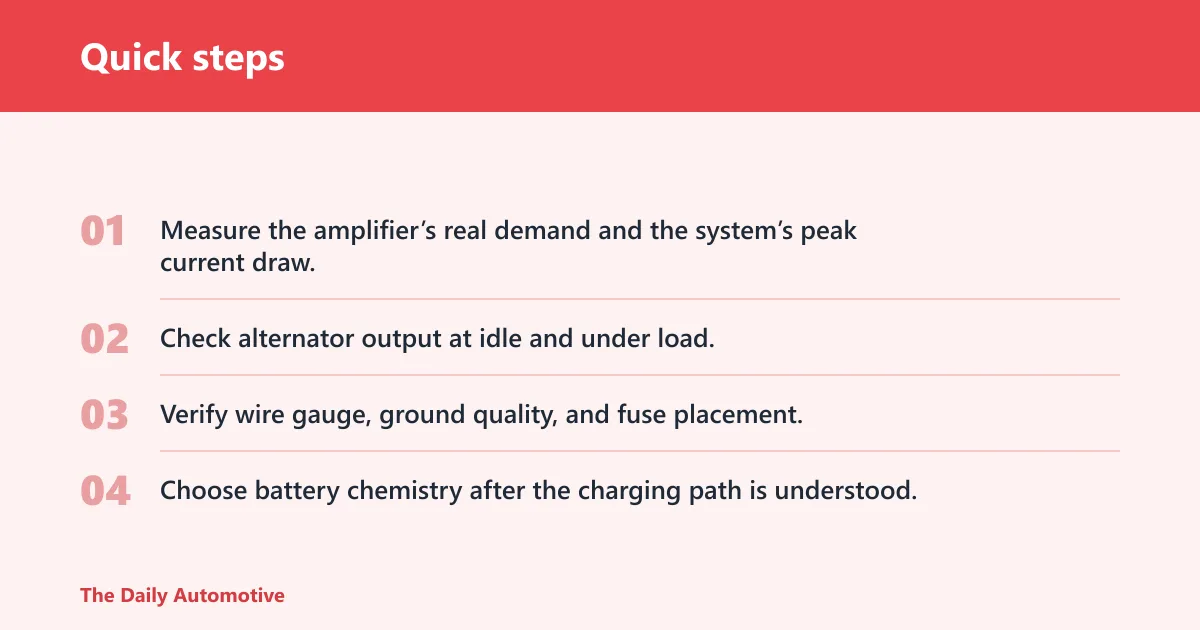
- Measure the amplifier’s real demand and the system’s peak current draw.
- Check alternator output at idle and under load.
- Verify wire gauge, ground quality, and fuse placement.
- Choose battery chemistry after the charging path is understood.
Starter battery, trunk bank, or competition-only role
As a starter battery, AGM Car Battery for Car Audio is usually the easier choice because it is more tolerant of mixed driving, cold starts, and imperfect charging. As a trunk bank, lithium makes more sense when the system is high output and the install already supports the pack. For competition-only use, lithium can be the better fit if the voltage control is set up correctly and temperature is controlled.
How climate changes the choice?
Climate changes the battery decision more than many builders expect. Below freezing, lithium charging becomes the main problem, while AGM Car Battery for Car Audio generally handles winter duty with less fuss. Cold air still reduces available performance for both chemistries, but lithium needs more care at the charging stage.
What changes below freezing
Below 32°F / 0°C, lithium performance and charging behavior can become less predictable. The pack may refuse charge, limit output, or trigger protection if the BMS sees unsafe conditions. AGM is not immune to cold, but it usually tolerates winter use better and is easier to live with in a daily-driven car.
When AGM is the safer year-round choice
If the car sits outside, sees winter starts, or runs short trips in a cold climate, AGM Car Battery for Car Audio is the safer default. It is also the better fit when the charging system is ordinary and the owner wants less setup complexity. Lithium can still work, but only with proper low-temperature protection and charge control.
Car audio battery decision matrix
This matrix maps battery choice to current draw, symptoms, climate, and install role. Use it as a practical filter, not a sales pitch. The right answer is the one that matches the load and the charging system you actually have.
| Wattage band | Likely symptom | Recommended chemistry | Required support |
|---|---|---|---|
| Under 1000W RMS | Minor dimming on hard bass hits | AGM Car Battery for Car Audio | Healthy alternator, proper grounds, correct fuse sizing |
| 1000W to 2000W RMS | Noticeable bass-hit sag or slow recovery after loud passages | AGM Car Battery for Car Audio in cold climates; Lithium in warm climates with strong charging support | Alternator matched to demand, heavier-gauge power wire, voltage monitoring |
| 2000W RMS and up | Headlight dimming, clipping risk, possible protection shutdown | Lithium | BMS, correct voltage settings, strong alternator, trunk-bank wiring, fuse protection |
| Competition-only high output | Short-term voltage collapse under repeated bursts | Lithium | Dedicated bank, cooling plan, charging profile matched to pack limits |
| Daily driver in sub-freezing weather | Weak cranking and slow recovery if the system is mismanaged | AGM Car Battery for Car Audio | Stock-like charging behavior, sound mounting, conservative load |
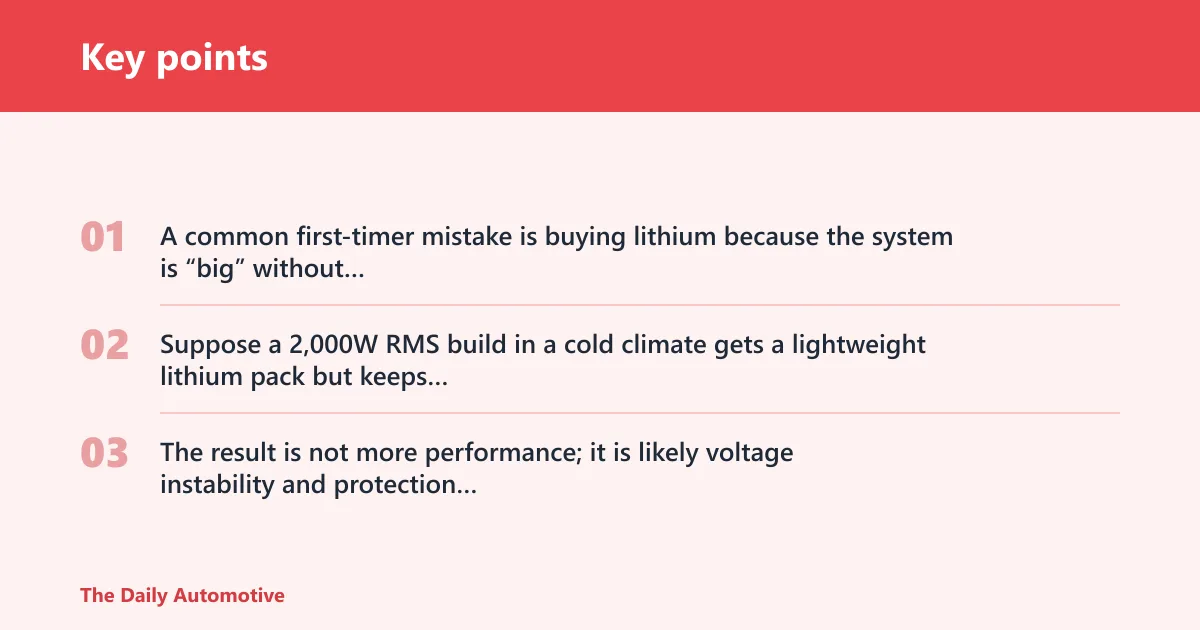
A common first-timer mistake is buying lithium because the system is “big” without checking whether the alternator can feed it. Suppose a 2,000W RMS build in a cold climate gets a lightweight lithium pack but keeps the same small alternator and thin cables. The result is not more performance; it is likely voltage instability and protection events.
Choose AGM car battery for car audio if…
Choose AGM Car Battery for Car Audio if the car is a daily driver, winter starts matter, or the charging system needs to stay simple. It also makes sense when the battery is acting as the starter battery, when budget is tighter, or when the build is under roughly 2000W RMS and does not need a weight cut.
AGM is the safer pick if you want a sealed, spill-proof, maintenance-free battery that is easier to integrate without special voltage logic. It is also the better choice when the system may sit in freezing weather or the owner wants fewer compatibility traps.


Choose Lithium if…
Choose Lithium if the build has sustained high current draw, you want faster recovery, and the install can support a BMS and proper voltage control. It is the better answer for weight-sensitive builds, large trunk banks, and systems where voltage sag on heavy bass hits is the main problem.
Lithium also earns its keep when the system is warm-climate, high output, and charging support is already sorted. The price is higher at purchase, but the cycle life is much longer, so the cost per cycle can improve if the pack is used hard and kept within spec.
Frequently asked questions
Lithium vs agm battery for car audio
Lithium is usually the better fit for high-current, supported systems because it weighs less, recharges faster, and lasts longer in cycle count. AGM Car Battery for Car Audio is the easier pick for colder climates, daily driving, and simpler charging. The best choice depends on alternator support and install role.
Lithium car battery vs agm
For car audio, lithium wins on weight and charge speed, while AGM wins on cold-weather tolerance and simplicity. Lithium needs a BMS and the right voltage range; AGM is more forgiving. If the build is a starter battery or sees winter use, AGM usually makes more sense.
Are agm batteries good for car audio?
Yes. AGM batteries are a strong choice for car audio when the system is moderate in output, the vehicle is daily driven, or cold weather is part of the equation. They are sealed, spill-proof, and maintenance-free, with better cold-weather tolerance than lithium. They are just not the lightest or fastest-charging option.
Does lithium reduce voltage drop in car audio?
Lithium can help reduce voltage drop during bass hits because it has lower weight and strong charge acceptance, but it does not fix a bad charging path. If wire gauge is too small, grounds are weak, or the alternator is undersized, sag can still happen. The battery is only one piece of the system.
Do lithium car audio batteries need a special charger?
They need charging that matches the pack’s allowed voltage range and BMS limits. In car audio, that usually means the alternator and any external charger must be compatible with LiFePO4 behavior. The pack is more sensitive than AGM to charging below freezing and to incorrect voltage settings.
When should I use lithium instead of AGM for car audio?
Use lithium when the build is high power, the system is warm enough to avoid charging problems, and the install can support a BMS, proper wiring, and a compatible alternator. It is the better pick for heavy bass loads, trunk banks, and weight-sensitive setups. If the car sees winter and daily starts, AGM is the safer call.
Products related to this article
Sponsored / affiliate links. As an Amazon Associate I earn from qualifying purchases. I may earn additional commission from eligible campaigns.