3 Best Truck Mudguards: Top Picks
A common breakdown of truck mudguards for 2026 is an OEM-fit splash guard for daily driving, a heavy-duty bolt-on flap for towing, and a full-coverage rubber mud flap for gravel, snow, and off-road debris. Poor fit leaves paint, trim, sensors, and trailers exposed. This guide ranks each type by use case and ends with a fit-and-failure checklist so you buy the right style.
Top pick for most pickup owners
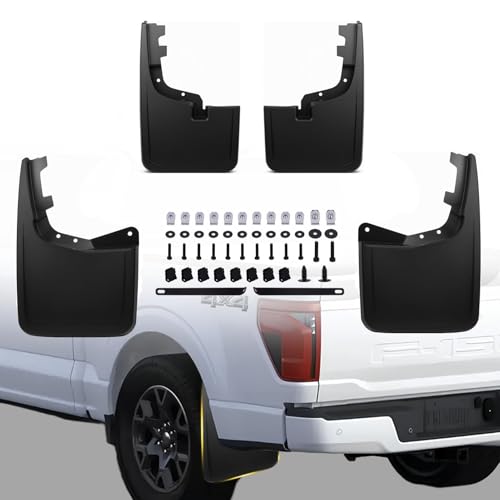


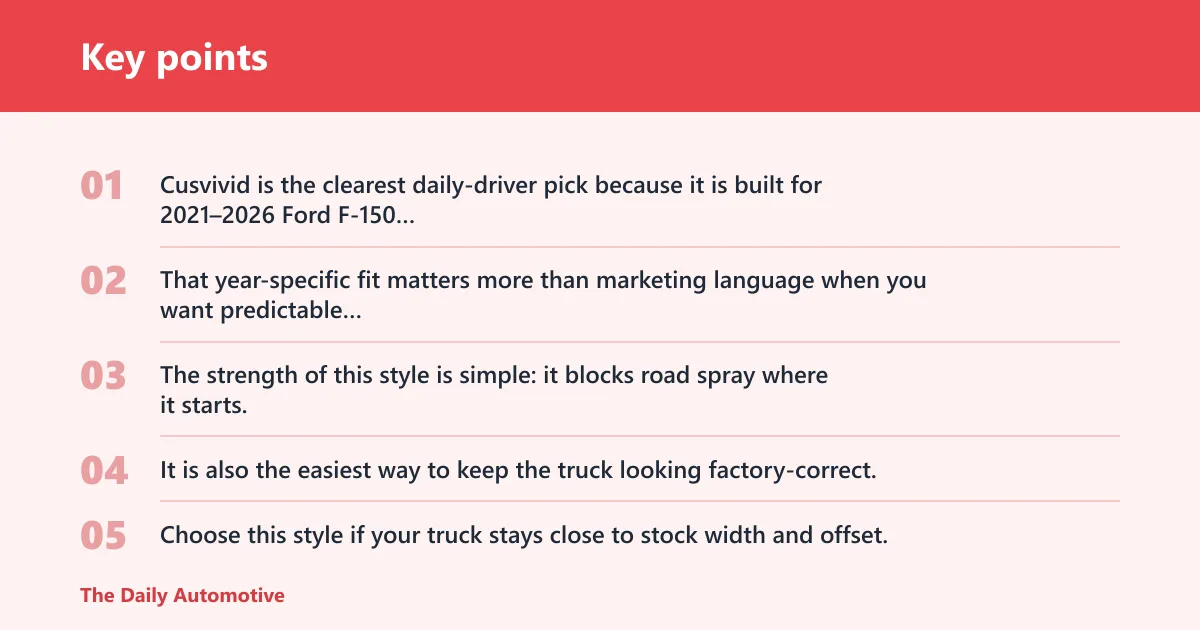
Cusvivid’s direct-fit mud flaps are the best all-around choice for a 2021–2026 Ford F-150 because they cut fit guesswork, keep spray control targeted, and avoid the bulk that can rub on stock street setups. For a daily driver, that matters more than oversized coverage.
The main advantage is less installation ambiguity. Model-specific mud flaps are built for one truck family, so you are not forcing a universal pattern around wheel-arch shape, bumper edges, or factory liners.
That makes them the best starting point for owners who want front-and-rear coverage without turning the install into a trim-and-drill project. The tradeoff is simple: they are less flexible if you run aggressive offset wheels or taller-than-stock tires.
Skip this style if your truck already has noticeable tire poke, extended suspension travel, or you need the widest spray control for mud roads. In that case, a larger rubber flap or a hitch-mounted setup makes more sense.
Which mudguards fit your truck best?
Which mudguard fits best depends on how you use the truck, how far the tires sit outboard, and whether you want a fixed, direct-fit install or a more adjustable setup. Universal flaps, model-specific flaps, and hitch-mounted systems solve different problems, and they do not fit every truck equally well.
Quick picks by use case
- Daily driving: Cusvivid direct-fit flaps for 2021–2026 Ford F-150 models.
- Towing: Gearif hitch-mounted adjustable mud flap option for receiver-mounted rear spray control.
- Heavy debris: Buyers Products RC24PPB, which measures 24 x 24 inches.
Universal, model-specific, and hitch-mounted
Universal mud flaps can work on pickups, but fit varies widely by wheel well shape, mounting points, and tire stance. Many universal sets use PP+TPO or PP+TPE and often require drilling, which makes them adaptable but less exact.
Model-specific mud flaps reduce the guesswork. They are the safer choice when you want direct-fit compatibility and fewer surprises during installation. The tradeoff is obvious: they only fit the vehicles they were designed around.
Hitch-mounted adjustable mud flaps are a separate category. They help tow vehicles because the rear protection can be set to trailer height and load height, and they rely on receiver and shank compatibility rather than wheel-arch clips or factory liner points.
Drill required or no-drill
Drilling is common on many mud flap sets, especially heavy-duty and universal options. No-drill designs are faster to install and less permanent, but they depend on the correct existing mounting points, and that means fit can be more vehicle-specific than the label suggests.
MZS lists a no-drill design, which is the right direction for owners who want a simpler install. A-Premium comes as a 4-pack and requires drilling, which is more work up front but can provide a firmer attachment on trucks that need it.
Best mudguards for daily driving
For everyday street use, model-specific mud flaps are the cleanest answer because they give enough front-and-rear coverage for spray control without hanging so low that they catch curbs, driveway ramps, or suspension movement. That balance matters most on stock-size tires and factory ride height.
Cusvivid direct-fit mud flaps
That year-specific fit matters more than marketing language when you want predictable coverage behind stock wheels and tires.
The strength of this style is simple: it blocks road spray where it starts, and it does so with less trial-and-error than a universal kit. It is also the easiest way to keep the truck looking factory-correct.
Choose this style if your truck stays close to stock width and offset. If your front tires stick out more than factory spec, a direct-fit flap may still work, but spray will escape around the outer edge sooner than on a narrow OEM-stance truck.
Winter durability and salt exposure
For winter, PP+TPE and PP+TPO matter because both are used in splash-guard construction and are chosen for a balance of stiffness and flexibility. That flexibility helps resist cracking when temperatures drop, while the polymer side helps with shape retention and salt exposure.
HDPE is also common for heavy-duty use, where impact resistance and warping resistance matter more than a soft, pliable hang. In cold weather, a flap that stays too rigid can ice up and crack; a flap that flexes well is less likely to fail at the mounting edge.
Suppose a pickup runs 275-width street tires through wet slush every weekday. A direct-fit set with front-and-rear coverage usually controls the spray line well enough without dragging through snowbanks at parking-lot speed. The wrong choice is a flap that sits too short, because slush will shoot past the rear edge and onto the trailer hitch, lower body, and bumper corners.
Best mudguards for towing
Tow rigs need rear spray control more than most pickups because the truck is throwing water, salt, and grit toward a trailer tongue, coupler, and front face of the trailer. A hitch-mounted system is often the best answer because height and width can be adjusted around towing hardware.
Gearif hitch-mounted adjustable mud flap
Gearif includes a hitch-mounted adjustable mud flap option, and that is the right style for tow-vehicle use because it can be set around trailer clearance rather than forcing a fixed wheel-arch pattern to do all the work. The compatibility point to check is the hitch receiver and shank fit, not a “ball mount” label.
That matters on trucks with different receiver sizes and on setups where trailer tongue height changes between loads. A hitch-mounted flap can be raised or lowered to keep spray off the trailer without dragging on the pavement.
For towing, look for adjustable width and height, plus a flap size that can be trimmed to the truck’s rear track width. If the flap ends too narrow, spray sneaks around the sides. If it hangs too low, it can contact driveways or steep boat ramps.
Winter towing notes
Road salt is hard on everything behind the axle. Hitch-mounted systems can help because they keep winter spray lower and farther back, but they also need to shed packed slush. If the flap traps ice, the added weight can change ride height at the mounting point and loosen hardware over time.
Best mudguards for heavy debris
For gravel roads, work sites, and off-road use, the best answer is a larger heavy-duty flap with enough width and length to block roost from the tire tread. Coverage matters more here than a clean factory look, and a drilled install is often worth the extra time.
Buyers Products RC24PPB
Buyers Products RC24PPB measures 24 x 24 inches, which gives it the broad coverage heavy-debris buyers want. That size helps catch spray from larger tire footprints and wider wheel openings.
This style is the better fit when the truck sees rocks, mud, or slush that would pass under a short street flap. It is also the more practical choice for trucks and SUVs that need more body protection than a small direct-fit guard can provide.
Heavy-duty rubber mud flaps, like the Cat option Gearif lists at 19 x 11 inches, are built for rugged debris control. Rubber works well in abuse-heavy settings because it flexes instead of chipping, and that matters when the flap gets hit by stones and frozen slop.
Drilled mounting is common on this class because retention matters. A large flap hanging behind a wide tire sees more wind load, more vibration, and more debris impact, so a stronger fixed mount is usually worth the extra effort.
Truck mudguard fit matrix
This matrix is the fastest way to match use case, tire setup, winter exposure, and install type to the right mudguard style. It is also where most buyers avoid the wrong purchase. Tire width, offset, and suspension travel decide whether a flap clears or rubs.
| Use case | Tire width / offset clue | Winter severity | Install type | Best mudguard style |
|---|---|---|---|---|
| Daily street driving | Stock-width tires, near-factory offset | Light to moderate salt | No-drill or direct-fit | Model-specific splash guard |
| Towing | Factory width or mild poke | Moderate to heavy salt | Hitch-mounted | Adjustable rear flap system |
| Gravel and work sites | Wider tires, possible offset wheels | Any, with slush risk | Drilled bolt-on | Large rubber flap |
| Off-road or lifted trucks | Large tire width, more suspension travel | Cold, mud, and ice | Drilled or heavy-duty mount | Wide coverage flap with clearance margin |
| Mixed snow and road salt | Moderate width, low-to-mid offset | Severe winter | Direct-fit if available | Flexible PP+TPE or rubber style |
3 truck mudguards checklist
- Rubbing: Check for contact at full lock and full suspension compression.
- Ice buildup: Avoid very rigid short flaps if packed snow is common.
- Poor spray coverage: If the flap stops above the tire centerline, expect more overspray.
- Loose hardware: Recheck bolts after the first few drives, especially on drilled installs.
- Trailer interference: Hitch-mounted units need clearance for couplers, safety chains, and ramps.
- Offset wheel exposure: More poke means spray escapes around the flap edge sooner.
How do you choose the right set?
Start with tire width and wheel offset, then check suspension travel and the room behind the tire. After that, match material to climate. PP+TPE and PP+TPO are often used when cold-weather flex matters, while HDPE and heavy rubber are commonly chosen for harsher impact and debris exposure.
Install complexity matters too. A no-drill set is easier and usually faster, but a drilled or direct-fit mount can hold better on heavy-duty use. Over time, the cheapest set is not always the best value if it needs replacement hardware, shifts out of position, or fails to cover the spray line.
A common first-timer mistake is buying a universal flap for a lifted truck with wider tires, then discovering the flap clears the tire at rest but touches when the suspension compresses. The truck looks fine in the driveway. The rub shows up on the first speed bump.
Another common miss is choosing a short flap for winter because it looks tidy. Once the first slush storm hits, the rear of the truck and the trailer tongue take the full spray load.
- Measure tire width and note wheel offset.
- Check whether the truck is stock height, leveled, or lifted.
- Look for full lock and full compression clearance.
- Decide whether you want drilling, no-drill mounting, or hitch mounting.
- Match the material to your climate and debris exposure.
- Choose the style with enough coverage to stop spray at the tire edge.
Frequently asked questions
Are mudguards worth it?
Yes, if you want less spray on paint, lower body panels, tow hardware, and trailer fronts. They matter most when the truck runs in salt, slush, gravel, or mud. The return is best on trucks that actually see winter roads or dirty work routes.
What are the best truck mudguards for pickup trucks?
The right pick is the one that matches your tire width, mounting method, and winter exposure.
Which mudguards fit my truck and tire size?
Model-specific guards fit best when you want the least guesswork. Universal flaps can fit many pickups, but tire width, wheel offset, and suspension travel still decide whether they clear. If you run wider tires or offset wheels, measure at full lock and full compression before buying.
Do truck mudguards require drilling?
Many do. Universal and heavy-duty sets often use drilled mounting because it gives a firmer hold. No-drill models and some direct-fit kits use existing mounting points, which is faster, but the fit window is narrower and may depend on your exact truck configuration.
Are no-drill mud flaps as good as drilled ones?
They can be good for light to moderate street use, especially when the truck has factory-size tires and no unusual offset. Drilled mounts usually win for heavy debris, larger flaps, and work-truck duty because they resist movement better and stay put under more load.
What mudguards are best for winter and road salt?
Flexible materials are the safest bet. PP+TPE and PP+TPO help with cold-weather flexibility, while rubber handles impact and slush well. Look for a shape that does not trap packed ice, because ice loading can crack brittle flaps and loosen mounting hardware over time.
Can I use universal mud flaps on a pickup truck?
Yes, but only if you are willing to fit-check them carefully. Universal sets often need drilling and may not match wheel-arch shape, tire poke, or factory liners. They work best when you want flexibility, not when you need a clean, direct-fit result.
Products related to this article
Sponsored / affiliate links. As an Amazon Associate I earn from qualifying purchases. I may earn additional commission from eligible campaigns.