4 Best Mud Flaps for SUVs (2026): We Compared
For most SUVs, vehicle-specific, bolt-on mud flaps with about 1 to 2 inches of tire-side coverage past the tread are commonly the best fit; universal flaps are usually better only if extra clearance matters and some trimming is acceptable. Bad fitment throws slush onto rocker panels, can rub at full lock, and may tear off on trails or in winter. This comparison breaks down four real mud flap options by fitment, coverage, installation method, and the failure mode to watch for.
Quick comparison
| Product | Badge | Best for | Price | ||
|---|---|---|---|---|---|
 |
Autorder Mud Flaps for Ford F150 F-150 2021-2026Autorder | Our pick | $32.29
Price as of 22 Oct 2026
|
View | |
 |
WeatherTech Custom No Drill Splash Guard MudFlaps forWeatherTech | Also great | WeatherTech · Front & Rear Set · Black · No Drill | $199.90
Price as of 22 Oct 2026
|
View |
 |
Durahalt No Drill Mud Flaps for 2025 2026 2027 ToyotaDurahalt | Budget pick | Durahalt · 4-Piece Set · Textured Black · OEM-Style | $46.99
Price as of 22 Oct 2026
|
View |
 |
Ecarzo Mud Flaps Compatible with Jeep Grand Cherokee LEcarzo | Also great | Ecarzo · 4-Piece Set · ABS · No Drilling | $34.69
Price as of 22 Oct 2026
|
View |
 |
4pcs Mud Flaps Splash Guards for Ford Expedition MaxVHNYWKCX | Also great | $77.96
Price as of 22 Oct 2026
|
View |
The main divide is simple: fixed fit or adjustable coverage. Custom-fit, no-drill sets work best when your SUV keeps factory mounting points and stock tire sizes; universal kits make more sense when lift height, wider tires, or running boards change the space around the wheel arch.
Coverage needs to match the vehicle. A wider flap blocks more spray, but a flap that hangs too low or sits too close to the tire can fail by rubbing, tearing at the mount, or folding under reverse articulation.
How we chose
This comparison prioritizes vehicle-specific fitment over marketing terms on the box. It also weighs front and rear coverage separately, because the rear tires usually throw more road spray onto the rocker panel and tail section.
We compared installation method, hardware quality, and the likely failure point of each style. That means looking at tire-rub clearance, mount compatibility, cracking risk, UV chalking, and how often loose hardware shows up after winter or trail use.
Climate changes the material choice. TPE, ABS plastic, polypropylene, and HDPE do not fail the same way, so the better pick depends on impact, cold, salt, and how much flex the flap needs near the wheel.
Finally, this guide separates commuter SUVs, winter-salt SUVs, lifted SUVs, and soft-roaders. Those owners need different answers, even when the product photos look similar.
WeatherTech No Drill: best for factory-style fit
- Custom fit for select 2021-2026 SUVs
- Made from heavy-duty premium material
- Designed & made in the USA
WeatherTech’s no-drill set is the cleanest match for owners who want a vehicle-specific install without opening up the wheel well. It is a front-and-rear set for Chevrolet Tahoe, Suburban, and Yukon XL applications, and the no-drill layout lowers the risk of crooked holes or weak retention at the body panel.
What stands out is the OEM-style approach. The set is positioned as a no-drill option and uses custom fitment for select 2021-2026 SUVs, which is the kind of setup that usually gives more predictable tire clearance than a universal kit.
The drawback is price. At $199.90, it is far more expensive than many universal kits, so the premium only makes sense if your SUV matches the listed application and you want the least fitment risk.
Durahalt No Drill: best for factory holes on a 4Runner
- Uses factory pre-drilled holes, no cutting
- OEM-textured black finish looks factory
- Blocks mud, rocks, gravel, and road salt
Durahalt is the strongest fit-for-purpose choice here if you drive a 2025-2027 Toyota 4Runner and want a bolt-on look without drilling. It uses factory pre-drilled holes, which usually means less guesswork around mount placement and less chance of a flap shifting after repeated spray and vibration.
The textured OEM-style finish is useful on an SUV that sees winter use, dirt roads, or both. The manufacturer also positions it as a four-piece set with front and rear coverage, so it addresses the tires that throw the most debris.
The drawback is obvious: it is specific to a narrow vehicle range. If you do not have the listed 4Runner generation, it is not the right buy, and the same tight fit that helps retention also leaves less room for oversized tire setups.
Ecarzo Grand Cherokee L: best budget no-drill set
- Vehicle-specific fit for Grand Cherokee L
- ABS thermoplastic, scratch and break resistant
- Includes all hardware for short DIY install
Ecarzo is the value pick for a Grand Cherokee L owner who wants a vehicle-specific flap without paying premium-brand money. It is an ABS set with no-drilling required, and the listing says it includes all hardware for a short DIY install.
ABS matters here because it is a rigid, durable plastic that usually holds shape better than softer universal rubber-style guards. That helps maintain a contoured fit and consistent splash blocking when the wheel throws slush straight back.
The drawback is the same one many budget-specific kits share: fitment is only as good as the listed application. If your trim package, wheel/tire combo, or running boards change the available space, you still need to confirm clearance before tightening anything down.
Autorder F-150: best no-drill value
Autorder is the value pick for F-150 owners who want a lower-cost no-drill solution. It is a four-piece set, it is built for 2021-2026 F-150 applications, and it avoids the extra step of drilling through painted panels or liners.
That makes it a strong commuter and winter-duty option when the truck is stock and the owner wants basic splash protection without a complicated install. The simple layout also helps when you want easy removal for cleaning or seasonal swap-outs.
The drawback is fitment specificity. It is not for Raptor models, and the lower price usually means less margin for modified suspension, wider tires, or accessories that crowd the wheel opening.
VHNYWKCX Expedition Max: best for larger SUV coverage
VHNYWKCX is the most useful pick in this group for a full-size SUV that needs more coverage around the wheel opening. The listing calls it a four-piece set with a durable flexible material and easy-install layout for the 2018-2024 Expedition Max.
Flexible polymer-style construction is useful when the goal is to absorb debris hits without cracking. That matters on a larger SUV where the rear wheels can throw more spray onto the quarter panel and where a longer flap has to survive more vibration.
The drawback is that flexible universal-style designs are more dependent on install quality. If the hardware is loose or the flap hangs too close to the tire, the most likely failure is tire rub or torn mounting points rather than cracking.
Material and fit trade-offs
Materials fail differently, so the “best” one depends on use case. TPE usually offers the best balance of impact resistance, flexibility under impact, and weather durability; ABS gives a more rigid, contoured fit and strong resistance to debris and road salt; polypropylene is flexible and crack-resistant for universal kits; HDPE brings UV resistance, flexibility, and wear resistance, but it can still need careful mounting to avoid sag.
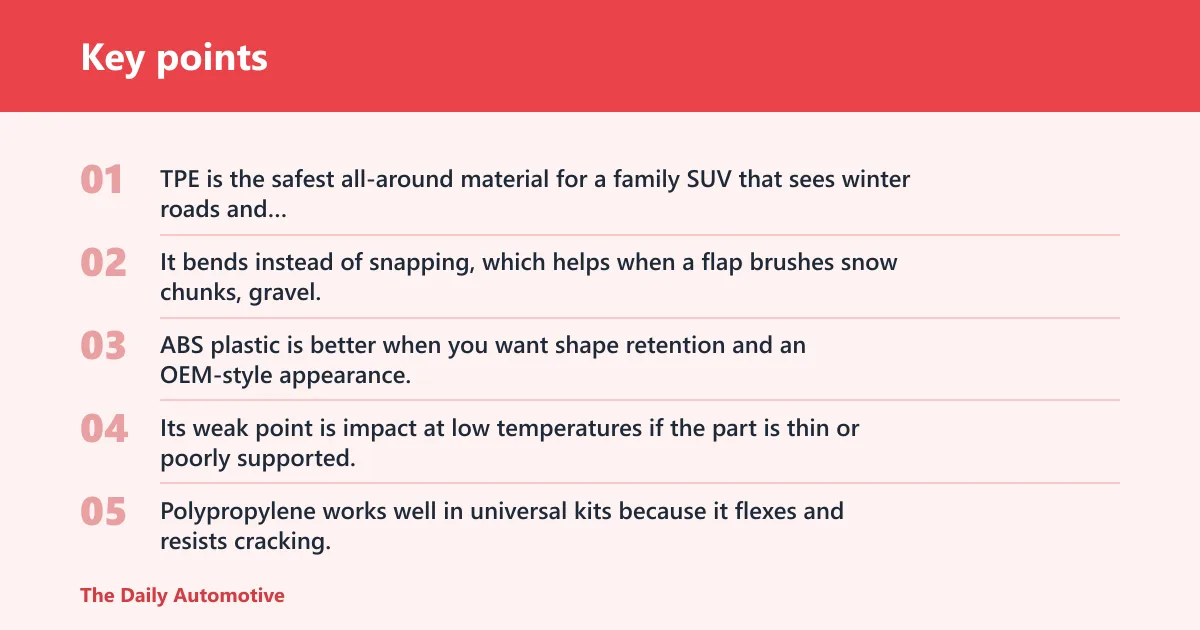
TPE is the safest all-around material for a family SUV that sees winter roads and parking-lot impacts. It bends instead of snapping, which helps when a flap brushes snow chunks, gravel, or a curb edge.
ABS plastic is better when you want shape retention and an OEM-style appearance. Its weak point is impact at low temperatures if the part is thin or poorly supported, so a rigid flap that is too close to the tire can crack sooner than a more flexible one.
Polypropylene works well in universal kits because it flexes and resists cracking. Its failure mode is usually less about the material itself and more about oversized cutouts, poor hole placement, or soft mounting points that loosen over time.
HDPE is a sensible pick for sun exposure and general wear. The trade-off is that a strong, flexible sheet can still creep or distort if the hardware is weak or if the flap is large and unsupported.
Say your SUV runs 275-wide tires and a mild lift, and the flap sits only half an inch from the tread at full lock. That setup may look fine in the driveway, then start polishing the flap edge on left turns and reverse maneuvers.
Coverage and clearance
Coverage should be judged in relation to wheel size, tire width, lift height, and running boards. A stock commuter SUV can usually use moderate coverage, while a lifted SUV with wider tires often needs a longer and slightly wider flap to keep spray off the rocker panel and rear quarter.
Front flaps are often the most important for steering clearance. Rear flaps matter most for road spray. If you want one number to keep in mind, many owners aim for about 1 to 2 inches of flap coverage past the outside edge of the tire tread, but that only works if the flap still clears the wheel at full lock and under compression.
Do not skip the clearance check. Turn the steering to full lock in both directions, compress the suspension if possible, and check reverse articulation if the SUV has soft rear suspension or towing load. A flap that clears in a straight line can still rub when the wheel swings inward or the body settles under load.
Picture a stock crossover with 235-width tires and plastic running boards. A medium-width flap can work well, but if the flap hangs too low it may slap the running board bracket or catch snow buildup in winter.
Installation hardware and mounting points
Hardware is part of the fitment story, not a separate detail. Screws, clips, and brackets need to match the body panel or liner thickness, and factory mounting points are the cleanest option when they exist.
Custom-fit mud guards use vehicle-specific mounting points to reduce drilling and keep alignment consistent. Universal mud flap kits usually include hardware, but they often require more measuring and more checking before the first hole is made.
For a drill-required kit, confirm panel thickness, liner position, and whether the fastener will bite into a reinforced area. Loose hardware is a common failure point because vibration works on the outer edge of the flap first, then the mount, then the fastener.
A-Premium universal mud flaps require drilling. That is not automatically bad, but it does make the install more permanent and increases the need to verify clearance before you commit to the holes.
Safety and failure modes by use case
The most common failure mode on a commuter SUV is loosened hardware. The most common failure on a lifted SUV is tire rub. The most common failure in heavy winter use is cracking at the lower edge or mount tearing after packed snow and slush add weight.
UV chalking is a real issue on dark flaps that sit in strong sun. It shows up as fading, surface whitening, or a dry look that comes before brittleness. That matters more for HDPE and some flexible plastics used on daily-driven SUVs that stay outdoors.
SUV mud flaps decision table
| Buyer scenario | Best fit type | Install style | Expected coverage | Clearance risk | Most common failure point |
|---|---|---|---|---|---|
| Commuter SUV | Custom-fit | No-drill if factory points exist | Moderate front and rear coverage, enough to stop direct spray off the tread | Low if stock tire size is kept | Loose hardware after repeated wash and vibration |
| Winter-salt SUV | Custom-fit or high-quality universal | Drill allowed if the mount is reinforced | Maximum splash control, especially behind the front tires | Medium, because slush buildup can change clearance | Mount tearing or corrosion at fasteners |
| Lifted SUV | Universal or extended custom-fit | Usually drill-required | Extra-long flap with wider rear coverage | High at full lock and during suspension compression | Tire rub, edge wear, or torn brackets |
| Soft-roader SUV | Flexible material, usually custom-fit if available | No-drill preferred, trim allowed | Moderate coverage with easy removal for trail days | Medium, especially near running boards or side steps | Cracking from repeated flex or poor trim edges |
Choose WeatherTech No Drill if… / Choose Durahalt No Drill if…
Choose WeatherTech No Drill if your SUV is one of the listed Chevrolet Tahoe, Suburban, or Yukon XL applications and you want the least fitment risk with a factory-style install. It is also the better call if you value a premium custom-fit kit over a lower upfront price.
Choose Durahalt No Drill if you drive a 4Runner in the listed model years and want factory-hole installation with a textured OEM look. It is the better choice when you want a mid-priced, vehicle-specific set and do not want to drill into painted bodywork.
Which one should you buy?
Choose a custom-fit set if your SUV has factory mounting points and you want the least fitment risk. That is the safest path for stock tires, stock ride height, and daily driving.
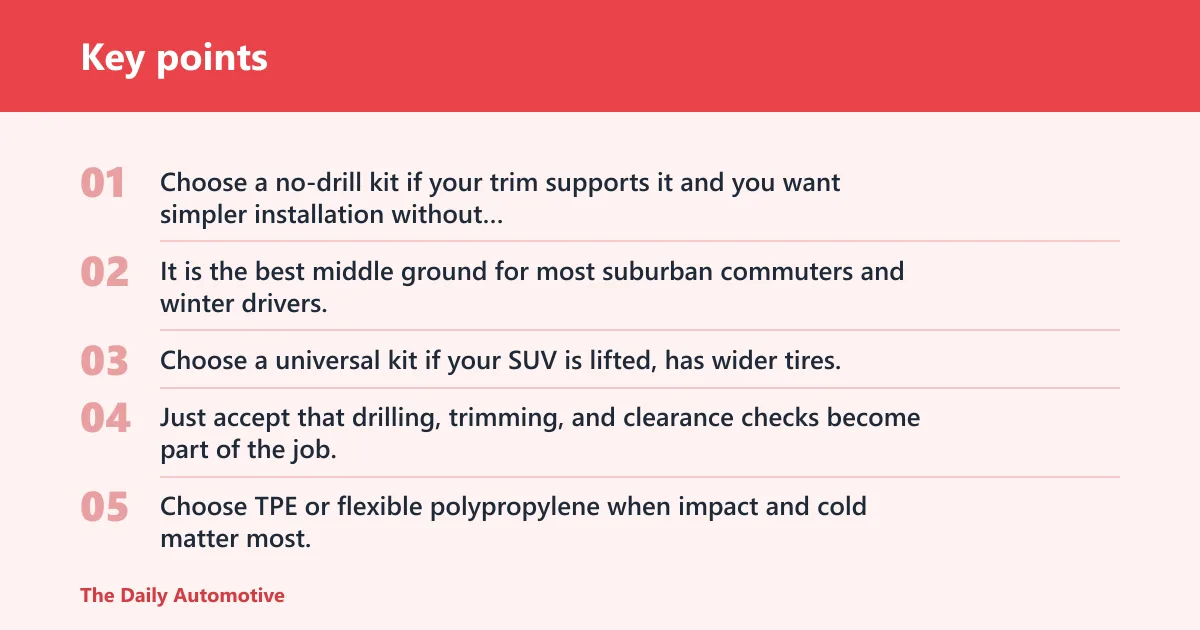
Choose a no-drill kit if your trim supports it and you want simpler installation without giving up a vehicle-specific layout. It is the best middle ground for most suburban commuters and winter drivers.
Choose a universal kit if your SUV is lifted, has wider tires, or needs more coverage than a stock-pattern part can offer. Just accept that drilling, trimming, and clearance checks become part of the job.
Choose TPE or flexible polypropylene when impact and cold matter most. Choose ABS when you want a more rigid OEM-style shape. Choose HDPE when UV exposure and wear are high and the hardware is strong enough to keep the flap from creeping.
Falcon Car Parts says used mud flaps can cost between $25 and $75 per flap, and it notes that OEM mud flaps usually bolt into existing factory holes with direct VIN matching for fitment. That is a useful reminder that a precise fit often matters more than the cheapest listing.
Husky Liners MudDog is available with a lifetime warranty, and Husky Liners mud guards are built for 2017-2025 Ford F-250/F-350 applications. Those facts do not make them the answer for every SUV, but they do show how tightly some brands tie coverage to vehicle-specific fitment.
Other useful benchmarks help with size judgment. SPARCO universal mudguards measure 28×47 cm, XUKEY mud flaps are listed at approximately 11-5/8" x 15" with a thickness around 0.118 inches, and a car mud flap set uses a 12 × 8.5-inch size. Those numbers are only useful if they still leave room for steering lock and suspension travel.
Maintenance and inspection
Re-check hardware after the first week, then after the first long highway trip or winter storm. If the flap shifts, tighten the fasteners before the hole elongates.
Trim only when clearance is close and only in small steps. Cut too much and the flap loses the coverage that keeps slush off the rocker panel.
Replace a flap when the lower edge is cracked, the mount hole has torn, or the material has gone brittle from UV exposure. If you see a flap rubbing at full lock, treat that as a fitment problem, not a minor noise.
Frequently asked questions
What are the best mud flaps for SUVs?
The best mud flaps for SUVs are usually vehicle-specific sets that use factory mounting points and clear the tires at full lock. That combination gives better retention, more predictable coverage, and less risk of rubbing than a universal kit that only fits after trimming or drilling.
Do universal mud flaps fit my SUV?
Universal mud flaps can fit many SUVs, but only after you check wheel opening shape, tire width, lift height, and running-board clearance. If the flap is too wide, too long, or mounted too close to the tread, it can rub, tear, or block steering movement.
Are no-drill mud flaps worth it for an SUV?
No-drill mud flaps are worth it when your SUV has the right factory points and you want a cleaner install with less risk of drilling errors. They are less useful on lifted or heavily modified SUVs, where extra clearance and custom placement may matter more than easy installation.
What material is best for mud flaps: rubber, TPE, ABS, or PP?
TPE is usually the best all-around choice for impact resistance and cold-weather flex. ABS is better when you want a rigid, contoured fit. Polypropylene is a good flexible choice for universal kits. HDPE can handle UV and wear well, but the mounting has to be solid.
How wide should SUV mud flaps be to stop road spray?
A practical target is about 1 to 2 inches of coverage past the tire tread on the tire-side edge, but width alone does not solve spray if the flap sits too high or too far from the wheel. Check coverage against steering lock and suspension compression, not just the tape measure.
Will mud flaps rub on tires or suspension at full lock?
They can, especially on SUVs with wider tires, a lift, or aftermarket wheels with less clearance. Turn to full lock in both directions, check reverse articulation, and inspect suspension compression if possible. If contact is close in any of those positions, the flap needs trimming or repositioning.
Do mud flaps protect against rock chips and road salt?
Yes, but only within the limits of flap size and placement. They help block spray, rocks, and salt that would otherwise strike paint and underbody parts, yet they do not stop every chip from larger debris thrown high by aggressive tires or by vehicles ahead of you.
How do I choose between custom-fit and universal mud flaps?
Choose custom-fit when your SUV has a listed application and you want predictable clearance with less installation work. Choose universal when your SUV is modified, lifted, or outside the catalog, and you are willing to measure carefully, drill if needed, and trim for fit.
Products related to this article
Sponsored / affiliate links. As an Amazon Associate I earn from qualifying purchases. I may earn additional commission from eligible campaigns.