Optima RedTop Review: Is It Worth It for Your Vehicle?
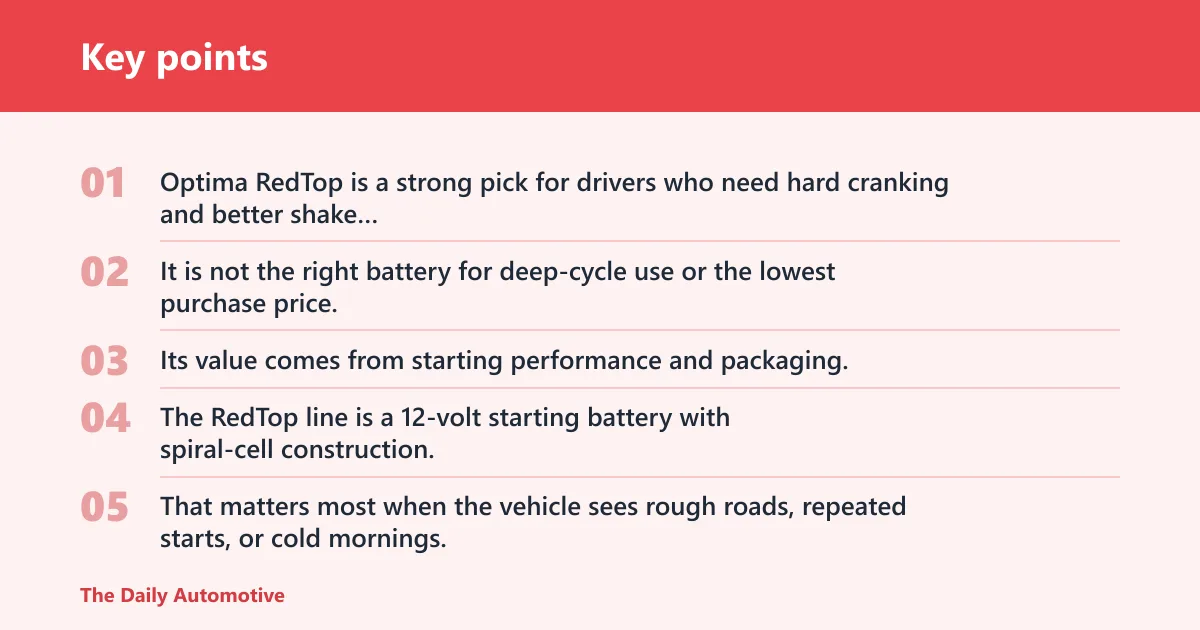
Optima RedTop is a strong pick for drivers who need hard cranking and better shake resistance. It is not the right battery for deep-cycle use or the lowest purchase price. Its value comes from starting performance and packaging, not from being a universal upgrade.
This guide is part of our Car battery basics: troubleshooting, charging and care series.
The RedTop line is a 12-volt starting battery with spiral-cell construction. That matters most when the vehicle sees rough roads, repeated starts, or cold mornings, because the design focuses on cranking output and resistance to vibration rather than long accessory run time.
Optima RedTop verdict

For buyers cross-shopping a standard AGM, the RedTop makes sense when starting demand is the priority and fitment matches the vehicle closely. It is a weaker buy for audio systems, stop-start cars, or any setup that needs deep discharge capability.
Best use cases
Choose RedTop for daily drivers that need dependable starts, older vehicles that see rough pavement, off-road trucks, and vehicles where vibration is a concern. It also makes sense when the factory battery tray and terminal layout already match one of the RedTop size variants.
Main reasons to skip it
Skip it if you need reserve capacity for accessories, if your vehicle uses stop-start technology, or if you are chasing the lowest possible battery cost. A standard AGM or another Optima line is usually the better fit when the battery has to do more than start the engine.
Pros and cons
Pros
- Strong starting output for a 12-volt battery.
- Spiral-cell construction is aimed at vibration resistance.
- Useful for rough-road and off-road service.
- Available in multiple fitment variants, including Red Top 34, Red Top 35, R-3.7, and R-4.2.
Cons
- Not a deep-cycle battery.
- Not the best choice for heavy audio or stop-start systems.
- Costs more than many standard replacement batteries.
- Fitment still needs a close check; CCA alone does not decide compatibility.
Who is it for?
RedTop suits drivers who want a starter battery with strong cranking output, better resistance to shake, and a 12-volt format that fits a known tray size. It is less suitable for drivers who want the cheapest replacement battery, or for vehicles that depend on long accessory runtime when the engine is off.
Suppose a pickup spends its time on broken back roads and cold starts matter more than sitting with the radio on. RedTop can be a smart fit there, provided the size, terminals, and charging system match.
A common mistake is choosing an Optima RedTop just because it looks premium without checking whether your vehicle’s starting power and tray size actually match. A battery can have good cranking output and still be wrong if the group size, length, terminal orientation, or hold-down pattern does not match the vehicle.
Daily drivers
For a normal commuter car, RedTop is a good daily-driving battery if the vehicle needs a strong starter battery and the alternator keeps it charged properly. If the car does not face rough roads or cold-weather starts, a standard AGM may offer similar day-to-day value for less money.
Off-road and rough-road vehicles
This is where RedTop has a clearer case. Optima’s vibration resistance claim is up to fifteen times more resistant, which is relevant for vehicles that live on washboard roads, trail use, or repeated chassis shake. That does not make it invincible, but it does point to a real use case.
Drivers who should look elsewhere
Look elsewhere if your vehicle is built around stop-start operation, large audio loads, or extended accessory use with the engine off. Those jobs need different battery behavior, especially when reserve capacity matters more than short bursts of starting current.
RedTop battery fitment table
How to read the table
This decision table ties vehicle type to likely starting demand and fitment risk. It does not replace a direct check of tray dimensions, terminal position, and hold-down style. Use it to narrow the choice, then confirm the exact variant before buying.
| Vehicle type | Required CCA range | Expected fitment risk | RedTop buy call |
|---|---|---|---|
| Small gasoline commuter car | 400-600 CCA | Low if the tray matches a Red Top 34 or 35 | Maybe |
| Midsize car with cold-weather starts | 550-700 CCA | Medium if space is tight | Yes, if the group size matches |
| Pickup or SUV used on rough roads | 650-800 CCA | Medium, depending on hold-down and case height | Yes |
| Diesel or high-compression vehicle | 700 CCA and up | High unless the exact spec matches factory need | Maybe |
| Audio-focused build or accessory-heavy rig | Varies, but reserve capacity matters more | Medium to high | No |
| Stop-start daily driver | Vehicle-specific | High | No |
Vehicle type and CCA range
Cold cranking amps, or CCA, is the key starting-performance number for cold weather. Compare the battery’s rating against the vehicle maker’s requirement, not against a random larger number. A battery with more CCA can help with winter starts, but only if the case size and fitment are correct.
One competitor review lists the Red Top 34 at 800 cold cranking amps. That gives you a sense of why this line is often cross-shopped for starting power, but the right choice still depends on the vehicle’s own spec sheet.
Fitment risk and buy call
Fitment risk rises when the battery case is close to the tray limit, when the terminal layout is unique, or when the hold-down hardware is exacting. RedTop is a yes only when the vehicle size, CCA need, and mounting setup line up. Otherwise, the correct answer is maybe or no.
What the specs mean
CCA and cold weather starting
CCA is the number to watch if your vehicle struggles in winter. It tells you how much starting current the battery can supply in cold conditions, which matters when oil thickens and the starter has to work harder. RedTop’s appeal is that it prioritizes that task.
The R-3.7 lists 730A starting current, while the R-4.2 lists 815A starting current. Those are strong figures for starter use, but they are not a stand-in for fitment. A battery can have the right output and still be the wrong physical size.
Reserve capacity and accessory run time
Reserve capacity is how long accessories can run without charging before the battery is depleted. Competitor copy commonly cites 100 minutes, which is useful to know, but reserve capacity does not make RedTop a deep-cycle battery. It simply tells you how much buffer exists if charging is interrupted.
If your vehicle idles with loads on for long periods, or if you often run lights, inverters, or audio gear with the engine off, reserve capacity becomes more important than peak starting output. In that case, RedTop is usually not the best family of battery to choose.
R-3.7 and R-4.2 size details
The Optima Red Top R-3.7 is a 12V battery with about 44Ah capacity, about 730A starting current, and dimensions of 237 x 162 x 191 mm. The Optima Red Top R-4.2 is a 12V battery with about 50Ah capacity, about 815A starting current, and dimensions of 254 x 175 x 200 mm.
Those numbers matter because tray length, width, and height determine whether the battery will physically fit, not just whether it will start the engine. The R-4.2 is the larger unit and generally suits vehicles that can accept the bigger footprint.
Spiral-cell construction and vibration resistance
Optima’s spiral-cell construction is part of the reason RedTop is known for vibration resistance. The cells are arranged to handle shake better than many conventional designs, which matters when the battery lives in a truck, SUV, or trail vehicle that sees repeated impact and chassis flex.
The case design also helps the battery package its starting power into a relatively compact form. That is useful when the battery bay is tight, but it does not change the basic rule: match the vehicle’s electrical needs before paying for the feature set.
How long does it last?
How long Optima RedTop batteries last depends more on the vehicle and charging system than on the brand label. In normal ownership, a well-matched battery can give several years of service, but heat, undercharging, overcharging, vibration, and long storage periods can cut that down sharply.
Typical ownership expectations
For many drivers, the real-world target is a battery that lasts through multiple seasons without slow cranking or repeated low-voltage events. That outcome is most likely when the alternator is healthy, the vehicle is driven often enough to recharge fully, and the battery is kept at the correct voltage range.
What shortens battery life
Short trips are a common killer because the alternator does not have enough time to replace the energy used for starting. Heat also ages batteries faster than most drivers expect. Repeated deep discharge, corroded terminals, and a weak charging system can turn a good battery into a short-lived one.
Picture a sedan that sits for ten days, then makes only a 12-minute trip to work. That use pattern can leave a starting battery undercharged week after week, which is exactly the sort of habit that shortens life even when the battery itself is decent.
Charging and maintainer tips
Before buying, check whether your alternator is healthy and whether the vehicle’s charging voltage matches the battery type. A maintainer is useful for long storage periods, especially if the car sits for weeks at a time. That matters more with any starter battery than many buyers realize.
- Confirm the factory group size and terminal layout.
- Check the vehicle’s required CCA.
- Inspect alternator output and charging voltage.
- Use a maintainer if the vehicle sits for long periods.
- Choose the RedTop only if starting performance is the main job.
Is Optima RedTop worth the price?
Optima RedTop can be worth the price if you need its starting strength, vibration resistance, and fitment options. It is less compelling if you only need a normal replacement battery, because a standard AGM may cover the same daily duty for less money. One listing prices the R-3.7 at 4,500 Kč, and another prices the R-4.2 at 5,010 Kč.
Premium price versus standard AGM
The value question is simple: are you paying for performance you will actually use? If your vehicle spends time on rough roads, sees winter starts, or needs a compact high-output starter battery, RedTop has a real case. If not, the price premium is harder to justify.
When the upgrade makes sense
Upgrade to RedTop when the vehicle needs strong cranking, you want vibration resistance, and the battery tray matches one of the fitments. That includes some smaller cars, many trucks, and rough-road rigs that do not need deep-cycle behavior.
When a cheaper battery is smarter
A cheaper battery is smarter when the vehicle is a basic commuter, when reserve capacity matters more than start-up burst, or when the battery is going into a stop-start setup. In those cases, the extra money may buy features you will not use.
Frequently asked questions
How long do Optima RedTop batteries last?
Life span depends on heat, charging health, driving pattern, and storage habits. A good RedTop can last several years in normal use, but short trips, repeated deep discharge, and a weak alternator can shorten that to far less. Maintenance and correct fitment matter as much as the battery itself.
Is Optima RedTop good for daily driving?
Yes, if the vehicle needs a strong starter battery and the size matches correctly. It is a sensible daily driver battery for cold starts and rough-road use. It is less convincing for vehicles that need deep-cycle behavior, long accessory runtime, or stop-start operation.
What vehicles fit an Optima RedTop 35 or 34?
Those group sizes generally suit cars and light trucks that were designed for that footprint and terminal arrangement. The right fit depends on the tray length, width, height, and hold-down setup. Check the vehicle’s factory battery dimensions before choosing the 34 or 35 by name alone.
What is the CCA of an Optima RedTop battery?
CCA varies by variant, so compare the exact model rather than the line name. One competitor review claims the Red Top 34 has 800 cold cranking amps, while the R-3.7 and R-4.2 listings provided here specify starting current instead. Match the rating to the vehicle’s requirement.
How much does an Optima RedTop cost?
Those figures are useful as a buying reference, but local pricing can change with retailer, stock, and fitment version. The better question is whether the battery’s features match your use.
Which Optima RedTop size should I buy?
Buy the size that matches the vehicle’s tray, terminal layout, and starting requirement.
Products related to this article
Sponsored / affiliate links. As an Amazon Associate I earn from qualifying purchases. I may earn additional commission from eligible campaigns.