Best USB-C Car Adapters for Fast Charging (2026): We Compared
For most drivers, a 30W to 45W USB-C car adapter is often enough for fast phone charging; a common rule of thumb is 60W or more with two ports for commuters, and 100W-plus with three or four ports for families and tablet top-ups. Undersized chargers waste time, run hot, and force devices to fall back to slower charging rates. This guide compares three picks by wattage, port mix, and power split so you can match the right charger to a solo commute, a two-device setup, or road trip use.
Quick comparison
| Product | Badge | Best for | Price | ||
|---|---|---|---|---|---|
 |
Belkin BoostCharge 42W Dual Port Fast Car Charger, USB-C &Belkin | Our pick | 42W · Dual Port · Car Charger | $19.99
Price as of 19 Oct 2026
|
View |
 |
UGREEN 130W USB C Car Charger with Cable, Type C CigaretteUGREEN | Upgrade pick | 130W · 3-Port · Car Charger | $22.47
Price as of 19 Oct 2026
|
View |
This comparison focuses on how the charger behaves when more than one port is active, because that is where charging speed changes. It also separates phone charging, Android PPS support, and laptop emergency top-ups so you can match the adapter to the cabin, not just the label.
How we chose
We compared the three products on total wattage, port layout, fast-charging support, and the likely effect of power sharing when two or more devices are plugged in. Also check whether each adapter fits common 12V-24V vehicle use, and whether it makes sense for iPhone, Samsung PPS, mixed USB-A gear, tablets, or laptop top-ups.
Form factor mattered too. A charger can be strong on paper and still be awkward if it sticks too far from the socket, crowds the console, or adds cable clutter in a tight dashboard.
UGREEN 130W car charger: best for family trips
The UGREEN 130W USB C car charger is the strongest pick here for multi-device cabins. Based on the published product details, it gives you 2 USB-C ports and 1 USB-A port, plus a 100W USB-C cable in the box, which makes it the most flexible choice when the front seat, rear seat, and a tablet all want power at once.
It stands out because the total wattage leaves more headroom for split loads than a 40W or 42W charger. That matters when one passenger is charging a phone while another is topping up a tablet, or when you want a better chance of keeping a laptop from draining in traffic.
The drawback is size and cost of headroom. A 130W rating does not mean every port gets that much at the same time, and most drivers with a single phone or two phones will not use the extra capacity. It is also overkill if your cabin is simple and your only need is quick phone charging.
Belkin BoostCharge 42W car charger: best for solo drivers
The Belkin BoostCharge 42W dual-port car charger fits the solo commuter who mainly wants fast phone charging without a bulky adapter. Its published spec is straightforward: 30W USB-C PD plus 12W USB-A, so it is easy to see where the power goes when you connect one modern phone and one older accessory.
This is the clearest pick for a single-device routine. A modern iPhone on the USB-C port gets the fast-charging standard it expects, while the USB-A side covers older cables, a passenger phone, or a legacy accessory that still depends on QC-style compatibility.
The drawback is the ceiling. Forty-two watts is enough for one strong phone charge and modest second-device support, but it is not the right call for a cabin with two power-hungry devices or a tablet that needs more than a light top-up. It is also less useful if your device mix is mostly USB-C.
How many watts do you need in a USB-C car charger?
For a phone-first cabin, 30W to 45W is enough to cover fast charging on a single port. Move to 60W or more if you want better two-device behavior, and choose 90W or higher when you expect two active USB-C ports, a tablet, or a laptop emergency top-up. Total wattage is capacity, not a promise that every port gets the full number at once.
What 67W can do in practice
A 67W car charger is the practical middle ground for many drivers. It is usually enough for one phone at fast speed and another device at a slower rate, and it often makes sense in multiport layouts where you want both USB-C and USB-A compatibility. That class also fits the common use case of a phone plus tablet without forcing the charger to operate at the edge of its output.
The KENHAO example in the supplied facts is a 67W three-port fast car charger with 12V-24V vehicle support. It claims PD 37W Max on USB-C and QC 30W Max on USB-A, which is a useful split on paper because it separates the main phone port from the legacy port instead of making both share one generic output.
When 90W is the better call
Choose 90W when two devices are active at once and neither one should be starved. A 90W car charger gives more headroom for dual USB-C use, tablet charging, and stronger laptop top-ups, especially when the charger has three or four ports and the load is divided across them.
That said, 90W only matters if the port map is usable. If the charger spreads power across four ports, a single connected device may get a decent share, but two or three connected devices will force a tradeoff. The total number looks large, yet the actual speed each device sees can be much lower.
Why advertised wattage is only part of the story
Wattage must be read with the port split. A charger can say 90W total and still deliver less to each phone once you use more than one port. The useful question is not “How high is the label?” but “How much power stays available to the port I care about when the cabin is full?”
Say your front-seat phone is on USB-C, your passenger’s phone is on USB-A, and a tablet is in the back. A 67W unit may still charge all three, but each device will likely slow down compared with single-device use. That is normal. It is also why families should look beyond the headline wattage.
KENHAO 67W car charger: best for solo commuting
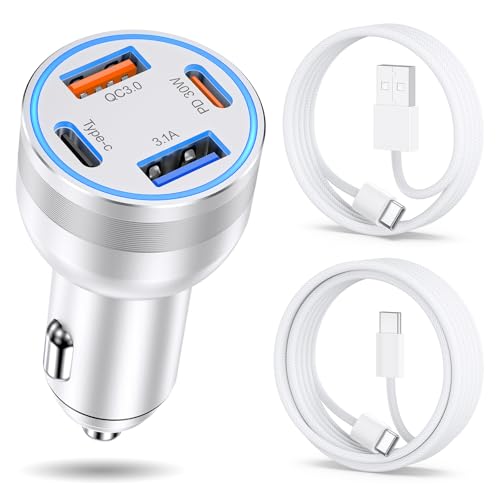
The KENHAO 67W three-port charger fits drivers who want a sensible blend of speed and compatibility. Based on the supplied details, it supports 12V-24V vehicles, includes two USB-C ports and one USB-A port, and claims PD 37W Max on USB-C with QC 30W Max on USB-A.
That combination works well for a commuter who charges one primary phone and occasionally adds a second device. It is also the most obviously mixed-format option in this group, which matters if you still carry older USB-A cables for accessories or backup devices.
The drawback is the split. Once more than one port is in use, the charger cannot give every device its top number at the same time. The claimed 0% to 60% in 35 minutes for most Android devices is a useful headline, but it should not be read as a guaranteed result for every device, every cable, and every two-port scenario.
JUNVANG 90W car charger: best for two-device cabins
The JUNVANG 90W four-port charger is the clearest pick for a cabin with more than one active device. Its published spec reaches up to 90W across four ports, which gives you more room to split power between a phone, a second phone, and a tablet without immediately running into a low-output ceiling.
This class makes the most sense for commuters who share the front row, rideshare-style setups, or families where the charger is expected to support multiple cables at once. The extra wattage helps more when the devices are used together, not when one phone is alone on the socket.
The drawback is that four ports invite power sharing. A four-port charger can be flexible, but it can also distribute power in a way that leaves each device below its ideal charging speed. If your cabin rarely uses more than one device, a simpler charger will be easier to manage.
Retractable USB-C charger: best for cable clutter
Retractable USB-C car chargers are worth considering when cable clutter is the real problem, not wattage. They can keep cords from tangling in the console and reduce the number of loose cables near the shifter, but that convenience comes with a bulkier body and more fit variables.
The tradeoff is physical clearance. Check socket depth, dashboard clearance, and the angle of the surrounding trim before you buy. A retractable design can press against a lid, block a nearby button, or sit too high in a tight dash opening. In some cars it is elegant; in others it is simply in the way.
When retractable cables are worth the tradeoff
They make sense in a family cabin, a rental car with frequent device swaps, or a daily driver where the front seat is always full of loose charging cords. If the goal is less clutter and fewer cables hanging from the dash, retractable can be a good fit.
Fit checks for tight dashboards and deep sockets
Look at the accessory socket’s depth before buying. A deep socket can hide part of the charger body and leave the retractable spool accessible, while a shallow or angled socket can make the charger protrude into knee space or interfere with nearby controls. Also check whether the plug shell blocks the lid on a center console outlet.
Who should skip it?
Skip retractable designs if you want the slimmest possible plug, if your car’s 12V socket sits close to a gear selector, or if you prefer separate premium cables instead of an integrated unit. They are convenient, not automatically better.
Charging fit matrix
The matrix below turns wattage and port layout into real cabin use cases. It shows which pick fits each scenario, what port gets priority, and who should look elsewhere.

| Scenario | Belkin 42W dual-port | KENHAO 67W three-port | JUNVANG 90W four-port |
|---|---|---|---|
| iPhone-only commuting | Best fit. USB-C PD gets the main priority; USB-A is optional backup. Speed tradeoff is minimal with one phone. | Good fit. USB-C should take priority, but the extra port count is not needed. Skip if you want the simplest setup. | Works, but oversized for one phone. Skip if you do not need extra ports or laptop headroom. |
| Dual-phone charging | Good for two phones, but 42W total means one device may slow down. USB-C should be the priority port. | Better balance. One USB-C and one USB-A can share the load more naturally. Skip if both phones need top-speed charging. | Best fit among these three for two phones plus buffer. Power split is still a factor, but there is more headroom. |
| Android PPS charging | Works if the phone accepts PD with PPS behavior on the USB-C side, but this model is not the strongest Android-first pick. | Strong fit for mixed Android use if the PPS behavior is supported by the connected device and cable path. Skip if your phone needs the highest sustained Android charging speed. | Good if your phone shares the charger with other devices. Skip if PPS support is your only goal and you do not need the extra ports. |
| Tablet plus phone | Usable for light tablet top-up and one phone, but total power is limited. Skip for frequent tablet use. | Best middle-ground choice. 67W is often enough for a phone plus tablet in a road-trip cabin. | Best if the tablet is large or there are other devices on board. The higher ceiling helps when the load is split. |
| Laptop emergency top-up | Usually too small for meaningful laptop charging. Skip unless the laptop has a very low USB-C watt target. | Possible for light emergency use only. Check the laptop’s required wattage first; many models will charge slowly or not at all. | Best of the three for low-to-mid-demand USB-C laptops, but still only appropriate if the laptop’s watt target fits the charger’s real output under load. |
| Family multi-device use | Skip. Two ports and 42W total are too limited for a full cabin. | Usable for a small family, but power sharing will be visible once several devices are plugged in. | Best fit here. Four ports and 90W total make it the strongest match for road trips. |
What is the best USB-C car adapter for fast charging?
The best USB-C car adapter for fast charging is the one that matches your device count, not the highest watt number on the box. For a single phone, a 30W to 45W USB-C PD charger is usually enough. For two phones, a tablet, or a laptop top-up, 67W to 90W gives you more usable headroom.
A common first-timer mistake is buying a high-watt charger and assuming every port will charge at full speed. Picture a driver with one phone, one tablet, and a passenger phone on a four-port adapter. The charger may still work well, but the speed per device will fall once all ports are active.
What is the difference between PD and QC in car chargers?
USB-C Power Delivery, or PD, is the fast-charging standard most modern iPhones and many USB-C devices expect. Quick Charge, or QC, is an older fast-charging standard that usually appears on USB-A ports and still matters for mixed-device compatibility and older cables.
PPS sits inside the Android conversation as a more precise charging profile. It is especially relevant for Samsung and other PPS-capable phones because it can negotiate voltage and current more granularly than generic fast charging. If Android charging speed matters most, PPS support is worth looking for on the spec sheet.
Do you need USB-C only or USB-C and USB-A in a car charger?
USB-C only is the cleanest choice if every cable in the car is modern and you mainly charge recent phones, tablets, or USB-C laptops. USB-C and USB-A is smarter if you still need legacy cable support, older accessories, or a port dedicated to a passenger device.
The right mix also affects power sharing. A charger with one USB-C and one USB-A port can be easier to manage in a mixed cabin, while a USB-C-only model often makes more sense for newer devices that all support PD.
Can a USB-C car charger charge a laptop?
Sometimes. A USB-C car charger can charge a laptop only if the laptop’s watt target is low enough for the charger’s real output after port sharing. Many ultrabooks want far more than a phone charger can provide, while some smaller notebooks can accept a slow emergency top-up.
Check the laptop’s charger label first. If the laptop expects 45W and the car adapter can truly supply that on the USB-C port with little or no sharing, you may get useful charging. If the laptop expects 65W, 70W, or more, a 40W dual-port unit is not enough.
Which laptops may charge slowly?
Thin-and-light models with modest USB-C power targets are the most plausible candidates. Even then, charging can be slow if another device is active. The car charger may maintain battery level or recover a little charge, but not necessarily refill the battery quickly.
When a car charger is not enough
If the laptop needs a high wattage to charge while in use, or if the vehicle is already powering phones, a tablet, and a dash accessory, a car charger may fall short. In that case, treat it as emergency power, not a daily laptop solution.
Which one should you buy?
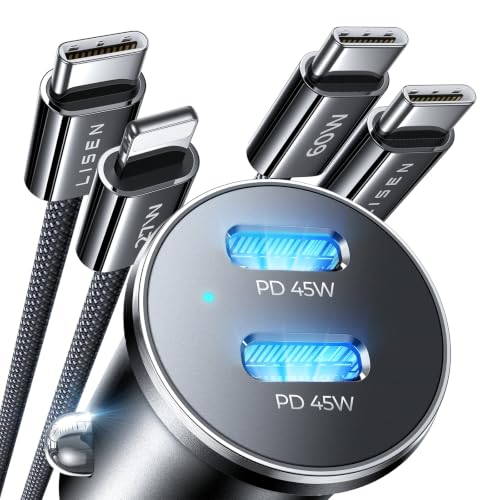
Buy the Belkin 42W if you drive alone, charge one main phone, and want a compact dual-port adapter with a simple power split. Buy the KENHAO 67W if you need a better middle ground for mixed USB-C and USB-A use, especially when a phone and tablet share the cabin. Buy the JUNVANG 90W if you expect two active USB-C devices, a family road trip, or a laptop top-up to be part of the routine.
If budget is the main concern, the 42W class is the easiest place to stop. If device count matters more than price, the 90W class is the safer long-term choice. If your dashboard is tight, skip bulky or retractable designs until you have checked socket depth and clearance.
Best pick by budget
The Belkin is the simplest low-cost choice here at $19.99. It is the least overbuilt for a single-driver cabin and the easiest to understand on paper.
Best pick by device count
The JUNVANG 90W is the strongest match for multi-device use. More ports and more total output make it the better road-trip charger when power is being divided across several devices.
Best pick by cabin layout
The KENHAO 67W is the best fit if you want a three-port layout with both USB-C and USB-A and you do not need the full size of a 90W four-port unit. It is also the clearest middle choice for 12V-24V vehicle support.
Frequently asked questions
What safety features should a USB-C car adapter have?
Look for over-current, over-voltage, over-heating, and short-circuit protection. A metal or fireproof housing is also worth favoring, because the charger sits in a hot, confined space and may run for long periods. Safety features should be listed plainly, not implied by a glossy shell.
Is a 67W car charger enough for an iPhone or Android phone?
Yes, for most single-phone use. A 67W charger is usually more than enough for an iPhone or Android phone, and it leaves extra room for a second device or a tablet. The catch is port sharing: once another device is plugged in, the speed available to each device changes.
Will a car charger work with wired CarPlay or Android Auto?
Yes, but charging and data are separate jobs. Wired CarPlay and Android Auto depend on the vehicle’s data connection and the cable, while the car charger only supplies power from the accessory socket. A good charger does not make a poor data cable better.
Are retractable USB-C car chargers worth it?
They are worth it when cable clutter is the main annoyance and your dashboard has enough space for the charger body. They are less appealing in tight sockets or shallow console layouts. The convenience is real, but so is the risk of a bulky fit.
Products related to this article
Sponsored / affiliate links. As an Amazon Associate I earn from qualifying purchases. I may earn additional commission from eligible campaigns.