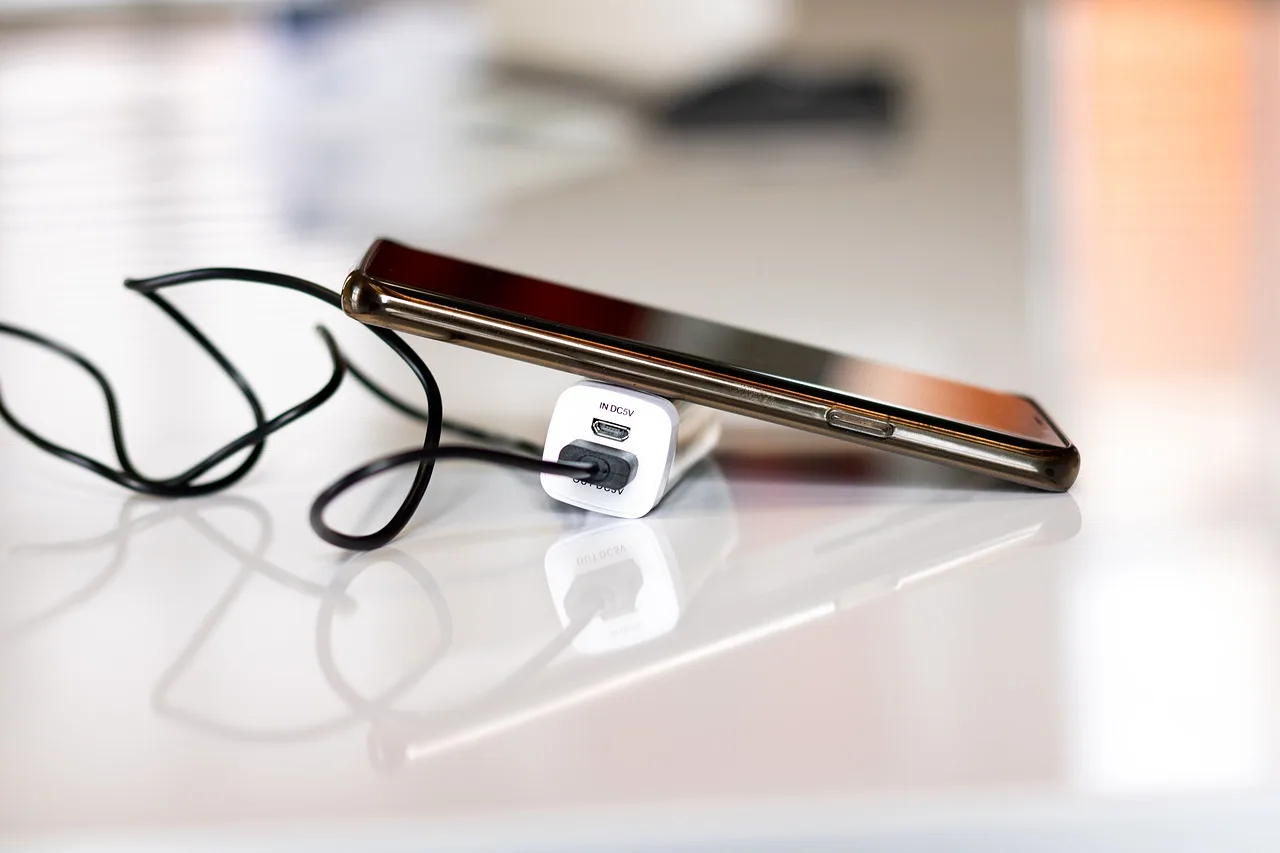
USB Car Charger review: What to Buy for Fast Charging
For most drivers, a 30W USB-C car charger is enough. Choose 45W to 65W only if you need two fast-charge ports or a laptop-friendly outlet. Pick the wrong setup and you pay for wattage you cannot use, slow top-ups, or blocked backseat charging on long trips. This review breaks down the right USB-A and USB-C port mix, wattage, and placement for commuting, family travel, and rideshare use.
Verdict
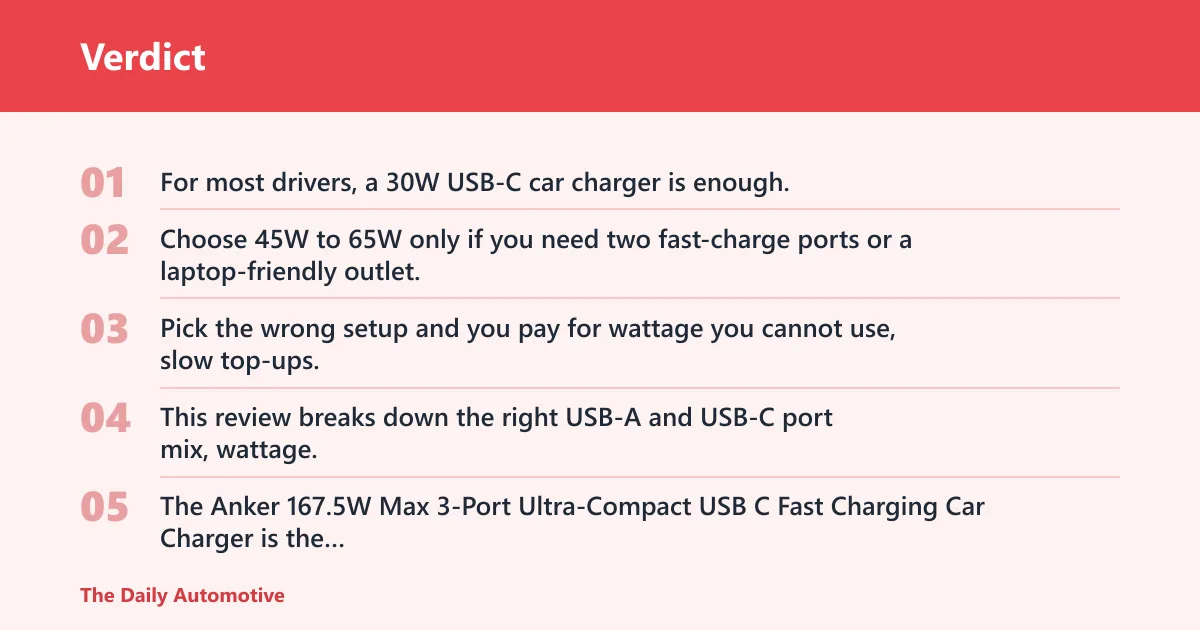

The Anker 167.5W Max 3-Port Ultra-Compact USB C Fast Charging Car Charger is the clearest all-around fit because it combines a high-output first USB-C port, a second USB-C port, and USB-A in a body that stays out of the way. Based on the spec sheet and review coverage, that mix matters more than raw peak wattage for drivers who need one charger to cover phones, tablets, and an occasional laptop top-up.
📊 USB was introduced in 1996. Source: USB.
Specs at a glance
| What matters | Why it matters in a car | What to check |
|---|---|---|
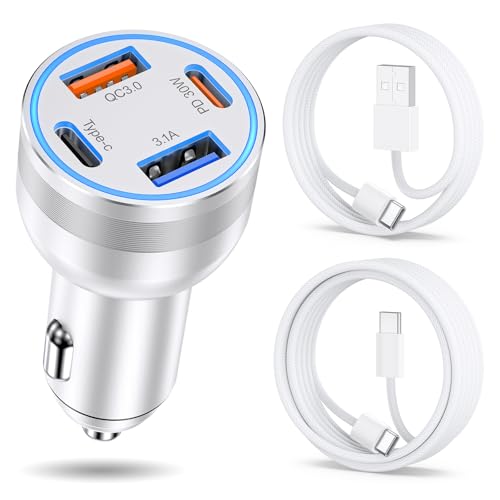
| Connector mix | USB-C covers modern phones and tablets; USB-A keeps older cables usable | At least one USB-C port; keep USB-A if you still carry legacy cables |
| Total output | Shared power decides whether two devices can fast charge at once | 30W for one phone, 45W to 65W for two fast-charge needs, more for mixed use |
| USB-PD support | USB Power Delivery is the main fast-charging standard on USB-C car chargers | Look for USB-PD, not just “USB-C,” if speed matters |
| Socket fit | 12V car sockets vary; bulky bodies can block shifters, storage lids, or adjacent switches | Low-profile plug body and a secure, snug fit |
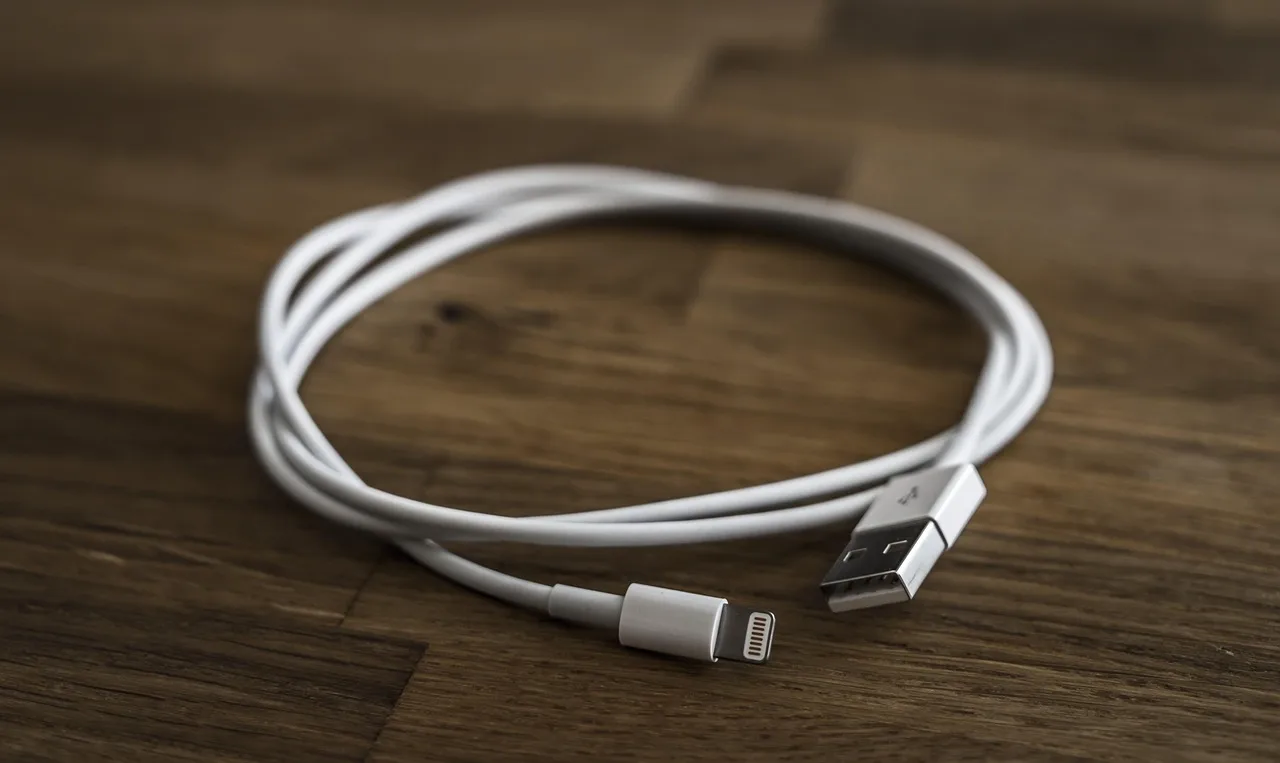
| Cable type | Charging speed depends on the cable as well as the port | USB-C to USB-C for USB-C devices; USB-A still fits older cables |
USB has been around since 1996, but the connector question is still where shoppers get tripped up. USB-C can replace many connectors and deliver up to 240 W, while USB4 supports up to 80 Gbit/s full-duplex. Those numbers matter in general, but a car charger is about power delivery first, data second.
That is why USB 2.0, USB 3.x, and USB4 are usually secondary concerns for car charging. A charger’s port shape does not decide charging speed by itself. USB-PD, cable quality, device support, and the vehicle’s 12V car socket do.
Who is this USB car charger for?
For solo commuting, a compact USB-C charger with one strong port is usually enough. For couples, a two-port layout helps avoid arguments over who gets the faster top-up. For families and rideshare drivers, a multi-port charger matters because one cable standard rarely covers front-seat phones and rear-seat tablets at the same time.
Solo commuting and daily phone top-ups
If you only need to restore a phone after navigation, calls, and streaming drain it, a 30W USB-C charger is often the cleanest buy. A single USB-C port with USB-PD support is more useful than extra ports you never use, especially in small cabins where every inch around the socket matters.
Couples sharing one charger
Two phones can be a better reason to buy a dual-port charger than “future proofing.” A mixed USB-C plus USB-A design works well if one phone is newer and the other still uses an older cable. If both devices are modern, dual USB-C is the simpler long-term choice.
Families, rideshare drivers, and rear-seat devices
Families need output, but they also need distribution. A charger with three or more ports can still disappoint if its power is split too thinly across active ports. Rear-seat tablets make the case for longer cables and a stable socket fit because short leads and loose plugs turn into constant repositioning.
What works well in real use
USB-C fast charging works best when the charger, cable, and device all speak the same language. A supported phone can charge quickly over USB-PD, but only if the port supplies enough wattage and the cable is rated appropriately. That is the difference between “USB-C” and “fast charging.”
Mixed-port layouts are practical in real households. USB-A still matters for older accessories and Micro-USB or USB-B cables, so a dual-format charger can reduce cable clutter. The best layouts keep the fastest port easy to reach while leaving a legacy port available for the one cable you still need on a trip.
Compact bodies also matter more than many product pages admit. A charger can have strong output and still be awkward if it blocks a neighboring control, sits too far out of the socket, or puts strain on a cable that gets bumped every time a passenger shifts a bag or phone.
Quick picks
- Best overall: Anker 167.5W Max 3-Port Ultra-Compact USB C Fast Charging Car Charger, for drivers who want the strongest mix of output and flexibility.
- Best for two-device charging: AINOPE 67.5W Car Charger USB C Fast Charge, for simple dual-port use in a tighter budget.
- Best compact three-port option: Spigen ArcStation Essential 113W USB C Fast Car Charger, for buyers who want multiple ports without a bulky footprint.
What does not work as well
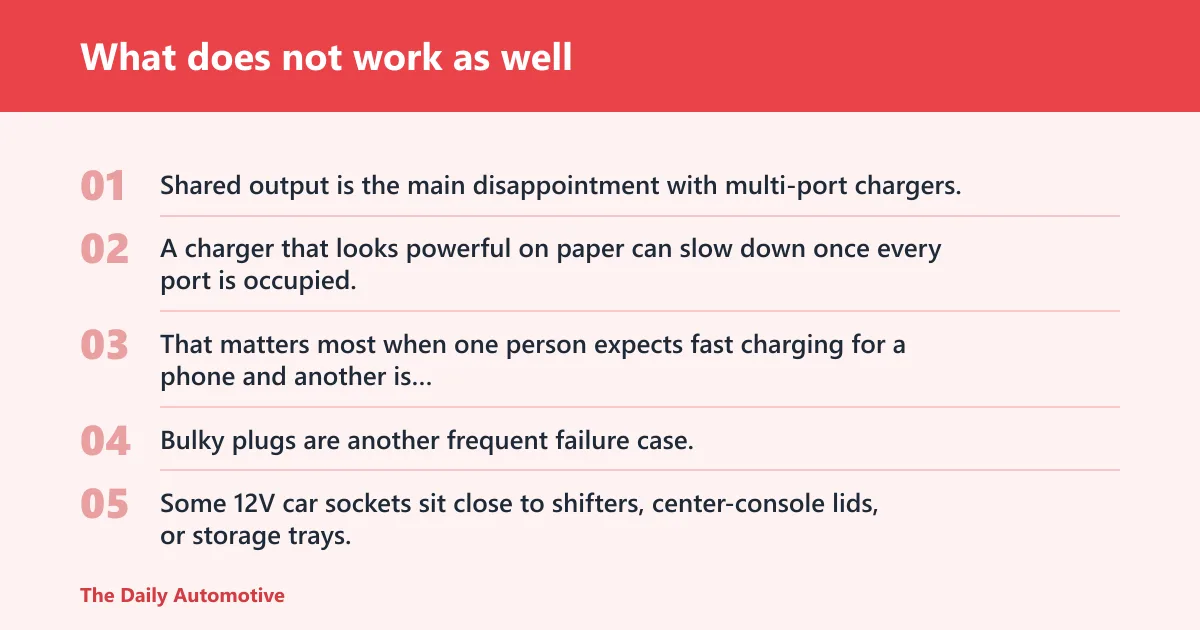
Shared output is the main disappointment with multi-port chargers. A charger that looks powerful on paper can slow down once every port is occupied, because the total wattage gets divided. That matters most when one person expects fast charging for a phone and another is trying to revive a tablet.
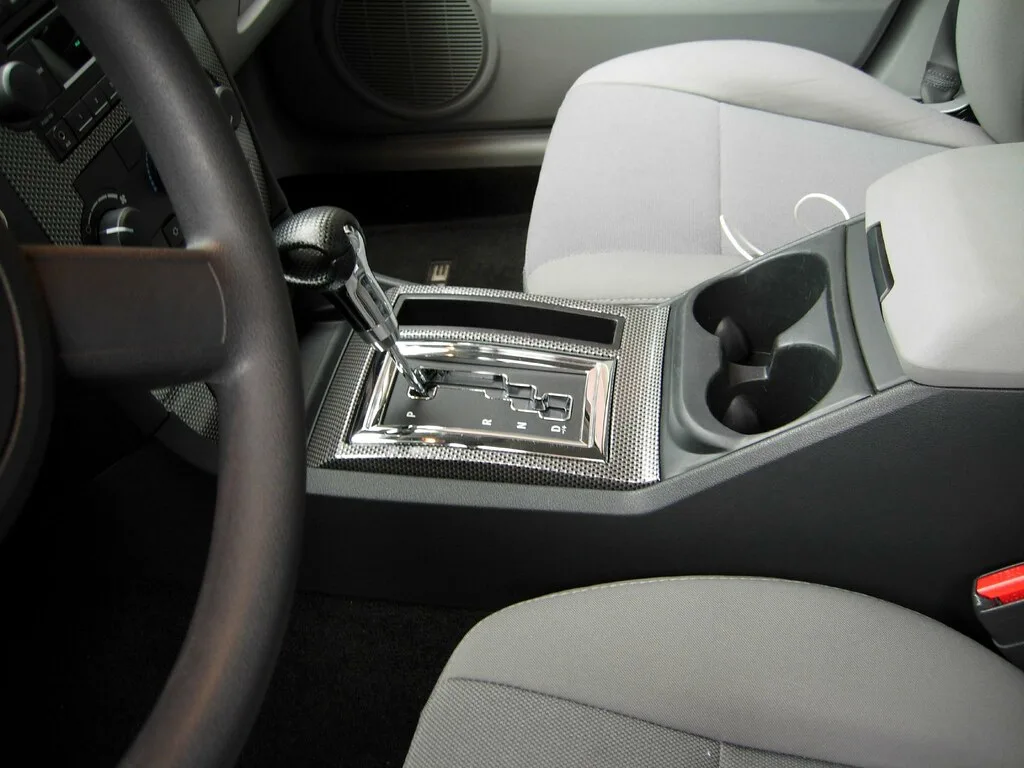
Bulky plugs are another frequent failure case. Some 12V car sockets sit close to shifters, center-console lids, or storage trays, and a large housing can get in the way even if the wattage is excellent. Retractable or long-cord designs also add wear points, especially when a cable gets pulled, twisted, or left under tension.
Loose sockets deserve more attention than they get. In older vehicles, a poor fit can cause the charger to shift, disconnect, or run warmer than expected. That is not a reason to avoid charging accessories altogether, but it is a reason to favor a snug, well-built plug over a giant body with aggressive claims.
What should I look for in a USB car charger?
Start with the charger’s port mix, then check its total wattage, USB-PD support, and fit in your 12V car socket. A good car charger should match your actual devices, not the biggest number on the box. USB-C matters for modern phones and tablets, while USB-A still helps with older cables and mixed households.
If you only need to keep a phone alive, one solid USB-C port is enough. If you have two people sharing power, a dual-port design makes more sense. For families, the useful question is whether the charger can deliver enough wattage across all active ports without turning into a slow trickle once everyone plugs in.
Minimum watts by use case
- One phone, one driver: aim for about 30W on a USB-C port.
- Two phones: 45W to 65W total is a more practical target if you want both devices charging at useful speed.
- Phone plus tablet: look above the basics, and expect sharing to reduce the top speed on at least one port.
- Phone plus laptop top-up: choose a higher-output charger and verify the device actually supports charging from a car USB-C PD port.
USB-C only versus USB-C plus USB-A
USB-C only is the cleaner choice when every cable in the car is modern. USB-C plus USB-A is better for mixed households, older accessories, and passengers whose cables have not caught up yet. The right answer is not universal; it depends on whether the car is serving one device ecosystem or several.
12V socket fit and older vehicle limits
The 12V car socket, often still called the cigarette lighter adapter, is the actual power source. That means fit and load matter. Older vehicles may have weaker or fussier sockets, and a charger that sits loosely can be annoying long before it becomes unsafe. A low-profile body is usually easier to live with than an oversized cube.
Is USB-C better than USB-A in a car charger?
USB-C is better for modern charging because it supports USB-PD, fits reversible plugs, and works with many newer phones, tablets, and some laptops. USB-A is still useful for legacy cables and older accessories, so “better” depends on what you already own and what your passengers actually carry.
For a new purchase, USB-C should usually be the priority. For a mixed household, a charger with both ports can reduce friction. That is especially true in older cars where the charger may live permanently in the 12V socket and serve as the family’s default power stop.
How many watts does a good car charger need?
A good car charger needs enough watts for the device you are actually trying to charge, not just enough to fill the spec sheet. In my experience, around 30W is a sensible floor for one modern phone. If you want two useful charging paths, or somewhat better tablet and laptop support, moving up to roughly 45W or 65W can make sense.
Fast-charging phone profiles are often the deciding factor. Some phones will charge quickly on lower wattage, but the cable and the phone’s own charging rules still matter. If the charger advertises high output and your phone still crawls, the missing link is often cable compatibility or the phone’s supported profile.
How to tell whether a charger will fast charge your phone
Check three things: USB-PD support, the wattage available on the port you will use, and the cable type. A USB-C phone usually wants a USB-C to USB-C cable for the cleanest match. iPhone and Android owners should also confirm that the phone’s charging standard aligns with the charger’s output claims.
Will a USB car charger fast charge my phone?
It can, but only if the charger, cable, and phone all support the same fast-charging profile. USB-C alone is not enough. USB Power Delivery is the key standard to look for, and the port’s wattage has to be high enough for the phone to negotiate a faster charge.
For phones, the practical question is whether you need “fast enough for a commute” or “fast enough for a long road day.” Those are different targets. A modest charger may refill a phone during a short drive, while a higher-output unit matters more once navigation, hot weather, and passenger charging stack up.
Are multi-port car chargers worth it?
Yes, if more than one device needs power often. Multi-port chargers are worth it for families, rideshare drivers, and anyone carrying a phone plus earbuds, tablet, or a second handset. The catch is shared output: more ports can mean less speed per port when every seat is occupied.
That trade-off makes port layout just as important as total wattage. A dual-port USB-C charger is often the best simple answer for couples. A USB-C plus USB-A layout is better when older cables still show up. Triple-port and family units make sense when rear-seat passengers are part of the routine, not the exception.
Scenario table: choose by use case
| Use case | Minimum watts | Best port mix | Cable type | Socket-fit risk | Likely trade-offs |
|---|---|---|---|---|---|
| Solo commuter | 30W | 1 USB-C | USB-C to USB-C | Low if body is compact | Fewest ports; simplest setup |
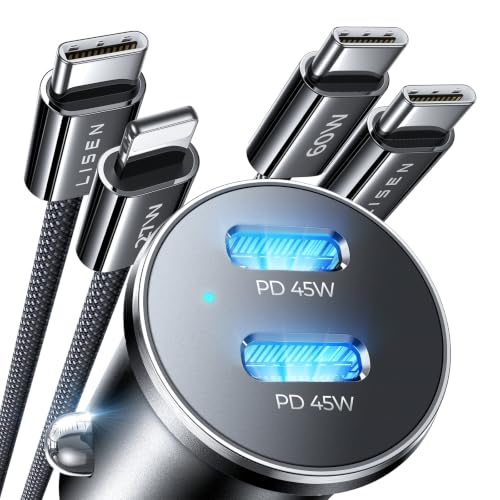
| Couple with two phones | 45W to 65W | 2 USB-C, or USB-C plus USB-A | Two matching phone cables | Medium in tight consoles | Shared output may slow both devices |
| Family road trip with tablets | 65W or higher | 3 ports minimum, preferably mixed | USB-C for tablets; legacy cables if needed | Higher if the body is bulky | Power gets divided across active ports |
| Backseat entertainment and tablet charging | 65W or higher, depending on device count | Multi-port charger plus long rear-seat cables | Long USB-C leads for tablets | Medium; cable routing matters | Long cords wear faster and can tangle |
What is the difference between USB-A and USB-C car chargers?
USB-A is the older rectangular connector, common on legacy chargers and accessories, often paired with USB-B or Micro-USB cables. USB-C is reversible, supports modern charging needs, and is the better fit for current phones, tablets, and some laptops. The difference is usefulness, not just shape.
USB 2.0, USB 3.x, and USB4 add another layer of confusion because shoppers sometimes assume faster data means faster charging. In a car charger, that is usually the wrong shortcut. Data standards matter less than USB-PD support and actual power output.
Do I need a 12V adapter or a USB car charger?
For most drivers, the answer is a USB car charger that plugs into the vehicle’s 12V socket. That is the standard aftermarket setup for phones and tablets. A 12V adapter is the power source interface; the USB charger is the device that converts that vehicle power into usable USB output.
If your car already has built-in USB ports, check whether they are charging ports or data-only connections. Some factory ports are slow. An aftermarket 12V charger can be the better choice when you need stronger output, more ports, or better rear-seat access.
Which USB car charger is safest for long-term use?
The safest long-term choice is a charger from a trusted brand that fits the socket well, stays cool enough under normal use, and matches the output you actually need. Overheating is a real concern with cheap or overstressed chargers, especially when high output, poor fit, and low-quality cables all show up together.
Look for a stable plug body, clear USB-PD support, and a layout that does not force cables into awkward bends. That matters more than chasing the biggest total wattage on the box. A charger that runs comfortably, fits cleanly, and meets your device needs is the one most likely to last.
Alternatives
![AINOPE 67.5W Car Charger USB C Fast Charge, iPhone 18 pro max Charger | [Mini&Metal]Fast USB-C Car Charger for iPhone 18](https://m.media-amazon.com/images/I/41dd7HnGAfL._SL500_.jpg)
The AINOPE 67.5W Car Charger USB C Fast Charge is the value-first choice for drivers who want a compact dual-port setup without paying for maximum output they may never use. Its dual-channel design helps with two-device charging, and the included 3.3 ft nylon USB-C cable is useful if your car’s socket sits awkwardly low. The trade-off is obvious: it is less flexible than higher-output three-port options.
![Spigen ArcStation Essential 113W USB C Fast Car Charger | [E-Marker Cable Included & 3 Ports] Mini Cigarette Lighter Cha](https://m.media-amazon.com/images/I/41aZ0ntQXAL._SL500_.jpg)
The Spigen ArcStation Essential 113W USB C Fast Car Charger fits drivers who want a cleaner three-port layout with a premium look. It is a stronger match than the AINOPE if you regularly juggle more than two devices, and the blue LED can help in dark cabins. The downside is that a brighter charger and a larger body can be more noticeable around tight controls.
Other published picks point to the same buying pattern. WIRED’s top pick is the Anker 167.5W Nano, and WIRED also recommends the Anker 75W Fast Charger for its retractable cord, which includes a 2-foot cable and 45W fast-charging capability on the built-in cord. Redline names the Anker PowerDrive III Duo as its best overall pick, with two USB-C Power Delivery ports, while My Car Planet’s best overall is the BESTEK MRC686C with 125W total output and a family pick with 3 USB-C and 3 USB-A ports.
Should you buy it?
Buy the Anker 167.5W Max 3-Port Ultra-Compact USB C Fast Charging Car Charger if you want one charger that can cover a modern phone, an older cable, and a second device without turning your console into cable clutter. It makes the most sense for mixed households, commuting plus occasional road trips, and drivers who value a compact body as much as output.
If you only need one phone charged, step down to a simpler 30W to 45W USB-C unit. If you regularly serve rear-seat tablets or multiple passengers, step up to a multi-port design and accept that shared output will shape real-world speed more than the headline wattage.
Products related to this article
Sponsored / affiliate links. As an Amazon Associate I earn from qualifying purchases. I may earn additional commission from eligible campaigns.