Electric Floor Jack for Cars: Revolutionize Tire Changes with Ease
Choose a 12V electric floor jack with at least about 2-ton capacity, a low minimum lift height that clears your jack points, and a manual backup; for roadside use, put stability and power-source reliability ahead of peak speed. Pick badly and you can strand yourself with a dead battery, a jack that will not fit under the car, or a lifted vehicle that feels unstable. This guide compares electric jack kits by real use case, failure risk, and the features that matter for tire changes, garage work, and roadside emergencies.
Electric floor jack for cars: top pick


What makes the safest all-around choice
The safest all-around pick is usually a trolley-style electric floor jack kit with controlled lowering, overload protection, and a power source you can count on in the scenario you plan to use. For most drivers, that means a 12V system with direct battery clips or a reliable vehicle-power setup, plus an included manual release.
For mixed use, start with fitment. If your vehicle is a sedan, crossover, or light SUV, a 3-ton kit can be enough when the lift range and minimum saddle height fit the car. If you want broader coverage for SUVs, MPVs, and light trucks, a 5-ton kit is commonly the safer margin.
Who should skip it?
Skip an electric floor jack if you need a tool for very uneven roadside surfaces, if your vehicle sits too low for the saddle height, or if you want the lightest possible trunk kit and do not need integrated tools. In those cases, a different jack style or a dedicated emergency kit may be a better fit.
Quick picks by use case
- Best for sedan owners: a 3-ton trolley-style kit with a low minimum lift height, controlled lowering, and 17/19 mm or multiple sockets.
- Best for SUV and truck owners: a 5-ton kit with a wider lift range and stronger fitment for higher curb weight.
- Best for roadside emergency kits: a 12V model with direct battery clips, warning light, and manual release.
- Best for low-profile cars: the model with the lowest minimum saddle height and the best clearance under the saddle.
Best for sedan owners
A 3-ton electric jack fits many sedans better than a bigger, heavier kit because the weight margin is usually enough and the jack can be easier to store. The key check is not capacity alone. It is whether the saddle starts low enough for the car and lifts high enough to remove the wheel.
Best for SUV and truck owners
A 5-ton kit is the better match when the vehicle is heavier, taller, or closer to the upper end of passenger-vehicle weight. VEVOR lists a 5-ton capacity equal to 11023 lbs, which gives more headroom for SUVs, MPVs, and some light trucks than a 3-ton unit can provide.
Best for roadside emergency kits
For roadside use, the safest choice is the kit with the most dependable power source, clear warning lighting, and controlled lowering. A battery-powered jack can fail at the worst time if the source is weak. A jack that supports both cigarette-lighter power and direct battery clips gives more fallback options.
Best for low-profile cars
Low-profile cars need the lowest possible start height, not the largest capacity label. A minimum saddle height that clears the underbody is the deciding factor. If the saddle cannot get under the pinch weld or approved jack point, the rest of the spec sheet does not matter.
Which electric jack fits your vehicle?
This decision matrix compares the fit, not the marketing label. Start with clearance and power source, then check the included tools and whether the jack style matches how and where you will use it.
| Vehicle type | Minimum clearance | Lift range | Power source | Included tools | Recommended jack style |
|---|---|---|---|---|---|
| Sedan | Low enough to clear factory ride height | About 6.1 to 17.7 inches or similar | 12V cigarette lighter or direct battery clips | Socket heads, LED work light | 3-ton trolley-style electric floor jack |
| Low-profile sedan or sports car | Very low saddle height with extra underbody clearance | About 3.3 to 20 inches if the kit supports it | Direct battery clips or built-in rechargeable battery | Low-profile pads, multiple sockets | Lowest-start-height trolley-style unit |
| SUV | Standard clearance under the saddle | About 5.9 to 17.7 inches or similar | 12V cigarette lighter or battery clips | Impact wrench, warning light | 5-ton trolley-style electric floor jack |
| MPV | Enough saddle clearance for body cladding and pinch welds | Mid-to-high range lift with stable stopping point | Battery clips preferred for reliability | Inflator pump, socket heads | 5-ton kit with roadside tools |
| Pickup truck or light truck | Enough start height for heavier underbody clearance | Higher maximum lift for wheel removal | Battery clips or built-in battery with manual backup | Impact wrench, warning light, inflator | 5-ton trolley-style electric floor jack |
Electric floor jack checklist
Use this short check before you buy or deploy the jack:
- Uneven ground: stop. A jack that is rated correctly can still shift or tilt on sloped, broken, or soft pavement.
- Dead battery: confirm the kit has a fallback power path, such as direct battery clips, or a charged internal battery.
- Lug-nut size mismatch: verify that the kit includes 17/19 mm sleeves, 21/23 mm sleeves, or multiple socket heads that match your vehicle.
What should you buy for sedans, SUVs, and trucks?
For sedans, a 3-ton electric jack is often enough. For SUVs, MPVs, and light trucks, a 5-ton model is the better safety margin. The real question is how the vehicle’s weight, clearance, and jack-point height match the kit’s range and saddle height, not which label sounds larger.
3 ton versus 5 ton capacity
A 3-ton jack is a practical match for many sedans and some crossovers. A 5-ton jack gives more reserve for larger vehicles and heavier trims. MyAuto describes a 3T electric jack with a 3000kg lifting capacity, while VEVOR lists a 5-ton capacity equal to 11023 lbs.
How 6,000 lbs and 11,023 lbs map to vehicle weight
Think of 6,000 lbs as a common upper boundary for many passenger vehicles that are not especially heavy, while 11,023 lbs points to much heavier headroom. The larger rating does not mean every SUV needs it. It means the jack is less likely to be close to its limit on heavier vehicles.
Suppose a sedan owner only needs to lift one corner for a tire swap and the car sits at a normal factory height. A 3-ton kit can be the sensible choice if the saddle starts low enough and the power source is dependable.
Picture an MPV with a full load of passengers earlier in the day and a roadside flat later. A 5-ton unit gives more reserve than a 3-ton unit, which matters when the vehicle is heavier and the owner wants a wider margin around the jack’s rating.
When pickup trucks and light trucks need the larger kit
Pickup trucks and light trucks are the clearest case for the larger kit. Their curb weight, tire size, and jack-point height can push a smaller jack toward its limits. A 5-ton kit is the safer starting point when the vehicle is in that class.
Can a low-profile car use an electric floor jack?
Yes, but only if the minimum saddle height and underbody clearance match. Low-profile cars are the hardest fit because a jack can be rated high enough and still be useless if the saddle is too tall to get under the car. Clearance, not capacity, decides the first move.
Minimum saddle height and underbody clearance
The important number is the jack’s minimum saddle height. If the car’s underbody or approved lift point sits lower than that, the jack will not slide into place. That is why low-profile compatibility must be checked against the vehicle, not just the product title.
Why sports cars and factory-low cars need a lower start height
Sports cars and factory-low cars often leave less room under the front jacking points. A jack with a low start height and enough upward travel can fit where a taller unit cannot. ROADTEK’s lift range is 3 to 20 inches, which is the kind of spread low-clearance buyers should compare closely.
When a trolley-style unit fits better than a scissor-style kit
Power Tools Insider separates trolley-style electric floor jacks from scissor-style cordless car jacks for good reason. A trolley-style unit is usually the better choice when you want a rolling base, a wider working stance, and more garage-friendly handling. A scissor-style kit can be more compact, but fitment and stability vary more.
How do power source and tools change the buy?
Power source affects whether the jack works when you need it most. Tools affect whether the kit is a complete roadside setup or just a lifting device. The best choice depends on whether you want garage convenience, roadside redundancy, or both.
12V cigarette lighter versus direct battery clips
Trihelper says some kits support power from a cigarette lighter or car battery. That flexibility matters. A cigarette-lighter connection is simple, but battery clips can be more dependable for higher draw or when the accessory socket is limited. For roadside use, the fallback path matters as much as the main one.
Built-in rechargeable battery versus 20V lithium battery
A built-in rechargeable battery can be convenient in the trunk, but it adds recharge downtime. ROADTEK’s 3-ton model uses a 20V lithium battery, which points to a cordless format. That can help with portability, but the buyer still needs to confirm charge status before heading out.
Impact wrench, inflator pump, LED light, and warning light
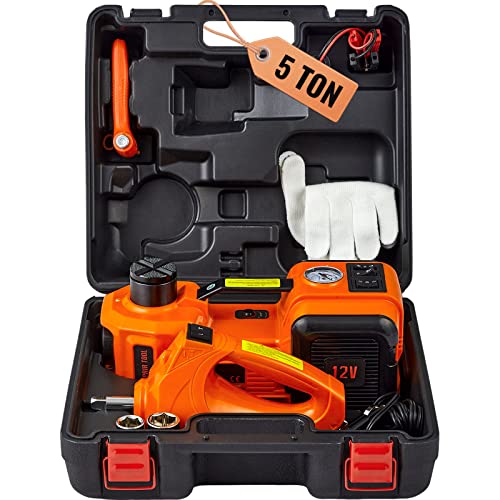
TYAYT’s 5-ton kit includes five functions in one package, and that bundled approach is common for electric jack kits. The usual extras are an electric impact wrench, a tire inflator pump, an LED work light, and a warning light. Those additions matter most if the kit lives in the trunk instead of the garage.
Mechanic Insider says VEVOR’s impact wrench delivers up to 450 N·m. That is the sort of figure that helps with lug removal, but only if the included socket sizes match the vehicle. The wrench is part of the package, not a substitute for proper socket fit.
The right buy is the one that fits the vehicle, the power source, and the failure mode you are trying to avoid. Do not start with capacity alone. Start with saddle height, lift range, and whether the kit can still work if the preferred power source is unavailable.
Safety features to verify before buying
Look for automatic stop at max height, overload protection, a self-locking mechanism, and a manual release or controlled lowering option. Those features do not make the jack safe on bad ground, but they reduce the chance of overtravel or an uncontrolled drop when used correctly.
Lug nut sizes and socket compatibility
Check the included socket heads before you buy. Many kits ship with 17/19 mm sleeves, 21/23 mm sleeves, or multiple socket heads. If the kit does not match your lug size, the lift tool becomes only half the solution.
What to check for roadside use versus garage use
Roadside use calls for redundancy, visibility, and compact storage. Garage use favors stability, a wider lift range, and tool completeness. A home garage buyer can prioritize a stronger kit with more accessories, while a roadside-only driver should put power reliability and manual backup first.
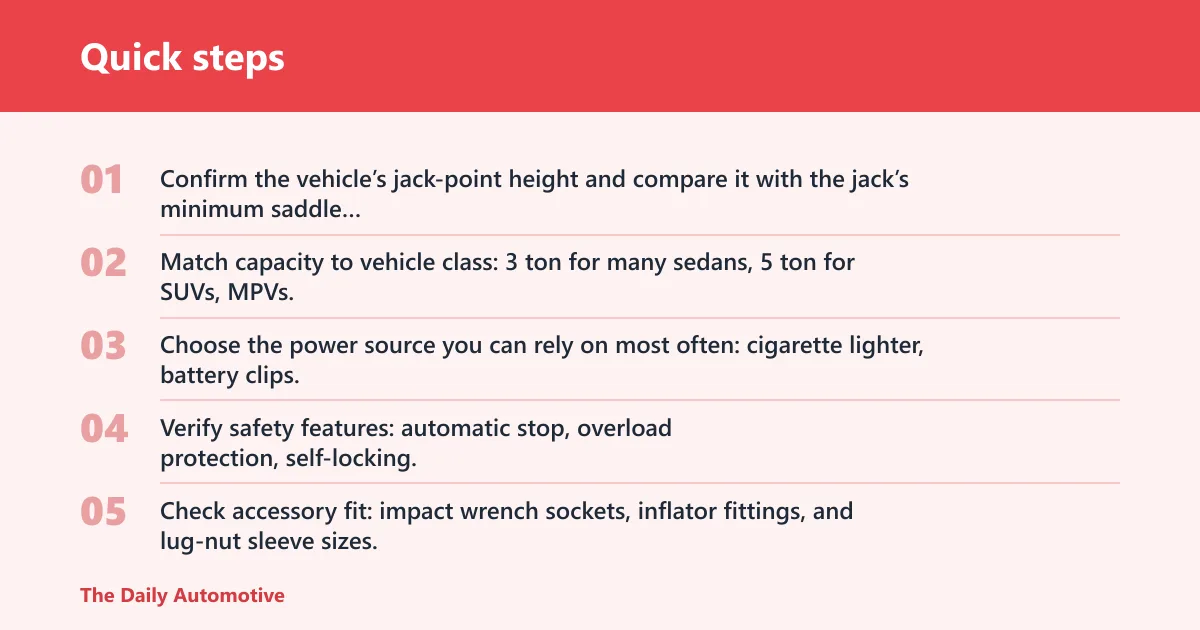
- Confirm the vehicle’s jack-point height and compare it with the jack’s minimum saddle height.
- Match capacity to vehicle class: 3 ton for many sedans, 5 ton for SUVs, MPVs, pickup trucks, and light trucks.
- Choose the power source you can rely on most often: cigarette lighter, battery clips, rechargeable battery, or 20V lithium battery.
- Verify safety features: automatic stop, overload protection, self-locking, and controlled lowering.
- Check accessory fit: impact wrench sockets, inflator fittings, and lug-nut sleeve sizes.
Do not work under a vehicle supported only by a jack. Use jack stands on level ground. Follow the vehicle and product manual. Never exceed the vehicle’s roof, hitch, tow, or payload rating in the owner’s manual.
Frequently asked questions
What is the best electric floor jack for cars?
The best electric floor jack for cars is the one that fits the vehicle’s clearance and lift range before it wins on capacity. For most sedans, a low-start-height 3-ton kit is the practical sweet spot. For SUVs, MPVs, and light trucks, a 5-ton trolley-style unit is the safer match.
How much weight can an electric car jack lift?
Common electric car jacks are rated around 3 ton or 5 ton, which makes the difference between many sedans and heavier vehicles. The same source lists a 5-ton capacity equal to 11023 lbs. A 3-ton rating is often enough for many passenger cars, but not every SUV or truck.
Do electric floor jacks work for SUVs and trucks?
Yes, but only if the capacity and lift range fit the vehicle. SUVs, MPVs, pickup trucks, and light trucks usually need the larger kit because of weight and ride height. A 5-ton model gives more reserve than a 3-ton unit when the vehicle is heavier.
What is the difference between a 3 ton and 5 ton electric jack?
A 3-ton jack suits many sedans and lighter crossovers, while a 5-ton jack provides more headroom for SUVs and trucks. The difference is not only strength. It also affects size, weight, and the amount of margin you have before the jack nears its limit.
Can I use an electric floor jack on low-profile cars?
Yes, if the jack’s minimum saddle height is low enough to clear the car’s underbody and approved jack points. Low-profile and sports cars need the exact clearance checked first. A taller jack can be strong enough and still fail the fit test at the start.
Do electric jack kits include an impact wrench and inflator?
Many do, but not all. Bundled kits often include an electric impact wrench, a tire inflator pump, an LED work light, and a warning light. Check the socket sizes and inflator fittings before buying, because the accessories are useful only if they match your vehicle.
Products related to this article
Sponsored / affiliate links. As an Amazon Associate I earn from qualifying purchases. I may earn additional commission from eligible campaigns.