
Car Rental Subscriptions: Flexible Access Guide for Buyers
Car rental subscriptions can make sense when you need a car for several months, want insurance and maintenance bundled together, and expect your vehicle needs to change over time. Pick the wrong model and you can end up paying lease penalties, depreciation, or daily rental rates that are far higher than needed. This guide shows when subscriptions beat leasing, buying, or renting by use pattern, cost, and flexibility.
What is a car subscription?
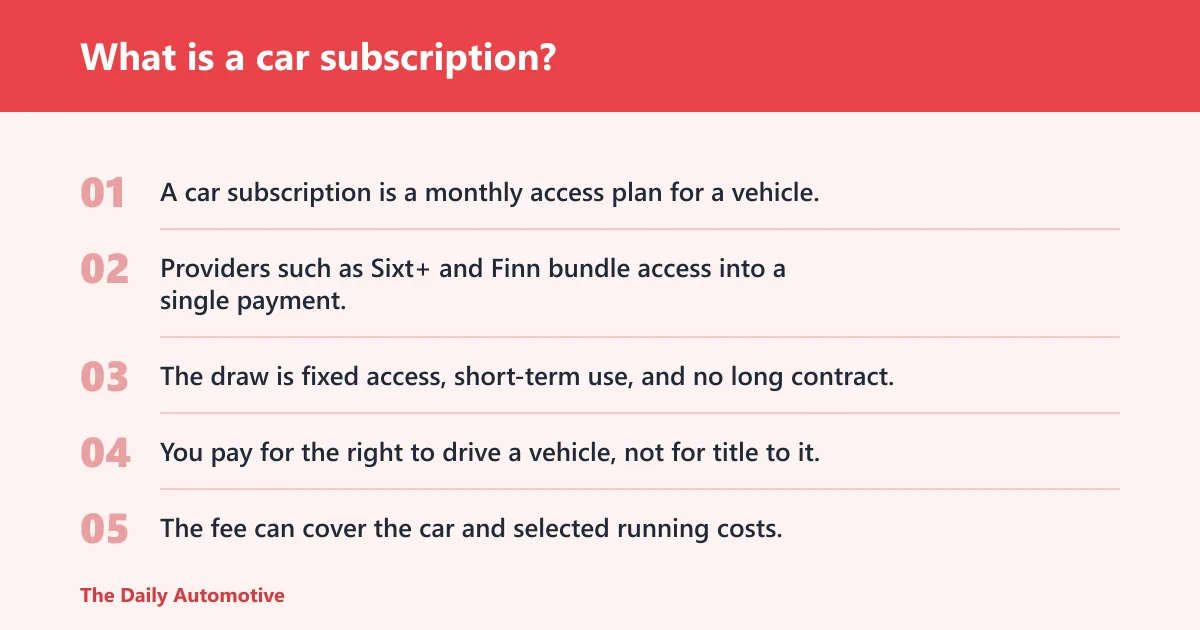
A car subscription is a monthly access plan for a vehicle, with one recurring fee instead of a purchase or long lease. Providers such as Sixt+ and Finn bundle access into a single payment, often with insurance and maintenance included. The draw is fixed access, short-term use, and no long contract.
How the monthly fee model works
You pay for the right to drive a vehicle, not for title to it. The fee can cover the car and selected running costs, while the exact bundle depends on the provider and region. Some services charge an upfront fee, a delivery fee, or a deposit; others fold more into the monthly price.
What is usually included in the bundle
At minimum, expect a vehicle, a set term, and the provider’s rules for use. In many cases, insurance and maintenance are part of the package, and some providers also include registration, taxes, roadside help, or routine servicing. Availability differs by market, vehicle class, and local rules.
How subscriptions differ from short-term rental
Traditional rental is built for days or weeks. Subscription sits between rental and ownership, with a longer access window and less friction than repeating daily rental bookings. That matters if you need a car for commuting, family use, or a work assignment that runs past a vacation-length trip.
How do car subscriptions compare with leasing and buying?
Car subscriptions sit between a lease and ownership. Compared with leasing, they usually offer shorter terms, easier vehicle changes, and more bundled costs. Compared with buying, they avoid depreciation risk and large upfront cash outlay, but they do not create equity and can cost more month to month.
Lease terms, mileage caps, and buyout differences
Leases typically run for a fixed term and often include mileage limits, with extra charges if you go over them. Many leases also ask for a down payment and may offer a buyout option at the end. Subscription plans often use shorter commitments, but they still can include mileage caps, eligibility checks, and swap rules.
Ownership costs you still pay after purchase
Buying shifts cost into your hands. The full stack usually includes depreciation, insurance, maintenance, registration, taxes, and any financing expense if you borrow. Ownership can be the lowest-cost option over a long enough holding period, but only if you can handle repair bills and depreciation.
Where subscriptions fit between renting and owning
Subscriptions are useful when you want more stability than rental and less commitment than ownership. They work best when your plan is measured in months, not days or many years. That makes them a decision tool, not a universal replacement for buying or leasing.

What do you usually get for the monthly fee?
The monthly fee often includes vehicle access and may include insurance, maintenance, registration, taxes, and roadside help, but the exact package depends on the provider. Read the contract carefully because exclusions, deductibles, and wear rules can change the real cost.
Insurance coverage and where it varies
Insurance is included in some subscriptions, and coverage scope varies by provider. A plan may cover liability and collision with a deductible, while another may leave you responsible for a higher excess or for named-driver restrictions. Monthly cost rises as coverage becomes broader.
Maintenance, wear-and-tear, and service limits
Many subscriptions include routine service, oil changes, and scheduled maintenance. That does not mean every repair is covered. Normal wear can be handled differently from damage, and providers often charge for tire abuse, curb rash, interior stains, smoking, or missing accessories.
Registration, taxes, roadside help, and other extras
Some providers bundle registration and taxes, while others charge them separately or pass them through in fees. Roadside help may be included, limited by region, or sold as an add-on. The only safe assumption is that bundle contents vary by company and market.
Who is a car subscription best for?

Car subscriptions are best for drivers who need flexibility more than equity. They suit people with short holding periods, changing schedules, or a need to move between vehicle types. They are less attractive for drivers who log heavy mileage, keep cars for many years, or want the lowest possible monthly cost.
Low-commitment drivers
If your situation may change in six months, a subscription can be easier than signing a long lease. That includes temporary job assignments, trial relocations, or households waiting on a longer-term transportation plan. The car is a tool, not a fixed long-range asset.
People who need access to different vehicle types
Some fleets include compact cars and luxury models, with SUVs and other categories in between. That matters if your week sometimes needs a small commuter and sometimes needs more cargo room. Fleet access varies by provider, city, and inventory, so “available” is never a guarantee.
Drivers with short holding periods or changing schedules
Subscriptions fit people who do not want to commit to a 24- to 36-month lease or a financed purchase. If your commute changes, your household grows, or you travel seasonally, the ability to change vehicle size can be more valuable than ownership perks.
Say your weekday commute is 18 miles each way, but your job shifts from downtown parking to a suburban site halfway through the year. A compact subscription now and an SUV later may beat buying twice or keeping a lease you no longer want.
Decision matrix: which option fits your driving pattern?

The best choice depends on monthly mileage, expected holding period, swap needs, and whether you want bundled costs. Subscriptions usually fit moderate mileage and high flexibility needs. Leasing fits stable use over a fixed term. Renting fits very short use. Buying fits long holding periods and low change risk.
| Driver profile | Monthly mileage band | Typical holding period | Need to swap vehicles | Best option | Usually bundled | Usually extra |
|---|---|---|---|---|---|---|
| City commuter with uncertain plans | 500 to 1,000 miles | 3 to 12 months | High | Subscription | Insurance, maintenance, sometimes registration and taxes | Overage miles, damage, delivery, cancellation fees |
| Stable commuter with predictable route | 600 to 1,200 miles | 24 to 36 months | Low | Lease | Usually none beyond the vehicle itself | Insurance, maintenance, mileage overages, down payment |
| Frequent traveler or occasional driver | Under 300 miles | Days to weeks | Medium | Rental | Basic vehicle access, sometimes liability coverage | Insurance upgrades, fuel, fees, daily rate spikes |
| Long-term owner with stable use | Any band, especially 800+ miles | 4+ years | Low | Purchase | None | Depreciation, insurance, maintenance, registration, taxes, financing |
| Family needing a larger car for one season | 700 to 1,500 miles | 2 to 9 months | High | Subscription | Insurance and service, depending on provider | Mileage caps, swap limits, wear charges |
When subscription beats lease, rental, or purchase
Subscription tends to win when you want predictable monthly access, moderate mileage, and a possible vehicle swap without a separate sale or lease end date. It can also help when bundled insurance and maintenance reduce the number of bills you track. If the term is short and plans are uncertain, it can be the cleanest option.
When a lease or purchase is the better call
A lease is often better when you want a newer car for a fixed period and can stay within mileage limits. Purchase is better when you expect to keep the car for years and can handle repair risk and depreciation. If you drive a lot, the subscription fee may lose its appeal quickly.
One provider may cover insurance and scheduled maintenance, while another charges for tires, excess wear, or a vehicle swap. If your annual use is steady and long, those add-ons can erase the convenience premium.
Checklist before you choose
- Estimate monthly mileage as a realistic range, not a wish.
- Decide how long you expect to keep the vehicle.
- Check whether you need to change vehicle size or class.
- Compare bundled costs against lease, rental, and ownership costs.
- Read mileage caps, damage rules, cancellation terms, and geography limits.
- Confirm insurance scope, deductible, and excluded drivers.
Which companies offer car subscriptions?
Providers include Sixt+ and Finn, along with region-dependent services that change by country and city. The market is expanding rapidly, but local inventory and policy details can differ sharply. Availability is not uniform, and one city may support a plan that another market does not.
Examples such as Sixt+ and Finn
Sixt+ and Finn are commonly cited examples of subscription services that bundle access into a recurring fee. Both are known for flexible access models, but the exact vehicle classes, insurance structure, and swap policies vary by market. Treat each provider as its own contract, not a standard template.
Why availability changes by country and city
Vehicle fleets depend on local supply, regulation, insurance rules, and delivery logistics. That is why a compact model may be common in one region while luxury models or SUVs are limited elsewhere. Geographic limits can affect pickup, home delivery, and even the ability to keep the car outside its launch area.
What to compare before you sign up
Compare the mileage cap, minimum term, cancellation fee, deposit, insurance deductible, and swap rules. Also check whether the provider can approve you based on age, license history, credit, or residence. If the provider excludes your zip code or charges to leave the market area, flexibility drops fast.
Can you switch cars with a subscription service?
Sometimes. Changing vehicles is one of the main draws of this model, and users can switch vehicles without a long-term lease in some programs. But swap rights are not universal. Some providers limit changes, set minimum holding periods, or charge a swap fee.
Swap frequency and vehicle-class limits
One service may allow frequent swaps within a fleet, while another may allow only one change per term. Access can also be restricted by vehicle class, so moving from a compact car to a luxury model may require approval or a higher fee. The fleet itself can be limited.
Pause, cancel, and renewal rules
Read the cancellation rules before you sign. Some subscriptions renew automatically unless canceled in time, while others use fixed terms with early termination charges. Pause options, if offered, may only apply in certain markets or during special billing cycles.
What are the downsides of car subscription services?
The biggest downsides are cost, availability, and rules. Subscriptions can be more expensive than a lease in some cases, and they often come with mileage caps, damage charges, or strict eligibility checks. Inventory can be limited, and local availability may block the car you want.
Inventory limits and swap restrictions
You may not get your preferred trim, color, or class. Fleets are finite, and popular models can disappear quickly. If the plan depends on swapping vehicles, confirm how often swaps are allowed and whether the provider can actually deliver the next vehicle in your area.
Mileage overages, damage charges, and cancellation rules
Overage mileage can create a surprise bill, especially if your commute grows or travel spikes. Damage charges are another risk, particularly for wheels, windshields, upholstery, and worn tires. Cancellation rules can also be strict, which reduces the value of the flexible headline.
When the monthly price stops making sense
If you keep the same car for years, drive predictable mileage, and do not need bundled insurance or maintenance, a subscription can stop making financial sense. Once the monthly fee approaches the combined cost of a lease or ownership, the flexibility premium may be too high.
Frequently asked questions
What is a car rental subscription?
A car rental subscription is a monthly access plan that lets you drive a vehicle without buying it or signing a long lease. The fee usually covers the car itself and may include insurance, maintenance, and other services. Terms, mileage limits, and swap rights vary by provider.
How does a car subscription differ from leasing?
Leasing usually has a fixed contract length, mileage caps, and a buyout path at the end. Subscriptions often run shorter and may allow easier vehicle changes, but they can also have higher monthly costs. The main tradeoff is flexibility versus a more traditional contract structure.
What is included in a car subscription monthly fee?
The monthly fee often includes vehicle access and may include insurance, maintenance, registration, taxes, and roadside help. Not every provider bundles the same items, and some exclude wear items, fuel, tolls, or excess mileage. Always check the contract rather than assuming full coverage.
Are car subscription services cheaper than buying a car?
Usually not over a long holding period. Buying can be cheaper if you keep the car for years and absorb depreciation, insurance, maintenance, registration, and taxes. Subscription may still be better if you value flexibility, want bundled costs, or need a car only for a limited period.
Which companies offer car subscription services?
Examples include Sixt+ and Finn, plus region-dependent providers that vary by country and city. Availability depends on local fleet supply, insurance rules, and delivery coverage. Before signing up, compare mileage caps, included services, swap rules, and cancellation terms, because those details change the real value.
Can you switch cars with a subscription service?
Sometimes, yes. One advantage of subscriptions is the ability to switch vehicles without a long-term lease, but that feature is not universal. Some providers limit swap frequency, charge a fee, or restrict changes to certain vehicle classes. Check the policy before assuming it is built in.
Products related to this article
Sponsored / affiliate links. As an Amazon Associate I earn from qualifying purchases. I may earn additional commission from eligible campaigns.