Fuel Cost Calculator: How to Estimate Trip Costs
A fuel cost calculator multiplies trip distance by vehicle consumption and local fuel price, so the cheapest per-mile option is not always the cheapest trip bill. Miss the inputs, and a long drive can come in tens of dollars over budget, or more on high-mileage routes. This guide compares petrol, diesel, EV, and CNG on the same trip, then shows how to pick the lowest total cost before you book or drive.
How is this calculated?
Press Calculate to see the math with your numbers.
How a fuel cost calculator works
A fuel cost calculator estimates trip cost from three things: distance, fuel efficiency, and fuel price. It can handle miles or kilometers, one-way or round-trip trips, and different drivetrain types. That matters because a vehicle with a lower cost per mile can still end up with a higher total bill once route length, the return leg, tolls, parking, and charging or fuel prices are added.
The U.S. fuel economy trip calculator is administered by Oak Ridge National Laboratory. It lets users select one or more vehicles and shows trip fuel cost for each selected vehicle. Fuel Calculate supports gasoline, diesel, and electric (EV), and it includes a round-trip option plus cold-weather assumptions that worsen gas mileage and EV range. (Fueleconomy)
When to use one-way, round-trip, or route-based inputs
Use one-way distance when you only need the outbound leg. Use round-trip distance when you already know you are returning on the same route. Use route-based input when the trip follows a specific road network, because road choice can change distance, elevation, and fuel use. Round trips double the miles before the calculator applies your efficiency and fuel price.
How distance, efficiency, and fuel price interact
The calculator estimates cost using distance, fuel efficiency, and gas price. If the route gets longer, cost rises. If the vehicle gets better mileage or lower energy use, cost falls. If fuel or electricity prices rise, the trip bill rises even when the route and vehicle stay the same. That is why a per-mile figure can hide the real total on a long route.
Fuel cost formula basics
The standard fuel-cost formula is distance divided by MPG times price per gallon. That gives gallons needed first, then total trip cost. For a round trip, double the distance before dividing by MPG. If you use liters or kilometers, keep the units consistent so the result stays meaningful.
How to convert between miles and kilometers
Fuel calculators commonly accept miles and kilometers for trip distance. They also support MPG, L/100 km, km/L, and liters per mile. You do not need to convert by hand if the calculator accepts your unit directly, but you do need to keep the distance and efficiency pair aligned. A miles-based route should use MPG or miles-per-liter style inputs. A kilometers-based route should use L/100 km or km/L.
Why round trips double the distance
A one-way 180-mile trip becomes about 360 miles when you return on the same route. That is not a small adjustment. It doubles the fuel used, the tolls if they apply both ways, and the parking time if the destination charges by the day or hour. For budget planning, always decide whether the trip input should be one-way or round-trip before you compare vehicles.
Which input should you use?
Choose the simplest input that matches the real trip. Manual distance entry works for a known route length. Route-based input is better when navigation can choose between roads with very different traffic or terrain. For efficiency, enter the number that matches your vehicle’s real driving pattern: MPG, L/100 km, km/L, or liters per mile.
Manual distance entry versus route-based distance
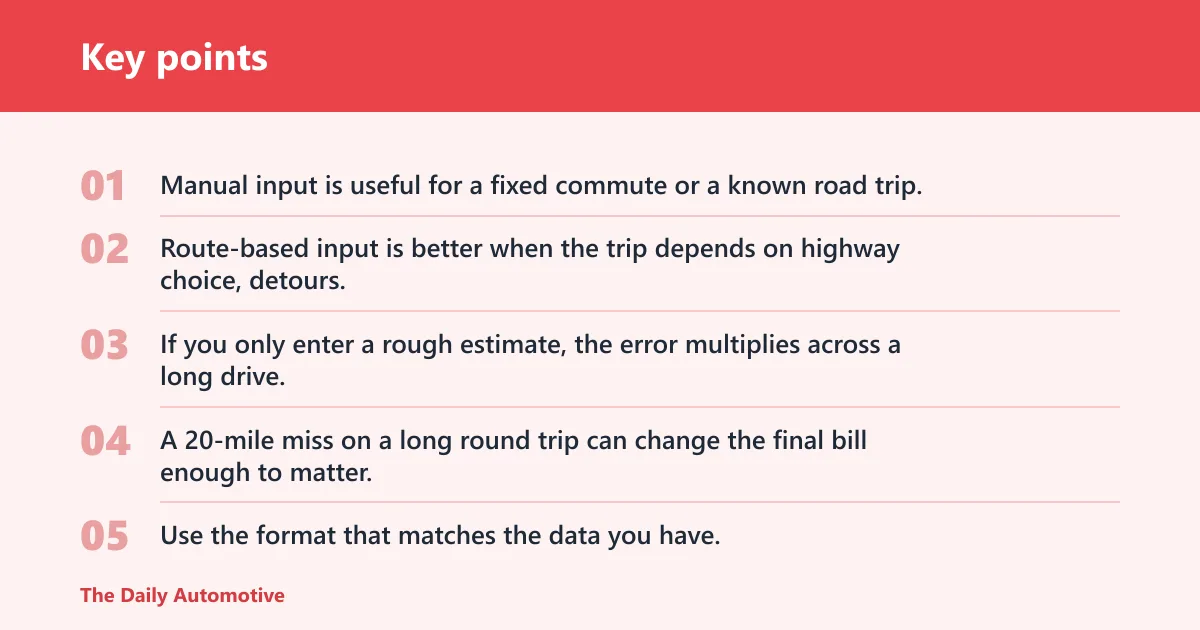
Manual input is useful for a fixed commute or a known road trip. Route-based input is better when the trip depends on highway choice, detours, or a precise map result. If you only enter a rough estimate, the error multiplies across a long drive. A 20-mile miss on a long round trip can change the final bill enough to matter.
MPG, L/100 km, and km/L inputs
Use the format that matches the data you have. MPG is common in the U.S. and Canada. L/100 km is common in many markets. km/L appears in some owner manuals and regional spec sheets. The calculator should accept the format directly, but you should still confirm whether the number is city, highway, or combined, because those can differ sharply.
City and highway efficiency inputs
City MPG and highway MPG are not interchangeable. City driving usually uses more fuel because of stops, starts, and lower average speed. Highway numbers can look better, but traffic, hills, cargo, passengers, tire pressure, and weather change real-world use. If you know the route mix, use a blended assumption instead of the best-case number from a sticker.
Suppose a hatchback is rated at 40 MPG highway, but the actual trip is 70% city streets and 30% highway. Using the highway figure alone will understate fuel cost. A blended estimate, or a real fill-up average from similar trips, gives a safer budget number.
Fuel price and efficiency inputs
Fuel price should come from the local pump price when you can get it. Regional variation is real, and it affects trip totals even on the same vehicle. Fuel economy data should come from the most relevant source available, then be adjusted for real driving conditions. For EVs, electricity price matters just as much as gasoline price does for a petrol car.
Local pump price and regional variation
Fuel Calculate says U.S. state gas taxes range from around 18-20¢/gallon to 70¢+/gallon in some states. That tax gap helps explain why the same car can cost different amounts to fuel in different regions. A calculator should let you enter your own local price instead of relying only on a national average.
It also states home electricity rates can vary from about 14-16¢/kWh to 30¢+/kWh. That is why an EV trip can be inexpensive in one area and far less attractive in another, especially if the route depends on public fast charging rather than home charging.
Real-world MPG versus EPA ratings
EPA or rated figures are a starting point, not a promise. Real-world MPG can be lower than the label when traffic is heavy, speeds are high, payload is heavy, or temperatures drop. For a trip budget, a measured fill-up average from similar conditions is better than a brochure number. If you only have the rating, use it conservatively.
Where to find fuel economy data
Good sources include EPA/fueleconomy.gov, AAA state averages, EIA state averages, and Tax Foundation gas tax data. Use EPA or manufacturer ratings for baseline efficiency, then compare them against your own refill history if you have it. For EVs, check whether the estimate assumes home charging or public charging, because those rates are rarely the same.
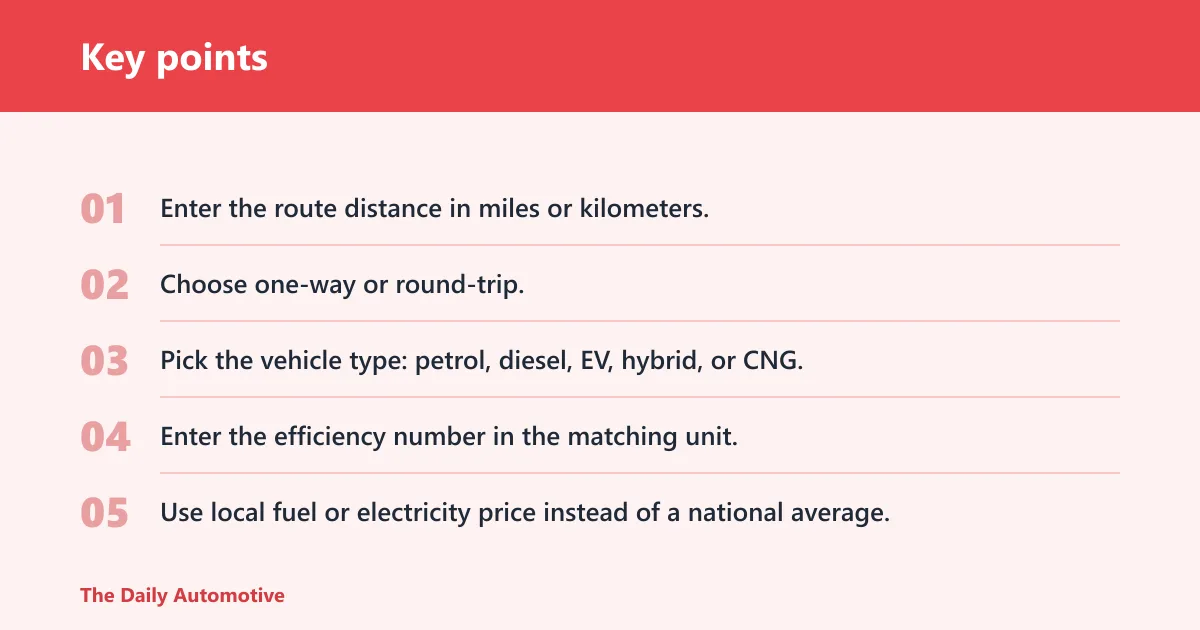
- Enter the route distance in miles or kilometers.
- Choose one-way or round-trip.
- Pick the vehicle type: petrol, diesel, EV, hybrid, or CNG.
- Enter the efficiency number in the matching unit.
- Use local fuel or electricity price instead of a national average.
- Add tolls, parking, and passenger count if you want the real trip total.
Trip fuel cost comparison table
The same route can produce very different totals depending on fuel type, price scenario, and weather. This table compares a 300-mile round trip, with costs shown per vehicle and then split across four passengers. Petrol is shown at about 30 MPG. Diesel is shown at about 36 MPG. The EV is shown at about 3.2 miles per kWh at a 12¢/kWh home rate, then at a higher public-charging rate of about 30¢/kWh. CNG uses 25 miles per gasoline-gallon equivalent at $2.50, $3.50, and $4.50 per GGE. The cold-weather row applies a 15% efficiency penalty.
| Vehicle type | Scenario | Total trip cost | Cost per mile | Cost per passenger |
|---|---|---|---|---|
| Petrol | $3.50/gal | $35.00 | $0.117 | $8.75 |
| Petrol | $4.35/gal | $43.50 | $0.145 | $10.88 |
| Petrol | $5.00/gal | $50.00 | $0.167 | $12.50 |
| Diesel | $3.50/gal | $29.17 | $0.097 | $7.29 |
| Diesel | $4.35/gal | $36.25 | $0.121 | $9.06 |
| Diesel | $5.00/gal | $41.67 | $0.139 | $10.42 |
| EV | 12¢/kWh home charging | $11.25 | $0.038 | $2.81 |
| EV | 20¢/kWh mixed charging | $18.75 | $0.063 | $4.69 |
| EV | 30¢/kWh public charging | $28.13 | $0.094 | $7.03 |
| CNG | $2.50/GGE | $30.00 | $0.100 | $7.50 |
| CNG | $3.50/GGE | $42.00 | $0.140 | $10.50 |
| CNG | $4.50/GGE | $54.00 | $0.180 | $13.50 |
| Petrol | Cold-weather penalty | $40.59 | $0.135 | $10.15 |
| Diesel | Cold-weather penalty | $33.97 | $0.113 | $8.49 |
| EV | Cold-weather penalty | $13.24 | $0.044 | $3.31 |
| CNG | Cold-weather penalty | $34.29 | $0.114 | $8.57 |
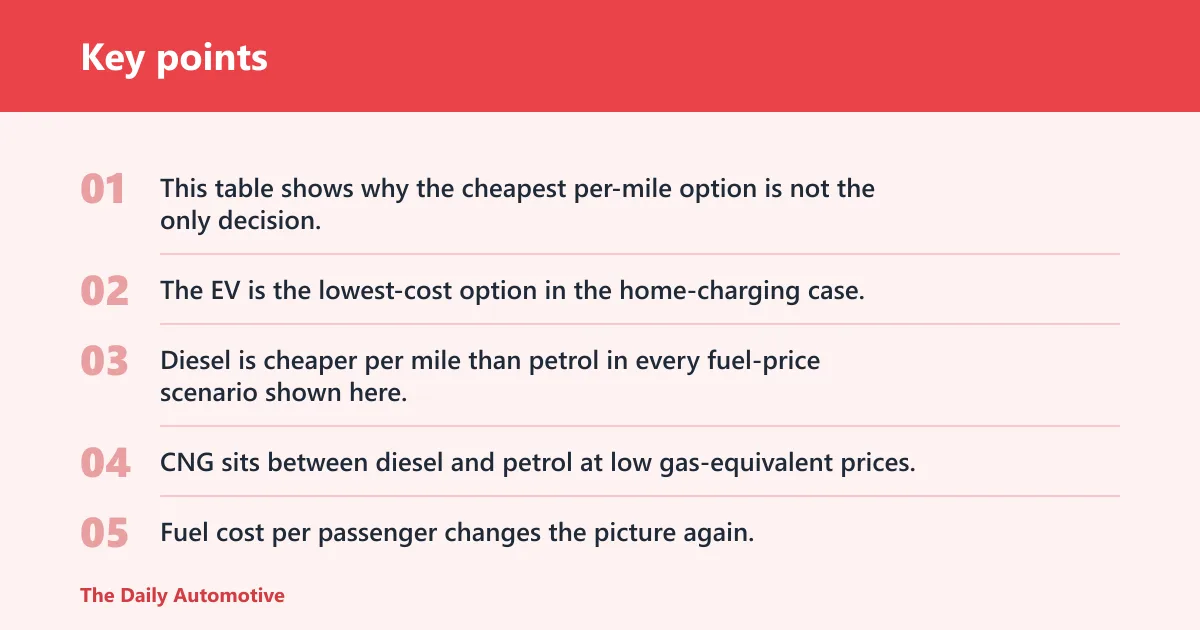
This table shows why the cheapest per-mile option is not the only decision. The EV is the lowest-cost option in the home-charging case, but public charging narrows the gap. Diesel is cheaper per mile than petrol in every fuel-price scenario shown here, yet the total bill still rises as price rises. CNG sits between diesel and petrol at low gas-equivalent prices, then overtakes petrol as the fuel price climbs.
Fuel cost per passenger changes the picture again. If four people split the trip, the total cost is divided across more riders, but the vehicle’s total fuel bill does not change. That means a carpool can make a higher-cost vehicle easier to justify for each person, even if it is not the lowest-cost vehicle on a total-trip basis.
What else changes trip cost
Fuel is only part of the total. Tolls, parking, and passenger count can change the decision just as much as MPG. Weather and traffic alter consumption too. A route that looks cheap on fuel alone may cost more once you add parking or a charging stop with a higher tariff.
Tolls and parking
Always add tolls and parking separately from fuel. A route with slightly worse fuel economy can still be the cheaper trip if it avoids a toll road or expensive downtown parking. That is a common planning miss. The fuel calculator tells you vehicle cost; it does not automatically know your parking receipt.
Passenger count and carpooling
Yes, you can split a fuel cost across passengers. Divide the total trip bill by the number of paying riders, then decide whether that shared cost still makes sense. The more people in the car, the lower the per-person cost, but only if everyone agrees on how tolls and parking are divided too.
Picture a 220-mile weekend trip with one driver and three passengers. The fuel bill stays the same whether the car is full or empty, but the cost per passenger drops fast when four people share it. That changes the trip decision even if the total fuel cost does not budge.
Driving conditions and weather
City driving percentage matters because stop-and-go traffic usually uses more fuel. Highway share matters because steady cruising often improves efficiency. Cold weather can reduce gas mileage and EV range, which is why Fuel Calculate includes cold-weather assumptions. If the trip happens in winter, budget with a penalty instead of the best-season number.
Frequently asked questions
How do I calculate fuel cost for a trip?
Use the route distance, divide by the vehicle’s efficiency, then multiply by fuel price. If it is a round trip, double the distance first. Add tolls and parking separately. For a more realistic budget, use local prices and a real-world MPG figure instead of the best number from a label.
How much fuel will my car use on this trip?
Divide the trip distance by your MPG to get gallons needed. If you use liters or kilometers, match the same units in the efficiency input. A trip calculator should show gallons, liters, or electricity use along with cost, so you can see both fuel demand and total spend.
What is the fuel cost calculator formula?
The standard formula is distance divided by MPG times price per gallon. For kilometers, use the matching metric unit and the right fuel price per liter or per equivalent unit. The formula only works cleanly when distance, efficiency, and price are all in compatible units.
Fuel cost calculator vs EV: which is cheaper?
An EV is often cheaper when home charging is available and electricity rates are moderate. It can lose that advantage with public charging, high local electricity prices, or a cold-weather range penalty. Compare the same route using your actual charging rate, not a generic average.
Petrol vs diesel fuel cost calculator: which costs less per mile?
Diesel often costs less per mile when the engine’s efficiency advantage outweighs the pump-price difference. That is not guaranteed. The cheapest result depends on your local diesel price, the vehicle’s real MPG, and the route. A higher diesel price can erase the mileage advantage on some trips.
Can I split a fuel cost across passengers?
Yes. Divide the total trip cost by the number of passengers who are sharing the expense. If one person pays tolls or parking, handle those separately. This gives a fairer per-person number and helps you compare a solo drive with a carpool more accurately.
Products related to this article
Sponsored / affiliate links. As an Amazon Associate I earn from qualifying purchases. I may earn additional commission from eligible campaigns.