
Gas Mileage Calculator: MPG, Cost Per Mile, Trip Fuel
A gas mileage calculator tells you miles per gallon by dividing miles driven by gallons used; for trip cost, multiply gallons by fuel price, and for reimbursement, use your employer’s or IRS rate. If you get the inputs wrong, you can overpay for fuel, underbill a trip, or misjudge which vehicle costs less to run. This guide shows how to pick the right calculation for MPG, trip fuel cost, reimbursement, and vehicle comparison.
How is this calculated?
Press Calculate to see the math with your numbers.
Gas mileage calculator basics
Pick the calculator for your goal. If you want accuracy, start with full-tank, tank-to-tank data. If you want a trip budget, add fuel price and trip distance. If you want reimbursement or tax records, track odometer readings and miles driven, then apply the rate you are allowed to use.
What MPG means
MPG means miles driven divided by fuel used in gallons. For gasoline and diesel vehicles, higher is better. The catch is the gallon unit: US MPG and Imperial MPG are not the same, so the result changes if the calculator uses US gallons or UK gallons.
What inputs the calculator needs
For a true MPG reading, you need distance and fuel used. The most accurate version uses the odometer fill-up method: fill the tank, record the odometer, drive, refill to full, then subtract the previous odometer reading from the current one. Add gallons or liters put back in on refill, and divide distance by fuel used.
When to use cost fields
Enter fuel price when the goal is cost per mile, cost per kilometer, or trip cost. That turns MPG into planning data. Fuel price is optional for plain MPG, but essential for road trips, reimbursement estimates, and comparing what a car really costs to drive when local pump prices change.
How do you calculate gas mileage accurately?
For the most accurate result, use a full-tank to full-tank measurement, not the dash estimate. Record the odometer before and after the trip, then divide miles driven by gallons added on refill. Partial fills, uneven pump shutoff, and top-offs can skew the result fast.
The fill-up method
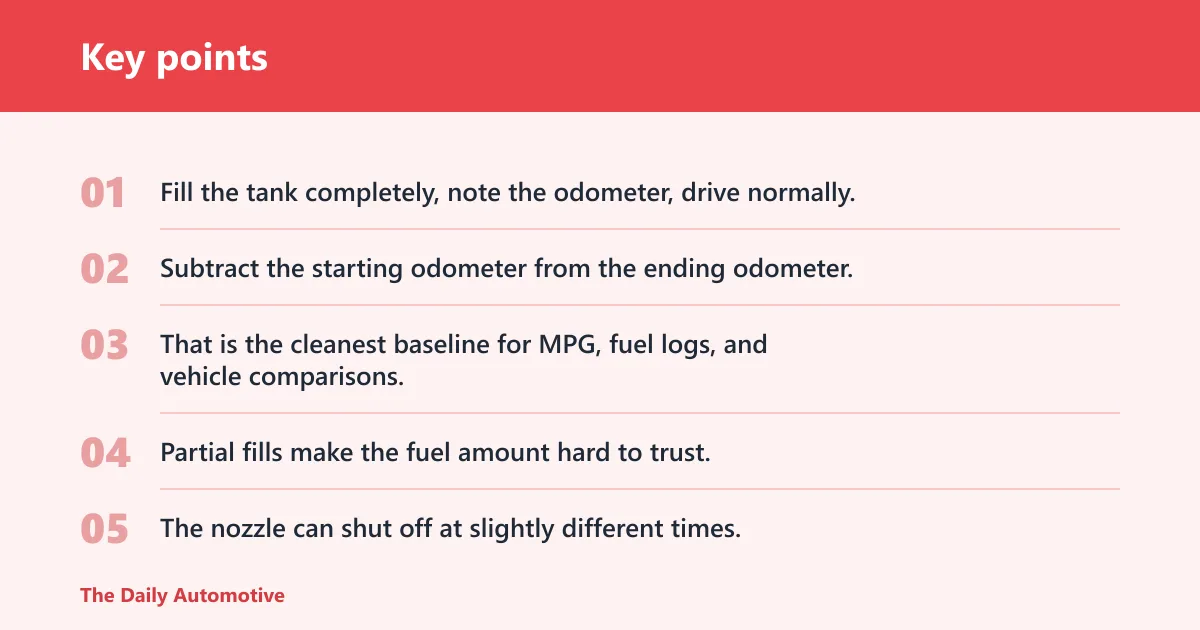
Fill the tank completely, note the odometer, drive normally, then refill to full at the same pump if possible. Subtract the starting odometer from the ending odometer. Divide that distance by gallons added. That is the cleanest baseline for MPG, fuel logs, and vehicle comparisons.
Why partial fills cause errors
Partial fills make the fuel amount hard to trust. The nozzle can shut off at slightly different times, and some pumps stop early while others allow a little more fuel in the neck. If the fill is not full to full, the denominator changes and the MPG result can swing.
Say your tank takes 11.2 gallons on one refill and 12.0 gallons on the next, even though the route was the same. That 0.8-gallon difference alone changes the MPG result enough to matter. The route did not change; the fill method did.
Why dashboard MPG can differ
Dashboard MPG is useful, but it is still an estimate from the vehicle’s computer. Measured tank-to-tank data should be the reference when accuracy matters. A dash readout can be optimistic, especially after short trips, idling, or mixed driving where the computer smooths out the numbers.
MPG vs L/100 km vs km/L
These are three ways to describe fuel efficiency. MPG and km/L get better when the number goes up. L/100 km gets better when the number goes down. If you compare vehicles across regions, make sure you are not mixing a US MPG figure with an Imperial MPG figure.
US gallons and Imperial gallons
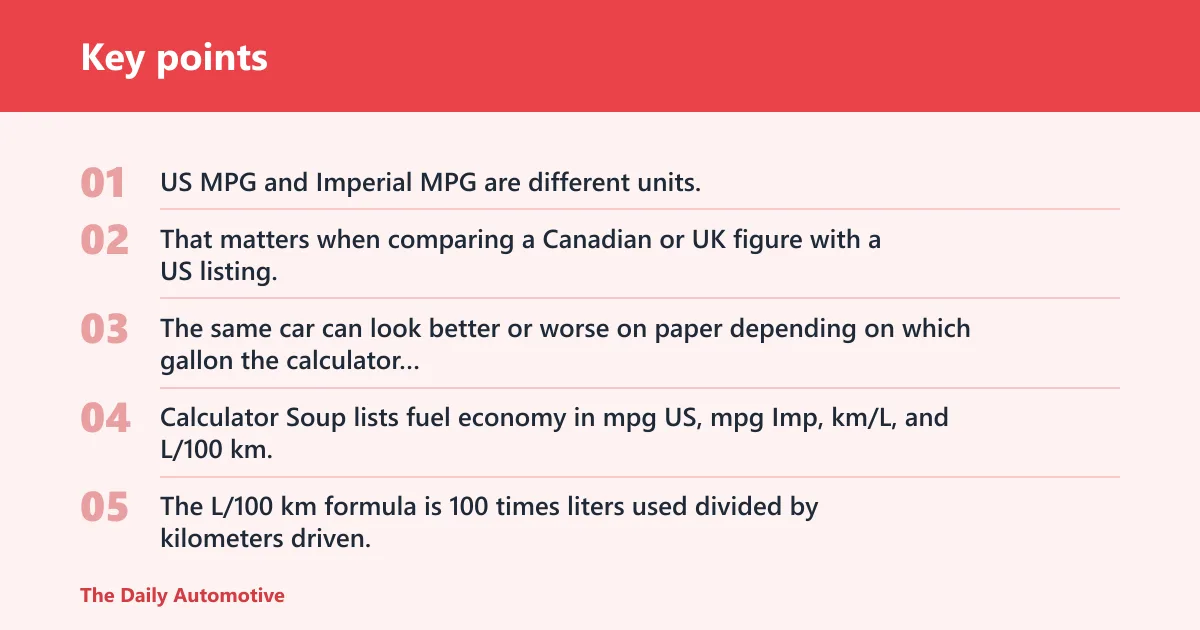
US MPG and Imperial MPG are different units, and Imperial MPG is about 20% higher than US MPG for the same vehicle efficiency. That matters when comparing a Canadian or UK figure with a US listing. The same car can look better or worse on paper depending on which gallon the calculator uses.
Metric conversions
Calculator Soup lists fuel economy in mpg US, mpg Imp, km/L, and L/100 km. The L/100 km formula is 100 times liters used divided by kilometers driven. Another way to convert from US MPG is the constant 235.215 divided by MPG.
US Calculator gives 27.8 MPG as 8.5 L/100 km. That is the same vehicle efficiency, written in a different unit. Lower L/100 km means less fuel burned over the same distance.
Which unit is easier to trust?
Use the unit that matches your records. If your receipts are in gallons and your trip meter is in miles, MPG is the cleanest check. If your log is in liters and kilometers, L/100 km or km/L keeps the math simpler and avoids unit mistakes.
When should you calculate trip fuel cost?
Use trip fuel cost when you are planning a route, setting a budget, or comparing whether the drive is worth it. Once you know fuel economy, you can estimate gallons or liters for the trip, multiply by local fuel price, and see how a price swing changes the total.
Road trip budgeting
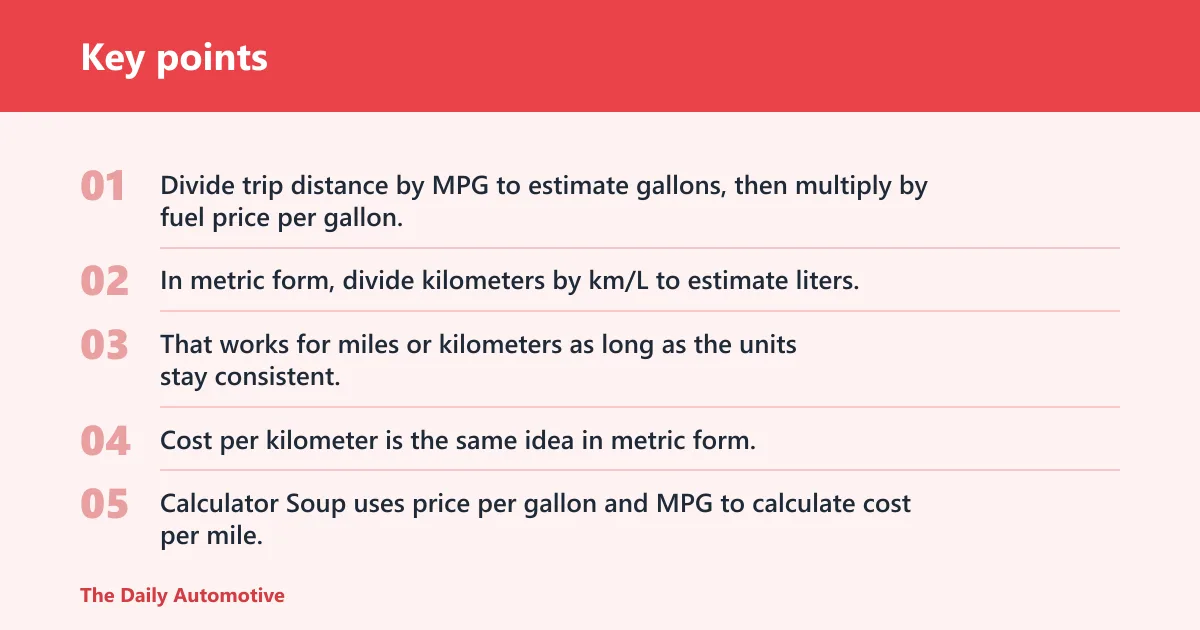
Trip distance is the key input. Divide trip distance by MPG to estimate gallons, then multiply by fuel price per gallon. In metric form, divide kilometers by km/L to estimate liters, then multiply by price per liter. That works for miles or kilometers as long as the units stay consistent.
Cost per mile or kilometer
Cost per mile is fuel price divided by MPG. Cost per kilometer is the same idea in metric form. Calculator Soup uses price per gallon and MPG to calculate cost per mile. This is the number to watch when comparing routes, commuting costs, or business mileage.
Suppose gas is $4.35 per gallon, which is the default price used by US Calculator, and a car gets 30 MPG. Fuel cost per mile is $4.35 divided by 30, or 14.5 cents per mile. If gas rises to about $5 per gallon, the same car costs roughly 17 cents per mile. The vehicle did not change; the local price did.
How price changes the result
Fuel price swings change cost per mile more than many drivers expect. A car with steady MPG can still become expensive to drive if pump prices jump. That is why a calculator with a fuel price input is better for budgeting than a plain MPG readout.
Gas mileage comparison decision table
Use the right calculation for the job. This table separates estimate-only tools from the methods that are accurate enough for logs, reimbursement, and vehicle-to-vehicle comparisons.
| Use case | Required inputs | Correct formula | Output to trust | Common failure mode |
|---|---|---|---|---|
| Trip budgeting | Trip distance, MPG or L/100 km, fuel price | Miles ÷ MPG × fuel price per gallon | Estimated trip fuel cost | Using dashboard MPG instead of measured MPG |
| Reimbursement | Odometer miles, trip dates, business purpose, allowed rate | Miles driven × reimbursement rate | Reimbursable amount or log total | Mixing personal and business miles in one total |
| Tax logs | Start odometer, end odometer, trip purpose, fuel receipts if needed | End odometer − start odometer | Documented trip mileage | Relying on partial-fill fuel data instead of miles |
| Diesel comparison | Distance, gallons or liters used, diesel price | Distance ÷ fuel used | MPG, km/L, or L/100 km | Using a gasoline assumption for a diesel vehicle without checking units |
| Hybrid trips | Fuel used, miles driven, electric miles if available | Distance ÷ gasoline used, then separate electric driving | Gas MPG plus electric share | Treating mixed electric driving as if all miles used gasoline |
| EV comparisons | kWh used, miles driven, charging cost | Miles ÷ kWh or cost ÷ miles | mi/kWh, kWh/100 mi, or cost per mile | Forcing EV data into an MPG calculator |
How do gas and electric mileage calculators differ?
Gas mileage calculators use fuel volume, so MPG fits gasoline and diesel vehicles. EVs use electricity, not gallons. For EVs, compare miles per kWh, kWh per 100 miles, or cost per mile from charging. Mixed gas and electric driving should be split, not forced into one MPG number.
Why MPG does not fit EVs
An EV has no gallons to divide by miles. That makes MPG the wrong unit. The better comparison is energy use, such as kWh per mile or miles per kWh. If you want a cost view, use charging cost per mile instead of fuel price per gallon.
Mixed gas and electric driving
Plug-in hybrids can mislead standard calculators because some trips use electric power first, then gasoline later. If you only enter gasoline bought at the pump, the MPG can look unrealistically high. If you only enter miles driven, you can miss the electric portion entirely. Split the two energy sources when you can.
What changes gas mileage results?
Driving style, speed, tire pressure, weather, traffic, maintenance, and vehicle load all affect results. Calculator.net says 55 MPH is best for gas vehicles when allowed by speed limits. It also says under-inflated tires can lower gas mileage by 0.3% per PSI drop, and aggressive driving can cut economy by 15% to 30% at highway speeds and 10% to 40% in stop-and-go traffic. (Fueleconomy)
Driving style and speed
Hard acceleration and late braking waste fuel. Smooth inputs help more than many drivers think. Calculator.net also says fuel economy can improve by 1-2% by using the recommended motor oil, which is a small but real gain for a maintenance item that is easy to ignore.
Tire pressure, weather, and traffic
Low tire pressure adds drag. Hot weather can also raise fuel use because air conditioning loads the engine, and Calculator.net says fuel economy can drop by 25% in hot climates due to AC usage. Stop-and-go traffic, short trips, and cold starts can all push measured MPG below the vehicle’s sticker rating.
Maintenance and load
Dirty filters, old plugs, poor alignment, extra cargo, and roof racks can all hurt economy. Follow the vehicle manual for maintenance and tire pressures. Also follow the vehicle and product manual for any service task. Never work under a vehicle supported only by a jack; use jack stands on level ground.
How much gas mileage calculator do you need for reimbursement?
For reimbursement, you need a mileage log, not just a fuel calculator. Record odometer start and end points, trip purpose, date, and miles driven. Then apply your employer’s rate or the IRS rate if that is the standard you are allowed to use. The fuel price matters less than the recorded miles.
Odometer tracking
The odometer is the cleanest source for reimbursement records because it measures distance directly. That is different from fuel economy math, which uses gallons or liters. For business driving, the key number is miles driven, not how full the tank was when you stopped for fuel.
Trip-by-trip logging
Keep each trip separate when the goal is reimbursement or tax records. A notebook, app, or spreadsheet can all work if the entries are consistent. The log should show business use clearly, because a mixed trip can create confusion later if the route was partly personal.
What to keep for records
- Start and end odometer readings.
- Date of the trip.
- Start and destination points.
- Business purpose.
- Any tolls or parking if your policy allows them.
Frequently asked questions
How is MPG calculated?
MPG is calculated by dividing miles driven by gallons used. For accurate results, use full-tank to full-tank data and the odometer difference between fills. If you use partial fills, the fuel amount can drift and the answer can move enough to matter.
How is highway MPG calculated?
Highway MPG is calculated the same way as any MPG figure: distance divided by fuel used. The difference is the driving pattern. Steady speed, fewer stops, and less idling usually improve the result, but the real number still depends on traffic, speed, weather, and load.
How much gas cost calculator do I need for a road trip?
For a road trip, you need distance, MPG, and fuel price. Divide the trip miles by MPG to estimate gallons, then multiply by the pump price. If local prices vary along the route, the estimate should be a range, not one fixed number.
Car cost vs gas mileage calculator: which is better to use?
Use a gas mileage calculator when fuel use is the question. Use a cost calculator when you want total driving expense. A car can post strong MPG and still cost more to run if fuel prices are high, maintenance is expensive, or the route is long.
Diesel vs gas mileage calculator: can I use the same formula?
Yes. The formula is the same: distance divided by fuel used. What changes is the fuel type, the price, and sometimes the unit system. Make sure the calculator matches US gallons, Imperial gallons, or liters, and keep diesel and gasoline logs separate if you compare operating costs.
How do I get the best gas mileage?
Keep speed steady, avoid hard acceleration, maintain correct tire pressure, and follow the maintenance schedule in the owner’s manual. Smaller gains add up. A few percent from tires or oil choice can matter over time, especially if you drive long distances or face frequent stop-and-go traffic.
Products related to this article
Sponsored / affiliate links. As an Amazon Associate I earn from qualifying purchases. I may earn additional commission from eligible campaigns.