Car Maintenance Cost: What to Budget by Mileage
Budget for car maintenance cost as a monthly reserve: a common starting point is about $75 to $150 for routine upkeep on many mainstream cars, then add a separate wear-and-tear fund and a failure reserve for older or higher-mileage vehicles. Skip those buckets and oil changes, brake work, tires, and surprise repairs hit your cash flow at once. This guide breaks down the three-part budget, then shows how drivetrain, mileage, and vehicle age change the number.
What car maintenance cost includes
Car maintenance cost works best as three separate buckets: routine service, wear-and-tear parts, and an unexpected repair reserve. That split keeps scheduled items like oil changes and filters out of the same bucket as tires, brakes, batteries, or a transmission problem. It also gives you a cleaner monthly target.
Routine service
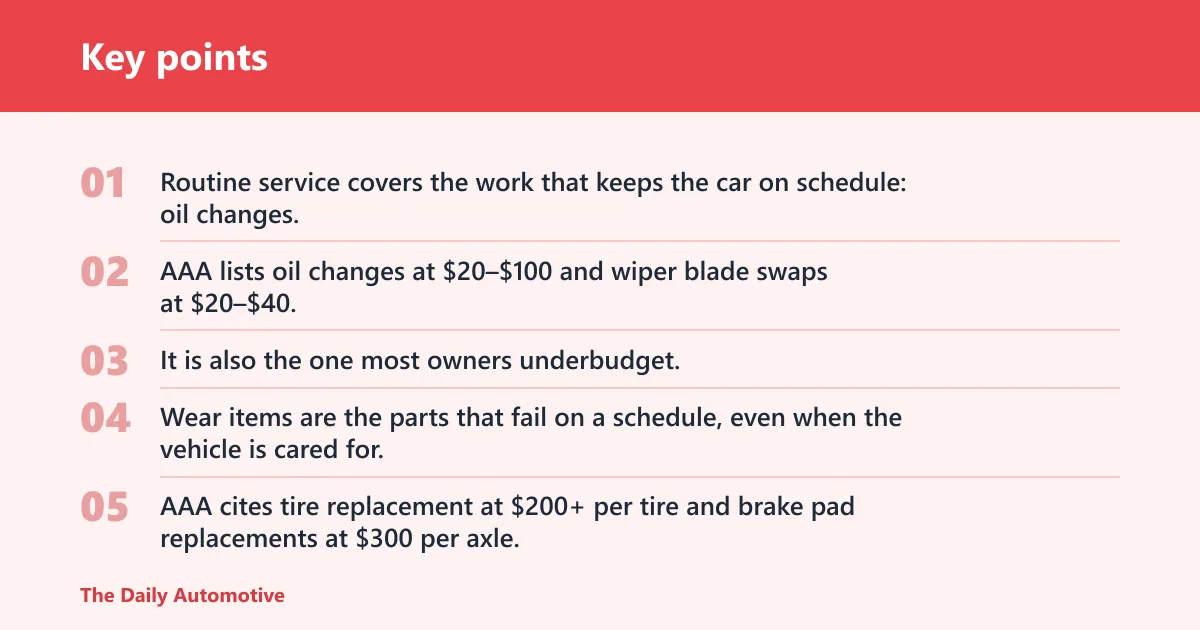
Routine service covers the work that keeps the car on schedule: oil changes, tire rotation, filters, wiper blades, fluid service, inspections, and emissions checks. AAA lists oil changes at $20–$100 and wiper blade swaps at $20–$40, while many manufacturers also call for periodic inspections and scheduled maintenance based on mileage or time.
That bucket is predictable. It is also the one most owners underbudget, because the bill shows up in pieces instead of all at once.
Wear-and-tear parts
Wear items are the parts that fail on a schedule, even when the vehicle is cared for. AAA cites tire replacement at $200+ per tire and brake pad replacements at $300 per axle. Spark plugs, batteries, and wiper blades also belong here because they wear out rather than fail without warning.
A common first-timer mistake is treating tires and brakes as rare repairs. They are not rare. They are recurring.
Unexpected repair reserve
This bucket is for failure cases: alternator failure, transmission replacement, battery replacement, and other large jobs that do not belong in the normal service line. AAA says alternator failures can cost $500–$1,000, battery replacements can cost $75–$200 plus labor, and transmission replacements can cost $2,500–$6,000.
That reserve keeps one breakdown from forcing a rushed choice. If the car is older, out of warranty, or already behind on service, this bucket needs to be larger.
📊 AAA says alternator failures can cost $500–$1,000. Source: AAA.
How much should you budget each month?
For many mainstream cars, a practical monthly plan is about $75 to $150 for routine upkeep, then extra for tires, brakes, and repairs. AAA says to budget around $100 per month for car maintenance and repairs. That benchmark works as a starting point, not a ceiling, because age, mileage, and drivetrain change the split fast. (AAA)
Monthly to yearly to mile-based budgeting
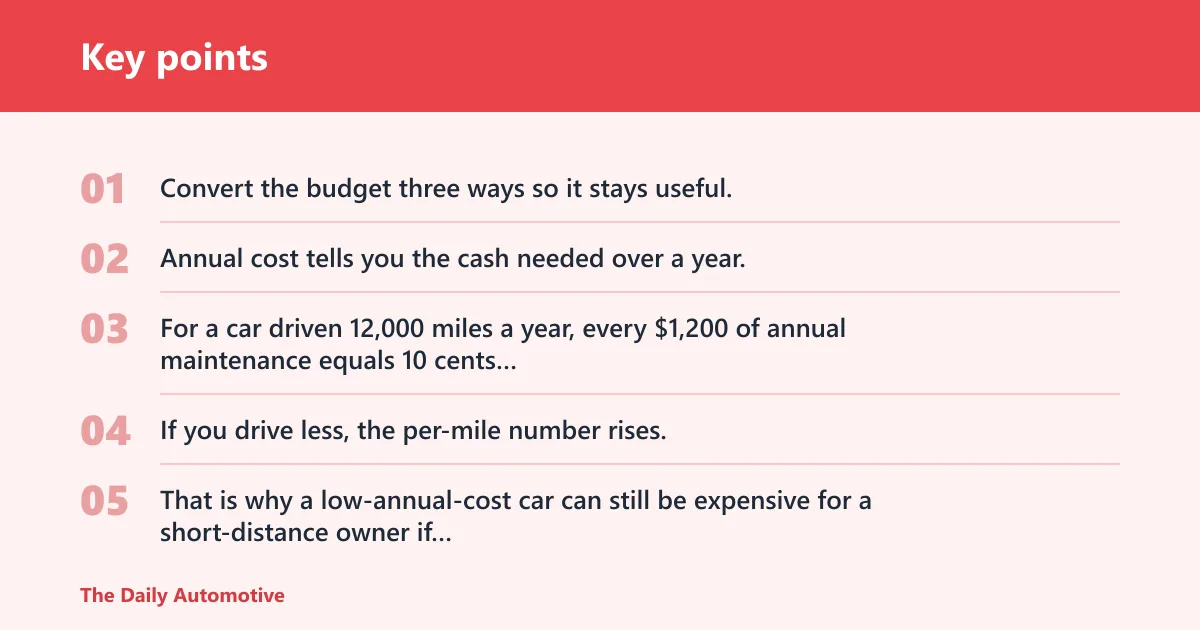
Convert the budget three ways so it stays useful. Annual cost tells you the cash needed over a year, monthly cost tells you what to set aside, and cost per mile tells you whether a higher-mileage car is still economical. For a car driven 12,000 miles a year, every $1,200 of annual maintenance equals 10 cents per mile.
If you drive less, the per-mile number rises. If you drive more, it falls. That is why a low-annual-cost car can still be expensive for a short-distance owner if the bills are infrequent but large.
Five-year planning frame
Five-year planning matters because ownership costs rarely stay flat. A vehicle that is cheap in year one often needs more wear items and a larger failure reserve by year five. Multiply the annual budget by five, then add a cushion if the car is near the end of factory warranty coverage.
| Scenario | Routine service | Wear-and-tear parts | Repair reserve | Age uplift | Ownership stage | Annual cost | Monthly equivalent | Cost per mile | 5-year projected total | Keep-or-replace threshold note |
|---|---|---|---|---|---|---|---|---|---|---|
| New gas car | $420 | $250 | $300 | $0 | $0 | $970 | $81 | 8.1¢ at 12,000 miles | $4,850 | Keep while warranty covers major failures and routine service stays on schedule. |
| 5-year-old hybrid | $360 | $320 | $450 | $100 | $0 | $1,230 | $103 | 10.3¢ at 12,000 miles | $6,150 | Keep if battery health is normal and annual repairs stay below a replacement payment. |
| 8-year-old EV | $240 | $280 | $500 | $150 | $0 | $1,170 | $98 | 9.8¢ at 12,000 miles | $5,850 | Keep if tires, suspension, and battery warranty status are still manageable. |
| High-mileage SUV | $500 | $550 | $700 | $250 | $200 | $2,200 | $183 | 14.7¢ at 15,000 miles | $11,000 | Replace if repair reserve and wear items are approaching the cost of a newer vehicle. |
These figures are budgeting models, not quoted shop estimates. The point is the split: routine service stays modest on a new car, while age and mileage push the repair reserve up fast.
Which services are due on schedule?
Scheduled service is the easiest part of car maintenance cost to plan. Oil changes, tire rotation, fluid checks, filters, inspections, and emissions testing usually follow the manufacturer’s maintenance schedule guidelines. If the car is still under factory warranty coverage, keep the service record tight and on time.
Oil changes and filters
Oil changes are the core routine item on gas engines, and many hybrids still need them because the engine does not disappear. Air filters and cabin filters belong here too. Skip them and the bill often moves into a more expensive repair later.
For a budget model, use the annual number rather than the individual visit price. A car that needs two or three small services through the year is easier to plan for than one that surprises you every six weeks.
Tire rotation and alignments
Tire rotation slows uneven wear. Alignment checks matter after pothole hits, curb impacts, or any steering pull. Tires themselves are a wear item, and AAA’s tire replacement figure of $200+ per tire shows why owners should treat them as a planned cost, not an emergency.
Fluid service, inspections, and emissions
Brake fluid, coolant, transmission fluid, and differential service belong in the schedule when the manufacturer calls for them. Regular inspections catch leaks and worn parts early. Emissions checks also matter on vehicles and in states where they apply, because failing a test can add both repair time and extra shop fees.
Suppose a 6-year-old sedan starts showing a brake warning light and a stiff pedal. If the owner delays, a brake pad job can turn into rotor work, and the budget can jump from a routine line item to a much larger wear-and-repair bill.
Which parts wear out first?
The first recurring wear items are usually brakes, tires, batteries, spark plugs, and wiper blades. Those parts do not wait for the perfect time. They wear with use, climate, and driving style, so their cost belongs in the annual plan even when the car seems healthy.
Brakes and tires
AAA cites brake pad replacements at $300 per axle. Tires are larger-ticket wear items because they often need replacement as a full set, and AAA puts tire replacement at $200+ per tire. Heavy vehicles, aggressive driving, and city traffic can speed that cycle up.
Batteries and spark plugs
Battery replacements can hit both gas cars and hybrids, and AAA lists them at $75–$200 plus labor. Spark plugs usually arrive later in the schedule, but they still belong in the wear bucket because their replacement timing is predictable on many engines.
Wipers and small items
Wiper blade swaps are cheap compared with tires or brakes, and AAA cites them at $20–$40. Small parts matter because they cluster. Cabin filters, bulbs, and battery terminals can turn a minor visit into a more expensive one if they are ignored too long.
How do drivetrain and brand change costs?
Drivetrain changes maintenance mix more than most buyers expect. Gas cars usually need the most routine engine service. Hybrids reduce engine wear but still carry gas-engine items plus electrical components. EVs skip oil changes, but they still need tires, brakes, cabin filters, fluid checks, and battery planning.
Gas, hybrid, PHEV, and EV
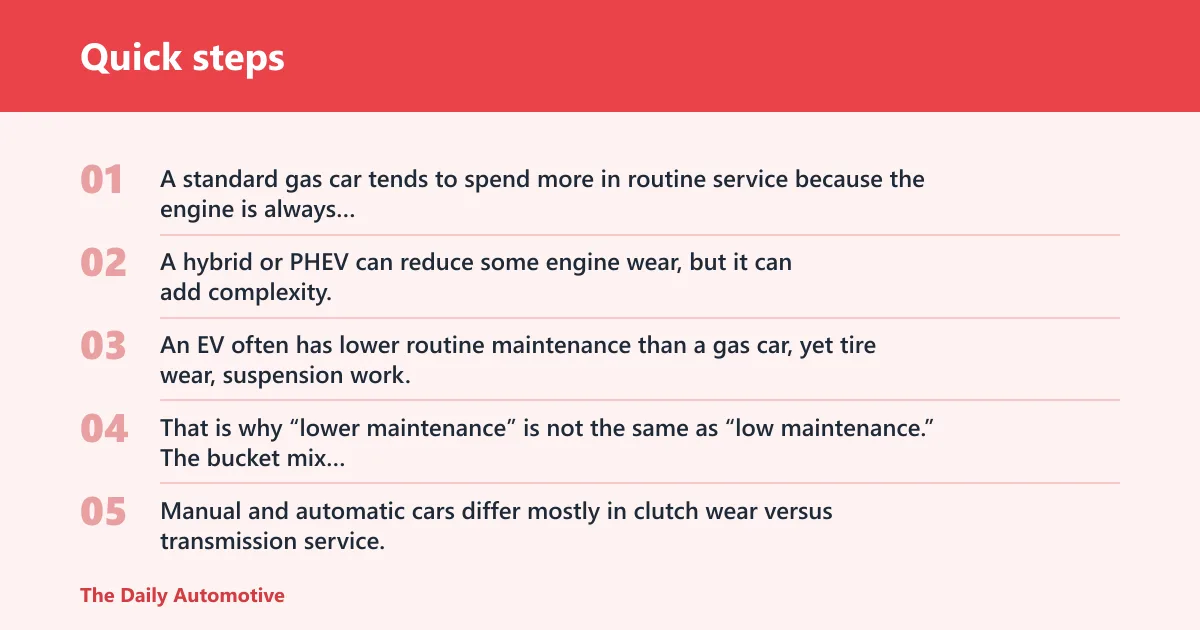
A standard gas car tends to spend more in routine service because the engine is always part of the maintenance schedule. A hybrid or PHEV can reduce some engine wear, but it can add complexity. An EV often has lower routine maintenance than a gas car, yet tire wear, suspension work, and battery-related planning still matter.
That is why “lower maintenance” is not the same as “low maintenance.” The bucket mix changes, but the budget does not disappear.
Manual, automatic, diesel, and petrol
Manual and automatic cars differ mostly in clutch wear versus transmission service. A manual can be cheaper if the clutch lasts, but aggressive stop-and-go driving can shorten that. Automatics may carry a larger transmission reserve over time. Diesel engines often need different service intervals and can bring higher repair bills on emissions-related parts than many petrol cars.
For buyers comparing diesel car maintenance cost vs petrol, the right question is not only fuel economy. It is also whether the local service network, parts availability, and usage pattern fit the engine type.
Brand ranking context
Consumer Reports says Buick and Lincoln cost the least to own, while European brands cost the most. That ranking is useful for setting expectations, but it should not replace a model-by-model service check. Toyota often lands in the low-cost conversation because of broad parts availability and service familiarity. Audi and Land Rover often need larger reserves because parts and labor can be pricier.
Brand matters most when service history is weak. A well-maintained Audi can outlast a neglected Toyota on cost control, but the average owner should still budget more for the European brand than for a mainstream Japanese model.
Say your car is a 4-year-old hybrid with 48,000 miles and full records. The hybrid system may still be in good shape, but tires, brakes, and 12-volt battery planning can make the next two years cost more than the first two.
When does maintenance get expensive enough to replace the car?
Replace the car when the annual repair reserve and wear items start to look like a down payment on something newer, especially after warranty coverage ends. A car can be worth keeping if the bills are steady and predictable. It is harder to justify if deferred maintenance has stacked up.
Warranty period versus post-warranty period
During the new-car warranty period, your reserve can stay lower because factory warranty coverage absorbs some major failure risk. Once the warranty ends, the failure bucket should grow. That is the moment when alternator, battery, and transmission risk become fully your problem.
High-mileage and deferred maintenance warning signs
High mileage by itself does not force replacement. Deferred maintenance does. If the car needs tires, brakes, fluid service, and a repair within the same season, the budget can jump sharply. Uneven tire wear, repeated warning lights, and growing oil consumption are all signs to run the numbers again.
Repair allowance versus replacement math
Use a simple rule: if one large repair plus the next year of wear items approaches the annual cost of replacing the car with a newer one, the ownership case weakens. The high-mileage SUV in the table shows how this works. At $2,200 a year, the car may still be sensible for some owners, but the replacement question should be active, not theoretical.
- List the routine service due in the next 12 months.
- Add tires, brakes, batteries, and other wear items that are likely to come due.
- Set a repair reserve for alternator, transmission, and battery failure.
- Increase the reserve if the car is out of warranty or has deferred maintenance.
- Compare the total with a replacement payment and the expected value of keeping the car.
Frequently asked questions
How much does car maintenance cost per year?
A practical annual budget often starts around $1,000 to $1,500 for many mainstream cars, with more for older or higher-mileage vehicles. AAA says to budget around $100 per month for car maintenance and repairs, which translates to about $1,200 a year. That baseline should rise when the car is out of warranty.
How much car maintenance cost per month
For many drivers, $75 to $150 a month is a workable planning range, and AAA’s $100 monthly benchmark fits inside it. A new gas car may sit near the low end, while an older SUV or a post-warranty vehicle can run higher because wear items and failure reserves start to matter more.
How much car maintenance cost
It depends on the car’s age, mileage, drivetrain, and service history. A new mainstream car may stay under $1,000 a year for maintenance and repairs, while a high-mileage SUV can climb well above that. The useful way to ask is not the total alone, but how much belongs in routine service, wear items, and repair reserve.
Electric car maintenance cost vs gas
EVs usually avoid oil changes and some engine-related service, so routine maintenance can be lower than on a gas car. But they still need tires, brakes, cabin filters, fluid checks, and a repair reserve for battery or electronics issues. That means lower routine cost, not zero maintenance.
Hybrid car maintenance cost vs gas
Hybrids often reduce engine wear because the gasoline engine does not run all the time, but they still carry both engine-related service and hybrid-system complexity. In practice, a hybrid can cost less than a similar gas car in routine use, while still needing a separate reserve for batteries and age-related repairs after warranty coverage ends.
Tesla maintenance cost vs gas car
A Tesla or other EV typically avoids oil changes and many engine service items found on a gas car. The offset is tire wear, suspension work, cabin filters, brake fluid, and battery planning. The maintenance budget can be lower than a comparable gas car, but it should still include a reserve for out-of-warranty repairs.
Products related to this article
Sponsored / affiliate links. As an Amazon Associate I earn from qualifying purchases. I may earn additional commission from eligible campaigns.