Gas Cars: The Ultimate Guide to Essential Differences
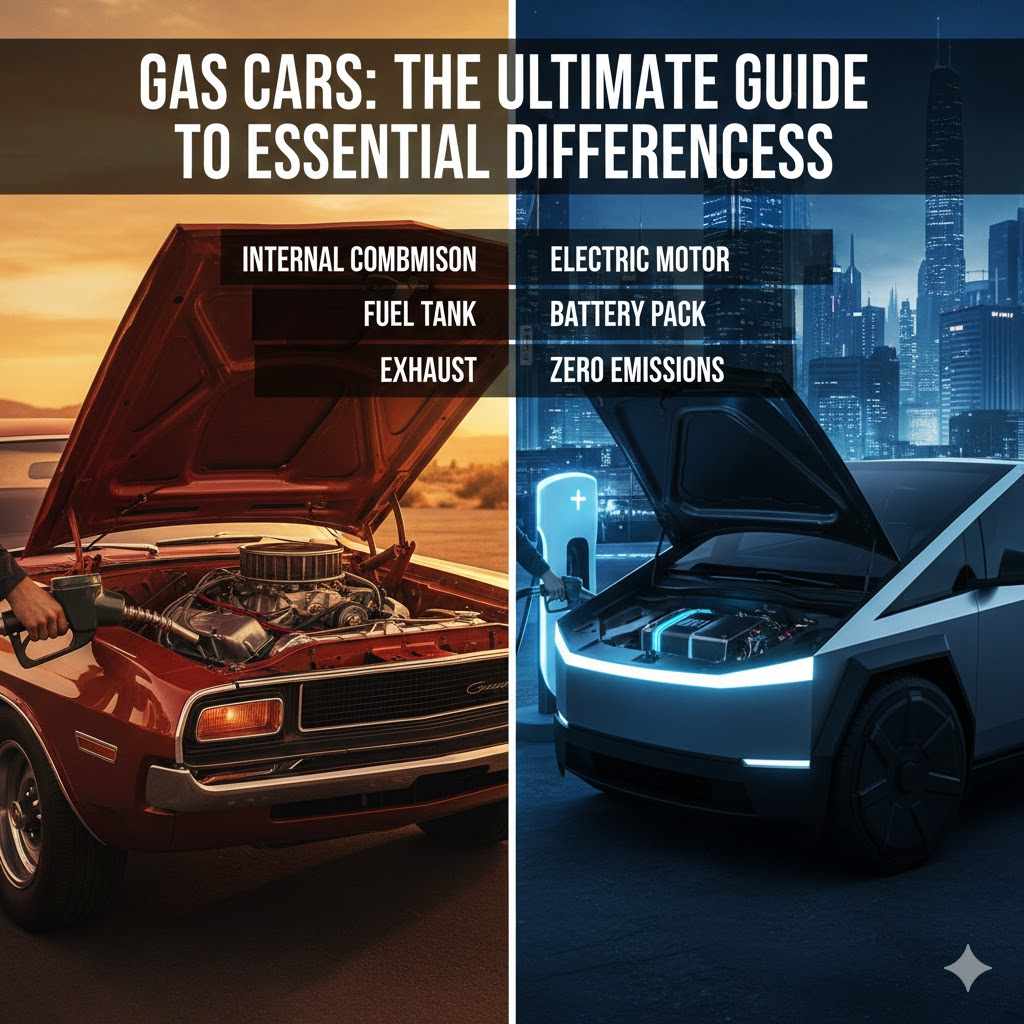
Gas cars primarily use an internal combustion engine (ICE) that burns gasoline to create power. The main differences between them come from the way the engines or motors work, such as their cylinder layout (Inline, V-type), how they get air (naturally aspirated vs. turbocharged), and the drivetrain that sends power to the wheels (FWD, RWD, AWD).
Have you ever popped the hood of your car and felt a little lost? All those parts can look complicated. You might hear people talk about a V6, a turbo, or an inline-four engine. It can sound like a different language. Many drivers feel this way. They know their car runs on gas, but the details are a mystery.
You are not alone in this! Understanding the basics of your gas-powered car is easier than you think. It helps you make smarter choices when buying a car. It also gives you confidence when talking to a mechanic. You can even handle some simple maintenance yourself.
This guide will gently walk you through the essential differences in gas cars. We will break down how the engines work in simple, clear terms. We will explore what makes one car feel different from another. Let’s lift the hood together and see what’s inside, one simple step at a time.
What is an Internal Combustion Engine (ICE)? The Heart of Your Gas Car
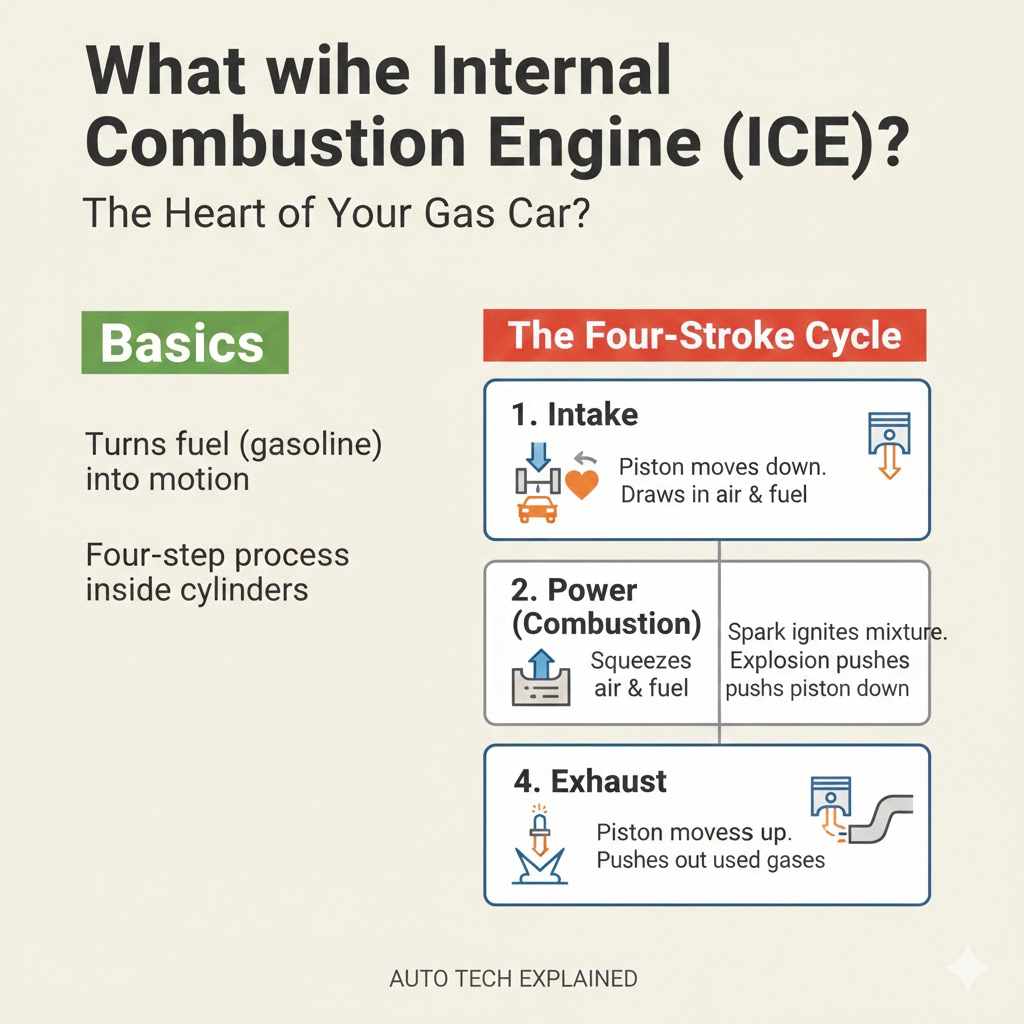
Before we dive into the differences, let’s start with the basics. Nearly every gas car on the road today uses an internal combustion engine, often called an “ICE.” Think of it as the car’s heart. Its job is to turn fuel (gasoline) into motion. But how does it do this? It all happens through a simple, repeated four-step process inside metal tubes called cylinders.
Imagine a tiny, controlled explosion happening thousands of times per minute. That’s exactly what powers your car down the road! This process is often called the “four-stroke cycle.”
- Intake: A piston inside the cylinder moves down, drawing a mix of air and a fine mist of gasoline in. It’s like taking a deep breath.
- Compression: The piston moves back up, squeezing the air and fuel mixture into a very small space. This makes it much more powerful when it ignites.
- Power (or Combustion): A tiny part called a spark plug creates a spark. This spark ignites the squeezed air-fuel mixture, causing a small explosion. The force of this explosion pushes the piston down with great power. This is the “bang” that creates the energy to move your car!
- Exhaust: The piston moves back up one last time, pushing the used gases (exhaust) out of the cylinder and into the exhaust pipe. It’s like exhaling.
This “suck, squeeze, bang, blow” cycle happens incredibly fast in each cylinder. The more cylinders an engine has, and the faster they complete this cycle, the more power the engine can make. This fundamental process is the starting point for understanding all the different types of gas cars.
How Gas Engines Are Different: Cylinders, Layout, and Airflow
Now that you know the basic four-step dance happening inside your engine, let’s look at how carmakers arrange these cylinders. The way the engines or motors work is largely defined by this layout. This design affects everything from the car’s power and smoothness to how much space it takes up under the hood.
Cylinder Layout: The Shape of Power
The arrangement of the cylinders is one of the biggest differences between vehicle types. It’s like organizing a team in different formations. Each formation has its own strengths.
Inline Engines (I-4, I-6)
An inline engine is the simplest design. All the cylinders are lined up in a single, straight row. Think of it like peas in a pod.
- I-4 (Inline-Four): This is the most common engine type in the world, found in most compact and mid-size cars. They are simple, fuel-efficient, and don’t take up much space.
- I-6 (Inline-Six): With six cylinders in a row, these engines are known for being incredibly smooth and balanced. They produce power effortlessly and are often found in luxury and performance cars.
V-Type Engines (V6, V8)
In a V-type engine, the cylinders are split into two rows, or “banks,” that sit at an angle to each other. If you look at it from the front, it forms a “V” shape. This design is a smart way to fit more cylinders into a smaller space.
- V6: A very popular choice for family sedans, SUVs, and trucks. A V6 engine offers a great balance of power and efficiency, providing more muscle than an I-4 without the fuel thirst of a V8.
- V8: The classic engine for muscle cars, large trucks, and high-performance vehicles. V8 engines are known for their deep, rumbling sound and massive power output. They are perfect for towing heavy loads or for thrilling acceleration.
Boxer Engines (Flat-4, Flat-6)
A boxer engine is like a V-engine that has been flattened completely. The cylinders lie flat and face away from each other. As the pistons move, they look like a boxer punching. This design is famously used by Subaru and Porsche.
- Key Benefit: Because the engine is flat and wide instead of tall, it gives the car a lower center of gravity. This helps with stability and handling, making the car feel more planted on the road, especially in corners.
Engine Layout Comparison
Here’s a simple table to help you see the differences at a glance:
| Engine Type | Commonly Found In | Main Advantage | Main Disadvantage |
|---|---|---|---|
| Inline-4 (I-4) | Compact cars, sedans | Fuel efficient, simple, low cost | Less powerful, can be buzzy |
| V6 | SUVs, minivans, larger sedans | Good balance of power and efficiency | More complex than an I-4 |
| V8 | Trucks, muscle cars, luxury SUVs | Very powerful, smooth, great for towing | Uses more fuel, heavier |
| Boxer-4 | Subaru cars, some sports cars | Low center of gravity, good balance | Wider, can be harder to service |
How Engines Breathe: Naturally Aspirated vs. Turbocharged
An engine needs air to mix with fuel for the combustion “bang.” The way it gets that air is another one of the essential differences between gas cars.
Naturally Aspirated Engines
A “naturally aspirated” engine is the standard, traditional type. It simply uses the natural atmospheric pressure and the downward movement of the piston to suck air into the cylinders. It breathes on its own, with no extra help. This design is simple, reliable, and provides a very direct and predictable response when you press the gas pedal.
Turbocharged Engines
A turbocharged engine, or “turbo,” has a special trick up its sleeve. It uses a small turbine (like a tiny pinwheel) that is spun by the car’s own exhaust gases. This turbine is connected to another wheel that acts like a fan, forcing extra air into the cylinders. More air means you can add more fuel, which creates a bigger “bang” and a lot more power from a smaller engine.
- The Benefit: Carmakers can use a smaller, more fuel-efficient engine (like an I-4) and add a turbo to give it the power of a larger engine (like a V6) when you need it. You get good gas mileage during normal driving and a boost of power when you accelerate.
- A Small Quirk: You might sometimes hear about “turbo lag.” This is a slight delay you might feel between pressing the gas pedal and the turbo kicking in to provide that extra power. Modern turbos have made this delay almost unnoticeable.
For more technical details on how turbos improve efficiency, you can check out this resource from the U.S. Department of Energy which explains how downsized turbocharged engines work.
Beyond the Engine: Drivetrain and Transmission Differences
The engine creates the power, but how that power gets to the wheels is just as important. The systems that do this are the transmission and the drivetrain. These are other major differences between the vehicle types.
The Drivetrain: Which Wheels Do the Work?
The drivetrain connects the engine to the wheels that push or pull the car forward. There are three main types.
- Front-Wheel Drive (FWD): The engine sends power only to the front wheels. This is the most common setup in modern cars because it’s compact and fuel-efficient. FWD cars generally have good traction in rain and light snow because the weight of the engine is sitting right over the wheels that are doing the work.
- Rear-Wheel Drive (RWD): The engine sends power only to the back wheels. This is the traditional layout for sports cars, luxury sedans, and trucks. RWD provides better balance and handling for performance driving because the jobs of steering (front wheels) and pushing (rear wheels) are split.
- All-Wheel Drive (AWD): The engine can send power to all four wheels. Modern AWD systems are very smart. They usually power the front or rear wheels during normal driving and automatically send power to the other wheels when they detect slipping. This provides the best possible traction in bad weather like heavy rain, snow, or ice.
The Transmission: Managing the Engine’s Power
The transmission is like the gear system on a bicycle. It allows the engine to operate at a comfortable speed whether you are starting from a stop or cruising on the highway. There are a few main types you’ll find in gas cars.
- Automatic Transmission: This is the most common type. It automatically changes gears for you. You just put it in “Drive” and go. It’s simple and easy to use in stop-and-go traffic.
- Manual Transmission (Stick Shift): With a manual, the driver uses a clutch pedal and a gear shifter to change gears by hand. Many enthusiasts prefer this because it offers more control and a more engaging driving experience.
- Continuously Variable Transmission (CVT): A CVT doesn’t have traditional gears. Instead, it uses a system of belts and pulleys to provide a seamless range of gear ratios. This helps the engine stay at its most efficient speed, which can improve fuel economy. When you drive a car with a CVT, you won’t feel the car shift; it’s just smooth, continuous acceleration.
Drivetrain and Transmission Quick Guide
| System Type | How It Works | Best For |
|---|---|---|
| Front-Wheel Drive (FWD) | Engine powers the front wheels. | Everyday driving, fuel economy, rain/light snow. |
| Rear-Wheel Drive (RWD) | Engine powers the rear wheels. | Performance driving, towing, dry conditions. |
| All-Wheel Drive (AWD) | Engine can power all four wheels. | All weather conditions, especially snow and ice. |
| Automatic Transmission | Shifts gears for you. | Convenience and ease of use, especially in traffic. |
| Manual Transmission | You shift gears with a clutch and shifter. | Driver engagement, control, and fun. |
| CVT | No distinct gears, provides smooth acceleration. | Maximizing fuel efficiency and smooth driving. |
What This Means for You: Maintenance and Ownership
Understanding these differences isn’t just for car trivia night; it directly impacts your experience as a car owner. The type of engine and drivetrain in your car can affect how much you pay for maintenance, fuel, and repairs.
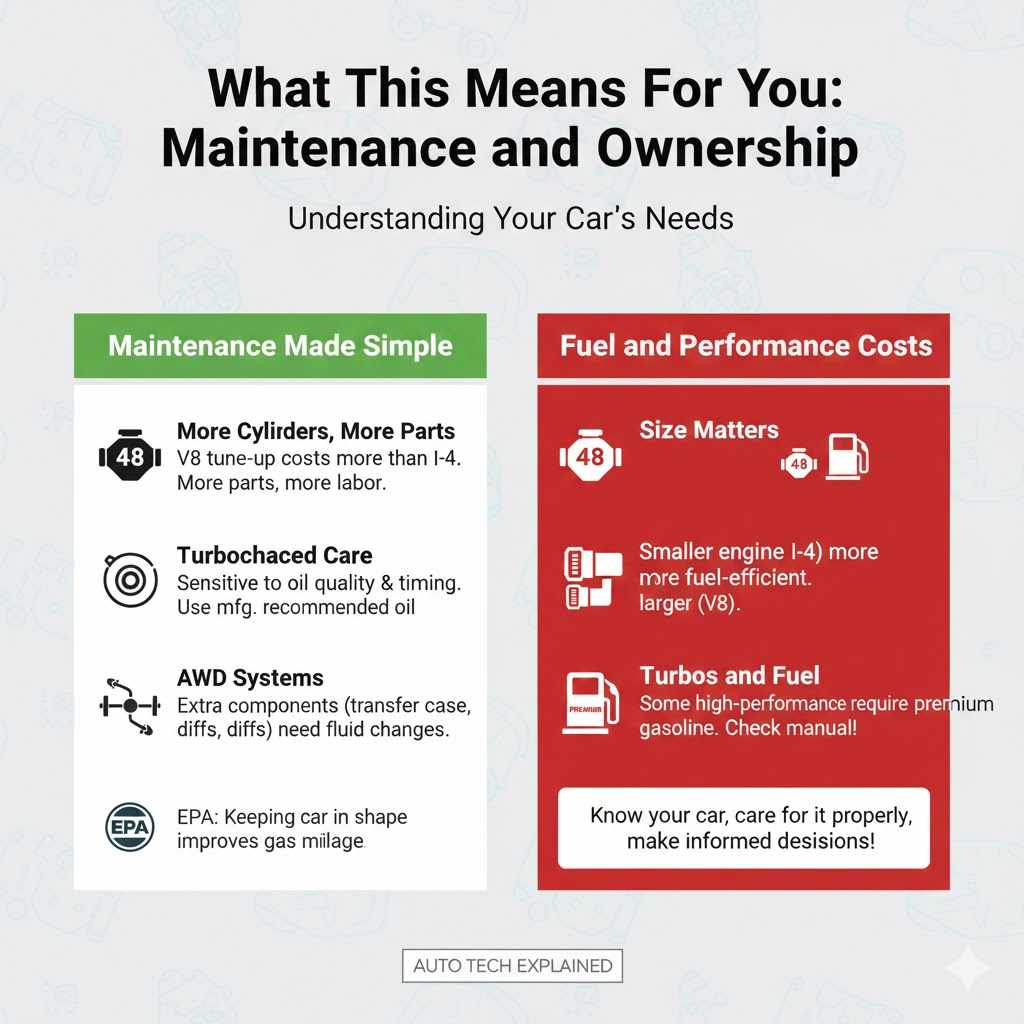
Maintenance Made Simple
While all gas cars need basic care like oil changes and tire rotations, some types have unique needs. Here are a few things to keep in mind:
- More Cylinders, More Parts: An oil change is an oil change, but a tune-up on a V8 will cost more than on an I-4. Why? The V8 has eight spark plugs and eight fuel injectors to service, while the I-4 only has four. More parts often mean more labor time and higher costs.
- Turbocharged Care: Turbocharged engines work harder and create more heat. Because of this, they are often more sensitive to the quality of the engine oil and the timing of your oil changes. It is very important to use the specific oil your car’s manufacturer recommends and to follow the maintenance schedule closely to keep the turbo healthy.
- AWD Systems: All-wheel drive systems have extra components like a transfer case and differentials that need their fluids checked and changed periodically. This is an extra maintenance step compared to a simpler FWD car.
The U.S. Environmental Protection Agency (EPA) offers great tips on how keeping your car in shape can improve your gas mileage, no matter what kind of engine you have.
Fuel and Performance Costs
The engine is the biggest factor in how much fuel your car uses.
- Size Matters: Generally, a smaller engine with fewer cylinders (like an I-4) will be more fuel-efficient than a larger one (like a V8).
- Turbos and Fuel: Some high-performance turbocharged engines require premium gasoline (higher octane) to run their best and avoid engine damage. This can add to your running costs over time. Always check your owner’s manual to see what fuel is recommended for your car.
By understanding the heart of your car, you are in a much better position to care for it properly and make informed decisions. You can now walk into a service center with more confidence or even feel ready to tackle some simple checks yourself!
Frequently Asked Questions (FAQ)
What is the easiest way to know what kind of engine my car has?
The easiest way is to check your owner’s manual. It will list all the specifications for your vehicle. You can also often find a sticker under the hood or on the driver’s side door jamb with this information. Sometimes, the engine type (like V6 or TURBO) is written on a plastic cover on top of the engine itself or as a badge on the trunk of the car.
Is a bigger engine always better or more powerful?
Not anymore! In the past, more cylinders and a bigger size usually meant more power. Today, with technology like turbocharging and direct fuel injection, a smaller, modern four-cylinder turbo engine can often produce more power than an older, larger V6 engine, all while using less fuel.
What does ‘naturally aspirated’ mean in simple terms?
Naturally aspirated simply means the engine breathes air naturally, without any help. It uses the piston’s suction to pull air in, just like you use your lungs to breathe. It’s the standard, non-turbo, non-supercharged engine type.
Are turbocharged engines less reliable than non-turbo ones?
Modern turbocharged engines are very reliable when properly maintained. The key is to follow the manufacturer’s maintenance schedule, especially for oil changes. Using the correct, high-quality oil is crucial for keeping the turbo’s moving parts lubricated and cool. When cared for, a turbo engine can last just as long as a naturally aspirated one.
What is the difference between gasoline and petrol?
There is no difference at all! “Gasoline” is the term commonly used in North America, while “petrol” is the term used in the United Kingdom and many other parts of the world. They are just two different words for the exact same fuel that powers your gas car.
Does an AWD car use more fuel than a FWD car?
Yes, typically an AWD car will use slightly more fuel than the exact same model with FWD. This is because the AWD system has more moving parts, which adds weight and creates more friction for the engine to overcome. However, for many drivers, the small trade-off in fuel economy is well worth the huge benefit in safety and traction in bad weather.
Your Journey to Car Confidence
Congratulations! You’ve just taken a huge step toward understanding your gas-powered car. We’ve pulled back the curtain on how gas cars work, exploring the way the engines or motors create power and the other key differences between vehicle types. From the simple four-stroke cycle to the layout of cylinders in V6 or I-4 engines, you now have a solid foundation.
You’ve learned how turbochargers give a power boost to smaller engines and how drivetrains like FWD and AWD send that power to the road. This knowledge isn’t just interesting—it’s empowering. It helps you understand why your car feels and sounds the way it does, what it needs to stay healthy, and what to look for in your next vehicle.
The world under the hood is no longer a complete mystery. The next time you hear someone mention a “turbo V6” or an “inline-four,” you’ll know exactly what they’re talking about. Remember, every expert was once a beginner. Keep asking questions, keep learning, and enjoy the confidence that comes with truly knowing your car.