Best Car Door Latches for DIY Repairs: Based on Specs and Reviews
Choose the latch that matches your door’s failure mode, connector style, and mounting shape; if the actuator is built into the assembly, replace the full unit, not a spring or cable alone. A mismatched latch can leave the door stuck closed, unlatch without warning, or waste money on returns. This guide compares replacement door latches for DIY repairs by symptom, connector type, and door-side fitment before you order.
Quick comparison
| Product | Badge | Best for | Price | ||
|---|---|---|---|---|---|
 |
GM Genuine Parts 13546554 Rear Passenger Side Door LatchGM GENUINE PARTS | Our pick | Rear passenger-side · OE latch · GM fit | $147.78
Price as of 3 Nov 2026
|
View |
 |
NewYall Front Right RH Passenger Side Power Door LockNewYall | Budget pick | Front right · power latch actuator · Ford fit | $24.99
Price as of 3 Nov 2026
|
View |
If your symptom is a rear passenger door that still needs OE-style fitment, start with the GM Genuine Parts latch. If the problem is on a front right Ford or Lincoln door with power lock failure, the NewYall latch-and-actuator assembly is the better match.
How we chose
Selection is based on available manufacturer specs, listing details, and published buyer feedback. Fitment accuracy mattered most, along with door-side compatibility, actuator or sensor integration, and whether the part looked likely to solve the symptom without connector trouble or a return.
For DIY buyers, install complexity matters too. A latch that matches the door position and connector layout is worth more than a cheaper part that leaves you with a stuck trim panel, a broken clip, or a warning light that stays on.
Which latch part do you actually need?
The right fix depends on the symptom you see first. A door latch assembly holds the door shut and may include an integrated actuator or door-ajar sensor, while the striker plate, handle linkage, and clips can create similar symptoms without the latch itself being bad.
| Symptom | Likely failed component | When replacement is justified | Buy-check points |
|---|---|---|---|
| Stuck-shut door | Latch mechanism, seized release pawl, or broken linkage | If the handle moves but the door will not release after checking the striker and linkage | Match exact year, make, model, and door side; confirm the mounting shape and cable or rod layout |
| Free-moving handle | Broken handle linkage clip or disconnected rod/cable | If the handle has no resistance and the latch itself still responds when manually moved | Inspect clips before ordering a full assembly; verify whether the linkage is sold separately |
| Weak power locks | Door lock actuator, sometimes built into the latch assembly | If lock cycling is slow, incomplete, or intermittent after battery and connector checks | Confirm integrated actuator layout and connector style; some parts use a 4-pin connector |
| Door-ajar light | Door-ajar sensor, often integrated into the latch | If the dash warning persists after the door closes fully and the striker is aligned | Check whether the sensor is part of the latch assembly or a separate switch before buying |
| Misaligned door | Striker plate or hinge alignment, not always the latch | If wear marks on the striker show off-center contact or the door must be lifted to close | Adjust alignment first; only buy a latch if the mechanism is damaged or worn |
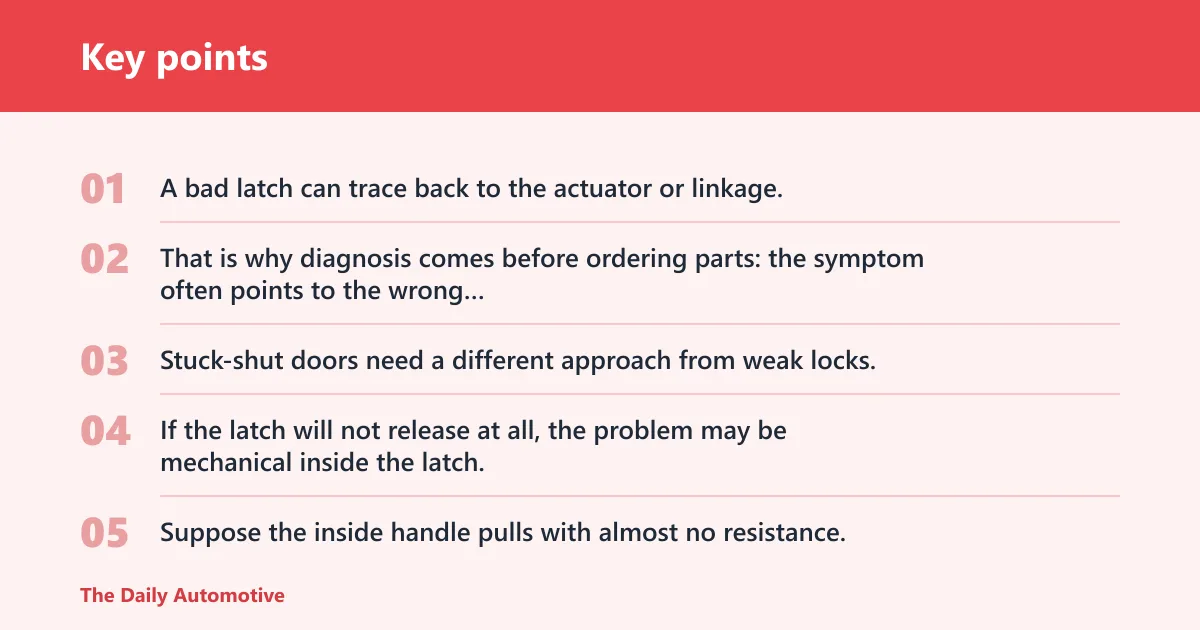
A bad latch can trace back to the actuator or linkage, and a door-ajar warning can mean a failed sensor. That is why diagnosis comes before ordering parts: the symptom often points to the wrong item if you skip the striker, hinge, and clip checks.
Start with the symptom
Stuck-shut doors need a different approach from weak locks. If the latch will not release at all, the problem may be mechanical inside the latch, while a handle that moves freely often means a broken clip at the linkage.
Suppose the inside handle pulls with almost no resistance, but the door still opens from the outside after some fiddling. That points toward a broken rod clip or cable end, not an automatic need for a full latch assembly.
Check the body-side hardware first
The striker plate, hinges, and door alignment can mimic latch failure. Wear marks on the striker, sagging hinges, or a door that needs to be lifted to close can keep a good latch from engaging correctly.
A misaligned striker can also trigger a false door-ajar condition. If the latch never reaches its full locked position, the sensor may report the door as open even when it looks shut.
Inspect the linkage and clips
Door handle linkage uses rods or cables that connect the handle to the latch. A broken clip can leave the handle free-moving while the latch itself remains serviceable.
Check these pieces before buying a complete assembly. A clip or rod failure is far cheaper than a full latch, and it avoids the extra work of replacing a part that still works.
Watch for integrated electronics
Some latches include a door lock actuator, and some include a door-ajar sensor. If either part is built into the assembly, partial repair options shrink fast.
That matters on vehicles where the power lock cycles weakly or the dash light stays on. In those cases, connector style and internal layout matter as much as the latch shape itself.
GM genuine Parts 13546554 rear passenger side door latch: best for OE-style rear fitment
This GM Genuine Parts latch is the cleanest match for a rear passenger-side repair where exact fit and original-equipment style matter more than saving a few dollars. It is listed as an OE latch for GM applications, and the product details say it is designed for Chevrolet, Buick, GMC, and Cadillac fitment.
It is a sensible choice when the door closes poorly, the latch mechanism is worn, or you want a part aimed at the original platform rather than a universal-style workaround. The listing also says it is built and tested to rigorous standards.
The honest drawback is cost. At $147.78, it is much pricier than a budget aftermarket part, so it makes the most sense when you want to reduce fitment risk on the rear passenger side rather than chase the cheapest possible repair.
NewYall Front Right RH Passenger Side Power Door Lock Actuator Latch: best for front-right power lock faults
This NewYall assembly is aimed at a front right passenger-side repair where the lock actuator and latch are tied together. The title says it is a power door lock actuator latch for Ford F150, Explorer, Edge, Mustang, Escape, Focus, and Lincoln applications, and the listing also says it covers select Lincoln, Mazda, and Mercury models.
It fits the use case where a weak or failed actuator makes the lock cycle poorly, but the latch body still needs to match the door position exactly. The listing’s front-right labeling is useful for buyers who need the passenger side and want a part that already includes the actuator side of the repair.
The drawback is fitment complexity. Multi-vehicle aftermarket listings can look broad, but the wrong connector, cable path, or door-side match can still leave you with a return. The published price is $24.99, which helps on budget, but you should verify your exact year and connector layout before ordering.
Which one should you buy?
If your rear passenger door is the problem and you want the closest match to original equipment, start with the GM Genuine Parts latch. If your issue is on the front right and the power lock is part of the failure, the NewYall actuator latch is the better fit.
Choose the more expensive OE-style part when the door has been hard to close, the original latch has an odd mounting shape, or you want to lower the odds of a return. Choose the budget actuator assembly when the door-side fit is clear and the lock symptom points to the electronic side of the latch.
Say your driver notices the rear passenger door will not stay fully latched after a winter freeze, but the striker and hinges look straight. That is the kind of case where a full rear latch assembly can make sense if the mechanism is binding inside the unit.
Suppose the front right lock only half-cycles and the handle still feels normal. That symptom leans toward actuator integration, so the correct purchase is the assembly that matches the connector and lock hardware, not a random mechanical latch.
What is the best replacement car door latch for my vehicle?
The best replacement latch is the one that matches the exact year, make, model, and door position, then matches the symptom you actually have. If the latch includes the actuator or sensor in your vehicle, buy the full assembly so you are not left with a partial repair that cannot restore locking or warning-light behavior.
OEM-style latch: best for exact fit
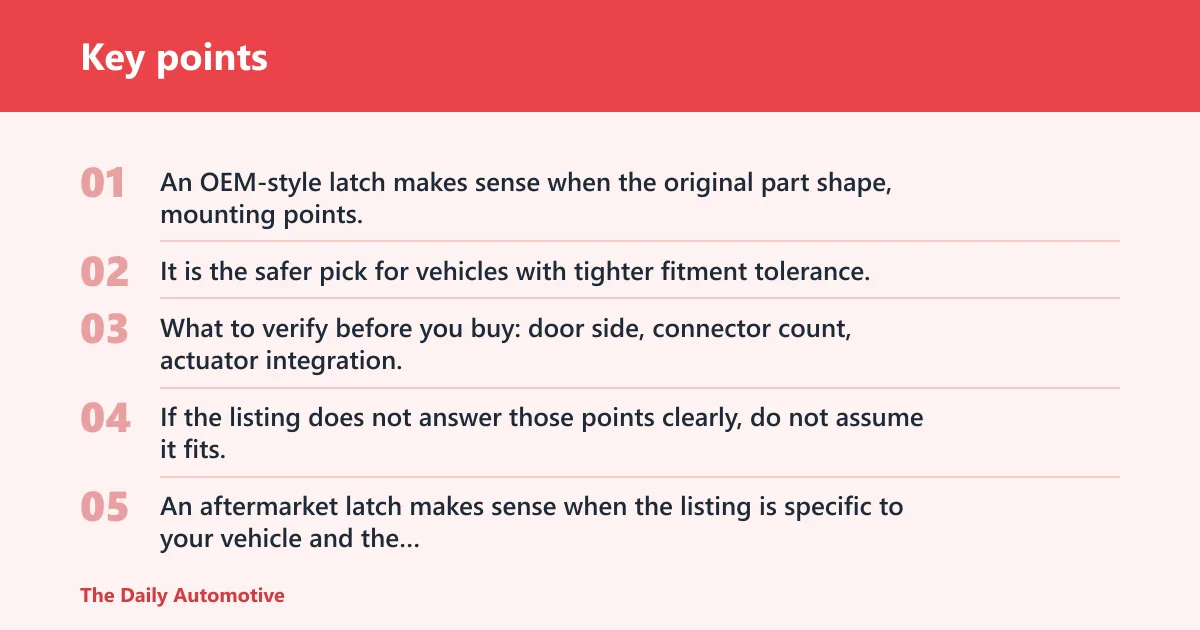
An OEM-style latch makes sense when the original part shape, mounting points, or connector layout are hard to match with a generic replacement. It is the safer pick for vehicles with tighter fitment tolerance, especially when the door must seal properly and the trim is difficult to remove twice.
What to verify before you buy: door side, connector count, actuator integration, and whether the latch includes the door-ajar sensor. If the listing does not answer those points clearly, do not assume it fits.
Aftermarket latch: best for budget repairs
An aftermarket latch makes sense when the listing is specific to your vehicle and the failure is straightforward. It can be a good budget fix for a known broken latch or actuator, but fitment and connector checks matter more because the part may cover multiple platforms.
Do not buy on price alone. A cheaper latch that needs a second removal because the connector or cable routing is wrong can cost more in broken clips, new vapor barrier material, and lost time than the better part would have cost up front.
Latch with actuator: best for power lock faults
If the lock motor is built into the latch assembly, replace the full unit when power cycling is weak, inconsistent, or dead. That is especially true when the door still latches by hand but the lock no longer responds cleanly to the switch or key fob.
Connector style matters here. One listed part supports a 4-pin connector, so the plug shape and pin count should be checked against the old unit before you order.
How do you choose the right latch?
Match the exact vehicle fitment first, then confirm whether you need front left, front right, rear left, or rear right. After that, check the connector style, actuator layout, and whether the door-ajar sensor is integrated into the assembly.
Match the door side first
Door position is not a small detail. A front left latch and a front right latch may look close enough in photos to fool a quick search, but the cable paths, connector angle, and mounting shape can differ enough to make the part unusable.
For a front right passenger door lock actuator, the fitment target is specific to Ford and Lincoln models in the listing data. For a rear passenger-side GM application, the rear passenger-side designation matters just as much as the brand name on the box.
Check connector style and integration
Some latch assemblies carry only the latch mechanism, while others add the actuator and sensor. That difference changes the connector you need and the failure the part will cure.
Confirm whether the replacement matches a 4-pin connector if your original plug uses that layout. If the sensor or actuator is built in, do not plan on reusing an old component that is no longer separate.
Compare price against misdiagnosis risk
DIY replacement can cost far less than a shop, but only if the diagnosis is right. VehicleRuns estimates DIY difficulty as moderate, with 1.5–3 hours of labor and $40–$180 in parts and supplies, while shop pricing is estimated at $180–$500.
That gap narrows fast if you buy the wrong part and have to reopen the door. Broken clips, resealing materials for the vapor barrier, and extra time can turn a budget repair into a more expensive one than the shop quote you skipped.
What tools do you need to replace a car door latch yourself?
At minimum, plan for trim removal tools, Torx and socket bit set, screwdrivers, and pliers. VehicleRuns lists that basic tool set, and the right pry tools matter because plastic trim pieces and retaining clips are easy to damage during panel removal.
- Use plastic pry tools to remove the interior door panel without gouging the trim.
- Back out the Torx and socket fasteners that hold the panel and latch hardware.
- Keep screwdrivers and pliers ready for clips, rod ends, and stubborn retainers.
- Peeled back the moisture barrier carefully, then reseal it with butyl tape or adhesive during reassembly.
Do not force a panel that feels stuck. Side airbag trim and fragile door panels deserve extra care, and VehicleRuns warns that professional help is smart in those cases.
How much does a DIY door latch replacement cost compared with a shop?
DIY is usually cheaper on paper, but the real cost includes the part, resealing materials, and the chance of buying the wrong assembly.
The cost comparison changes if diagnosis is wrong. A bad striker adjustment can look like a failed latch, and a broken clip can look like a dead actuator. Buying the wrong part means you pay twice: once for the wrong assembly and again for the correct one.
Shops charge more, but they absorb the risk of part selection and trim damage. DIY makes the most sense when the symptom is clear, the connector is known, and the door side is confirmed before the first bolt comes out.
Can a bad door latch be fixed without replacing the whole part?
Sometimes, yes. A broken linkage clip, a striker adjustment issue, or a dry latch mechanism can be repaired without replacing the full assembly, as long as the latch body itself still moves correctly and the door-ajar sensor is not part of the failure.
A sticky latch is not automatically a dead latch. If the mechanism only feels stiff, lubricant may be enough for a temporary or permanent fix, provided the latch is not worn, bent, or contaminated by rust or broken internal pieces.
When lubrication is worth trying
Jeepzine recommends WD-40 or a similar lubricant for stiff latches. That is most useful when the latch is sticky but not broken, and when the goal is to see whether the mechanism frees up before you spend money on a full replacement.
If the latch improves only briefly, the internal wear is probably still there. Lubricant can buy time, but it does not fix a broken actuator, a failed sensor, or a cracked clip.
When replacement is the better call
Replace the assembly when the latch will not hold the door shut, the actuator fails to cycle, or the door-ajar light keeps returning after alignment checks. If the sensor is built into the latch, the full assembly is often the practical fix.
The same is true if the mechanism has a pattern of sticking after repeated cleaning or lubrication. That usually points to wear rather than simple dryness.
Can a sticky door latch be repaired with lubricant instead of replacement?
Yes, if the latch is only stiff and not mechanically damaged. A lubricant can help a dry or slightly corroded mechanism move again, but it should be treated as a test step, not a guarantee that the assembly is healthy enough to keep.
Start with alignment and linkage checks, then use lubricant only if the parts still appear intact. If the latch continues to bind, the safer answer is replacement, especially when the door can become stuck shut.
Will a new latch fix a door-ajar light that stays on?
Sometimes. If the door-ajar sensor is integrated into the latch and the warning stays on after the door closes fully, a new assembly can fix the problem. If the striker, hinge, or alignment is wrong, though, the light can stay on even with a good latch.
Check whether the door closes squarely and whether the latch fully engages before ordering parts. A misaligned striker can keep the sensor from reading the closed position correctly.
Frequently asked questions
How do I know if I need a full latch assembly or just a clip?
If the handle moves freely but the latch still responds, a broken clip or disconnected linkage is likely. If the door will not latch, lock, or report closed even after alignment checks, the full assembly is more likely needed. Inspect the rod ends and cable clips before ordering the bigger part.
What tools do I need to replace a car door latch myself?
Plan on trim removal tools, Torx and socket bits, screwdrivers, and pliers. Use plastic pry tools to limit broken clips and scratched trim. You will also need material to reseal the moisture barrier after the panel comes off, since water protection matters inside the door.
How do I choose the correct front left or front right door latch?
Use the exact door position printed in the listing and match it to your vehicle’s side. Front left and front right parts can differ in mounting shape, connector angle, and linkage routing. Confirm the connector style and whether the actuator is built into the unit before ordering.
After installation, test the latch several times with the door open and closed, then check lock cycling, door-ajar behavior, and the closing feel. If the door does not sit flush or the warning light stays on, recheck the striker, linkage, and connector before assuming the new part is wrong.
Products related to this article
Sponsored / affiliate links. As an Amazon Associate I earn from qualifying purchases. I may earn additional commission from eligible campaigns.
 Universal Mini Bear Jaw Car Door Latch Kit for Hot & Street Rods, Rod & Cable Release Compatible, Ideal for Ford Model A & T, Supports Shaved & Suicide Doors, Ensures Safety & Reliability
 IINAWO Large Door Latches w/Install Kit Street Autbclgkt Muscle Hot Rod for Ford, for Toyota, for Jeep, for GMC, for Chrysler, for Dodge, for Buick, for Plymouth, for Cadillac Zinc Plated