Glass for Car: Tested & Reviewed (3 Picks)
The best glass for a car is the exact OEM-spec piece that matches your sensors, tint, acoustic layer, and heating or HUD options. When fit and calibration matter, OEM or OE-equivalent glass is the safest choice. Pick the wrong spec and you can get wind noise, distorted vision, failed rain or lane sensors, or a windshield that cannot be calibrated correctly. This guide shows how to pick glass by vehicle system, replacement quality, and the tradeoff between OEM, OE-equivalent, and budget parts.
Quick comparison
| Product | Badge | Best for | Price | ||
|---|---|---|---|---|---|
 |
JMTAAT Door Window Glass Compatible with 2014-2019 Soul EVJMTAAT | Our pick | Driver side · tempered · rear door glass | $75.05
Price as of 1 Nov 2026
|
View |
 |
Rear Defroster Repair Kit DIY Rear Defogger Defroster GridGeneric | Budget pick | Rear defroster · repair kit · conductive paint | $6.45
Price as of 1 Nov 2026
|
View |
 |
99% Anti UV Car Windshield Window Tint Adhesive HeatMEGICOLIM | Pair with it | 40 inch x 100 feet · 85% VLT · tint film | $199.88
Price as of 1 Nov 2026
|
View |
Use this as a starting point, then check the vehicle’s glass position, sensor package, and trim level. Front windshield choices hinge on optics, calibration, and factory fit. Side and rear glass depend more on safety standard, tint match, and correct tempering.
How we chose
This comparison is based on manufacturer specs, listing details, and published buyer feedback. It separates windshield use from side and rear glass use, then puts safety, compatibility, and installation fit ahead of price alone.
Three things matter most: whether the glass position is laminated or tempered, whether the vehicle has HUD or ADAS hardware, and whether the replacement part meets the applicable safety standard, such as ANSI Z26.1 or an equivalent regional rule. Brand reputation matters too, especially for optical quality and sensor compatibility.
OEM glass: best for HUD vehicles
OEM glass is the factory-matched option and the safest buy for a vehicle with a HUD, a lease, or a sensitive sensor package. It is the highest-cost option in the comparison table, but it gives the closest fit, the most predictable clarity, and the best odds of keeping projection alignment correct.
Modern windshields can house cameras, rain sensors, antennas, and HUD projectors. If the windshield carries any of those systems, small differences in curvature, tint band placement, or optical clarity can matter more than the sticker price.
Why OEM matters here
HUD-equipped cars are especially sensitive because the projection tint must match exactly. Acoustic glass is another reason to stay close to factory spec. OEM often preserves the original sound insulation better, which matters more on premium vehicles and long highway drives.
For leased vehicles, OEM also avoids arguments about non-factory parts at turn-in. A common first-timer mistake is assuming all “good-looking” glass is equal. On a HUD car, a clear pane can still project poorly if the optical zone is wrong.
OEE glass: best for modern daily drivers
OEE glass is the middle ground. It is often positioned as a close match to OEM fit and function, but the actual result still depends on the specific part and brand. For many daily drivers, especially non-luxury cars with standard sensors, that balance makes sense.
OEE is a stronger fit when the vehicle needs good fitment and calibration compatibility, but does not depend on factory-branded glass for HUD projection or premium acoustic performance. If the listing clearly states compliance with the right safety standard and the installer confirms the correct sensor cutouts, OEE can be the practical choice.
When OEE is the better buy
Choose OEE when the car is newer, used every day, and equipped with ADAS but not a picky HUD layout. It is often the best compromise between cost and confidence, especially if you want the replacement to behave like the original glass without paying OEM pricing.
Say your commuter sedan has a forward camera and a rain sensor, but no HUD and no lease penalty. OEE is often the sensible target because it can match the necessary specs without forcing you into the highest-cost part.
Aftermarket glass: best for older vehicles
Aftermarket glass is widely available and usually the lowest-cost option, but quality varies by brand. That makes it suitable for many older vehicles, basic trims, and non-HUD applications where exact optical behavior matters less than proper fit and a compliant part number.
Buyers still need to check the listing carefully. Reputable aftermarket brands can be useful vetting examples, but the real question is whether the part meets ANSI Z26.1 or the equivalent regional safety standard and whether the installer can set it correctly.
When aftermarket is sensible
Aftermarket glass can be a smart buy for an older car with plain side or rear glass, or for a windshield on a vehicle without camera-based driver assistance. It is less attractive when the car has HUD projection, acoustic requirements, or calibration-sensitive sensors.
One failure mode to watch is optical distortion. A low-quality windshield can look fine at a glance and still create warping, wind noise, or a poor camera image after installation.
What type of glass is used in car windows
Front windshields use laminated glass, which means two layers of glass bonded by a plastic interlayer. Side windows are made from tempered glass that breaks into blunt pieces, and rear windshields are often tempered and may include a defroster grid.
That difference matters because windshield glass is meant to stay intact on impact, while side and rear glass are meant to break in a controlled way. Do not treat them as interchangeable parts. The right replacement depends on the window position and the vehicle’s equipment.
Front, side, and rear priorities
Front glass has the strictest optical and calibration demands because it can carry cameras, rain sensors, antennas, and HUD projectors. Side and rear glass are more about the correct tempering, tint match, and defroster function where equipped.
Tempered glass is not repairable once broken in the same way laminated windshield glass can sometimes be repaired for chips. It shatters into small blunt pieces, which is why it is used for side and rear windows.
Do you need ADAS recalibration?
If the vehicle uses a windshield camera or another ADAS sensor, the system may need recalibration after replacement. Skipping recalibration can disable lane assist and automatic braking, so this is not optional when the vehicle requires it.
ADAS recalibration restores camera and sensor accuracy after the glass is replaced. The job adds cost and labor, and it often changes the real replacement price more than the glass brand does.
How recalibration affects price
A windshield-only quote can be misleading if it leaves out camera work. The labor for calibration, plus any setup needed for the specific driver-assistance system, is part of the job on many newer cars.
Windshield glass decision matrix
This matrix is the quickest way to match the glass to the vehicle system. Use it to separate a plain commuter car from a HUD vehicle, an ADAS-equipped SUV, or a lease return where factory fit matters most.
| Vehicle type | Glass type | Sensor/HUD compatibility | Recalibration need | Optical distortion risk | Safest buy |
|---|---|---|---|---|---|
| HUD-equipped sedan | OEM | Best match for HUD projection and camera cutouts | Usually yes if camera-based ADAS is present | Lowest when OEM spec is correct | Choose OEM for projection accuracy and clarity |
| Leased vehicle with front camera | OEM | Strong fit for sensors and factory trim | Usually yes on 2016+ vehicles | Low | Choose OEM to stay closest to factory condition |
| New daily driver without HUD | OEE | Often compatible with modern ADAS layouts | Usually yes if the camera mounts on the windshield | Low to moderate, depending on brand | Choose OEE when the listing matches OEM specs |
| Older commuter car | Aftermarket | Usually fine if no HUD and no camera-dependent driver aid | Often no, unless the vehicle still uses a windshield camera | Moderate, varies by brand | Choose a branded part that meets the safety standard |
| Premium car with acoustic glass | OEM | Best chance of matching sound insulation and optics | Usually yes if equipped with ADAS | Low | Choose OEM when cabin noise control matters |
| Side or rear window only | Tempered glass | Usually no HUD concern | Not typical unless the rear glass has heating or a camera feature tied to the replacement | Low if the fit is correct | Choose the correct tempered panel and defroster spec |
ANSI Z26.1 is the U.S. safety baseline to look for, and the equivalent regional standard matters just as much outside the United States. If the replacement part does not meet the right safety marking, move on.
Rear defroster repair kit: best for grid lines
This is for a rear glass defroster grid that has a broken or scratched line, not for cracked glass itself. It is a low-cost repair option when the defroster is the problem and the rear windshield is otherwise intact.
The key detail is in the listing: it is a conductive adhesive paint repair kit for heater grid lines, and it is designed for quick fixes on scratched or broken defroster lines. That makes it useful for a functional repair, especially when you want to restore rear visibility in cold or wet weather.
The drawback is simple. It repairs the grid, not the glass, and it will not help if the rear window itself is cracked, shattered, or leaking.
JMTAAT rear door glass: best for side window replacement
This is a tempered rear door glass replacement for a specific vehicle application. It fits the side-window job, where tempered glass is the correct material and the main concern is clean fit, tint match, and durability after breakage.
The listing notes tempered glass for strength and durability, dark tint for privacy, and a smooth surface to help keep the view clear. Those are the right kinds of details to check on side glass, where the optical demands are lower than on a windshield but the fit still has to be exact.
The drawback is that it is a vehicle-specific part. You need to verify the exact model and door position before ordering, and it will not substitute for windshield glass or rear defroster repair.
Anti-UV front window film: best for glare control
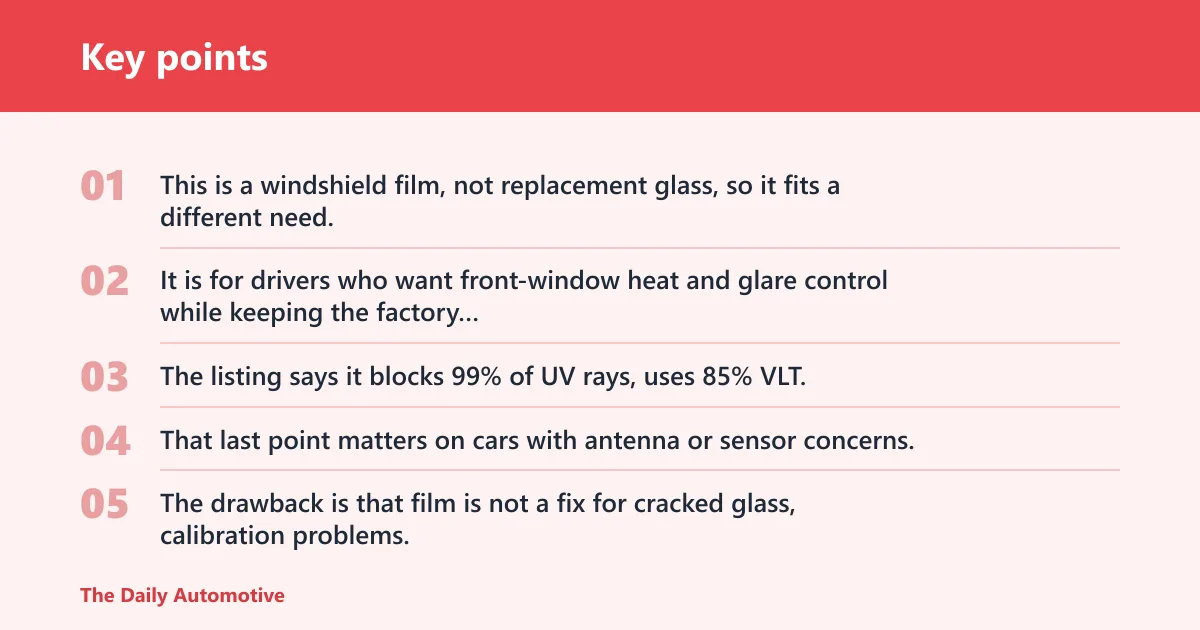
This is a windshield film, not replacement glass, so it fits a different need. It is for drivers who want front-window heat and glare control while keeping the factory glass in place, provided the vehicle and local laws allow that kind of film.
The listing says it blocks 99% of UV rays, uses 85% VLT, and is non-metallized to avoid signal interference. That last point matters on cars with antenna or sensor concerns, because signal-friendly film can be a better fit than a metallic alternative.
The drawback is that film is not a fix for cracked glass, calibration problems, or a bad windshield spec. If the car needs a new windshield, the film comes after the correct part choice, not before it.
Which one should you buy?
Choose OEM if you drive a HUD car, lease the vehicle, or want the closest factory match. Choose OEE if you want a strong middle ground on a newer daily driver with ADAS. Choose aftermarket if the car is older and the brand meets the right safety standard.
For front glass, start with the vehicle’s equipment list and build from there. A windshield with cameras, rain sensors, or a HUD is a different job from a plain side window or a rear door pane. Do not let a lower price distract you from fit and calibration.
Picture a midsize SUV with lane assist and a head-up display. The safer buy is usually OEM, because the optical zone and sensor setup matter more than saving a small amount on the part.
Suppose you are replacing a rear door window on a 10-year-old hatchback. Tempered aftermarket glass from a reputable brand can be a sensible choice if it matches the original tint and the correct safety marking.
Simple pickup checklist
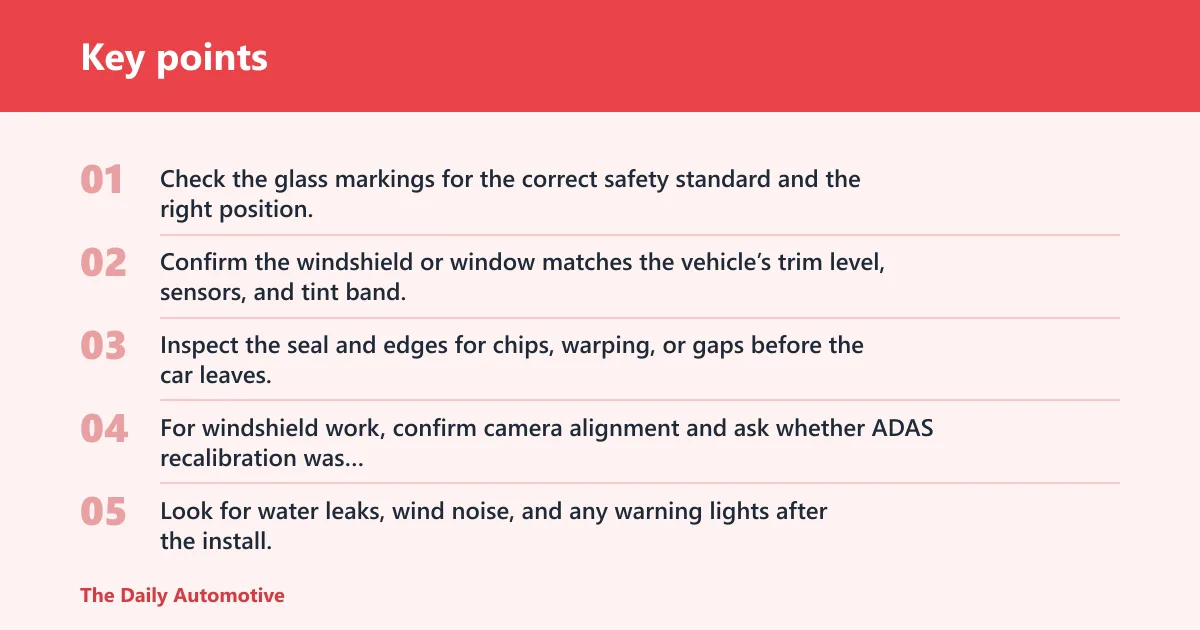
- Check the glass markings for the correct safety standard and the right position.
- Confirm the windshield or window matches the vehicle’s trim level, sensors, and tint band.
- Inspect the seal and edges for chips, warping, or gaps before the car leaves.
- For windshield work, confirm camera alignment and ask whether ADAS recalibration was completed when the vehicle requires it.
- Look for water leaks, wind noise, and any warning lights after the install.
Keep dash and windshield items out of airbag zones and the driver’s view, and check local laws before adding films or accessories. Follow the vehicle manual for any related work, and use a certified technician for glass replacement whenever the job involves sensors or structural glass.
Frequently asked questions
What type of glass is used in car windows: front windshields use laminated glass
Front windshields use laminated glass with two layers of glass bonded by a plastic interlayer. Side windows and rear windshields are usually tempered glass, which breaks into small blunt pieces. The correct material depends on where the glass sits in the vehicle.
Is there a difference in windshield glass quality?
Yes. OEM glass is the highest-cost option and usually gives the closest factory match for fit and clarity. OEE glass is meant to be a close match, while aftermarket glass can vary by brand, so quality differences show up in optics, fit, and sensor compatibility.
What is the best quality glass for a car windshield?
For a windshield, the best quality choice is usually OEM when the vehicle has a HUD, acoustic glass, or camera-based driver assistance. OEE can also be a strong choice on newer daily drivers if it truly matches the needed specs and safety markings.
How do I know if I need OEM or aftermarket glass?
Use OEM if the car has a HUD, is leased, or has sensitive sensor placement. Aftermarket can work on older vehicles or plain-glass applications if it meets the right safety standard and the listing matches the vehicle exactly. The decision should follow the car’s equipment, not the sticker price.
Do I need ADAS recalibration after windshield replacement?
If the vehicle uses a windshield camera or another ADAS sensor, recalibration may be required after replacement. Recalibration restores sensor accuracy, and skipping it can disable lane assist and automatic braking. That makes the calibration part of the repair, not an optional add-on when it applies.
Which glass is better ceramic or tempered glass?
They are not direct substitutes. Tempered glass is the material used for side and rear windows. Ceramic usually refers to a coating or tint type, not the structural glass itself. If you are choosing replacement glass, the position and safety spec matter more than the label.
Products related to this article
Sponsored / affiliate links. As an Amazon Associate I earn from qualifying purchases. I may earn additional commission from eligible campaigns.