Glass Window for Cars: Enhance Safety and Style on the Road Today
For most cars, the right mix is laminated glass for the windshield, tempered glass for side and rear windows, and acoustic or UV/IR-coated glass if you want less noise and heat. Pick electrochromic glass only when glare control justifies the price. Wrong glass can raise breakage risk, cabin noise, heat load, and repair bills. This guide compares automotive glass types so you can choose the right mix for safety, glare control, privacy, noise, and climate.
What a glass window for cars includes

A car window is more than the pane you see. It includes the glass type, the frame that holds it, the seals that block air and water, and sometimes sensors and switches that control movement, tint, or safety functions. That full system shapes safety, comfort, and repair cost.
Glass, seals, and frames
Automotive window systems now use laminated and tempered glass for passenger safety. The frame supports and secures the glass, while the seal closes the gap against wind, rain, dust, and pollen. If any one part wears out, you can get leaks, noise, vibration, or rattles even when the glass itself is intact.
Window seals help stop water and air intrusion into the cabin. Good seals also cut road and wind noise for a quieter ride. That matters in trucks, family vehicles, EVs, and anything with large side glass or a panoramic roof.
How the system supports safety and comfort
Modern car window technology can use sensors, weather sensing, and privacy glass. Car window technology can also use anti-pinch protection to reduce injury risk. Those features matter because window glass is part of the restraint and visibility environment, not only a styling feature.
A common first-timer mistake is replacing only the pane after a leak complaint. Suppose a driver has a recent crossover with a front door glass rattle at around 45 mph. If the frame trim is bent or the seal lip is hardened, a new pane alone may still buzz and may still admit water in heavy rain.
Where sensors and switches fit
Power-window switches, rain sensors, light sensors, privacy controls, and anti-pinch systems generally depend on correct calibration and wiring. A glass swap can be simple on a manual side window and more involved on a heated, sensor-equipped, or camera-adjacent windshield. Do not confuse power-window initialization with ADAS camera recalibration.
- Confirm the exact window position: windshield, front door, rear door, quarter glass, rear hatch, or sunroof.
- Check whether the replacement needs heater-grid connections, light sensors, or anti-pinch setup.
- Inspect seals and frame alignment before accepting the job.
- Ask whether any camera or driver-assist recalibration is required after windshield replacement.
- Test full travel, pinch protection, and wind noise before the vehicle leaves.
How do laminated and tempered glass differ?
Laminated glass holds together when it cracks because it uses a bonded interlayer, so it is the usual choice for windshields and other passenger-protection roles. Tempered glass is heat-treated to break into many small fragments, which is why it is common in side and rear windows where escape and shatter behavior matter differently.
Break pattern and occupant protection
Laminated glass is built to stay in one piece after impact, which helps resist ejection and keeps broken pieces from scattering. Tempered glass breaks differently. It is part of advanced automotive glass construction and is valued for controlled breakage and strength, especially in side and rear positions.
That difference matters in a crash and after a stone strike. Laminated glass can crack and still hold its shape. Tempered glass usually fails more abruptly, but its break pattern is designed to reduce sharp-edge hazards compared with ordinary plate glass.
Typical placements in modern vehicles
F1 says automotive window systems now include laminated and tempered glass for passenger safety, and that placement is still the practical rule of thumb: laminated up front, tempered in side and rear positions unless the OEM specifies otherwise. Luxury vehicles may add acoustic layers or solar-control coatings, but the safety logic remains the same.
When replacement choice matters
If you replace a windshield, matching the OEM construction matters because camera mounts, rain sensors, and acoustic layers can affect fit and recalibration. For side glass, correct tempering and tint level matter more than adding aftermarket features that were not designed into the door system.
For a family sedan parked outside in a hot climate, a laminated windshield with a solar-control coating can cut cabin heat load more effectively than a plain pane. For a delivery van, durable tempered side glass and good seals may matter more than advanced tinting.
Automotive smart glass decision matrix
Smart glass is best treated as a targeted tool, not a default upgrade. PDLC and SPD variants can change how a vehicle handles privacy, glare, and thermal comfort, but they add cost, electrical complexity, and in some positions, legal or visibility limits. Use this matrix to match the technology to the job.
| Glass type | Glare reduction | Privacy | UV/IR control | Visibility | Maintenance | Best-fit vehicle type |
|---|---|---|---|---|---|---|
| Standard | Low; depends on tint or shade | Low | Low unless coated or filmed | High and predictable | Low; simplest to replace | Budget cars, utility vehicles, basic fleet use |
| Laminated | Moderate when paired with coating | Low to moderate | Moderate when paired with solar-control layers | High; retains fragments after crack | Moderate; windshield repair and calibration can matter | Windshields, family vehicles, EVs, highway commuters |
| Tempered | Low to moderate with tint | Low to moderate | Low unless coated or filmed | High until breakage; then shatters into small pieces | Low to moderate; easy to replace but cannot be repaired when shattered | Side windows, rear glass, mass-market cars |
| PDLC | Good for privacy and solar light control | High when opaque | Moderate; solar-control PDLC can block up to 86% of IR light | High when transparent; opaque when switched | Higher; needs power and control hardware | Luxury cabins, partition glass, sunroofs, display-adjacent glass |
| SPD | Very high; dimmable shading | Moderate; preserves a view rather than going fully opaque | High shading effect; OEM package dependent | High, with variable dimming | Higher; needs control logic and system integration | Hot-climate premium vehicles, panoramic roofs, glare-sensitive drivers |
What the matrix means in practice
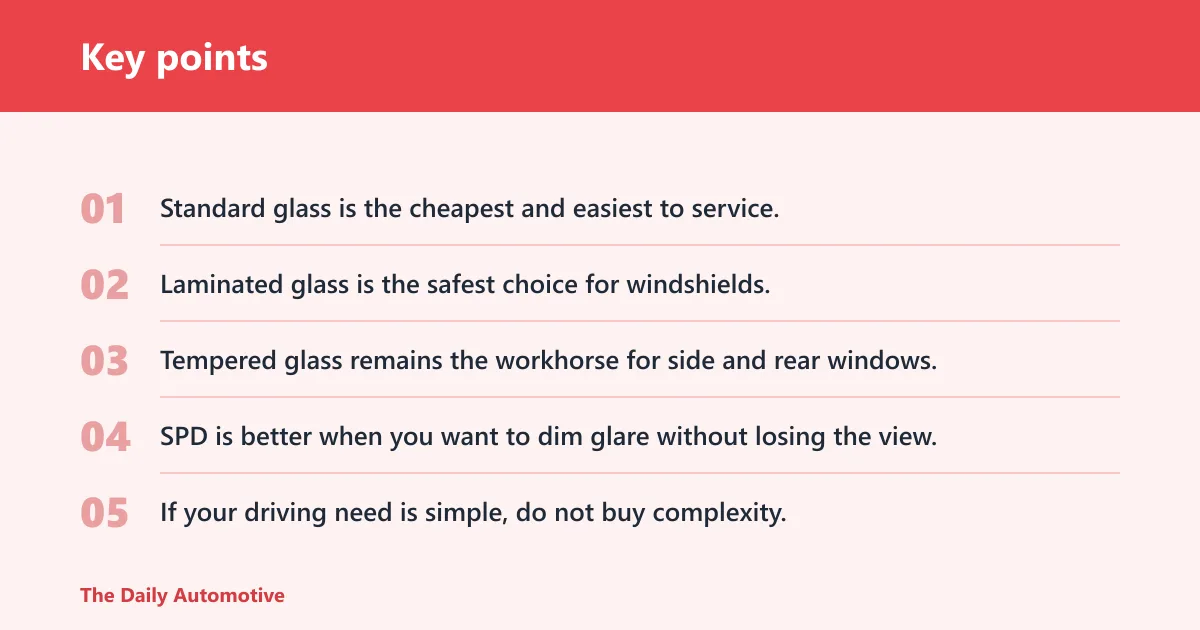
Standard glass is the cheapest and easiest to service. Laminated glass is the safest choice for windshields. Tempered glass remains the workhorse for side and rear windows. PDLC is useful when you want privacy fast. SPD is better when you want to dim glare without losing the view.
If your driving need is simple, do not buy complexity. If your need is specific, buy the specific technology. That is the key decision.
What do PDLC and SPD smart glass do?
Automotive smart glass is used in passenger windows, sunroofs, sunvisors, and display areas to support privacy, glare reduction, and thermal comfort. PDLC and SPD are the two common approaches, but they solve different problems. PDLC switches between transparent and opaque in milliseconds, while SPD dims light through variable shading.
PDLC: fast switch to opaque for privacy and solar control
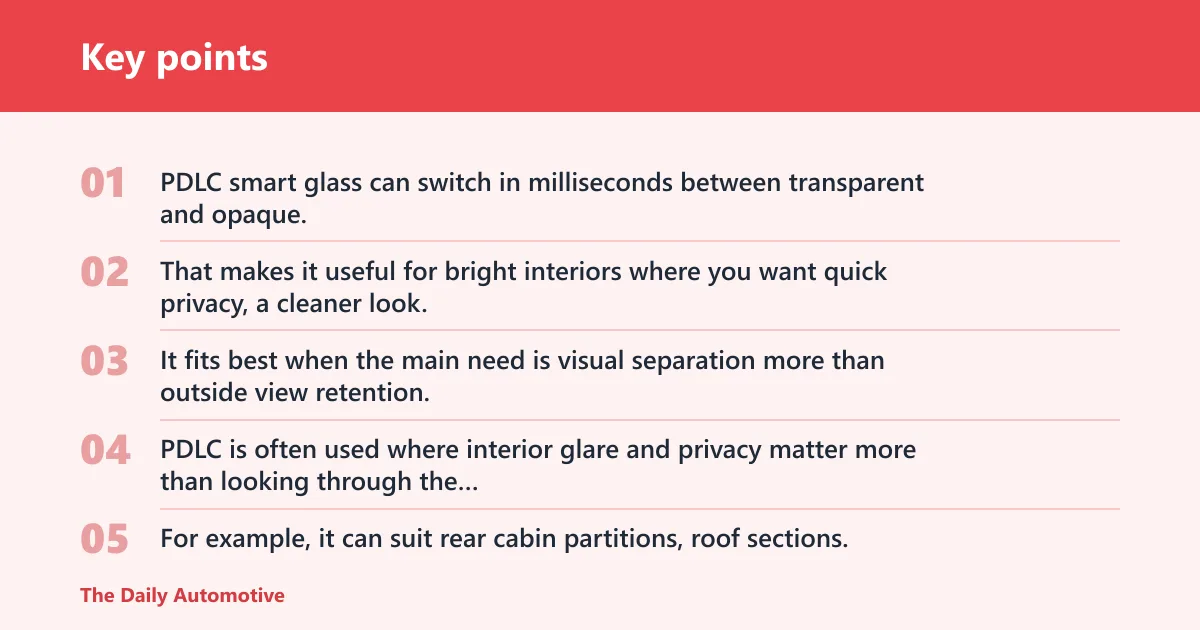
PDLC smart glass can switch in milliseconds between transparent and opaque. That makes it useful for bright interiors where you want quick privacy, a cleaner look, or rapid sun shielding without a manual shade. It fits best when the main need is visual separation more than outside view retention.
PDLC is often used where interior glare and privacy matter more than looking through the glass at all times. For example, it can suit rear cabin partitions, roof sections, or rear passenger areas in premium vehicles and shuttle-style layouts.
SPD: variable shading with a retained view
SPD smart glass can block up to 99% of visible light. That makes it a better fit for glare blocking when the driver or passenger still wants some outside reference. It supports dimmable shading rather than a hard opaque state, so the view remains usable while brightness drops.
That matters on a panoramic roof in a hot climate or in a vehicle with low-angle sun glare. SPD is often the better option when the goal is comfort, not full privacy.
Where each type fits in real cars
F10 says automotive smart glass is positioned for sunroofs, sunvisors, passenger windows, and side window displays, and F11 adds that it can be used throughout cars, from panoramic sunroofs to passenger windows. That does not mean every position is equally practical. OEM packaging, local law, and visibility needs still set the limits.
Do not assume a smart-glass windshield is the right answer. Windshields have the strictest visibility and sensor requirements. Smart glazing is far easier to justify in roofs, rear passenger areas, or display-adjacent zones than in the driver’s forward view.
Can smart glass go in sunroofs and side windows?
Yes, smart glass can go in sunroofs and side windows when the vehicle platform is designed for it. Those are the most credible applications because they can improve comfort without interfering as directly with the driver’s forward view. Windshields need extra caution, local compliance checks, and OEM approval.
Common OEM placements
Panoramic roofs are a natural fit for PDLC or SPD because the complaint is usually heat, brightness, or privacy, not forward visibility. Side windows can also use smart glass, especially in rear seating areas. Sunvisors and display-adjacent glass are another sensible use when the goal is glare management and a clean cabin layout.
Why windshields need extra caution
Smart tint on the windshield raises more issues than it solves in many markets. Driver visibility, head-up display clarity, camera exposure, and local tint rules all matter. A windshield also has to work with rain sensors, light sensors, and driver-assist cameras, so the margin for error is small.
Local law and visibility limits
Local regulations can limit visible-light reduction, especially on front side windows and the windshield. Because F8 says SPD smart glass can block up to 99% of visible light, that number is useful for understanding capability, not as a blanket recommendation. Always confirm what is legal for the exact window position where you plan to install it.
Say your SUV has a large panoramic roof and a child seat in the second row. PDLC can help with fast privacy and sun control for rear passengers. SPD can be the better call if the family wants to cut glare while still seeing clouds, buildings, and traffic signals through the roof.
Do seals and frames really change cabin comfort?
Yes. Seals and frames directly affect noise, leaks, and vibration. If the seal is worn or the frame is misaligned, road noise rises, water intrusion becomes more likely, and rattles can appear even when the glass itself is intact. These parts are part of the comfort system, not trim extras.
Noise, water, dust, and pollen control
F4 says window seals help prevent water and air intrusion into the cabin, and F5 says good seals reduce road and wind noise. That also helps keep dust, pollen, and dirt out. In a hot or dusty area, that can matter almost as much as the glass type itself.
Vibration and rattle prevention
Window frames support and secure the glass, which helps create tight seals and reduce vibration and rattling. If a door glass chatters over rough pavement, the issue may be the run channel, regulator alignment, or a weakened frame fit rather than the pane. Replacement glass alone will not cure every noise complaint.
Inspection points after repair
After replacement or retrofit, check the glass edge seating, seal compression, and full travel of the window. Also check for wind whistle at highway speed, water entry after a wash, and one-touch or anti-pinch operation. If the vehicle has sensor-based features, verify that all related warnings stay off after the work is complete.
How does automotive glass affect fuel efficiency or EV range?
Automotive glass affects cabin heat gain, which affects how hard the HVAC system has to work. That can influence fuel use in gasoline vehicles and range in EVs. The biggest gains usually come from reducing solar load with coatings, smart shading, and good seals rather than from the glass type alone.
Heat load and HVAC demand
Solar-control film can reduce sunlight and heat and may work with sensors in modern automotive window systems. That matters because a cooler cabin needs less air-conditioning effort. On a sunny day, the difference is most visible in vehicles with large glass areas, dark interiors, or long parking exposure.
What this means for EVs and hot climates
EV drivers tend to feel cabin heat gains more quickly because HVAC use can take a larger bite out of driving range. In hot climates, a roof or rear glass package that reduces solar load can help comfort and may reduce AC demand. The effect depends on glass area, tint level, parking exposure, and how often the vehicle is preconditioned.
A common first-timer mistake is choosing the darkest tint available and expecting a major range gain. Picture an EV with a glass roof parked outdoors all day in July. If the roof still passes a lot of heat, the cabin can stay hot enough that the HVAC works hard even after startup. Shade control matters more than darkness alone.
Frequently asked questions
What is a glass window for cars?
A car window is a system made up of the glass, the frame, the seals, and sometimes sensors or switches. The pane handles visibility and impact behavior. The seals block water and air, the frame holds everything in place, and the electronics support functions such as anti-pinch or smart tint control.
How does automotive smart glass improve safety?
Smart glass can improve safety by reducing glare, giving the driver a clearer view in harsh sun, and helping manage cabin brightness without improvised shades that block sightlines. In some systems, it also works with sensors and anti-pinch logic, which can reduce injury risk during window movement.
What is the difference between laminated and tempered car glass?
Laminated glass is built to stay together after cracking, which is why it is favored for windshields and passenger protection. Tempered glass is heat-treated to break into many small pieces, which suits side and rear windows. Both are part of modern automotive glass construction, but they fail in different ways.
Can smart glass reduce glare while driving?
Yes, but placement matters. SPD is the better fit when you want variable shading and want to keep a view through the glass. PDLC is better when you want fast privacy or a more opaque state. For the windshield, check legal and OEM limits before considering any variable-tint option.
Do car window seals really reduce noise and water leaks?
Yes. Window seals are a first line of defense against water and air intrusion, and they help cut road and wind noise. If seals age, harden, or misalign, you can get leaks, whistles, dust entry, and more cabin noise even if the glass is still the correct type.
Is smart glass worth it for privacy and comfort?
It can be, if the vehicle has a real use for fast privacy, glare control, or cabin heat management. For many drivers, solar-control film or a conventional coated glass package is the better value. Smart glass makes the most sense when the comfort gain clearly justifies the cost and complexity.
Products related to this article
Sponsored / affiliate links. As an Amazon Associate I earn from qualifying purchases. I may earn additional commission from eligible campaigns.