Mirror Tint for Cars: Privacy and Style
Mirror tint works best on rear side windows, where daytime privacy matters most; use one-way reflective film only if your state allows it, and leave the windshield alone. Wrong choices can lead to tickets, dim night vision, and failed inspections. This guide compares reflective film and mirror-style clip-on upgrades on legality, heat control, glare, and DIY installation.
Top pick: reflective film for rear windows
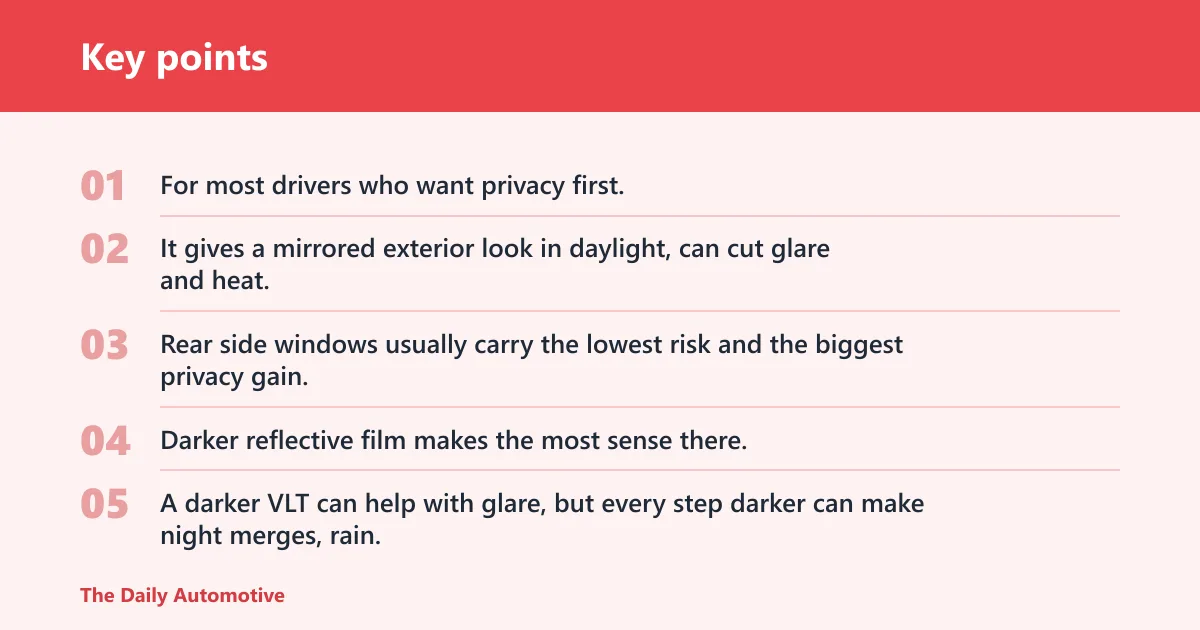

For most drivers who want privacy first, reflective film on the rear side windows is the strongest all-around choice. It gives a mirrored exterior look in daylight, can cut glare and heat, and still leaves front windows and the windshield easier to keep legal and visible.
Why rear side windows get the best payoff
Rear side windows usually carry the lowest risk and the biggest privacy gain. Darker reflective film makes the most sense there, especially if the car parks outside or carries visible gear in the back seat or cargo area.
Front side windows need more caution. A darker VLT can help with glare, but every step darker can make night merges, rain, and low-light curb checks harder. The windshield is tightly restricted in many states, so it should stay at stock visibility unless local rules clearly allow a limited treatment.
When to skip the front windows
If you drive after dark often, or if your state is strict about front glass, keep the front windows closer to a lighter film band or leave them alone. That choice preserves side visibility, helps inspection compliance, and avoids a mirrored look that works on rear glass but creates risk up front.
Quick picks
- Best for daytime privacy: reflective one-way film in a darker VLT band on rear side windows.
- Best for style-first color shift: chameleon film with a blue or purple-blue finish.
- Best for anti-glare rear visibility: a 12-inch clip-on rear-view mirror.
- Best for compact DIY install: precut or peel-and-stick film on rear glass only.
Best for daytime privacy
Reflective film is the clear pick if privacy matters more than looks alone. Other privacy-focused film listings are commonly around 12% VLT.
Best for style-first color shift
Chameleon film fits drivers who want a blue or purple-blue shift that changes with viewing angle. It can include UV protection, but it should be treated as a style-first option rather than a true privacy solution.
Best for anti-glare rear visibility
Clip-on rear-view mirrors are a different product category. A 12-inch clip-on mirror and a 10.6-inch clip-on mirror are both sold as wide-angle, anti-glare accessories, and both are aimed at reducing blind spots rather than changing window privacy.
Best for easier DIY install
Clip-on accessories are usually simpler than film because there is no cutting, wet application, or edge sealing. For window film, precut kits are easier than uncut rolls, and peel-and-stick or self-adhesive formats are easier still when fitment is straightforward.
Which mirror tint fits your windows?
Match the product to the glass, not just the look. Rear side windows are the best place for mirror-style privacy film, front side windows need more caution, and the windshield is usually the least suitable place for anything dark, reflective, or hard to inspect through.
Rear side windows for parking privacy
Rear side windows are the sweet spot for one-way reflective film. Bright daylight gives the mirror effect its best privacy benefit, so this is the best location for drivers who park on the street, carry tools, or want less visibility into the cabin and cargo area.
SunTek InfinityOP is a good example of this category. SunTek says it uses all-metal nichrome construction for a mirrored exterior appearance, reflects solar heat for cooler cabin temperatures, and is sold in a selection of reflective tint shades. SunTek also says the film is meant to improve daytime privacy and notes that some states require compliance before mirrored tint is installed.
Front side windows for legal caution
Front side windows are where legality and night visibility matter most. A lighter VLT band is usually the safer move, because the driver still needs clear lane changes, mirror checks, and pedestrian scans after dusk. Dark film on the front can create a privacy gain that is not worth the visibility loss.
Windshield use and why it is usually the most restricted
The windshield is usually the most controlled area for tint rules. Even if a product claims strong heat rejection or UV blocking, a mirrored film on the windshield can interfere with outward vision, sensors, and inspection compliance. That makes it the last place to consider, not the first.
Reflective film vs clip-on mirrors
Reflective film changes the window surface itself, while clip-on mirrors change the rearward view inside the cabin. They solve different problems. Use film for privacy and heat control on glass, then use a mirror accessory if the goal is wider rear visibility or less glare from headlights.
Reflective film for privacy and heat control
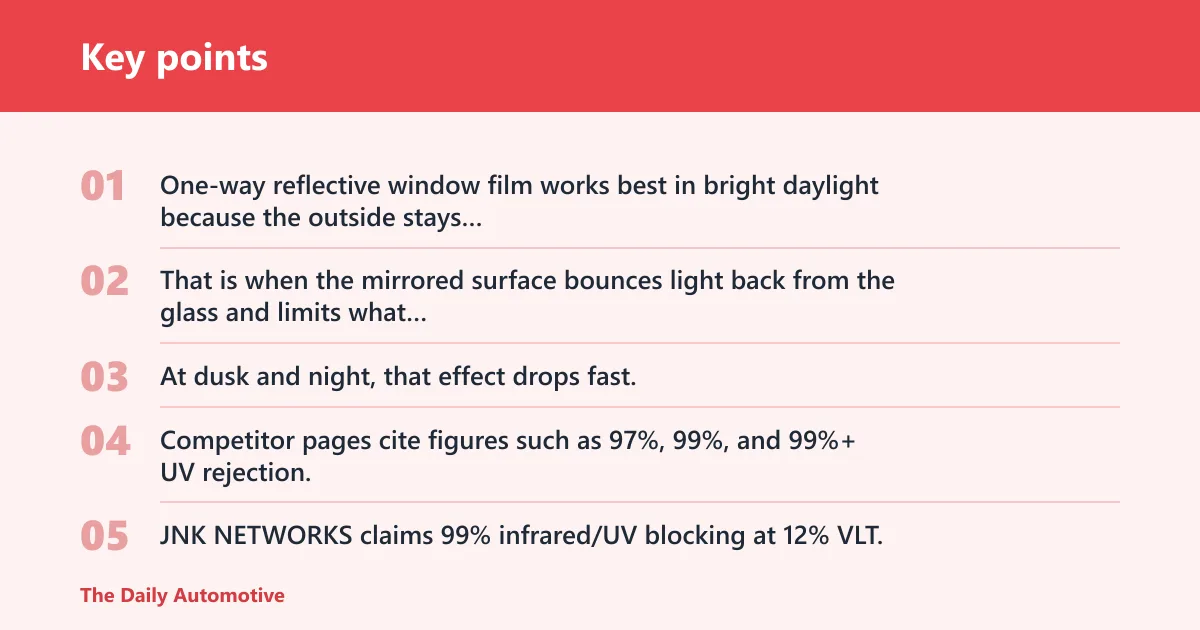
One-way reflective window film works best in bright daylight because the outside stays brighter than the cabin. That is when the mirrored surface bounces light back from the glass and limits what people can see inside. At dusk and night, that effect drops fast, so privacy is no longer one-way in any practical sense.
Heat and UV claims vary by product. Competitor pages cite figures such as 97%, 99%, and 99%+ UV rejection, while some reflective film claims reach up to 80% heat reduction. JNK NETWORKS claims 99% infrared/UV blocking at 12% VLT, and ASENDIWAY is described as 1.8 mil thick PVC vinyl with 99% UV rejection. Those claims can help, but they depend on the product, the glass, and the install quality.
Clip-on rear-view mirrors for wide-angle rear visibility
Clip-on mirrors are for visibility, not privacy. The Verivue rear-view mirror is described as 12-inch and clip-on, while ICBEAMER offers a 10.6-inch clip-on rear-view mirror option. Both are marketed with panoramic wide-angle and anti-glare benefits, and both are typically pitched as universal-fit accessories.
If your main complaint is blind spots or glare from lifted trucks at night, a mirror accessory may help more than darker glass. It will not change what people outside can see into the cabin.
Where each one belongs on the car
Use reflective film on rear side windows and, where legal, on other side glass. Use a clip-on mirror on the interior rear-view mirror only. Mixing the two categories leads to bad buying decisions, especially when a driver expects a mirror accessory to act like privacy film.
Chameleon tint or mirror tint?
Choose chameleon film if you want the look, and choose reflective film if you want privacy. Chameleon tint is style-led, with a blue or purple-blue color shift that changes by angle. Reflective film is function-led, with stronger daytime privacy and a more obvious mirrored exterior.
Blue and purple-blue color shift
Chameleon films are chosen for their color change, not because they are the strongest privacy option. They can still offer UV protection, but the visual effect is angle-dependent, so the car may look different from the curb, from a side angle, or in direct sun.
Angle-dependent looks versus privacy performance
Mirror film is usually better when the goal is to block views into the cabin. Chameleon film can look distinctive, but it does not always give the same outward mirror effect. If the main question is “Can people see in?” the reflective product generally answers that better in daylight.
Picture a sedan that parks outdoors all day in a hot lot. A reflective rear-side film helps hide the back seat and can cut glare off the glass. A chameleon film may look more customized, but it is the weaker match if privacy is the priority.
Style gains without confusing it for one-way film
Style-first film should be bought as style-first film. That sounds simple, but it avoids the common mistake of expecting a color-shift product to work like a true privacy layer after sunset. Once the light drops, the privacy advantage shrinks regardless of color.
Mirror tint decision matrix
This matrix matches window location, driving habits, and legal risk to the safest product choice. Use it as a filter before you buy, because the same film that works on a rear side window can be a poor choice for a front door glass or windshield.
| Use case | Recommended VLT band | Expected daytime privacy | Night-visibility risk | Install difficulty | Legal caution |
|---|---|---|---|---|---|
| Rear side windows, parked outside, privacy first | 5% to 20% | High | High | Medium | Check rear-window and side-window rules before buying |
| Rear side windows, mixed day and night driving | 35% to 50% | Moderate | Moderate | Medium | Usually safer than darker film, but still state-specific |
| Front side windows, visibility first | 60% to 70% | Low to moderate | Low | Medium | Front glass is commonly restricted |
| Windshield area | Generally avoid mirror film | Low | High | High | Most restrictive location |
| Style-first look with some UV protection | Varies by product | Low to moderate | Moderate | Medium | Confirm the color shift still meets local rules |
| Product type | Privacy | Visibility | Install difficulty | Legal caution |
|---|---|---|---|---|
| Reflective film | Best in bright daylight | Can be risky at night if too dark | Medium to high | Highest on front glass and windshield |
| Chameleon film | Lower than mirror film | Usually better than very dark mirror film | Medium | Still needs window-by-window checking |
| Clip-on mirror accessory | None | Improves rear visibility | Low | Usually simpler, but fit and mirror rules still matter |
How to read the matrix
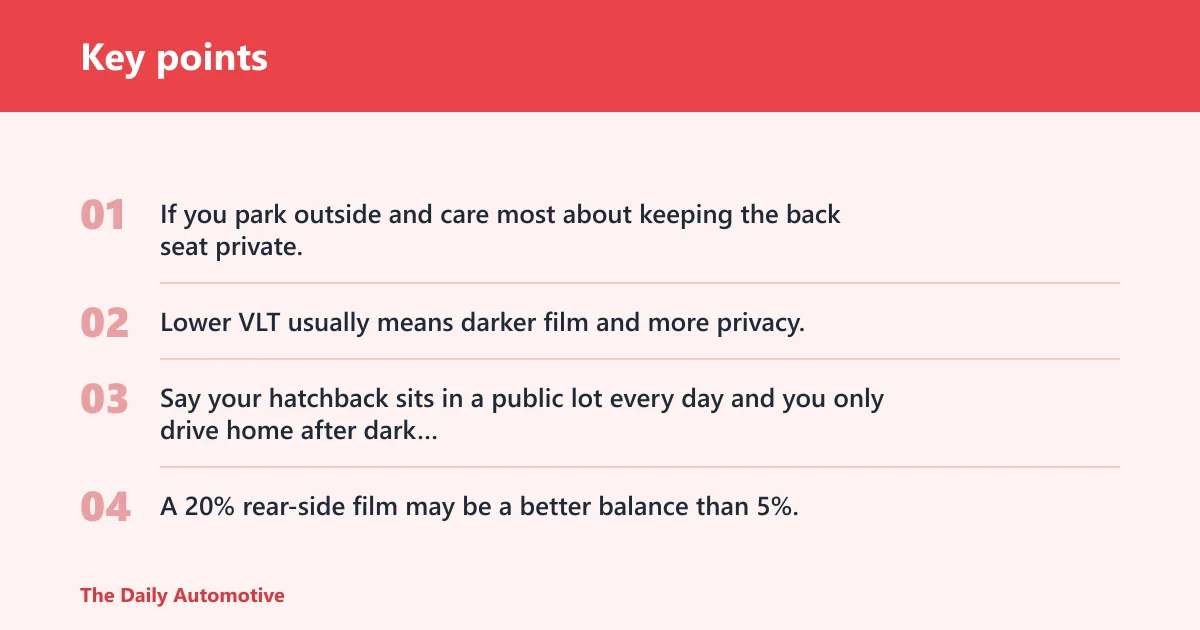
If you park outside and care most about keeping the back seat private, start in the 5% to 20% range on rear side windows. If you drive at night often, move lighter. Lower VLT usually means darker film and more privacy, but it also raises the chance of poor night visibility.
Say your hatchback sits in a public lot every day and you only drive home after dark twice a week. A 20% rear-side film may be a better balance than 5%, because it still blocks casual viewing in daylight without making the cabin as difficult to see out of at night.
Can you install mirror tint yourself?
Yes, but the format matters. Precut kits are the easiest film option, uncut rolls require the most trimming skill, peel-and-stick products reduce prep time, and clip-on accessories are the simplest overall. Fitment and clean edges matter as much as the film itself.
Precut kits versus uncut rolls
Precut kits reduce the chance of trimming errors and are the better DIY choice for most drivers. Uncut rolls can be cheaper in some cases, but they demand careful measuring and trimming around seals, defroster lines, and curved glass.
Peel-and-stick and self-adhesive film
Peel-and-stick or self-adhesive film can be easier to place, but it still needs a clean surface and careful squeegeeing. Dust, moisture, and rushed alignment are the main reasons bubbles and edge lift show up after installation.
Common install mistakes and how to avoid them
- Clean the glass fully before fitting the film.
- Measure the window shape before trimming.
- Keep edges away from rubber seals when possible.
- Check for bubbles after the film settles.
- Test visibility at dusk before assuming the tint is usable.
A common first-timer mistake is picking a very dark film for front glass because it looks good in the parking lot. That choice can turn into poor shoulder checks, trouble with rain glare at night, and a legal headache if the front windows fall outside local limits.
Watch for signal and sensor issues too. Some mirrored films can interfere with electronics more than plain dyed film, especially near antennas, toll tags, or cameras. If the car has advanced driver-assist hardware near the glass, check the film maker’s fit guidance before ordering.
Frequently asked questions
What is mirror tint for cars and how does it work?
Mirror tint uses a reflective exterior layer to bounce light away from the glass, which makes the cabin harder to see into during the day. The effect is strongest when it is bright outside and weaker after sunset, so it is best treated as daytime privacy film rather than full-time privacy.
Is mirror tint legal on car windows in my state?
That depends on where the film goes and how dark it is. Windshields and front side windows are usually the most restricted, while rear side windows often have more flexibility. SunTek also notes that some states require compliance before mirrored tint is installed, so check local rules first.
Does mirror tint reduce heat and UV rays?
Many products claim heat and UV benefits, but the exact numbers vary. Competitor claims include 97%, 99%, and 99%+ UV rejection, plus up to 80% heat reduction or infrared blocking on some reflective films. The actual result depends on the product, the glass, and the installation.
What VLT is best for privacy without ruining visibility?
For privacy-first rear windows, 20% to 35% is often the practical middle ground, while 5% gives the strongest daytime privacy and the highest night-visibility risk. On front windows, 50% to 70% is the safer range if your local law allows film there at all.
Can I install mirror tint myself or do I need a pro?
You can install it yourself if you choose the right format and take your time. Precut kits and peel-and-stick film are the easiest DIY routes. If the car has complex curved glass, sensors near the window, or you want a warranty tied to professional install, a pro is the safer route.
Will mirror tint affect night driving visibility?
It can. Darker VLT and reflective film both reduce how much light passes through the glass, which matters most after dark. That is why rear side windows can tolerate darker film better than front side windows, and why the windshield is usually the wrong place for mirror tint.
What is the difference between reflective film and clip-on mirror accessories?
Reflective film changes the window and can add privacy, heat control, and UV rejection. Clip-on mirror accessories change the interior rear-view mirror and are meant to widen the view or reduce glare. They solve different problems and should not be bought as substitutes for each other.
Which mirror tint is best for rear side windows versus front windows?
Rear side windows suit reflective film best because privacy matters more there and legal risk is often lower than at the front. Front windows usually need a lighter, visibility-first approach, and the windshield should generally stay free of mirrored film unless local law clearly permits a limited treatment.
Products related to this article
Sponsored / affiliate links. As an Amazon Associate I earn from qualifying purchases. I may earn additional commission from eligible campaigns.