Car Battery Terminal Replacement Cost
Car battery terminal replacement cost is commonly reported at around $20 to $120 for a clamp or terminal cleaning, and roughly $80 to $300 when the cable end or full battery cable must be replaced. Bad connections can leave you with a no-start, charging faults, or repeat jump starts. This guide breaks down the cost factors, the repair choices, and how to read a quote without paying for cable work when a terminal cleanup will do.
Factors that raise terminal replacement costs
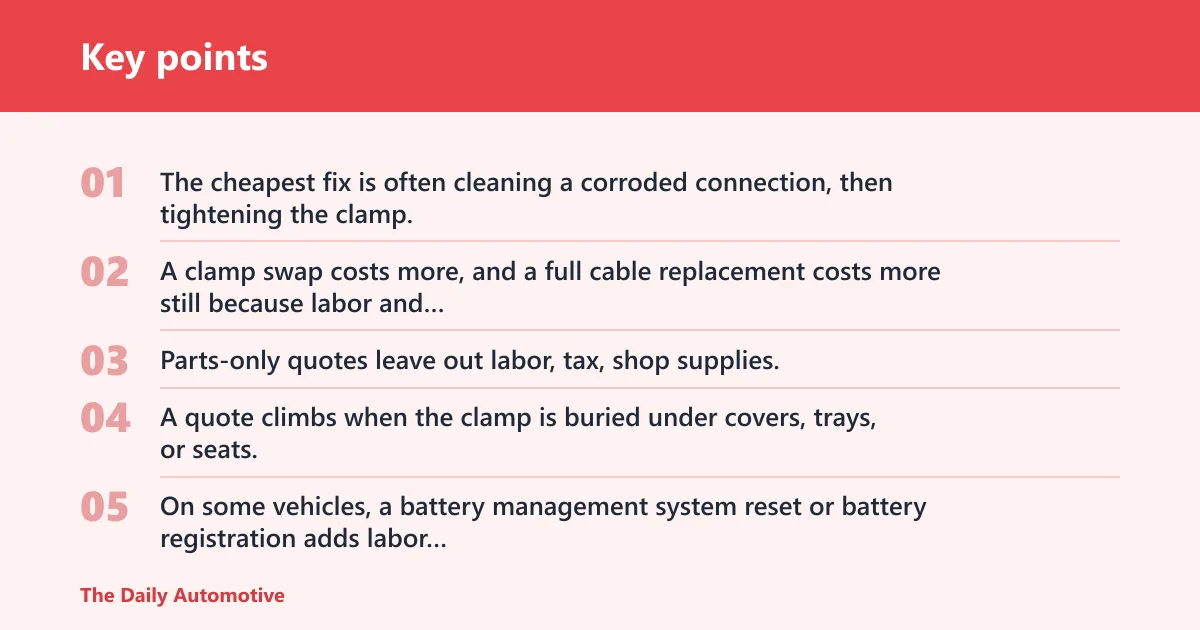


The cheapest fix is often cleaning a corroded connection, then tightening the clamp. A clamp swap costs more, and a full cable replacement costs more still because labor and parts rise once the cable, routing, or connector design is part of the job. Parts-only quotes leave out labor, tax, shop supplies, and any handling fee for the old part.
What pushes a quote upward
A quote climbs when the clamp is buried under covers, trays, or seats; when the post is damaged; or when corrosion has traveled into the cable strands. On some vehicles, a battery management system reset or battery registration adds labor after the repair, especially on newer cars with tighter charging control.
Battery replacement figures help set expectations, too. Car battery replacement costs range from $75 to $300+ depending on type and quality, and the national average for a mid-range installed battery is approximately $175. AGM batteries are priced about 40-80% more than traditional flooded lead-acid batteries.
Those battery numbers do not replace terminal pricing, but they matter when the diagnosis is unclear. A weak connection can mimic a weak battery, and a flat battery is not always a bad battery.
Why installed pricing is usually higher
Parts-only pricing can look cheap because it leaves out labor, tax, shop supplies, and any recycling or old-part handling. A battery job may also include a core charge or old-part return deposit, and that line can change the total if the shop expects the old battery or terminal assembly back.
For buyers in the UK market, the same pattern appears: standard lead-acid batteries are listed at £40-£120, AGM batteries at £120-£250+, and fitting usually adds about £30-£50. The exact terminal job changes with access and connector style, but the split between parts and labor stays the same.
Terminal clamp replacement cost
Clamp replacement is the middle option. It makes sense when the lead is sound, the post size matches, and the damage is limited to the clamp body or its pinch section. Positive and negative versions are not always priced the same because access, connector style, and surrounding components can differ.
Positive and negative clamp differences
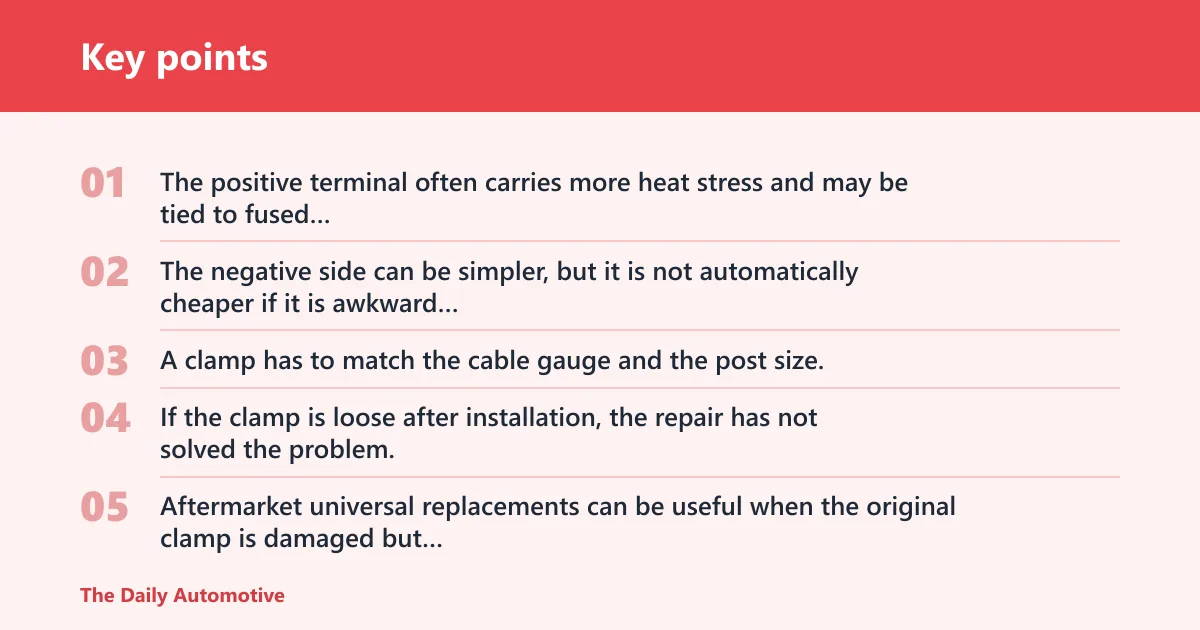
The positive terminal often carries more heat stress and may be tied to fused distribution or integrated cable hardware. The negative side can be simpler, but it is not automatically cheaper if it is awkward to reach or bonded to a ground cable that runs deep into the body or engine bay.
Fitment matters. A clamp has to match the cable gauge and the post size, and a universal replacement only works when the dimensions line up well enough for a secure bite. If the clamp is loose after installation, the repair has not solved the problem.
Aftermarket universal clamps and fitment limits
Aftermarket universal replacements can be useful when the original clamp is damaged but the cable itself is still healthy. They are not a cure-all. If the original design uses a molded connector, a battery sensor, or an unusual routing path, a generic clamp may fit poorly or leave too much slack.
Suppose a 12V starter battery in a sedan has a split positive clamp and light white corrosion only at the outside edge. If the cable strands are still bright and firm after cleaning, a clamp replacement may be enough. If the cable is green under the insulation, the cheaper clamp becomes a false economy.
When a clamp swap is enough and when it is not
A clamp swap is enough when the metal is still structurally sound, the conductor is not heat damaged, and the cable end has not turned brittle. It is not enough when the clamp will not hold tension or when the terminal face is so pitted that contact area is unreliable.
A common first-timer mistake is treating white crust as proof of cable failure. Corrosion can be cleaned if the metal underneath is intact. If the clamp springs open, the bolt is stripped, or the terminal ear has cracked, replacement is the smarter spend.
When a full cable replacement is smarter
A full cable replacement is smarter when corrosion has moved inside the cable, the strands are broken, or the terminal connector is built into the cable end. In those cases, a terminal swap can hide the symptom for a while, then fail again because the damaged section was never removed.
Heat damage and internal corrosion
Heat damage usually shows up as hardened insulation, discoloration, or a cable end that feels stiff near the terminal. Internal corrosion can be harder to spot. A green powdery trail inside the insulation means the current path is no longer healthy, even if the outside looks acceptable.
That matters because the starting circuit depends on a clean, low-resistance path. If resistance rises at the terminal or cable end, the starter can click, crank slowly, or fail only under load. The charging system may still be fine.
Integrated terminal connector designs
Some battery terminal cable assemblies use integrated connectors, molded sensor leads, or fused links. In those setups, replacing only the visible clamp may not restore the original connection quality. The repair may have to extend farther into the cable assembly.
Labor also shifts with cable length and routing. A short, open engine-bay lead is one thing. A longer run that passes under a tray, cover, or interior panel can take much more time and add diagnostic labor if clips, fasteners, or trim pieces have to come off.
What does a battery terminal quote include?
A battery terminal quote usually includes parts, labor, tax, and often shop supplies. It may also include testing, corrosion cleaning, battery disconnect and reconnect time, and an old-part return or recycling fee if the shop handles the removed component as part of the job.
Parts, labor, tax, and shop supplies
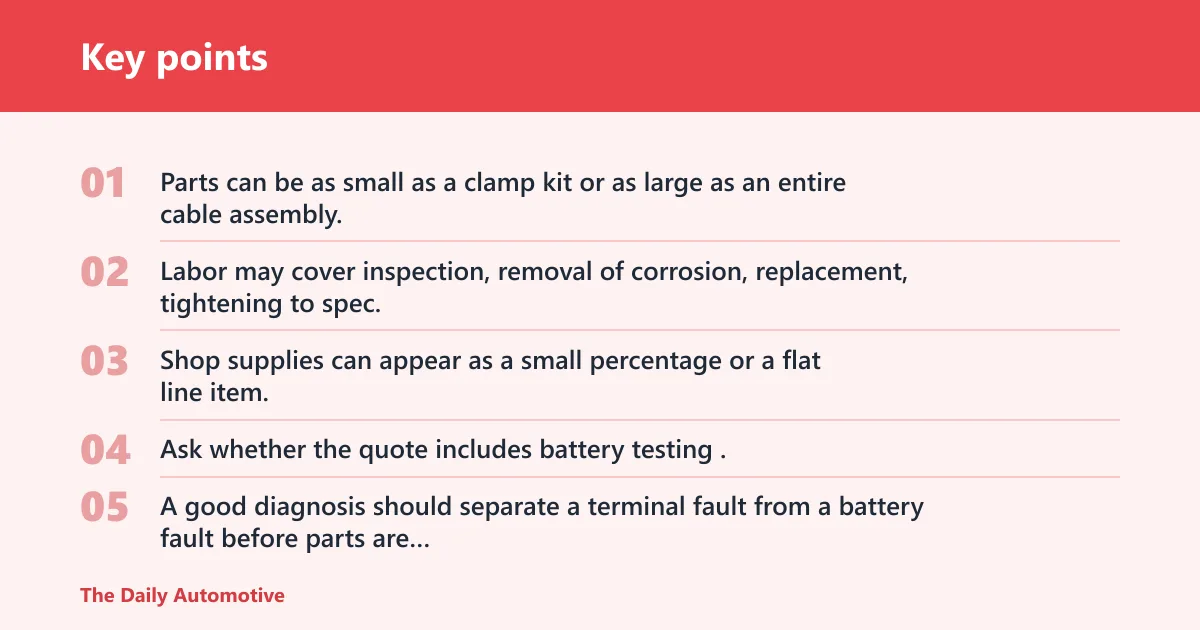
Parts can be as small as a clamp kit or as large as an entire cable assembly. Labor may cover inspection, removal of corrosion, replacement, tightening to spec, and checking the connection under load. Shop supplies can appear as a small percentage or a flat line item.
Ask whether the quote includes battery testing. A good diagnosis should separate a terminal fault from a battery fault before parts are sold. That step is especially useful when symptoms look like a parasitic draw or charging issue.
Recycling fee or old-part return
Some shops list a core charge or old-part return separately. On battery jobs, this can be a refundable deposit or a credit once the old battery or assembly is returned. It is not always applied to a terminal-only repair, but it can appear if the battery itself is also replaced.
Labor can rise if the vehicle needs a battery management system reset or registration after the work. That does not happen on every car, but on some newer models it is part of a proper repair and should be on the estimate.
Should you clean or replace the terminal?
Clean the terminal when corrosion is light, the clamp still grips firmly, and the metal has not been eaten away. Replace it when the clamp is loose, cracked, or heat damaged, or when cleaning leaves you with a rough, pitted surface that will not make reliable contact.
When corrosion can be cleaned
White or blue-green buildup on the outside of a battery terminal often can be removed with the right cleaning tools. A wire brush, battery terminal cleaner, wrench set, and multimeter are the basic tools for sorting out whether the problem is simple contamination or deeper damage.
After cleaning, inspect the connection for tension and continuity. If the clamp tightens properly and voltage drop is normal, the terminal may be serviceable. If the surface looks clean but the cable still runs hot or the crank remains weak, keep checking.
When corrosion means replacement
Corrosion becomes a replacement issue when it has attacked the clamp body, spread under the insulation, or caused the terminal to lose clamp force. That can create voltage drop risk and make the car behave like it has a weak battery even when the battery is still good.
Picture a crossover with blue-green corrosion on the negative post and a slow crank on cold mornings. If cleaning restores a solid connection and the test numbers improve, the fix was the terminal. If the same symptom returns and the cable insulation is stiff near the end, the cable has likely started to fail.
How do you know if the problem is the terminal, cable, or battery?
Start with the symptom pattern. A click with no crank, slow cranking, or repeat jump starts can come from a loose terminal, a damaged cable, or a weak battery. Testing matters because corrosion at the post can imitate a parasitic fault, and the battery may be blamed first by mistake.
Starter-no-crank and slow-crank clues
If lights work but the starter barely turns, the terminal or cable is a prime suspect. If the vehicle starts after the clamp is twisted by hand or moved slightly, the connection is failing under load. That is different from a battery that simply cannot hold charge.
When the vehicle cranks normally after a jump but dies soon after, the charging system may need inspection as well. The terminal job should not be treated as a complete fix unless the testing supports it.
Multimeter checks for voltage drop and connection loss
A multimeter can help separate a bad terminal from a bad battery. Voltage drop testing across the connection shows whether resistance is excessive. If the reading changes when the clamp is moved, the issue is likely at the terminal or the cable end, not inside the battery.
Follow the vehicle and product manual, especially for jump-starting and battery work. Connection order matters. Fuel, coolant, and electrical work also need ventilation, no sparks, and the battery disconnected.
Terminal replacement cost by vehicle access
Access changes the price more than many drivers expect. Top-post batteries are generally simpler than side-post designs. Hard-to-reach terminals under trays, covers, or seats can turn a short parts swap into a longer labor job, and that extra time shows up in the quote.
Hard-to-reach layouts and labor inflation
Some vehicles hide the battery under the rear seat, under a cargo-floor panel, or under heavy plastic covers in the engine bay. When the technician has to remove trim or support hardware just to reach the terminal, labor can climb even if the part itself is cheap.
That is one reason quote-reading matters. A low parts cost with high labor does not automatically mean overcharging. It may mean the terminal is buried and the shop is billing the real access time instead of guessing.
Battery registration and reset labor
Newer vehicles may need battery management system reset or battery registration after terminal or battery work. That can add labor because the system may need to relearn charging strategy. If the vehicle requires it, skipping the reset can create charging complaints after the repair.
Always check the owner’s manual and the service procedure for the exact model. Do not assume all battery work is the same across brands or trim levels.
Battery terminal decision table
The table below maps the cheapest appropriate fix to the condition you actually see. Use it to separate cleaning, clamp replacement, and full cable replacement before you approve the most expensive line on the estimate.
| Symptom | Likely cause | Parts needed | Labor complexity | When full cable replacement is smarter |
|---|---|---|---|---|
| White crust on the post, starts after cleaning | Surface battery terminal corrosion | Cleaner, brush, maybe new clamp hardware | Low | Not needed if metal is intact and tension is good |
| Clamp will not tighten, slips on the post | Worn or stretched battery terminal clamp | Clamp replacement | Low to moderate | Only if the cable strands are damaged or corroded |
| Green corrosion under insulation near the end | Internal cable corrosion | Battery cable replacement | Moderate | Yes, because the corrosion has moved beyond the clamp |
| Hot terminal, melted plastic, brittle lead | Heat damage | Clamp or full cable assembly | Moderate to high | Yes, if the connector or insulation is heat damaged |
| Intermittent no-crank when the clamp moves | Loose connection or broken strands | Clamp check, cable end repair, or cable | Moderate | Yes, if movement changes the reading or the cable end fails inspection |
| Battery tests good, but voltage drop stays high | Bad terminal connection or cable fault | Clamp, cable end, or full cable | Moderate | Yes, if the cable fails voltage-drop testing |
Frequently asked questions
How much does it cost to replace a car battery terminal?
Most terminal-only jobs land below a full cable replacement because the part is small and the labor is lighter. A simple cleaning or clamp swap is usually the cheapest path, while a cable-end or full cable repair rises quickly if access is tight or corrosion has spread into the conductor.
How much are new battery terminals?
New battery terminals are usually inexpensive as parts, but the installed price depends on fitment, access, and whether the cable end must be replaced too. A universal clamp may cost far less than a vehicle-specific cable assembly, but the wrong fit can create repeat failures.
Can you replace car battery terminals yourself?
Yes, many drivers can replace a clamp or clean a terminal themselves if they follow the manual, use the right tools, and work safely. The job gets harder when the battery is buried, the clamp is integrated into the cable, or the vehicle needs registration after the repair.
Is terminal corrosion enough to replace the whole cable?
Not always. Light white or blue-green buildup can often be cleaned. Full cable replacement makes more sense when corrosion has reached inside the insulation, the strands are broken, or heat has damaged the connector so that a fresh clamp would still leave a weak circuit.
What does a battery terminal replacement quote usually include?
A proper quote should separate parts, labor, tax, and any shop supplies. It may also include testing, corrosion cleanup, recycling or old-part handling, and battery management system reset or registration if the vehicle requires it. Ask for those items to be listed separately.
Can a bad terminal make a new battery fail?
Yes. A bad terminal can leave a new battery undercharged, create voltage drop, or make the charging system work against a poor connection. That can make a fresh battery seem weak or dead even though the real problem is still at the terminal or cable end.
Products related to this article
Sponsored / affiliate links. As an Amazon Associate I earn from qualifying purchases. I may earn additional commission from eligible campaigns.