Hood Scoop for Car: Functional vs. Decorative Options Explained
A hood scoop only helps when it is sealed, ducted, and matched to a real airflow or heat-management need; otherwise it is mostly cosmetic. Ignore that, and you can add drag, invite water, or pay for parts that do nothing for temperatures. This guide compares Functional and Decorative Options, explains sealed versus open designs, and shows what to inspect before you buy.
| Decision factor | Functional | Decorative Options | Winner |
|---|---|---|---|
| Performance potential | Can feed the air filter, intake manifold, or an intercooler when it is sealed and ducted | No internal airflow path, so it does not change intake thermodynamics | Functional |
| Heat management | Can lower intake air temperature or help extract underhood heat when the layout is right | No thermal effect beyond any change caused by body shape | Functional |
| Install complexity | Needs routing, sealing, and compatibility checks with hood and engine bay layout | Often adhesive-mounted or no-drill | Decorative Options |
| Daily-driver practicality | Better if the ducting is sealed, drained, and protected from debris | Usually easier to live with because there is no airflow path to manage | Decorative Options |
| Show appeal | Can still look purposeful, especially on a matched build | Often chosen for style first | Decorative Options |
| Drag risk | Can add drag if the opening is poorly placed or left open to dead air | Usually lower concern because it is not trying to move air through the hood | Decorative Options |
Functional vs decorative hood scoops
The split is simple: a Functional hood scoop has a real airflow job, while Decorative Options are there for appearance. Shape alone tells you nothing. What matters is whether the opening is sealed to intake hardware, an intercooler, or a heat-extraction path.
Performance
Functional scoops can help when they connect to a real system. A sealed hood scoop can feed the air filter, airbox, or an intercooler, and a well-designed ram scoop may produce a modest power gain. Decorative Options do not change intake thermodynamics.
Heat management
Functional scoops can lower intake air temperature or move hot air out of the engine bay. In cited tests, intake air temperature dropped, but that only matters when the ducting and sealing are correct. Decorative Options do not manage heat.
Install complexity
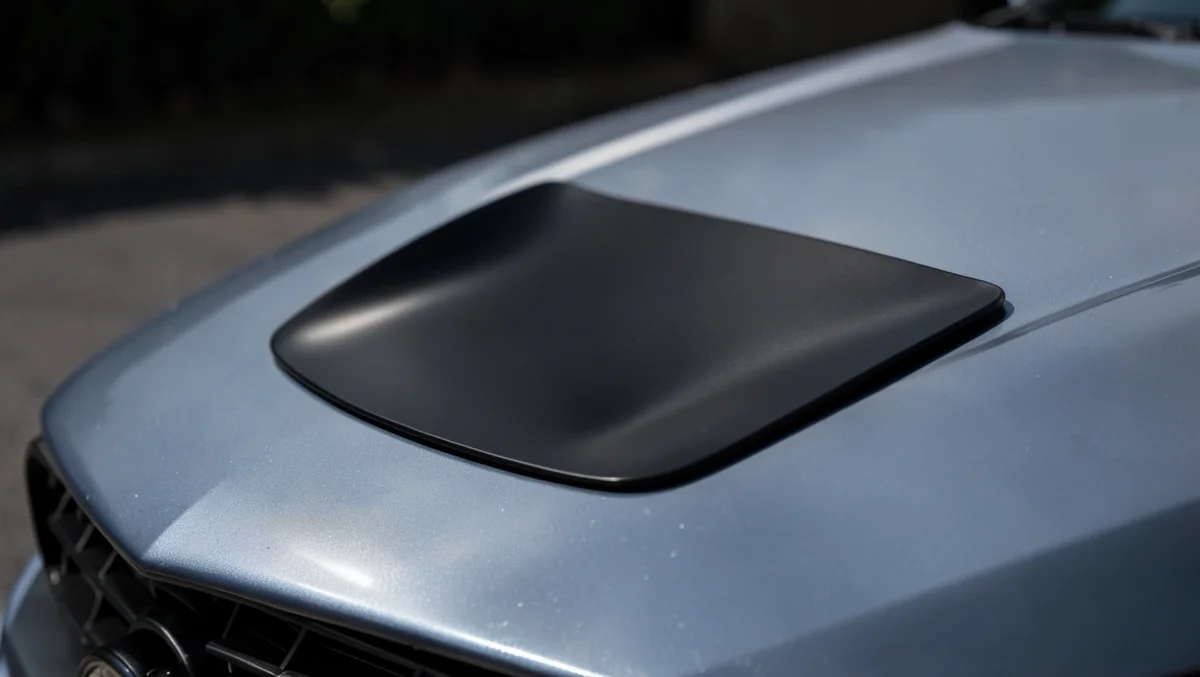
Functional parts need careful fitment, sealing, and routing. Decorative Options are usually easier because a universal decorative hood scoop vent can be ABS plastic and may use no-drill installation. That simplicity comes with a tradeoff: the part may do nothing except change the look of the hood.
Does a hood scoop add horsepower or is it just for looks?
A hood scoop can add horsepower only when it moves useful air to the right place and does not create new losses. Cooler, denser intake air carries more oxygen per unit volume, which can support cleaner combustion, but the gain is usually modest and setup-dependent. If the scoop has no ducting, it is mainly for looks.
At highway speeds, a well-designed scoop can create a ram air effect. That effect depends on vehicle motion and on whether the scoop sits in a high-pressure hood area. If the opening is in the wrong spot, it may move hot underhood air or add drag instead of power.
Why cooler air can help combustion
When the intake charge is cooler, it contains more oxygen in the same space. That is the basic reason a functional scoop can help, especially when it feeds the air filter or an intake inlet with outside air rather than hot engine-bay air.
Why gains are usually modest
Competitor claims place modest power gains at about 1 to 5 percent from functional scoops. That is not a large jump, and it depends on sealing, speed, and the engine layout. A decorative opening can look aggressive without producing anything close to that.
When a scoop can hurt performance
A scoop can backfire when it opens into dead air, leaves the intake path unsealed, or pulls hot air from underhood space. It can also add drag if the opening is large and poorly placed. In that case, the car may get more noise than useful airflow.
Ram air, cold air, and shaker setups
Ram air, cold-air intake feeding, and shaker setups are not the same thing. Ram air depends on speed and pressure placement, cold-air intake feeding depends on sealing to outside air, and a shaker scoop is defined by how it mounts, not by a single airflow trick. Each works differently.
How ram air depends on vehicle speed
Ram air uses vehicle motion to raise inlet pressure, so it works best at speed. A well-designed ram scoop may produce a modest power gain, but that only makes sense when the scoop is in a high-pressure area and the rest of the path is sealed.
Why cold-air intake sealing matters
A functional cold air scoop must be in a high-pressure hood area, and the cold air intake must be tightly sealed to the air cleaner and intake inlet. Shorter air paths can be beneficial, but the best layout still depends on pressure drop, filter placement, and packaging. If the system leaks, the engine can still breathe hot underhood air and lose the advantage.
What makes a shaker scoop different
Shaker scoops are mounted directly to the air cleaner and move with the engine; some designs use a ram air valve or flapper door. Sources note the Shaker was originally proposed as a styling element before becoming functional. That history matters because some shaker setups are both visual and practical. (Wikipedia)
Say your coupe has a hood opening centered over a hot engine bay, but the underside is blank plastic with no tube or airbox connection. That is decorative. Suppose the same car uses a sealed duct to a cold-air box at the front of the engine bay; the shape may look similar, but the function is completely different.
Hood scoop decision matrix
This matrix compares five common scenarios by what they do, not by how aggressive they look. Read it as a practical filter: choose the setup that matches the job, the speed range, and the amount of fabrication you can accept. One size does not fit every car.
| Scenario | Horsepower potential | Heat management | Drag risk | Install complexity | Daily-driver suitability | Show-car value |
|---|---|---|---|---|---|---|
| Cosmetic add-on | Low | Low | Low to moderate | Low | High | High |
| Sealed cold-air scoop | Moderate | Moderate to high | Moderate | Moderate to high | Moderate | Moderate |
| Ram-air scoop | Moderate to high | Moderate | Moderate to high | High | Low to moderate | High |
| Intercooler-fed scoop | Moderate | High | Moderate | High | Moderate | Moderate |
| Extractor vent | Low | High | Low to moderate | Moderate | High | Moderate |
Cosmetic add-on versus sealed cold-air scoop
The cosmetic add-on wins on ease and appearance. The sealed cold-air scoop wins when you want a real airflow path and are willing to pay for fabrication, sealing, and fitment. If your goal is only visual change, the decorative route is the cleaner choice.
Ram-air scoop versus intercooler-fed scoop
Ram air is about pressure and speed. An intercooler-fed scoop is about cooling pressurized intake air, which makes it especially useful on turbocharged or supercharged engines. Intercoolers are heat exchangers used to cool pressurized intake air, and they benefit from continuous airflow; without that, heat soak becomes a problem.
A functional scoop can help top-mounted intercoolers fight heat soak during spirited driving. In stop-and-go traffic, the benefit is much smaller because the car is barely moving. That is different from a ram-air setup, which needs speed to matter. If the car spends most of its time crawling in traffic, ducting for cooling may be more useful than a speed-based intake gain.
Extractor vent versus intake-focused scoop
An extractor vent is not an intake part. It expels hot air from under the hood, reduces underhood temperatures, and helps protect wiring and rubber components. NACA ducts are a low-drag solution used in aeronautics, but they still need a purpose; an extractor vent needs an exit path, not an intake claim.
Do scoops help turbo and supercharged cars?
Yes, but the benefit is usually tied to intercooler cooling rather than direct horsepower from the scoop itself. Intercoolers are heat exchangers used to cool pressurized intake air, and a functional scoop can help them get more continuous airflow. On heat-soak-prone cars, that matters more than the opening’s size.
Top-mounted intercoolers are the clearest fit. A functional scoop can help them fight heat soak during spirited driving. In stop-and-go traffic, the benefit is much smaller because the car is barely moving. If the ducting is poor, though, a larger scoop can still miss the core and leave the system working harder than it should.
Why continuous airflow matters for charge cooling
Charge cooling works best when air keeps moving through the intercooler core. A scoop that only looks large does not guarantee that flow. The duct must direct air across the heat exchanger, and the exit path must let that air leave without backing up under the hood.
When ducting matters more than scoop size
A smaller scoop with a tight duct can outperform a larger opening with bad routing. That is why the decision should start with the intercooler location, the hood geometry, and the engine bay layout. If the path is not aligned, the scoop becomes a styling piece with a complicated cutout.
How can I tell if a hood scoop is functional or decorative?
Check the underside first. A functional hood scoop has a sealed path to something real: the air filter, an intake inlet, intercooler, or an engine bay outlet for hot air. If the underside is open to the hood skin only, or the opening ends in a dead cavity, it is decorative.
Look beyond the shape. Decorative hood scoops can be adhesive-mounted or no-drill, while functional setups usually need hardware, ducting, and sealing. Water management also matters; if there is no drain plan, no splash control, or no debris protection, the part may be more style than system.
- Inspect the underside of the scoop for a duct or sealed box.
- Trace where the air goes after the opening.
- Check whether the path ends at the air cleaner, intake inlet, intercooler, or a heat vent.
- Look for weather sealing around the opening and duct joints.
- Verify there is a plan for water, leaves, and road grit.
- Confirm the hood and engine bay layout actually line up with the claimed airflow path.
A common first-timer mistake is judging function from the top surface alone. A vented hood with no duct can look serious but do nothing for intake temperature. Another common error is assuming any open scoop helps; if it feeds hot air from the engine bay, the result can be worse than stock.
What installation details matter?
Fitment, sealing, and routing matter more than the badge on the box. A functional scoop must clear underhood hardware, line up with the intended target, and resist leaks. Decorative Options are simpler to install, but they also come with less thermal or airflow value.
Fitment and hood clearance
Check that the scoop clears braces, hood liners, airboxes, and engine cover height. A good-looking scoop that sits too close to the engine can rub, rattle, or block the airflow path. Hood material also matters because not every panel tolerates the same cut or reinforcement method.
Sealing, routing, and mounting method
Functional units need sealed joints so hot underhood air does not mix with the intake stream. Routing should be as direct as the layout allows without creating extra pressure drop or packaging problems. Mounting also matters: adhesive may be enough for a cosmetic part, but a ducted setup usually needs a more secure installation.
Daily-driver tradeoffs versus show-car value
Daily use raises the stakes. Noise, water ingress risk, and fitment failures from universal add-on scoops can become real annoyances, especially in rain or winter slush. Show cars can accept more compromise, but a driver that sees traffic and weather usually benefits more from conservative ducting or from no scoop at all.
Choose Functional if the car has a real airflow or heat problem, especially on turbocharged or supercharged setups, track use, or any build that needs cooler intake air or better underhood heat control. Choose Decorative Options if the goal is appearance, simple installation, and low risk. That is the clean split.
Verdict: Functional or Decorative Options?
Choose Functional if you want a sealed cold-air scoop that feeds the air filter, an intake inlet, or an intercooler, or an extractor vent that lowers underhood temperatures and helps on a turbocharged or supercharged car fighting heat soak.
Choose Decorative Options if you only want a cosmetic add-on with no internal airflow path, like a universal no-drill hood scoop used for style on a coupe where the underside is blank plastic and nothing connects to the opening.

Frequently asked questions
Can I tell if a hood scoop is functional without removing the hood?
Often, yes. Look for a visible duct path, a sealed base, or a connection to an airbox, intercooler, or heat vent. If the opening is only skin-deep or ends in blank space, it is usually decorative. Water management clues also help separate real hardware from styling pieces.
What is the difference between ram air and a cosmetic hood scoop?
Ram air uses vehicle speed to raise inlet pressure, so it works best at speed and in a high-pressure hood area. A cosmetic scoop has no real airflow path. The outside shape may be similar, but only one is built to move air into the engine or cooling system.
Do hood scoops help with intercooler cooling on turbo cars?
Yes, if the scoop feeds the intercooler directly and the ducting is tight. That setup helps fight heat soak, which matters during spirited driving and stop-and-go traffic. A large opening without proper routing is much less useful than a smaller, well-directed path.
Is a hood scoop worth it for a daily driver?
Only if the car has a specific heat or airflow problem and the scoop is designed around it. For most daily drivers, the tradeoffs are noise, water risk, and fitment complexity. If the goal is style, Decorative Options usually make more sense and are easier to live with.
What installation details matter for a functional hood scoop?
Sealing, placement, routing, and compatibility matter most. The scoop must sit where the pressure or heat path actually exists, and the duct must connect cleanly to the target. If the hood, airbox, or intercooler layout does not line up, the scoop will not deliver the result you want.
Products related to this article
Sponsored / affiliate links. As an Amazon Associate I earn from qualifying purchases. I may earn additional commission from eligible campaigns.