Smart Car Climate Control App Review: Is It Worth It?
Remote preconditioning is worth paying for if you often start in very hot or very cold weather, especially in an EV where cabin conditioning can affect usable range. In a mild climate, it is usually a comfort feature, not a need. The real question is whether the convenience beats the subscription fee, setup steps, and signal dependence.
Remote climate control comparison
| Criterion | App climate control | Remote start | Scheduled departure |
|---|---|---|---|
| Cabin comfort before departure | Can cool or heat the cabin in advance, depending on vehicle support and market | Often runs HVAC before you get in, if the trim supports it | Can time cabin conditioning for a planned departure |
| Range impact | Can use battery energy in EVs, but may preserve comfort and reduce cold-soaked efficiency loss | Similar effect where available, with the same energy trade-off | Often the best way to manage energy use because the vehicle can condition while plugged in |
| Convenience | Highest when you have a phone and a predictable departure time | Simple for quick starts, but usually tied to more limited feature sets | Good for routine commuters, weaker for irregular schedules |
| Subscription dependence | May require connected-services access or a package tier | May be bundled with the same package | Often tied to the same account and service layer |
| Reliability dependence | Needs a modem, cellular signal, and successful app-to-vehicle activation | Shares the same connectivity limits | Usually less time-sensitive, but still depends on the same vehicle systems |
What remote preconditioning actually does
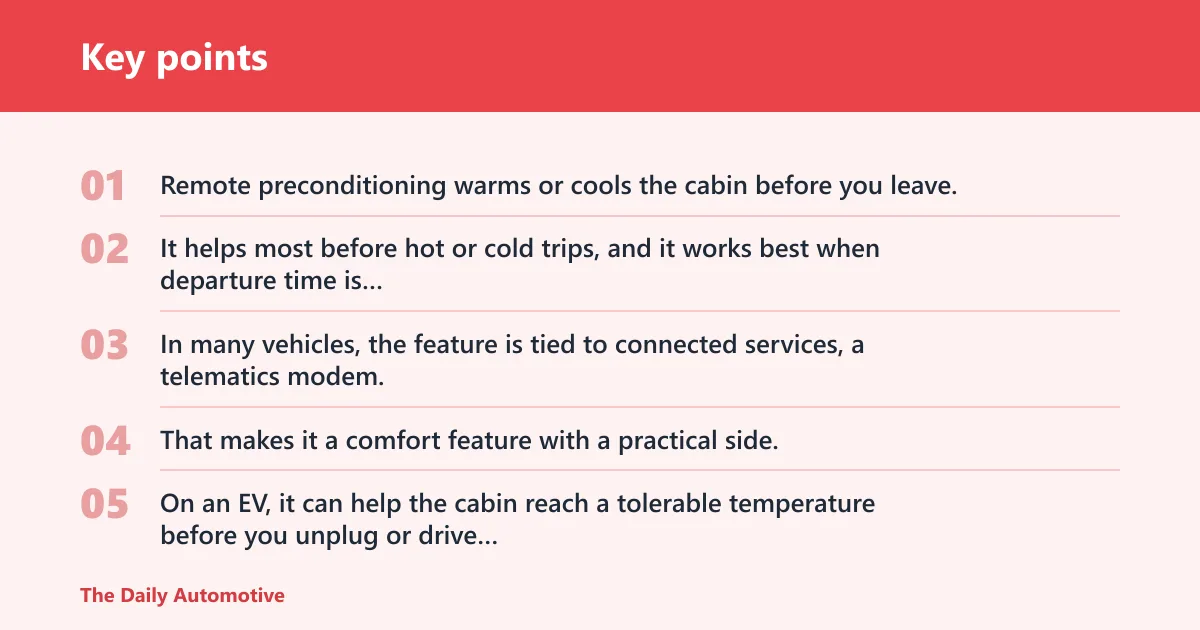
Remote preconditioning warms or cools the cabin before you leave. It helps most before hot or cold trips, and it works best when departure time is predictable. In many vehicles, the feature is tied to connected services, a telematics modem, and market-specific software support.
That makes it a comfort feature with a practical side. On an EV, it can help the cabin reach a tolerable temperature before you unplug or drive away. On a gasoline or plug-in hybrid vehicle, the value is usually easier entry comfort and less idling in the driveway.
The real trade-off: comfort, range, and cost
The gain is simple: you get into a cabin that is already closer to your preferred temperature. The cost is less simple. You may pay for a subscription, accept setup friction, and rely on cellular service and OEM software that can change by update or region.
For EV owners, the trade-off can include battery use. For ICE owners, it is mostly a convenience calculation. For PHEV owners, the answer often sits between the two, because the cabin can be preconditioned, but the value depends on whether the vehicle supports that function and how often you actually need it.
When is remote preconditioning worth it?
It is worth paying for when you face hot or cold starts often, your vehicle supports the feature, and your departures are predictable enough that the system can finish before you leave. If you drive in a mild climate or leave on a random schedule, the value drops fast.
Cold-weather and hot-weather use cases
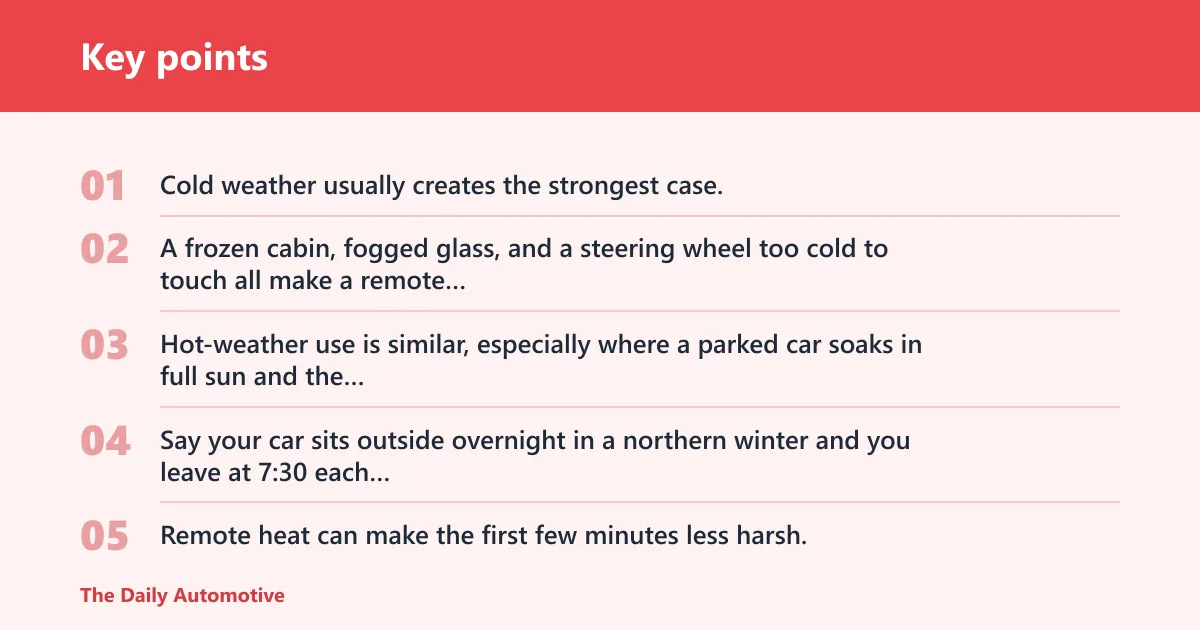
Cold weather usually creates the strongest case. A frozen cabin, fogged glass, and a steering wheel too cold to touch all make a remote heat function feel useful. Hot-weather use is similar, especially where a parked car soaks in full sun and the cabin becomes unpleasant within minutes.
Say your car sits outside overnight in a northern winter and you leave at 7:30 each morning. Remote heat can make the first few minutes less harsh, and in some EVs it can help preserve driving comfort without spending those first minutes waiting in the driveway.
Suppose the car sits in a sun-baked lot at work for eight hours. Remote cooling can make the return trip bearable, but only if the vehicle supports the function and the app can reach it. If the signal is weak, the value falls to almost nothing.
EV, PHEV, and ICE ownership differences
EVs usually get the biggest upside because preconditioning can improve comfort before departure and reduce the need to spend energy after you start moving. That matters most in harsh climates, where cabin conditioning can be a noticeable part of day-to-day use.
PHEVs can benefit too, but the value depends more on trim support and package availability. ICE vehicles gain comfort, not range efficiency. That makes remote climate control easier to justify on a long cold commute than on a short drive to a mild-weather grocery run.
ICE owners should be cautious about paying for a premium package solely for climate control. If the vehicle already has heated seats or a basic remote start function, the app may add convenience rather than meaningfully change the ownership experience.
Commute patterns that make it pay off
The best fit is a routine commute with a known departure time. If you leave at the same hour every weekday, scheduled departure and app-based preconditioning can do real work. If you leave whenever the day allows, the feature may sit unused.
Short commutes can still justify it in extreme climates because the whole drive is brief and the cabin never has much time to recover. Longer commutes can benefit too, but the added value comes from comfort rather than large cost savings.
How much subscription value are you buying?
The value depends on how much the connected-services package costs relative to how often you will use the feature. If remote climate control sits behind a higher-tier package, the feature can move from useful to expensive very quickly. If it is included or complimentary, the math changes.
Connected-services tiers and package gating
Many systems place remote climate features behind a package tier. That means you may have access to lock, vehicle status, or other functions at one tier, while preconditioning or full climate control sits behind another. Availability can also differ by model, software, and region.
Land Rover Remote requires a subscription package fitted to the vehicle, and the climate function can cool or heat the vehicle before a trip on higher tiers. Ford says the app is free to download and that remote features are complimentary with the app, but EV preconditioning still depends on vehicle capability and activation.
Subscription cost sensitivity versus convenience value
If the monthly or annual fee is easy to ignore, the feature can be a good comfort upgrade. If the fee feels like a stretch, you need a harder standard. Ask how many winter mornings, summer afternoons, or awkward parking-lot departures it will actually solve.
A common first-timer mistake is paying for the feature because it sounds advanced, then using it only a few times a season. In that case, heated seats, a good windshield defroster, or a scheduled departure setting may cover most of the same ground.
When the feature becomes expensive fluff
It becomes fluff when the climate is mild, the departure time is unpredictable, or the vehicle rarely sits in conditions that make preconditioning worthwhile. If you also have to add a subscription on top of that, the feature can become hard to justify.
It is also weaker value when the vehicle already has enough physical comfort aids to make the cabin acceptable within a minute or two. In that case, the app is solving a problem that is small enough to ignore most days.
What Ford and Land Rover actually include
Ford and Land Rover both offer remote vehicle functions, but the feature sets are not identical. The same source says the app is free to download and includes remote start, vehicle access, and GPS tracking. Land Rover Remote can cool or heat the vehicle before a trip, but access depends on package tier, software, and market.
Ford app remote climate controls
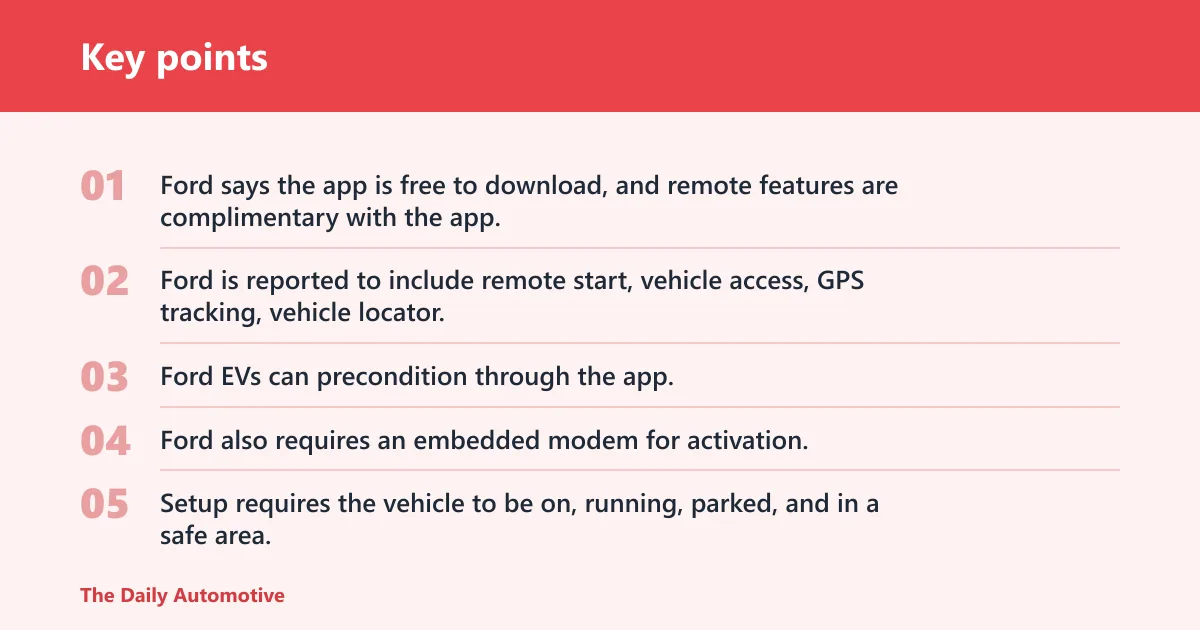
The same source says the app is free to download, and remote features are complimentary with the app. Ford is reported to include remote start, vehicle access, GPS tracking, vehicle locator, and vehicle stats. Ford EVs can precondition through the app, and remote commands may take up to two minutes to complete.
Ford also requires an embedded modem for activation, and the device and vehicle need a strong cellular signal. Setup requires the vehicle to be on, running, parked, and in a safe area. That is a real limitation if you are trying to activate the feature in a weak-signal garage or an area with poor coverage.
Land Rover Remote climate controls
Land Rover Remote can cool or heat the vehicle before a trip on higher tiers. Land Rover Remote is available with InControl Remote Premium features, and it requires a subscription package fitted to the vehicle. Land Rover also says feature availability depends on capability, software, and market.
Higher-tier access can also include vehicle access. That makes the app useful beyond climate control, but the climate function still depends on the vehicle’s exact specification. Two similar-looking trims can behave differently once software, region, and package tier are factored in.
Where activation and modem requirements can block use
Vehicle telematics modem support matters because the app must talk to the car over the network. If the modem is not embedded, if the signal is weak, or if activation has not been completed inside the vehicle, the system may not work as expected.
That is why a feature can look simple on a brochure and still disappoint after delivery. The app is only one part of the system. The vehicle, the subscription, the signal, and the activation process all have to line up.
Remote climate control comparison
The best choice depends on climate, vehicle type, commute pattern, and how much you want to pay for convenience. An EV in a severe climate gets more value from preconditioning than an ICE car in a mild one. Predictable departures matter almost as much as vehicle type.
| Climate severity | Vehicle type | Commute pattern | Subscription cost sensitivity | Likely ROI | Verdict |
|---|---|---|---|---|---|
| Severe cold | EV | Fixed weekday departure | Low | High comfort gain and meaningful convenience | worth it |
| Severe heat | EV | Predictable daily departure | Medium | Strong comfort benefit, especially after parking in sun | worth it |
| Mild year-round | ICE | Unpredictable schedule | High | Low practical gain versus the fee | skip it |
| Moderate winter | PHEV | Mostly regular commute | Medium | Useful if bundled, less compelling if priced high | maybe |
| Hot climate | ICE | Regular, but short trips | Low | Comfort gain exists, but alternatives may cover most needs | maybe |
| Extreme cold | EV | Varied schedule | High | Feature helps, but unpredictability reduces value | maybe |
Climate severity rows
Severe climates push the feature into the useful column. Mild climates pull it back toward convenience only. If the cabin rarely feels harsh at departure, the app does not have much work to do.
Vehicle type rows
EVs are the strongest case because cabin preconditioning can do more than improve comfort. PHEVs land in the middle. ICE vehicles usually need the most help only when the weather is extreme and the feature is bundled at a low cost.
Commute and cost sensitivity rows
A predictable commute makes the feature easier to use and easier to justify. High cost sensitivity pushes you toward skip unless the climate is severe or the feature comes included. If you hate recurring fees, the feature should earn its keep quickly.
Choose remote climate if… / Choose something else if…
Choose remote climate if the weather is harsh, the vehicle supports the function, and your departure is usually predictable. It also makes more sense if the subscription is bundled, complimentary, or already included in the trim you want.
Choose something else if your climate is mild, your trips start at random times, or the fee is high enough to feel like an extra luxury tax. Heated seats, ventilated seats, and scheduled departure can cover much of the same comfort gap for less money.
- Choose remote climate if you live with freezing mornings or hot parked-cabin conditions most weeks of the year.
- Choose remote climate if your EV or supported PHEV can precondition through the app and you leave on a routine schedule.
- Choose something else if you mostly drive in moderate weather and the feature would be used only a few times a season.
- Choose something else if the vehicle needs a higher subscription tier and you are sensitive to recurring costs.
- Check whether your exact trim, model year, software, and market support remote climate control.
- Confirm whether activation needs an embedded modem, in-vehicle confirmation, or a specific connected-services tier.
- Compare the fee against how often you face extreme hot or cold starts.
- Look at alternatives such as scheduled departure, heated seats, or ventilated seats.
- Buy the feature only if it solves a routine problem, not a rare one.
Frequently asked questions
Is remote preconditioning worth it for my car?
It is worth it when your climate is harsh, your departures are predictable, and your vehicle supports the feature without an expensive add-on. In mild weather, it is usually a convenience feature rather than a necessity. EV owners tend to get the clearest return.
How does a car climate control app work?
The app is said to send a command to the vehicle over its connected-services system, usually through an embedded modem and cellular connection. The car then starts the climate system, and in supported vehicles it can heat or cool the cabin before you get in. Activation and signal quality matter.
Which cars support remote start or preconditioning?
Support depends on the exact model, trim, software, region, and package tier. The same source says its app includes remote features and EV preconditioning on supported vehicles, while Land Rover says availability depends on capability, software, and market. Check the manufacturer’s listing for your model before buying.
Do I need a subscription to use remote climate control?
Often yes. Many brands put remote climate functions behind a connected-services subscription or a higher package tier. Land Rover Remote requires a subscription package fitted to the vehicle. The same source says remote features are complimentary with the app, but availability still depends on the vehicle and activation.
How long does remote preconditioning take to work?
There is no universal timer because cabin size, outside temperature, and vehicle design all change the result. The same source says remote commands may take up to two minutes to complete, but that is the command time, not the full cabin-conditioning time. Expect longer in extreme cold or heat.
Is a remote climate app safe and reliable to use?
It is generally safe when used as directed and only in a parked vehicle, but reliability depends on connectivity, software, and successful activation. Weak cellular signal, delayed app updates, or a missing in-vehicle confirmation step can block the command. That is a feature limit, not a flaw in every car.
Products related to this article
Sponsored / affiliate links. As an Amazon Associate I earn from qualifying purchases. I may earn additional commission from eligible campaigns.