
How Long to Wait Before Refinancing a Car (60 Days Min)
A common rule of thumb is to wait at least about 60 days after origination before a car refinance lender will consider an application, though some lenders may require 90 days or more. Apply too early and you can waste credit checks, lose time, and miss better rates once your account qualifies. This guide explains the 60-day rule, the situations that still block refinancing, and whether waiting longer can improve approval odds and savings.
What the 60-day wait really means
The 60-day wait is usually a lender timing rule, not a universal legal ban. It means many auto refinance lenders want at least about 60 days to pass from the original loan origination date before they review a refinance application. Some lenders set a waiting period of about 90 days or longer, and some may still refuse if the loan is too new, too small, or tied to a vehicle that does not fit their rules.
Why lenders use a 60-day floor
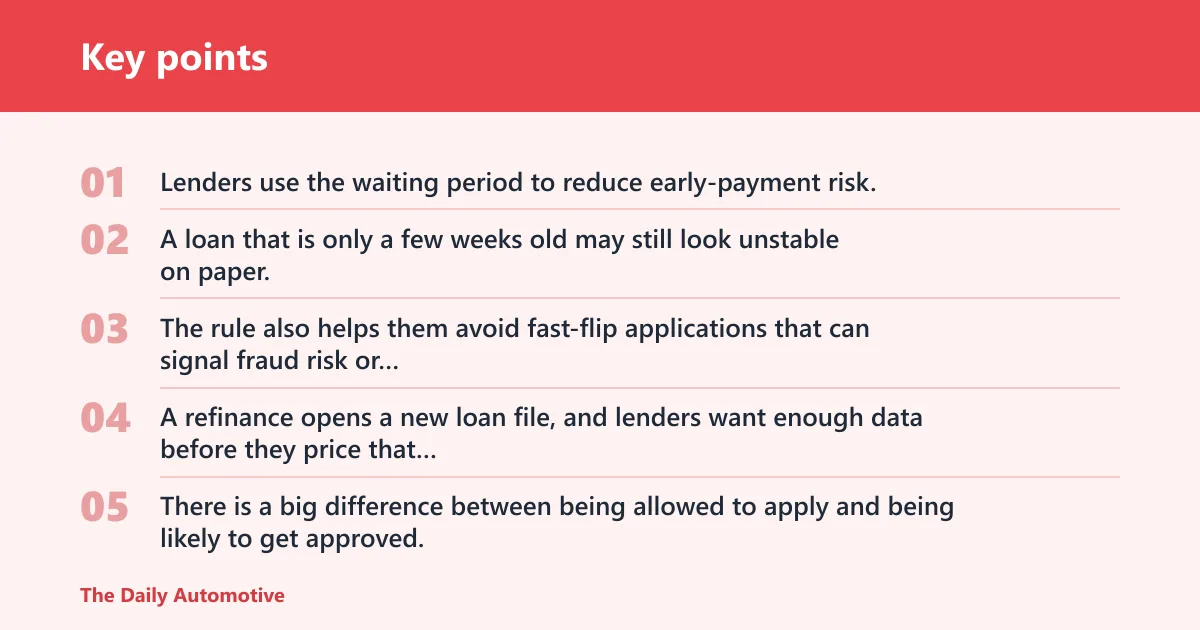
Lenders use the waiting period to reduce early-payment risk, confirm that the title and lien transfer can be handled cleanly, and make sure the original loan has enough payment history to judge. A loan that is only a few weeks old may still look unstable on paper, even if the borrower has strong credit.
The rule also helps them avoid fast-flip applications that can signal fraud risk or inaccurate paperwork. A refinance opens a new loan file, and lenders want enough data before they price that risk.
Legal eligibility versus lender policy
There is a big difference between being allowed to apply and being likely to get approved. A borrower can be technically eligible to submit an application after the first payment, but the lender may still deny it because the loan is too new, the equity is thin, or the vehicle misses mileage or model-year limits.
That distinction matters. An early application can leave a hard inquiry, cost time, and still end with the same answer: not yet.
How to find your origination date
Your auto loan origination date is the date the original loan closed. Check the retail installment contract, the first billing statement, or the lender’s online account details. If those are unclear, the payoff quote or customer service team can usually confirm the closing date.
That date matters more than the day you took the keys home. If the contract closed on March 4, day 60 is counted from March 4, not from the date you signed the purchase order.
Can I refinance my car after 30 days?
Usually not with a mainstream refinance lender. Thirty days is often too soon for a typical auto refinance policy, and many lenders may reject the application before a full review begins. A few niche lenders may accept it, but that is the exception, not the norm.
Why most lenders will say no
At 30 days, the lender sees almost no payment history. The title and payoff process may also be too fresh, and the borrower may not yet have built enough equity from principal reduction or market movement to meet the new lender’s loan-to-value rules.
Situations where an exception is possible
An exception is more likely if the original deal came with a very high APR, the borrower’s credit score improved sharply after closing, and the vehicle is worth well more than the payoff. Even then, the lender may still require the loan to age past 60 days or 90 days before funding.
Suppose a borrower financed a $28,000 used SUV at a dealer rate and then found a lower APR with a credit union a month later. The better score may help, but if the refinance policy says 60 days, the lender will likely ask the borrower to wait.
What an early denial does to your next application
An early denial does not usually hurt your long-term refinance chances, but the hard inquiry can cause a small temporary dip. If you apply again soon after, the lender may see the same stale file unless your credit, income, or vehicle equity has changed enough to matter.
A better move is to use the denial as a timing signal. Wait until the account clears the lender’s minimum age, then recheck your payoff balance, vehicle value, and rate quotes before you try again.
Car refinance decision table
| Borrower scenario | Likely eligibility | Biggest blocker | Worth refinancing now? |
|---|---|---|---|
| New loan under 60 days | Usually low | Lender timing rule and thin payment history | Usually no |
| Loan aged 60–90 days | Possible, if other rules fit | Vehicle age, mileage, or limited equity | Maybe, if the APR drop and fees work |
| Underwater loan | Often limited | Negative equity and lender LTV cap | Usually not unless the lender allows roll-in equity and savings are clear |
| Improved-credit borrower | Strong, if the loan is old enough | Current loan age and refinance fees | Often yes, if the new APR beats the old APR by enough |
Will waiting longer improve your approval odds?
Often yes, but only if the extra time changes the numbers lenders care about. More days can mean a better credit score, lower payoff balance, more equity, and a cleaner payment record. If none of those move, waiting may not improve your odds much.
Credit score changes that matter most
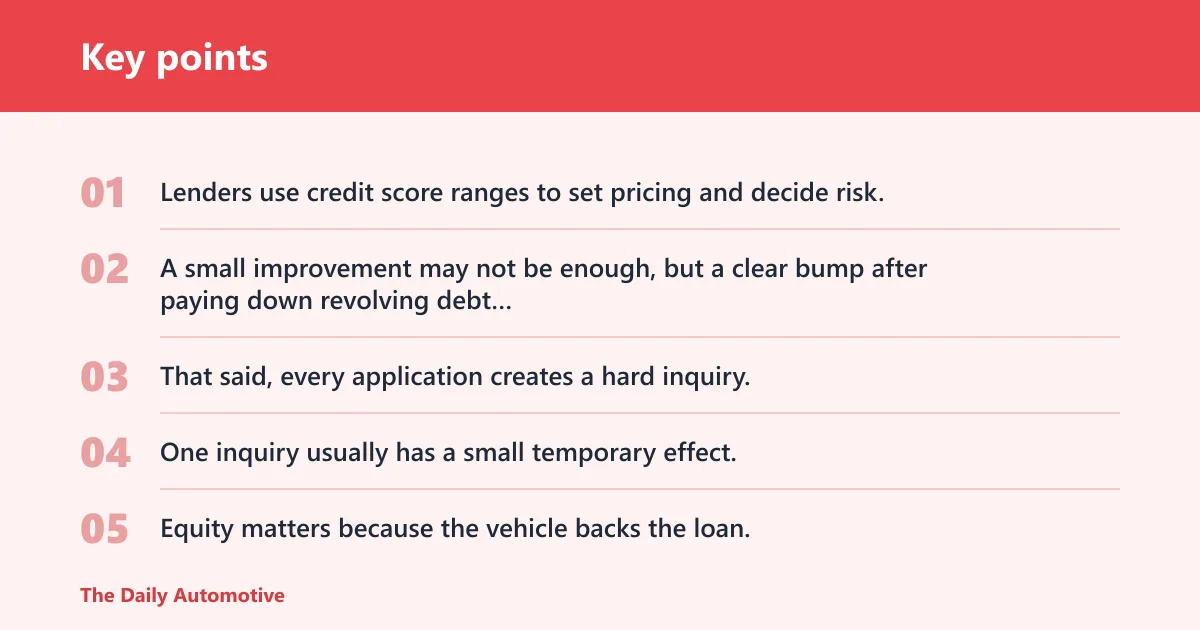
Lenders use credit score ranges to set pricing and decide risk, and a recent score jump can help if it moves you into a better tier. A small improvement may not be enough, but a clear bump after paying down revolving debt or fixing an error can change the rate offered.
That said, every application creates a hard inquiry. One inquiry usually has a small temporary effect, but multiple applications close together can make the file look less stable if the lender is already hesitant.
How equity and loan-to-value ratio affect approval
Equity matters because the vehicle backs the loan. If the payoff amount is close to or above the car’s current value, the loan-to-value ratio rises and the lender may cap the amount it is willing to finance. Many lenders have their own LTV ceiling and will not refinance a loan that sits too far underwater.
If the loan is underwater, a refinance can still happen in some cases, but the terms may be weaker. The lender may refuse negative equity altogether or require the borrower to bring cash to closing.
When a recent score jump is enough to reapply
Reapply when the score change is real, the payoff has come down, and the new APR would clearly beat the old one. A recent bump can be enough if it moves you into a lender’s preferred range and the vehicle still fits its age, mileage, and balance rules.
Picture a borrower who paid down a credit card balance, raised a score by a noticeable amount, and now has 18 months left on a car loan. If the refinance quote only trims the rate by a tiny amount, the score gain alone does not make the deal worthwhile.
When does refinancing actually save money?
Refinancing saves money when the new APR is low enough to offset fees and the remaining term is long enough for the savings to matter. A lower monthly payment can help cash flow, but that alone does not prove the refinance is worth it.
How to compare APR before and after refinancing
Start with the current APR, the new APR, the remaining balance, and the remaining months on the loan. Credit Karma says refinancing can lower monthly payments and shorten the loan term and save interest, but those outcomes depend on the size of the rate drop and the term you pick.
If the new loan trims only a fraction of a point, the savings may be too small to matter after fees. The cleaner the rate drop, the easier it is to justify the switch.
How fees change the break-even point
Refinance fees can include title transfer or lien recording fees, state registration costs, and any prepayment penalty on the existing loan. Those costs raise the break-even point, so the rate drop must be large enough to recover them within a reasonable time.
A simple check helps: divide total refinance fees by the monthly savings. If the answer is too many months for your plans, the refinance is weak even if the payment goes down.
Shorter term versus lower payment
A shorter term often cuts total interest but can raise the monthly payment. A longer term can lower the payment, but you may pay more interest over the life of the loan. The right choice depends on whether you need immediate monthly relief or lower total cost.
If the current loan already has a short balance left, a refinance that stretches the term may look attractive on the monthly bill and still cost more overall. That is why the payment alone should never decide the deal.
What lenders check before they approve a refinance
Most lenders review the loan age, credit profile, income, vehicle details, and payoff amount before approving a refinance. The process commonly includes seven steps, and third-party work can slow it down. The same source says the refinance timeline can vary by third-party work, and underwriting can take a few days up to a few weeks.
Required documents and payoff statement
The application may require proof of income, assets, and debts. You should also have proof of insurance, the vehicle title or VIN, and a current loan payoff statement. Lenders use those documents to verify identity, balance, and collateral details before funding.
Have the payoff statement ready before you compare offers. Without it, the new lender cannot estimate the exact loan amount needed.
Vehicle age, mileage, and minimum balance rules
Many lenders set vehicle age limits, mileage limits, minimum loan balance thresholds, and model-year cutoffs. A car that is too old, too high-mileage, or too small in balance may be excluded even if the borrower has good credit.
That is one reason refinancing a low-balance loan can be difficult. The lender may see too little remaining interest income to justify the cost of opening the account.
Underwater loans and other common blockers
Negative equity is one of the most common blockers. If the payoff is higher than the car’s market value, the lender may reject the file or ask for cash at closing. Some lenders will allow limited roll-in of negative equity, but that usually makes the new loan less attractive.
Another blocker is a recent dealer-rate contract that already used a promotional structure. If the original deal included a rate buydown or other incentive, the refinance may not beat it by enough to matter.
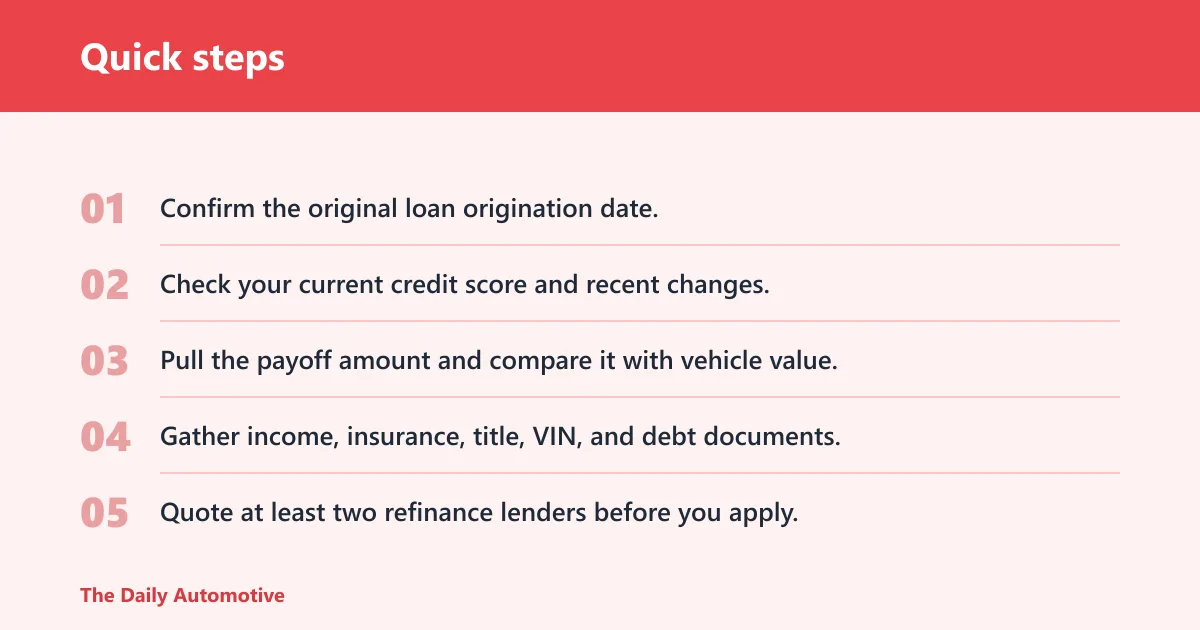
- Confirm the original loan origination date.
- Check your current credit score and recent changes.
- Pull the payoff amount and compare it with vehicle value.
- Gather income, insurance, title, VIN, and debt documents.
- Quote at least two refinance lenders before you apply.
- Compare APR, fees, and the remaining term, not payment alone.
Frequently asked questions
How long do you have to wait before refinancing a car?
Many lenders want at least 60 days from the original loan origination date before they will consider a refinance, and some require 90 days or more. That waiting period is lender policy, not a universal law, so you should check each lender’s rules before applying.
Why do lenders say to wait 60 days before refinancing a car?
Lenders use the 60-day floor to reduce risk and give the original loan time to settle. They want a payment record, a cleaner title and lien path, and more confidence that the vehicle value and payoff amount make the refinance worthwhile.
Does refinancing a car hurt your credit?
It can cause a small temporary dip because the lender will usually pull your credit. The effect is often limited if you shop in a short window, but repeated applications spread over time can keep the score under pressure while the new loan is being reviewed.
What documents do I need to refinance a car?
Bring proof of income, proof of insurance, the vehicle title or VIN, and a current loan payoff statement. Many lenders also ask for proof of debts and assets so they can confirm your overall profile before they issue final approval.
Can I refinance if I am underwater on my car loan?
Sometimes, but it is harder. An underwater loan raises the loan-to-value ratio and may push you past the lender’s limit. Some lenders allow limited negative equity, while others reject the file outright unless you pay down the balance first.
Products related to this article
Sponsored / affiliate links. As an Amazon Associate I earn from qualifying purchases. I may earn additional commission from eligible campaigns.