How Many G’s Does a F1 Car Pull: Proven Science
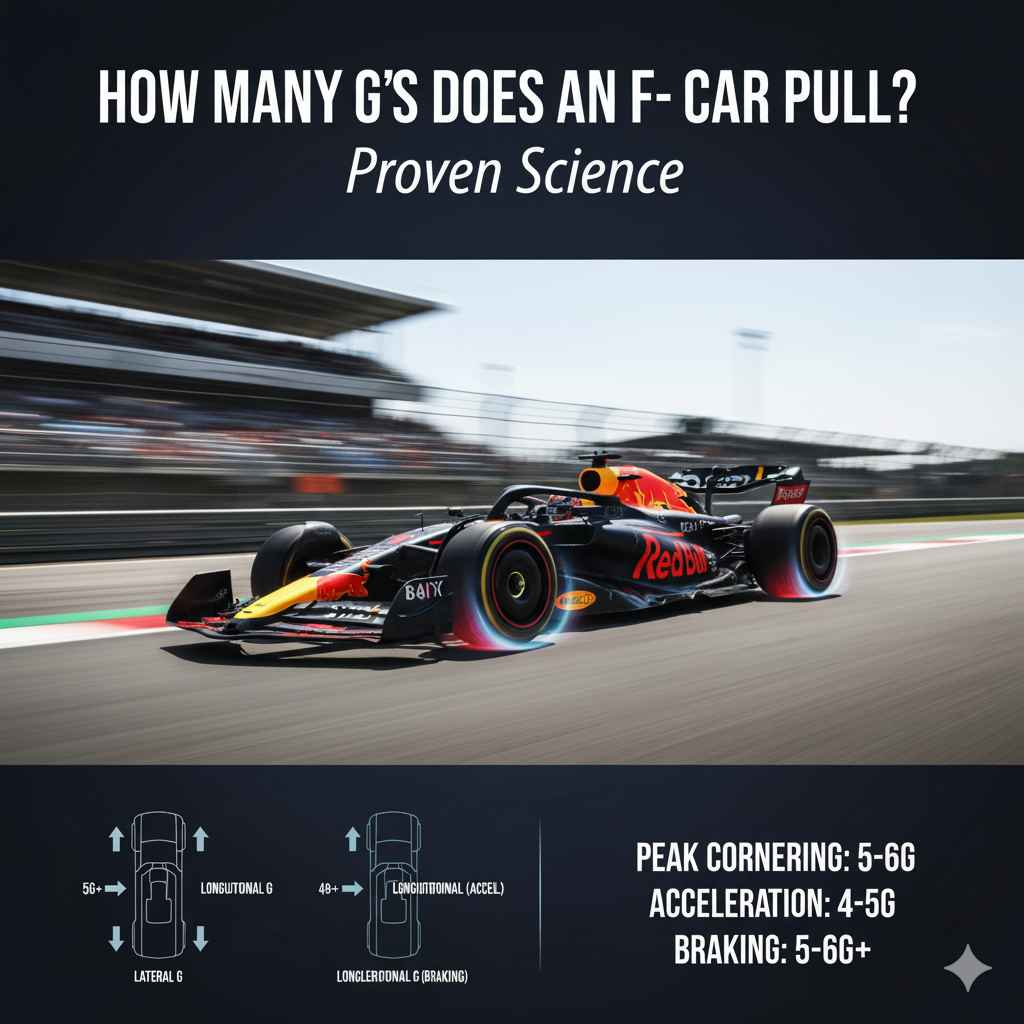
A Formula 1 car can pull over 5 Gs of force when cornering, braking, and accelerating. This means a driver experiences forces more than five times their own body weight!
Have you ever watched a Formula 1 race and wondered how drivers manage those incredible turns and sudden stops without flying out of their seats? It looks like something out of a science fiction movie, doesn’t it? But it’s all real physics and engineering working together. The sheer forces involved are astonishing, and it’s a common question for many of us: just how much “G-force” are these amazing machines and their drivers dealing with? Understanding this will give you a whole new level of appreciation for F1 drivers and the technology that makes it all possible. Let’s break down the science behind those nose-diving corners and lightning-fast straights!
What Exactly is G-Force?
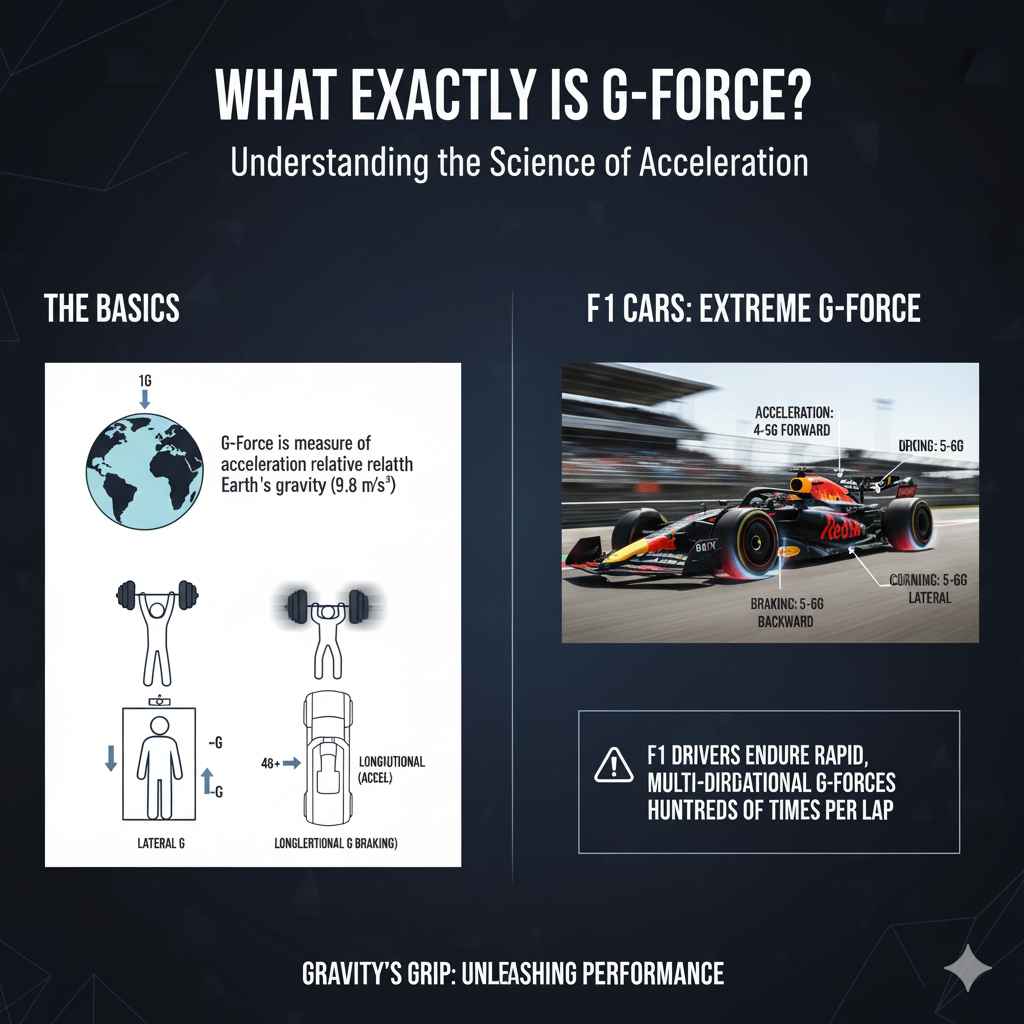
Before we dive into how much G-force an F1 car pulls, it’s important to understand what G-force actually is. In simple terms, G-force isn’t a force itself, but rather a measure of acceleration expressed in multiples of the standard acceleration due to gravity on Earth. We measure it as “g.”
One “g” is the acceleration we feel standing still on Earth. When you’re in an elevator and it suddenly starts moving upwards, you feel a slight push into the floor – that’s you experiencing a little more than 1 g of force. When an F1 car is turning, braking, or accelerating rapidly, the forces are much, much higher.
The “G” in G-force stands for “gravity.” It’s a way to compare the acceleration an object or person experiences to the acceleration we naturally feel due to Earth’s gravity (which is about 9.8 meters per second squared, or roughly 2.2 miles per hour per second).
Imagine a weightlifter holding a dumbbell. If they hold a 1kg dumbbell, they’re experiencing 1 “g” of force from that dumbbell pulling down. If they could somehow hold a dumbbell that felt like it weighed 5kg, they’d be experiencing 5 “g”s of force. This is what F1 drivers endure, but hundreds of times a second as the car’s speed and direction change!
How Much G-Force Does an F1 Car Pull?
This is the big question! Formula 1 cars are designed to generate immense amounts of downforce, which is the aerodynamic force that pushes the car down onto the track, dramatically increasing grip. This downforce, combined with high speeds and precise engineering, allows these cars to pull mind-boggling G-forces.
In Formula 1, drivers can experience G-forces that are several times their own body weight. The exact figures vary depending on the specific corner, braking zone, or acceleration phase, but here’s a general breakdown:
- Cornering: This is where the highest G-forces are typically experienced. In high-speed corners like Copse at Silverstone or Suzuka’s 130R, F1 cars can pull between 5 Gs and 6 Gs. That means a driver weighing 70 kg (about 155 lbs) would feel like they weigh over 350 kg (about 775 lbs)!
- Braking: When an F1 car brakes from its top speed, it’s decelerating incredibly quickly. This can generate forces of up to 5 Gs or even slightly more. Imagine slamming on the brakes in your car – now multiply that feeling by five! This intense braking pressure pushes the driver forward against their harnesses.
- Acceleration: While not as high as cornering or braking, acceleration still generates significant G-forces. When an F1 car rockets off the starting line or out of a slow corner, drivers can experience around 3 Gs to 4 Gs. This force pushes them back into their seats.
It’s important to remember that these numbers are peaks. A driver experiences these forces continuously throughout a race, constantly fluctuating as the car navigates the track.
The Science Behind the G-Force: Aerodynamics and Grip
The incredible G-forces F1 cars can pull are not magic; they are the result of brilliant engineering, particularly in aerodynamics. Formula 1 cars are essentially high-performance wings on wheels.
The complex aerodynamic devices on an F1 car – the front wing, rear wing, diffuser, and undertray – are meticulously designed to generate “downforce.” Downforce is an upward-acting aerodynamic force that, counter-intuitively, pushes the car down onto the track. The faster the car goes, the more downforce is generated.
This increased downforce acts like glue, pressing the tires against the asphalt. More tire pressure on the track means more friction, and more friction means more grip. With exceptional grip, the car can:
- Take corners at much higher speeds.
- Brake much later and harder.
- Accelerate out of bends more aggressively.
This is why F1 cars are so incredibly fast. They are not just about raw engine power; they are about maximizing the car’s ability to stick to the track, even when subjected to extreme forces. For a deeper dive into how F1 aerodynamics work, this resource from Formula1.com is excellent.
The Impact on the Driver
Experiencing 5 Gs or more is not something the human body is built for without preparation. F1 drivers are elite athletes specifically conditioned to withstand these immense forces.
The physical toll on an F1 driver is astronomical. When pulling 5 Gs, a driver feels like they are carrying their own body weight additionally. This constant strain affects every part of their body, especially their neck and cardiovascular system.
Physical Conditioning
F1 drivers undergo rigorous training regimes to prepare their bodies for the demands of racing. This training focuses on:
- Neck Strength: Their necks are trained to support the weight of their helmet and head under extreme lateral forces. Imagine trying to hold your head up with an extra 50-70 kg pulling it to the side!
- Cardiovascular Fitness: Drivers need incredible endurance to maintain focus and physical control for two-hour races, all while their heart rate is elevated due to the exertion and G-forces.
- Core Strength: A strong core helps drivers maintain stability within the cockpit and resist the forces that try to pull them out of position.
This extensive physical preparation is one of the primary reasons drivers can manage such high G-loads. Without it, they would be quickly overwhelmed.
Head and Neck Support
Beyond physical training, the car’s safety equipment plays a crucial role:
- HANS Device: The Head and Neck Support (HANS) device is a mandatory piece of safety equipment. It’s a yoke-like device that rests on the driver’s shoulders and attaches to their helmet, helping to prevent extreme whiplash and limit the forward movement of the head under heavy braking. You can learn more about its development and impact from FIA.com.
- Cockpit Design: The seat is custom-molded to each driver, providing a snug fit that helps brace them against the forces.
- Seatbelts: The five-point harness system is designed to keep the driver firmly seated and distribute forces across their body.
These combined elements of driver conditioning and car safety equip allow drivers to not just survive, but excel under these incredible pressures.
Forces Experienced in Different Parts of the Track
The G-forces an F1 car experiences aren’t uniform across a lap. Different sections of a circuit present unique challenges and therefore different G-force profiles.
Let’s look at a typical F1 track and identify where these extreme forces are most prominent:
High-Speed Corners
Corners like the Parabolica at Monza or Copse at Silverstone are designed for cars to carry maximum speed. The aerodynamics are working overtime here, pushing the cars down and allowing for those massive lateral G-forces.
Example: Cornering at 200 mph (320 km/h) with a radius of 150 meters can easily result in forces exceeding 5 Gs. The physics behind this involves the centripetal acceleration: a = v²/r, where ‘v’ is velocity and ‘r’ is the radius of the turn. Even with this simplified formula, you can see how high speed and a tight radius amplify acceleration.
Heavy Braking Zones
At the end of long straights, drivers must decelerate from speeds often exceeding 200 mph (320 km/h) to much lower speeds for tight corners. This demands brutal braking power.
Example: Braking from 200 mph down to 50 mph (80 km/h) in just a few seconds requires massive deceleration. If a car can achieve 5 gs of braking force, it means it can reduce its speed by about 108 mph (174 km/h) every second (5 Gs * ~21.6 mph/g). This rapid slowing pushes the driver hard against their belts.
Acceleration Zones
As cars exit slower corners, their engineers aim to get them accelerating as quickly as possible. While the peak Gs are lower than in corners or braking zones, sustained acceleration is still a significant factor.
Example: Accelerating from 40 mph (64 km/h) to 160 mph (257 km/h) in a short distance applies a constant push into the driver’s seat. This sustained force, though less potent than peak lateral forces, contributes to driver fatigue over a long race.
The Role of Tires and Suspension
It’s not just aerodynamics that allow for these forces. The tires and suspension system are equally critical.
Tires: F1 tires are specially designed to withstand incredible forces and generate immense grip. Their construction, compound, and tread pattern (or lack thereof) are optimized for these extreme conditions. When pulling 5 Gs, the tires are under enormous stress, trying to maintain contact with the road and transfer the car’s power and braking forces.
Suspension: The suspension must manage these forces while keeping the car stable and predictable. It controls how the car reacts to bumps, kerbs, and the massive accelerations and decelerations, ensuring the tires remain planted and the chassis is kept level.
Comparing F1 G-Forces to Everyday Experiences
To truly appreciate how extreme F1 G-forces are, it’s helpful to compare them to experiences we might be more familiar with.
Even common experiences involve G-forces, but on a much smaller scale. Understanding these comparisons can make the almost incomprehensible numbers of F1 more relatable.
Everyday G-Forces for Context
Here’s a look at G-forces in more common situations:
- Standing Still: You experience 1 G constantly due to Earth’s gravity.
- Elevator Movement: A quickly starting elevator might push you down with about 1.2 Gs, and a sudden stop might lift you slightly, experiencing around 0.8 Gs.
- Roller Coaster: Some of the most intense roller coasters can reach peaks of 3 Gs to 4 Gs.
- Aerobatic Aircraft: Fighter pilots, highly trained and in specialized suits, can handle even higher G-forces, sometimes up to 9 Gs for very short periods.
- Car Accidents: A severe car crash can involve forces ranging from 30 Gs to over 100 Gs, which is why safety equipment like seatbelts and airbags are vital and why such impacts are so dangerous.
F1 Cars vs. Other Racing Series
Formula 1 cars generally pull higher G-forces than cars in many other racing series. For instance:
IndyCar: IndyCars, especially on oval tracks, experience high G-forces, particularly in sustained turns. However, their aerodynamic design and chassis are different, often resulting in slightly lower peak lateral Gs compared to F1, though still within the 4-5 G range.
WEC/Le Mans Prototypes: These cars also generate significant downforce and pull high Gs, but they often prioritize endurance and overall speed across different conditions, which can influence their aerodynamic balance and peak G-force potential compared to F1, usually in the 3-4 G range.
The F1 Car: A Superior Gripping Machine
The constant evolution of Formula 1 technology, particularly in aerodynamics and tire development, has allowed these cars to push the boundaries of what’s physically possible on four wheels. The ability to generate more downforce means more grip, and more grip means higher cornering speeds and braking capabilities, directly translating to higher G-forces. The current generation of F1 cars are arguably the most aerodynamically advanced and fastest-cornering cars ever produced.
How Is G-Force Measured in F1?
Measuring G-force isn’t something done with a simple gauge in an F1 car. It involves sophisticated telemetry and onboard sensors.
Onboard Telemetry Systems
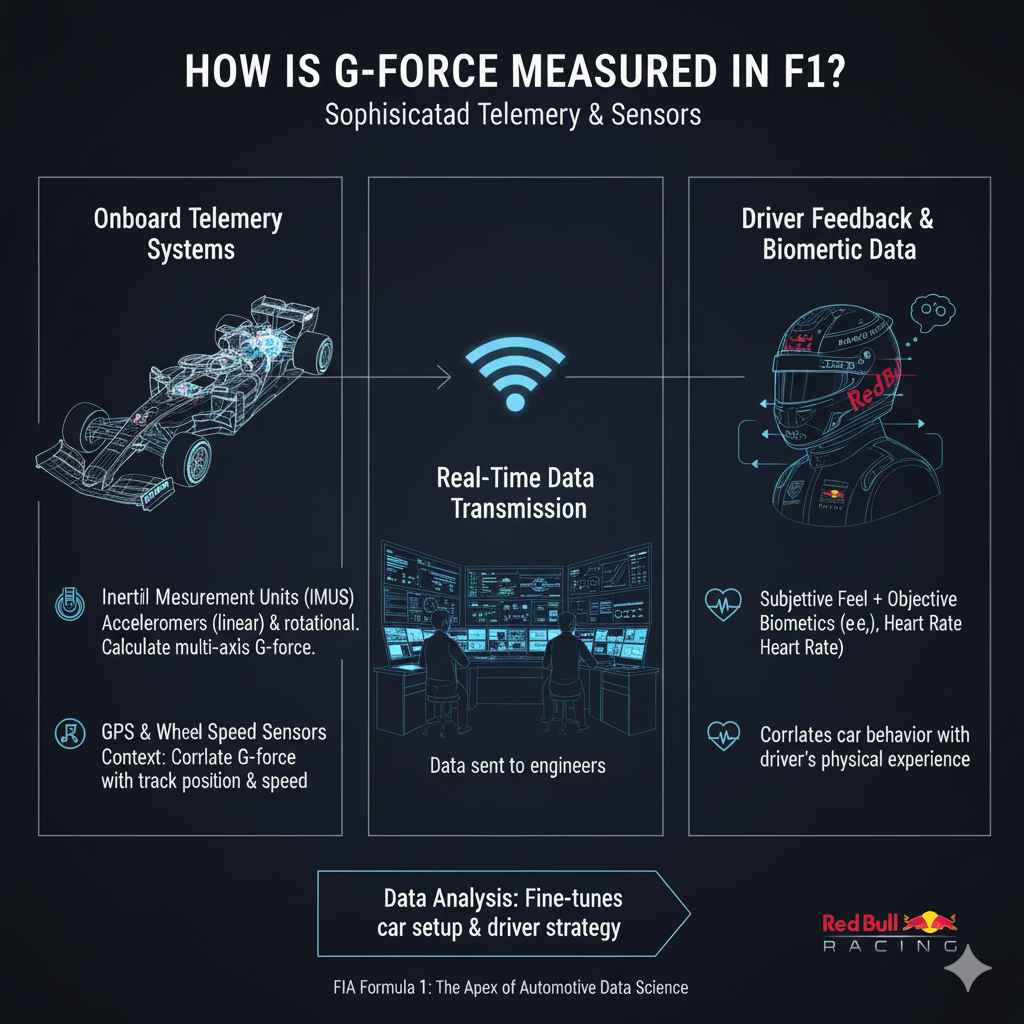
Every F1 car is equipped with an array of sensors that collect vast amounts of data during a race. This data is transmitted to the team’s engineers in real-time.
Inertial Measurement Units (IMUs): These are the primary devices for measuring acceleration. An IMU typically includes accelerometers and gyroscopes. Accelerometers measure linear acceleration (forward/backward, side-to-side, up/down), while gyroscopes measure rotational velocity. By combining the data from multiple accelerometers oriented in different axes, engineers can precisely calculate the total G-force being experienced by the car and driver at any given moment.
GPS and Wheel Speed Sensors: These provide crucial context for the acceleration data. Knowing the car’s speed and where it is on the track allows engineers to correlate the measured G-forces with specific corners or straight sections. This helps optimize car setup and driver strategy.
Driver Feedback and Biometric Data
While sensors provide objective data, driver feedback is also invaluable. Drivers report how the car feels, which helps correlate the mechanical response with the physical sensations.
Some teams may also use biometric sensors on the driver (e.g., heart rate monitors) to understand the physiological impact of these forces and the overall demands of the race.
This detailed data collection allows teams to fine-tune everything from the car’s suspension settings to the driver’s braking points, all in pursuit of shaving off fractions of a second per lap by maximizing the car’s performance within its physical limits.
Can G-Forces Cause Health Issues for Drivers?
While F1 drivers are conditioned athletes, the extreme forces they endure can still have long-term and short-term effects.
The immense physical stress of Formula 1 racing is a significant factor in a driver’s career and well-being. While drivers are fitter than most athletes, the continuous assault from G-forces takes its toll.
Short-Term Effects
During a race, drivers can experience:
- Dehydration: The heat and physical exertion lead to significant fluid loss.
- Muscle Fatigue: Especially in the neck, shoulders, and core.
- Blurred Vision or “Grey Out”: In corners with very high G-forces, blood can be drawn away from the pilot’s head towards the lower extremities, leading to temporary visual impairment. This is one reason for the rigorous fitness training.
Long-Term Effects
Over many years of racing at the highest level, some drivers may face:
- Neck and Spinal Issues: The constant strain can lead to wear and tear on the spine and neck muscles.
- Cardiovascular Strain: While they have excellent endurance, the extreme heart rates and blood pressure fluctuations during races can put a long-term load on their hearts.
- Injuries from Accidents: While safety has improved dramatically, the potential for serious injury from crashes, which involve even higher G-forces, is always present.
However, it’s essential to reiterate that modern F1 safety measures, including car design, driver equipment, and medical support, have made the sport significantly safer. The physical demands are part of the challenge, and drivers embrace it as a consequence of competing at the pinnacle of motorsport.
Frequently Asked Questions (FAQ)
What is the highest G-force ever recorded in an F1 car?
While exact figures can vary and are often proprietary, records suggest F1 cars can momentarily exceed 6 Gs in certain high-speed corners. Peaks around 5.5 G are commonly cited for sustained cornering.
Does the G-force change based on the specific F1 car?
Yes, slightly. Different car designs, especially their aerodynamic packages and suspension setups, can influence the peak G-forces experienced. However, the fundamental physics of how a car handles forces remain the same.
How do F1 drivers deal with the physical demands?
They undergo intense, specialized fitness training focusing on neck strength, cardiovascular endurance, and core stability to prepare their bodies for the extreme forces.