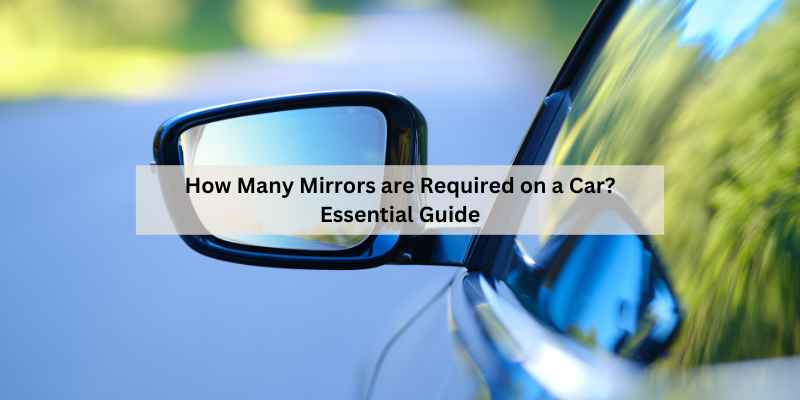
How Many Mirrors Are Required on a Car? (FMVSS 111 Explained)
Federal law (FMVSS 111) requires only two mirrors on a passenger car — an interior rearview mirror and an exterior mirror on the driver’s side — not the three most drivers assume. Skipping the passenger-side mirror is only legal if the interior mirror gives an unobstructed view; towing a trailer or hauling cargo that blocks the rear window makes a passenger mirror mandatory. This guide covers the federal minimum, state-by-state differences, and when extra mirrors are legally required.
Quick Answer
Federal law (49 CFR 571.111, also called FMVSS 111) requires only 2 mirrors on a passenger car: an interior rearview mirror and a driver-side exterior mirror. A passenger-side mirror is legally required only when the interior mirror does not give an unobstructed rear view — for example, when towing or hauling cargo that blocks the back window.
How Many Mirrors Does Federal Law (FMVSS 111) Actually Require?
Every passenger car, truck, bus, and motorcycle sold in the US must meet Federal Motor Vehicle Safety Standard No. 111 (FMVSS 111), the regulation that sets mirror requirements. The standard’s actual minimum surprises most drivers: an inside rearview mirror that meets a specific field-of-view test, plus an outside mirror on the driver’s side. That’s it — two mirrors, not three.
📊 49 CFR § 571.111 sets the legal mirror minimum at just 2 — an interior rearview mirror plus a driver-side exterior mirror. A passenger-side mirror is only mandatory if the interior mirror fails the standard’s field-of-view test. — Source: eCFR, 49 CFR 571.111
Almost every car sold today ships with a passenger-side mirror as standard equipment anyway — but that’s a manufacturer choice, not a federal mandate, unless your specific vehicle’s interior mirror can’t clear the rear window on its own.
The 3 Types of Mirrors Found on Most Cars
Even though only two are legally mandatory, most modern cars carry three (sometimes four) mirror types, each covering a different gap in the driver’s view.
| Mirror Type | Location | Legally Required? | Purpose |
|---|---|---|---|
| Interior rearview mirror | Top-center of windshield | Yes — always | Shows traffic directly behind the car |
| Driver-side exterior mirror | Driver’s door | Yes — always | Shows traffic beside and behind on the driver’s side |
| Passenger-side exterior mirror | Passenger door | Only if the interior mirror is obstructed | Shows traffic beside and behind on the passenger side |
| Blind-spot mirror | Small convex add-on, clipped to a side mirror | No — aftermarket only | Covers the gap the side and rearview mirrors miss |
When Is a Passenger-Side Mirror Legally Required?
The passenger-side mirror flips from optional to mandatory the moment your interior rearview mirror can’t do its job. Under FMVSS 111, that happens when the view through the back window is blocked — most commonly by:
- A trailer, camper, or boat wide enough to block the rear window
- Cargo, passengers, or headrests stacked high enough to obstruct the interior mirror’s field of view
- A cargo van, box truck, or windowless rear compartment with no rear glass at all
In any of these situations, a passenger-side exterior mirror (or a clip-on towing mirror extension) isn’t optional — it’s the only way to legally restore the field of view the interior mirror lost. If a mirror is missing or cracked and needs replacing before your next inspection, here’s how to fix a side mirror yourself. Or if you need to get back on the road safely today, a temporary side mirror can restore that legal field of view in minutes.
Best Blind Spot Mirror Pick
LivTee 2″ Round HD Glass Frameless Convex Blind Spot Mirror (Pack of 2)
A cheap, no-drill add-on that widens your existing side mirrors’ field of view without touching your car’s factory equipment.
- Best for: covering the gap between your side mirror and rearview mirror on any car, SUV, or truck
- Why we picked it: stick-on install takes under a minute and doesn’t affect your legally required mirrors
- Main drawback: convex glass slightly distorts distance — objects appear farther than they are
Compare more mirror-visibility options
 Option 1 CIPA 11950 Clip-On Towing Mirror, 15.75″
|
 Option 2 JOYTUTUS 12″ Panoramic Wide-Angle Clip-On Mirror
|
 Option 3 Blind Spot Mirror 2-Pack, 2″ Convex Stick-On
|
As an Amazon Associate we earn from qualifying purchases.
Do State Mirror Laws Differ From the Federal Minimum?
FMVSS 111 governs what mirrors a car must have when it’s manufactured and sold. States separately regulate what counts as street-legal on an existing car, and those rules aren’t identical everywhere.
| Jurisdiction | Minimum Mirrors | Key Rule |
|---|---|---|
| US Federal (FMVSS 111) | 2 | Interior mirror + driver-side exterior mirror; passenger-side only if the interior mirror is obstructed |
| California | 2 | Driver-side exterior mirror plus either the interior mirror or a passenger-side mirror, each with a 200-ft rear view |
| Texas | 1 (in practice) | The interior mirror alone is legal if it gives a clear 200-ft view; a side mirror is only required once that view is blocked |
| UK (registered on/after Jan 26, 2010) | 3 | Offside, nearside, and interior mirror required, unless the interior mirror can’t see the rear |
| UK (registered before Jan 26, 2010) | 2 | Offside (driver’s side) mirror is mandatory, plus one more working mirror |
Because these rules vary, the safest baseline is simple: keep every mirror your car left the factory with intact and unmodified. That satisfies every state and country’s minimum without you needing to track individual vehicle codes.
Backup Cameras: The Other Rear-Visibility Rule Most Guides Miss
Mirrors aren’t the only rear-visibility requirement anymore. Since May 1, 2018, every new passenger vehicle sold in the US with a gross vehicle weight rating of 10,000 pounds or less must also include a backup camera, under a separate 2018 amendment to FMVSS 111. Congress mandated the rule through the Cameron Gulbransen Kids Transportation Safety Act after backover crashes were found to disproportionately kill young children and older adults standing behind a vehicle in its mirrors’ blind zone.
📊 Before the 2018 rule, NHTSA estimated backover crashes caused about 292 deaths and 18,000 injuries a year in the US — a major reason backup cameras are now required alongside mirrors on every new car. — Source: Federal Register, FMVSS No. 111 Rear Visibility
The backup camera doesn’t replace your mirrors legally — it’s an addition on top of the FMVSS 111 mirror minimum, not a substitute for it.
Blind-Spot and Towing Mirrors: Do You Need Them?
Blind-spot mirrors are small convex mirrors, usually round or rectangular, clipped or stuck onto your existing side mirrors. They aren’t required by any law — they’re an aftermarket fix for the gap between what your side mirror shows and what your rearview mirror shows. If you’ve never installed one, this guide to blind spot mirrors for cars covers the install and adjustment in detail, and this roundup of the best blind spot mirrors compares the top options.
Towing mirrors extend or clip onto your existing side mirrors to see past a wide trailer, camper, or boat. Unlike blind-spot mirrors, these can cross from “nice to have” into “legally required” the moment your trailer is wide enough to block your normal rear view — see the obstruction rule above. Clip-on towing mirrors and stick-on blind-spot mirrors are legal in every state as long as they don’t create their own hazard (extending so far they widen your vehicle beyond a safe clearance, for example). Remove towing mirrors when you’re not hauling anything.
Advanced Mirror Technology: Auto-Dimming and Camera Mirrors
Auto-dimming mirrors use a light sensor to darken automatically when headlights glare hits them from behind, reducing night-driving glare without the driver reaching for a manual tab. Most mid-trim and higher vehicles now include this as standard equipment on the interior mirror.
Camera-based mirror systems replace the glass with a small in-cabin screen fed by an exterior camera, cutting wind noise and improving the view in rain or glare. Where automakers use a camera-monitor system in place of a traditional interior or side mirror, it must still meet the same FMVSS 111 field-of-view performance the standard sets for a physical mirror — the technology changed, but the legal requirement behind it didn’t.

How to Adjust Your Mirrors for Maximum Visibility
Most drivers set their side mirrors so they can see part of their own car — which is exactly what creates a blind spot. A 1995 SAE research paper on mirror positioning recommends the opposite: angle each side mirror outward until your own car disappears from the frame, so its field of view picks up traffic the instant it leaves your rearview mirror.
- Get in your normal driving position: Adjust your seat and steering wheel first — mirror settings only work if your seating position doesn’t change afterward.
- Center the interior mirror: Aim it at the back window for a full, unobstructed view of the traffic directly behind you.
- Set the driver-side mirror using the SAE method: Lean your head against the driver’s window, then angle the mirror outward until your own car’s body is only just out of frame.
- Set the passenger-side mirror the same way: Lean toward the center console the same distance, then angle that mirror outward until your fender barely disappears from view.
- Test it on the road: Watch a car pass — it should move smoothly from your rearview mirror to your side mirror to your peripheral vision with no gap. If it vanishes completely at any point, fine-tune the angle.
“Lean your head against the driver’s window and adjust the mirror outward until the side of your car is only just out of frame — then do the same on the other side. The goal isn’t to see your own fenders; it’s to catch traffic the instant it leaves your rearview mirror.”
Frequently Asked Questions
How many mirrors does a car legally need?
Federal law (FMVSS 111) requires only two mirrors on a passenger car: an interior rearview mirror and an exterior mirror on the driver’s side. A passenger-side exterior mirror is legally required only if the interior mirror doesn’t provide an unobstructed view to the rear — most automakers include one anyway as standard equipment, even though it isn’t strictly mandated by federal law.
What are the 3 types of car mirrors?
The three mirror types found on most cars are the interior rearview mirror (mounted at the top of the windshield), the driver-side and passenger-side exterior mirrors (mounted on the doors), and aftermarket blind-spot mirrors (small convex mirrors added to the exterior mirrors to cover the gap between the side and rearview mirror’s fields of view).
Are additional mirrors required for larger vehicles?
Yes. Trucks, buses, and vehicles towing a trailer often need extra mirrors because the standard mirrors can’t see around a wider load. Federal towing regulations require a clear view of the road behind and beside the trailer, which usually means adding clip-on towing mirrors or a factory-extended mirror package. Check your state’s specific towing-mirror rules before hauling a wide trailer.
Can I drive without a side mirror?
It depends on which mirror and your state. Losing the passenger-side mirror is legal in most states as long as your interior mirror and driver-side mirror still give a clear rear view. Losing the driver-side mirror is illegal almost everywhere, since it’s the one exterior mirror FMVSS 111 requires on every passenger car. Replace a missing or cracked mirror before your next inspection to avoid a citation.
Is it legal to drive with only one mirror in the US?
In some states, yes. Texas law allows a car to be driven with just the interior rearview mirror if it provides a clear view of the road for at least 200 feet behind the vehicle. California requires at least two mirrors, including the driver-side exterior mirror. Since state equipment laws vary, check your state’s vehicle code — or simply keep all factory-installed mirrors intact, which satisfies every state’s requirement.
Do all new cars need a backup camera in addition to mirrors?
Yes. Since May 1, 2018, every new passenger vehicle sold in the US with a gross weight of 10,000 pounds or less must include a rear visibility system (a backup camera), on top of the mirrors already required by FMVSS 111. The rule was added after NHTSA found backover crashes caused hundreds of deaths and thousands of injuries a year, many involving children and older adults.
Are mirror extensions or clip-on towing mirrors legal?
Yes, in every state, as long as they don’t obstruct your required field of view or extend so far that they create a road hazard. Clip-on towing mirrors and stick-on blind-spot mirrors are legal accessories nationwide because they add visibility rather than remove it. Remove towing mirrors when you’re not hauling a trailer, since an oversized mirror can itself become a visibility or width-clearance problem.
Conclusion: Two Mirrors Are the Legal Floor, Not the Full Story
Federal law sets the mirror bar low — an interior mirror and a driver-side exterior mirror — but that floor rises fast the moment your view is blocked, whether by cargo, a trailer, or your state’s own vehicle code. Keep your factory mirrors intact, add a blind-spot or towing mirror when your setup calls for one, and adjust every mirror using the SAE method above so your car’s blind spot disappears instead of just shrinking.
Products related to this article
Sponsored / affiliate links. As an Amazon Associate I earn from qualifying purchases. I may earn additional commission from eligible campaigns.
 Car Rear View Camera 720p HD Night Vision Backup Camera with Fisheye Lens for Vehicles Parking Monitor Compatible with Cars and Trucks Black
 Wukanleng Car Rear View Mirror Tablet Holder, RearView Mirror Phone Mount with Universal 360 ° Rotatable Retractable Arm for Car SUV Truck Fits iPad Pro 12.9/Air/Mini, Galaxy Z, Garmin, 4-13'' Devices