3 Best Blind Spot Mirrors for Car (2026): We Compared
The best blind spot mirror for car use is often a 2-inch convex stick-on model for most sedans and compact cars, while SUVs and trucks may fit better with larger 2.5- to 3-inch options or clip-on designs if you want to avoid adhesive risk. Poor placement can leave a lane-change gap or send the mirror flying in heat, rain, or car washes. This guide compares three picks by vehicle size, mounting risk, and installation durability so you can choose the least failure-prone setup.
Best blind spot mirror for car: quick answer
The best all-around pick here is the Essential Contraptions 2-inch convex mirror for most sedans and compact cars, because its smaller footprint is less likely to block the factory mirror while still adding useful blind-zone coverage. If you drive a truck or SUV, the larger KeMioYuXin mirror is the safer fit for coverage, while the CCNU model is the better choice when adjustability matters most.
Quick comparison
| Product | Badge | Best for | Price | ||
|---|---|---|---|---|---|
 |
CCNU Blind Spot Mirrors 2 PCS, Car Blind spot Mirror 360CCNU | Our pick | 2 PCS · 360 Rotatable · HD Glass | $9.99
Price as of 23 Oct 2026
|
View |
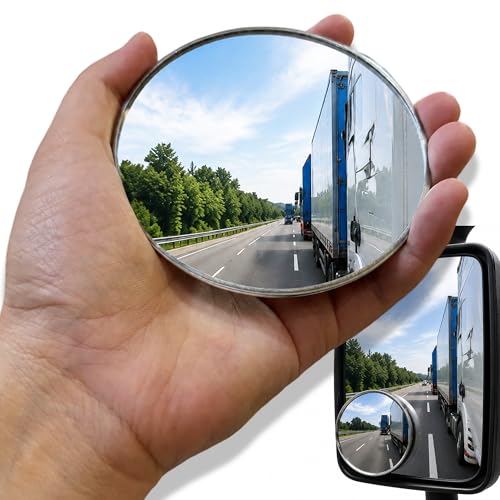 |
2 PCS 3.75 Inch Convex Blind Spot Mirror for Truck –KeMioYuXin | Upgrade pick | 3.75 Inch · Heavy Duty · Adhesive | $9.99
Price as of 23 Oct 2026
|
View |
 |
Blind Spot Mirror 2 Pack 2 Inch, Convex Stick-On BlindspotEssential Contraptions | Budget pick | 2 Inch · Aluminum Frame · HD Glass | $6.99
Price as of 23 Oct 2026
|
View |
The main trade-off is simple: smaller mirrors are easier to place without blocking the factory glass, while larger mirrors cover more side-view area but raise the risk of glare, distortion, and over-obscuring. Mounting style matters just as much, because adhesive-backed mirrors usually stay cleaner visually, while clip-on designs cut the risk of permanent adhesive failure.
How we chose
These picks were compared on coverage versus obstruction, mounting risk versus removability, clarity and glare control, and weather durability. We also weighed vehicle fit, because a mirror that works on a truck housing can crowd a compact car mirror fast.
For this kind of accessory, shape and placement matter more than generic star ratings. A good blind spot mirror has to fit the housing, aim into the right lane zone, and stay put through heat and washing.
CCNU 2 PCS 360 Rotatable: best for adjustable fit
This is the best match if you need a mirror that is easy to fine-tune after installation. The listed 360-degree rotation and dual-sided glass structure make it the most adjustable of the three, which helps when different drivers use the same car or when the seat height changes often.
The drawback is that a more adjustable base can also mean more setup sensitivity. If the angle is left off by a little, the mirror can show too much of the door or too little of the adjacent lane, so it rewards careful placement.
It suits drivers who want a middle ground between compact size and flexible aiming. For sedans and crossovers, that can be enough to capture the lane beside the car without jumping to a much larger lens.
KeMioYuXin 3.75-inch convex mirror: best for maximum coverage
This is the strongest fit when the priority is coverage, especially on trucks and SUVs with taller housings and wider blind zones. The 3.75-inch lens gives the most horizontal area in this group, and the product details point to durable HD glass and universal fit for larger vehicles.
The drawback is also the reason it works so well: bigger glass is easier to see, but it is also more likely to overlap the factory mirror on smaller housings. On a compact car, that can create visual clutter or block part of the normal rear-view area.
If your vehicle is large, or if you have a hard time catching passing traffic with smaller mirrors, this is the safest size choice among the three. It is the one to look at when coverage matters more than a minimalist look.
Essential Contraptions 2-inch round mirror: best for small mirrors
This is the best fit for compact cars and tight mirror housings. The 2-inch round shape, real glass, and rust-resistant aluminum frame keep the profile small, which reduces the chance of over-obscuring the factory mirror while still giving a useful blind-zone view.
The drawback is straightforward: smaller mirrors cannot cover as much horizontal area as larger ones. That means you may need more precise placement, especially if your seat is set far back or your side mirror housing is unusually shallow.
This is the cleanest choice if you want a low-clutter install and you do not need the broadest possible field of view. The aluminum frame also gives it a more durable feel than thin plastic housing, based on the product details.
Round convex mirror: best for compact cars
Round convex mirrors are the safest starting point for compact cars because they keep the lens compact and reduce the odds of covering the factory mirror’s useful area. A convex blind spot mirror still widens the field of view, but in a small housing, a smaller round lens usually fails less often than a larger shape.
Why the smaller profile helps tight mirror housings
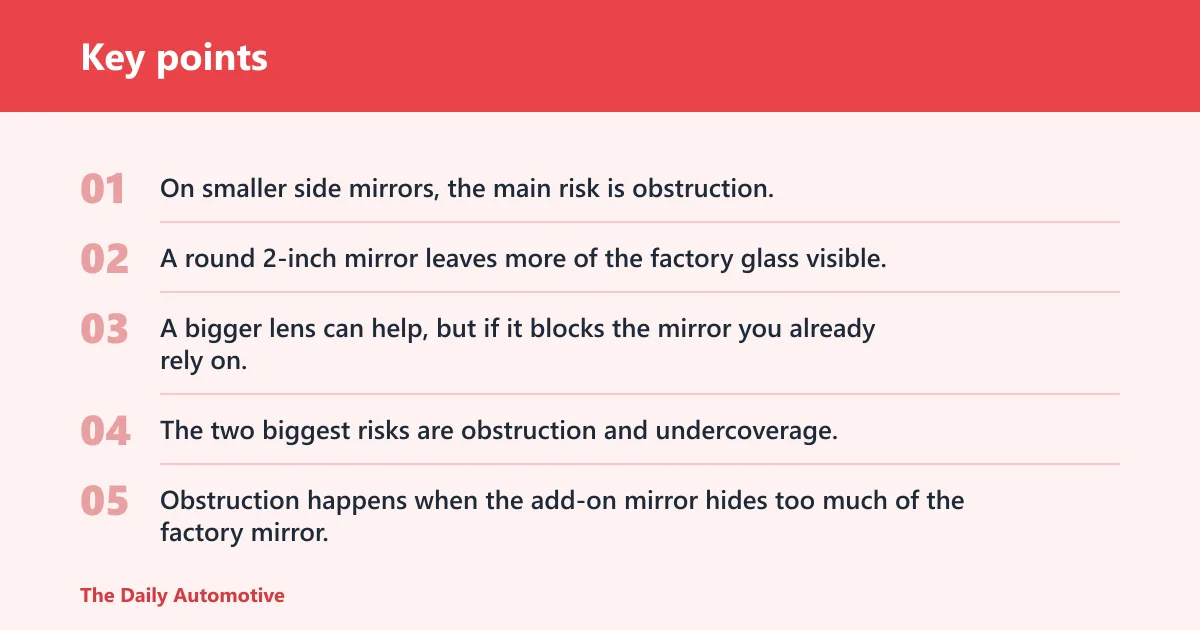
On smaller side mirrors, the main risk is obstruction. A round 2-inch mirror leaves more of the factory glass visible, which helps preserve the normal rearward view while still adding a lane-check view near the outer edge.
That matters more than raw size. A bigger lens can help, but if it blocks the mirror you already rely on, the trade-off is worse than the benefit.
Failure risk: obstruction and limited horizontal coverage
The two biggest risks are obstruction and undercoverage. Obstruction happens when the add-on mirror hides too much of the factory mirror, while undercoverage shows up when the mirror is too small to catch the lane beside a wider vehicle.
Suppose your compact hatchback has a narrow mirror housing and a long commute with frequent lane changes. A 2-inch round mirror is more likely to fit cleanly than a larger rectangular lens, but you may need to angle it carefully to avoid leaving a small gap at the edge of the lane.
Placement check before final adhesion
Before pressing the adhesive down fully, hold the mirror in place with light pressure and check whether you can still see the rear quarter panel edge and the next lane. If the add-on mirror covers too much of the factory mirror, move it outward slightly and retest.
The goal is simple: keep the mirror low enough to catch the blind zone, but not so far inward that it crowds the main mirror image.
Oval frameless glass mirror: best for balanced coverage
Oval frameless HD glass mirrors are a strong middle choice when you want a cleaner look without giving up too much coverage. Frameless HD glass matters because it usually gives a clearer reflection than plastic and leaves less visual clutter around the edge of the mirror.
Why frameless HD glass matters for a cleaner view
Frameless glass reduces the border you see in the mirror and can make it easier to judge where the lane line sits. That is useful when you want a more natural transition between the factory mirror and the blind spot add-on.
The trade-off is that frameless designs can be less forgiving if the angle is off. A small misalignment may be more noticeable because there is less frame to visually anchor the image.
Where oval shape fits sedans and crossovers
Oval mirrors tend to work well on sedans and crossovers because they spread coverage horizontally without looking bulky. Larger shapes cover more horizontal area, but oval lenses often strike the best balance between reach and obstruction.
A common first-timer mistake is placing an oval mirror too far inboard. That can leave the outer lane edge missing from view while also making the add-on mirror compete with the factory glass for space.
Failure risk: glare and angle misplacement
The main failure risks are glare and poor angle placement. If the mirror sits at the wrong tilt, sunlight can bounce off the surface and make the image harder to read, especially during a lane change at midday.
That is where a 360-degree adjustable swivel helps. The extra adjustment lets different seat heights and mirror angles land on the same usable view without forcing a compromise that works for nobody.
Rectangular swivel mirror: best for SUVs and trucks

Rectangular mirrors are the best option when horizontal coverage matters more than a compact look. On SUVs and trucks, the wider side mirror housing can accept a larger shape without crowding the factory lens, which is why the rectangular style often works better there than it does on small cars.
Why larger horizontal coverage helps tall vehicles
Tall vehicles often need a wider slice of the adjacent lane because the driver sits farther from the mirror and the blind zone can stretch outward. A rectangular lens covers more horizontal area, so it is better at capturing that side-lane traffic edge.
The KeMioYuXin mirror’s larger 3.75-inch lens is the clearest example here. It is the right direction when your vehicle size makes a tiny round mirror feel too narrow.
Why 360-degree adjustment matters for different seat heights
Seat height changes the apparent angle of the mirror, and that is where 360-degree adjustment earns its keep. The CCNU mirror’s 360-degree rotation makes it easier to align the mirror for a low-sitting driver in one day and a taller driver the next.
That flexibility is especially useful in shared vehicles. It does not replace careful setup, but it reduces the odds that one driver’s preferred angle makes the mirror useless for another.
Failure risk: over-obscuring the factory mirror
The biggest risk with a larger rectangular mirror is that it can cover too much of the main mirror view. Once that happens, you may gain blind-zone coverage but lose the easier rearward view you still need for normal driving.
Picture a full-size SUV with a large side mirror and a 3.75-inch add-on lens. If the add-on sits too far inward, the driver may see more glass overall but less of the lane line, which defeats the point.
Blind spot mirror decision matrix
This matrix ties together shape, mounting style, vehicle type, and failure risk. Use it to match the mirror to the car, not just the price tag.
| Vehicle type | Best shape | Best mount | Best use case | Failure-risk notes |
|---|---|---|---|---|
| Compact car | Round, 2-inch | Adhesive-backed | Low-clutter lane checks with tight mirror housings | Obstruction if the lens is too large; glare if tilted upward; fitment issues on very small housings |
| Sedan | Oval or round | Adhesive-backed | Balanced coverage with a cleaner look | Adhesive failure if the mirror is mounted on dirty plastic; glare if the angle is too flat |
| SUV | Oval or rectangular | Adhesive-backed or clip-on | Wider horizontal coverage for taller seating positions | Fitment issues if the mirror is too small; obstruction if it crowds the factory view |
| Truck | Rectangular, larger lens | Clip-on or adhesive-backed with outdoor-rated adhesive | Maximum lane-side visibility on larger housings | Adhesive failure from heat and wash cycles; obstruction if placed too far inward |
Mounting style by climate and wash frequency
Adhesive-backed mirrors are the better choice when you want a permanent install and a cleaner look. They depend on outdoor-rated adhesive, which needs heat resistance, weather resistance, and car-wash durability if the car sees summer sun or frequent washes.
Clip-on designs make more sense if you lease the vehicle, change cars often, or want to avoid adhesive failure. They are more removable, but they can be bulkier and may not sit as cleanly on some mirror housings.
Fast placement checklist for first-time installation
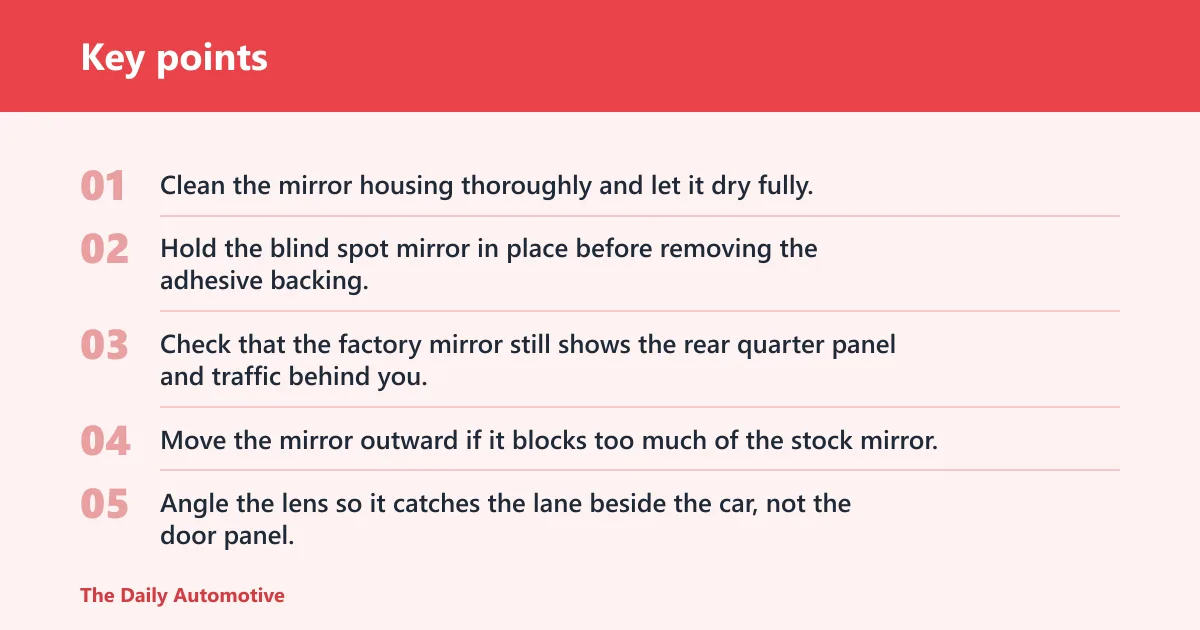
- Clean the mirror housing thoroughly and let it dry fully.
- Hold the blind spot mirror in place before removing the adhesive backing.
- Check that the factory mirror still shows the rear quarter panel and traffic behind you.
- Move the mirror outward if it blocks too much of the stock mirror.
- Angle the lens so it catches the lane beside the car, not the door panel.
- Press firmly only after the view is correct.
- Wait before exposure to rain or washing if the adhesive instructions call for curing time.
Which one should you buy?
Choose the Essential Contraptions 2-inch round mirror if you drive a compact car or want the lowest obstruction risk. Choose the CCNU 360 rotatable mirror if you share the car, need angle flexibility, or want a balanced option that is easier to fine-tune after installation.
Choose the KeMioYuXin 3.75-inch mirror if you drive an SUV or truck and want the broadest lane-side coverage. Larger vehicles usually have more mirror real estate to work with, so the bigger lens is less likely to crowd the factory mirror.
If you care most about lease friendliness or easy removal, clip-on designs are the safer direction in general. If you expect rain, heat, and frequent car washes, adhesive-backed mirrors need outdoor-rated adhesive or they are more likely to fail over time.
Will a blind spot mirror work with factory blind spot monitoring? Yes, but it should complement the warning system, not replace it. The add-on mirror helps with visual confirmation, while the electronic system can still miss certain angles or trigger later than a quick mirror check.
Do blind spot mirrors stay on in rain and car washes? They can, but only if the adhesive is rated for outdoor use and the surface prep is done correctly. Water resistance alone is not enough; heat resistance and wash durability matter too, especially on permanent installs.
Frequently asked questions
What is the best blind spot mirror for a car?
The best blind spot mirror for a car depends on mirror housing size, but a 2-inch convex model is the safest all-around starting point for most sedans and compact cars. It adds useful coverage without crowding the factory mirror, while larger vehicles often benefit from 2.5- to 3-inch options.
Are round or rectangular blind spot mirrors better?
Round mirrors usually fit compact cars better because they leave more of the factory mirror visible. Rectangular mirrors cover more horizontal area, which helps SUVs and trucks, but they are more likely to over-obscure a small housing if the lens is too large or mounted too far inward.
Do blind spot mirrors stay on in rain and car washes?
They can, but only when the adhesive is outdoor-rated and the surface is cleaned well before installation. Heat resistance, weather resistance, and car-wash durability matter more than a generic “strong adhesive” claim, because moisture and temperature swings are what usually expose weak installs.
How do I install a blind spot mirror on my side mirror?
Clean and dry the mirror housing, place the blind spot mirror lightly first, and check the view before committing to the adhesive. You want the mirror to catch the adjacent lane without blocking the stock mirror’s rearward view. Press firmly only after the angle looks correct.
What size blind spot mirror is best for SUVs and trucks?
SUVs and trucks usually do better with larger mirrors, often in the 2.5- to 3-inch range or larger, because their mirror housings can handle more coverage. A bigger lens helps capture the adjacent lane from a higher seating position, but it still needs careful placement to avoid obstruction.
Should I choose adhesive or clip-on blind spot mirrors?
Choose adhesive-backed mirrors if you want a cleaner, more permanent install and are willing to prep the surface carefully. Choose clip-on mirrors if you lease the vehicle, switch cars often, or want to avoid adhesive risk. The trade-off is permanence versus removability, not just convenience.
How do I position a blind spot mirror to avoid distortion?
Set the mirror so it shows the lane beside the car, not the door panel or too much of the sky. Keep the angle low enough to catch traffic in the blind zone, then fine-tune with small adjustments. A 360-degree swivel helps, but only if the initial placement is close.
Products related to this article
Sponsored / affiliate links. As an Amazon Associate I earn from qualifying purchases. I may earn additional commission from eligible campaigns.