Car Care Subscription Review: Is It Worth Paying Monthly?
A car care subscription pays off only when the monthly fee stays below what you would spend on washes, inspections, tire checks, and oil changes. Low-mileage drivers usually get better value from a basic maintenance plan. Skip the math and you may pay for services you never use. This review compares recurring membership plans and subscription-style maintenance plans by real ownership costs, service frequency, and convenience.
What Car Care Subscriptions Cover
A car care subscription is a recurring monthly or annual charge for routine maintenance and service perks. It makes sense when you use the included visits often enough that the total value beats pay-per-visit work. If you rarely need maintenance help, the subscription becomes a fixed cost with little return.
What the recurring fee usually covers
Most plans center on preventative maintenance. That often includes oil changes, tire rotations, routine inspections, and preventative checks. Some programs also add digital dashboards, automated reminders, or roadside assistance. The real question is whether those extras match the upkeep your vehicle actually needs.
Where the real trade-off starts: convenience versus total cost
The model is built to replace irregular mechanic bills with a steady monthly or annual fee. That predictability has value. But convenience only pays when the included services, visit frequency, and scheduling benefits are worth more than what you would spend at a shop or dealership as needed.
Car care subscriptions vs pay-as-you-go maintenance
Subscriptions can beat per-visit pricing when you use routine services often, while pay-as-you-go works better when maintenance is occasional. The decision usually comes down to visit frequency, mileage, and whether the plan limits how often you can use the benefits. Miss those details and the cheaper-looking plan can cost more.
| Comparison point | Subscription | Pay-as-you-go |
|---|---|---|
| Payment style | Recurring fee, monthly or annual | Paid per service visit |
| Cost predictability | High | Low to medium |
| Best fit | Drivers who use routine maintenance often | Drivers with infrequent maintenance needs |
| Included service scope | Depends on tier and coverage scope | Chosen visit by visit |
| Limit risk | Service caps, mileage caps, cancellation terms | Little subscription lock-in |
Side-by-side cost factors to compare
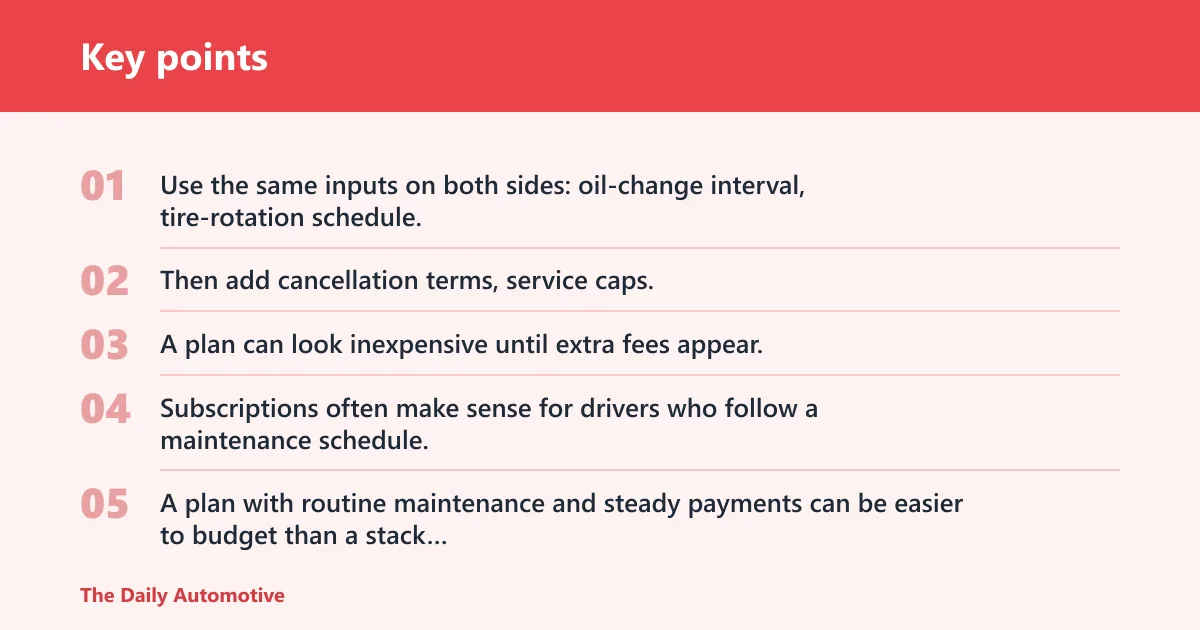
Use the same inputs on both sides: oil-change interval, tire-rotation schedule, inspection frequency, and any add-ons such as roadside assistance. Then add cancellation terms, service caps, and whether a mobile technician comes to your home or office. A plan can look inexpensive until extra fees appear.
When a subscription can beat per-visit pricing
Subscriptions often make sense for drivers who follow a maintenance schedule, want priority scheduling, or value digital maintenance tracking. A plan with routine maintenance and steady payments can be easier to budget than a stack of shop invoices. That is especially true if the included visits line up with the car’s service interval.
When paying per visit is the smarter move
Pay-per-visit is usually better when you drive few miles, keep the car in warranty-covered service, or already get maintenance elsewhere. It also fits people who dislike annual commitments. If the plan includes services you will not use, the subscription becomes an expensive convenience fee.
What does a car care subscription include?

A car care subscription usually includes routine maintenance services and service perks tied to a recurring fee. Common inclusions are oil changes, tire rotations, routine inspections, and preventative checks. Some plans add digital maintenance tracking, roadside assistance, or priority access, but the coverage scope varies widely by tier.
Routine maintenance services
Routine maintenance is the core value. Look for oil changes, tire rotations, multi-point inspections, and preventive checks. One competitor describes an 85-point wellness inspection, which shows how detailed these visits can be. The count matters less than whether the inspection actually covers your vehicle’s most common wear items.
Bundled services versus add-ons
Bundled services can create value when they package items you already need. Add-ons are different. Roadside assistance, extra inspections, or specialized repairs may cost more on top of the base fee. Read the coverage scope carefully so you know what is included and what is sold separately.
Priority scheduling and digital maintenance tracking
Priority scheduling can shorten waits and improve appointment access. Some plans also use digital dashboards for maintenance history, upcoming appointments, and cost tracking. That is useful for keeping a clean service record, especially if you expect to sell the vehicle later or manage multiple cars.
Roadside assistance add-ons
Roadside assistance can be a good add-on if you travel far from home or depend on the car daily. But it is still an add-on in many plans, not a default benefit. Compare the extra cost against a standalone roadside policy and against what your insurer already provides.
How does mobile technician service compare with dealership service?
Mobile technician service brings maintenance to your home or office, while dealership service requires a shop visit and usually offers broader repair capacity. Mobile service is often better for routine maintenance and quick inspections. Dealerships still matter for complex diagnostics, brand-specific repairs, and jobs that need specialized equipment.
Home or office visits versus shop visits
Mobile service saves drive time and waiting-room time. That convenience matters for routine work such as oil changes or tire checks. Dealerships, though, may have more repair depth and parts access for harder jobs. If the plan is only good for basic maintenance, do not assume it replaces a full-service shop.
Inspection reports and post-visit summaries
Many programs provide an inspection report after the visit, with a post-visit condition summary and recommended actions. That can help you track vehicle health status over time. It is useful only if the report is specific enough to guide the next service, not just a generic checklist.
Minor repairs on-site and service limits
Some mobile technicians can handle minor repairs on-site, but that does not mean every repair qualifies. Service limits matter. Ask what can be done in a driveway, what requires a lift or dealership bay, and how the plan handles parts, labor, and follow-up visits.
How much does a car care subscription cost?
Car care subscriptions usually use tiered plans with predictable payments. The real price depends on vehicle type, mileage, service frequency, and coverage scope. Exact pricing changes by provider, so the safer way to judge cost is to compare the recurring fee against the routine services you are likely to use.
Monthly and annual fee structures
Some plans bill monthly, while others offer an annual fee. Annual billing can lower the effective monthly cost, but it also increases the risk of paying for unused coverage. The competitor model described an Essential Plan and a Total Care Plan, which is the usual pattern: a lower tier with basic services and a higher tier with added services.
How mileage, vehicle type, and visit frequency affect price
Higher mileage typically means more frequent service needs, which can make a subscription more attractive. Newer cars may need less routine work, while older or high-mileage cars may hit service more often. Fleet users often care most about predictable payments and digital tracking rather than one-off discounts.
What to watch for in extra charges and tier upgrades
Watch for add-on pricing, mileage caps, service frequency caps, and cancellation terms. A plan can look affordable until you exceed the limit or upgrade for one needed repair. Also check whether complex repairs are included or only routine maintenance, because that gap changes the value math fast.
What should I check before joining a car care subscription?

Before joining, check coverage scope, included visit limits, mileage caps, cancellation rules, and the cost of add-ons. The best plan is not the one with the longest feature list; it is the one that matches your driving pattern and the maintenance your car actually needs.
Decision checklist and value scorecard
- List the services you use in a year: oil changes, tire rotations, inspections, and any roadside help.
- Count how often you expect to use them based on mileage and driving pattern.
- Check whether the plan includes those services or charges extra for them.
- Read the mileage cap, visit cap, and cancellation terms before you sign.
- Add the plan fee and likely add-ons, then compare that total with pay-per-visit costs.
| Value scorecard item | Score 0 | Score 1 | Score 2 |
|---|---|---|---|
| Included visits vs actual use | You will use fewer than half | You will use about half | You will use most of them |
| Cancellation rules | Long commitment or hard exit | Some limits | Clear, flexible terms |
| Mileage fit | Mismatch with driving pattern | Partial fit | Matches your annual mileage |
| Coverage scope | Many exclusions | Some exclusions | Services align with needs |
Score guide: 0-3 points usually means skip the subscription. A score in the 4-6 range suggests comparing more plans. A score in the 7-8 range suggests the subscription may be a good fit if the price still comes out better than pay-per-visit service.
Scenario examples
Say your compact sedan needs an oil change every 6,000 miles or so, you drive about 7,500 miles a year, and you only need one rotation and one inspection. A plan with monthly fees and a service cap may cost more than paying each shop visit separately.
Suppose a delivery driver covers around 20,000 miles a year and wants same-week access, digital history, and mobile visits at the office. A recurring plan with predictable payments may be easier to justify if the included services are actually used.
Choose car care subscriptions if… / choose pay-as-you-go maintenance if…
Choose a subscription when regular maintenance, priority scheduling, and bundled service perks are likely to be used often enough to beat the fee. Choose pay-as-you-go when mileage is low, visits are rare, or the plan’s exclusions, caps, and cancellation terms shrink the value too much.
Best-fit drivers for subscriptions
Subscriptions fit high-mileage drivers, fleet users, and owners who want a predictable expense and digital maintenance tracking. They also fit people who will use mobile technician service at home or office and who value faster appointment access over shopping for each visit.
Best-fit drivers for basic maintenance planning
Basic maintenance planning is better for low-mileage drivers, drivers already covered by another maintenance program, and anyone who only needs occasional inspections or oil changes. If you expect to underuse the included visits, the recurring fee becomes dead weight.
When the plan type should change
If your mileage rises, your car ages, or your service needs become more frequent, a subscription may become more attractive. If the opposite happens and you drive less, move back to pay-as-you-go before the plan renews. That keeps the value aligned with actual use.
Frequently asked questions
is a car subscription worth it
A car subscription is worth it when the recurring fee is lower than the likely cost of the services you will actually use. If the plan mainly adds convenience, priority scheduling, and routine maintenance, it can work. If you underuse it or face heavy limits, pay-per-visit is usually better.
does a car care subscription save money versus pay-per-visit service
It can, but only if you use enough included visits and services. Drivers with high mileage or frequent maintenance needs may come out ahead. Low-mileage drivers often do better paying per visit because they avoid paying for unused coverage and extra plan limits.
is mobile car care better than a dealership
Mobile car care is better for convenience, routine service, and saving time at home or office. Dealerships are often better for brand-specific repairs, complex diagnostics, and work that needs shop equipment. The better choice depends on service scope, turnaround, and whether the plan limits repairs.
Products related to this article
Sponsored / affiliate links. As an Amazon Associate I earn from qualifying purchases. I may earn additional commission from eligible campaigns.