Convertible Car Seat vs All-in-One Car Seat
Choose a Convertible Car Seat if you want a tighter fit now and plan to buy a separate booster later; choose an All-in-One Car Seat if you want one seat to cover rear-facing, forward-facing, and booster use, and can accept more bulk. The wrong choice can leave you with a seat that is awkward in your car, outgrown sooner than expected, or passed down with less useful life left.
Sizing, shell width, and long-term utility
| Decision factor | Convertible Car Seat | All-in-One Car Seat | Winner |
|---|---|---|---|
| Fit in smaller vehicles | Usually more compact and easier to place in tight rear seats. | Often bulkier and heavier. | Convertible Car Seat |
| Rear-facing to booster lifespan | Rear-facing, then forward-facing only. | Rear-facing, forward-facing, and booster modes. | All-in-One Car Seat |
| Need to buy a booster later | Yes, if you want to keep using the seat after that stage. | No, in many cases the seat can take a child through booster use. | All-in-One Car Seat |
| Three-across likelihood | Usually better because the shell is often narrower. | Can be harder because the shell is often wider. | Convertible Car Seat |
| Long-term simplicity | May require a later booster purchase. | Can replace both a harness seat and booster. | All-in-One Car Seat |
Fit in the car
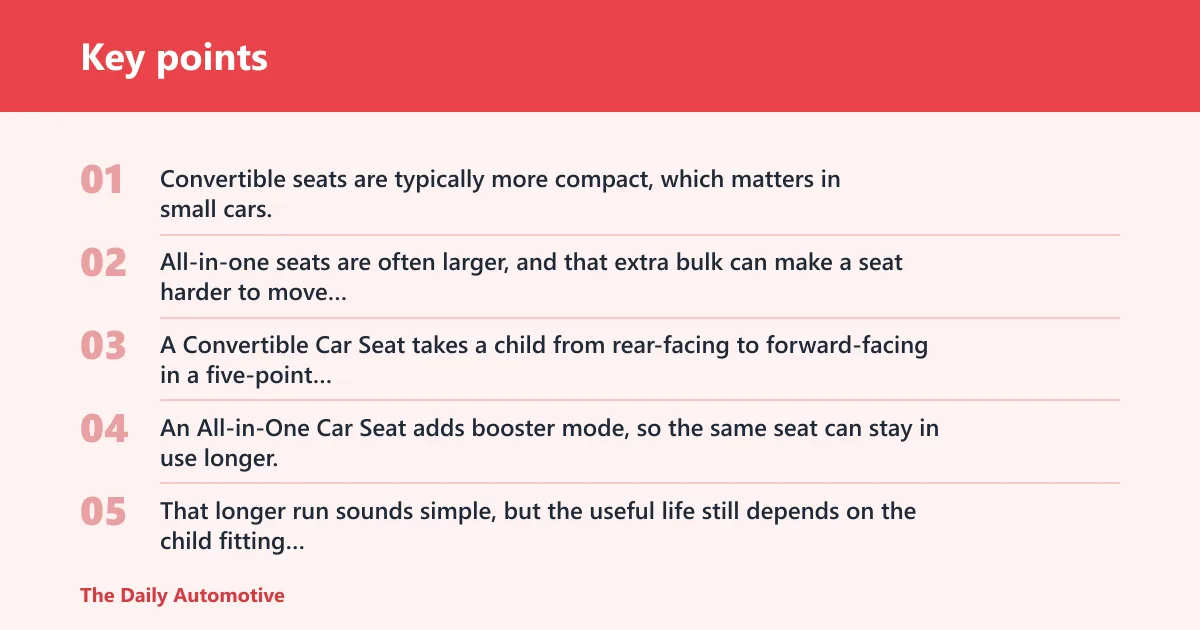
Fit is often the first real separator. Convertible seats are typically more compact, which matters in small cars, in back seats with shallow cushion space, and in three-across setups where every inch counts. All-in-one seats are often larger, and that extra bulk can make a seat harder to move between vehicles or harder to place next to another child restraint.
How long each seat works
A Convertible Car Seat takes a child from rear-facing to forward-facing in a five-point restraint, then stops. An All-in-One Car Seat adds booster mode, so the same seat can stay in use longer. That longer run sounds simple, but the useful life still depends on the child fitting the shell, staying within the listed limits, and using the seat before it expires.
Rear-facing limit
The rear-facing limit matters because higher limits can extend rear-facing time, and the AAP says children should remain rear-facing as long as the seat allows. Many convertible and all-in-one seats are commonly listed with rear-facing ranges of about 4 to 50 pounds, so the seat’s actual limit matters more than the category name. A child who outgrows rear-facing sooner can reach the next stage months earlier, even if the seat still has plenty of five-point restraint use left.
Installation and daily use
Installation ease can outweigh the label on the box. Britax ClickTight is a premium comparator because it routes the seat belt through a marked path and uses automatic tensioning, which can simplify belt installation. A convertible benchmark such as the Britax Poplar is known for easy installation, while the Clek Foonf is described as super-heavy, which can matter if you move the seat often.
What is the difference between these seats?
Convertible Car Seat and All-in-One Car Seat differ mainly in how far they carry a child through the riding stages. A convertible seat covers rear-facing and forward-facing use, while an all-in-one seat adds booster mode and often lasts longer on paper. The better choice depends on whether you want the longest single purchase or the better fit for the first several years.
Convertible seat modes
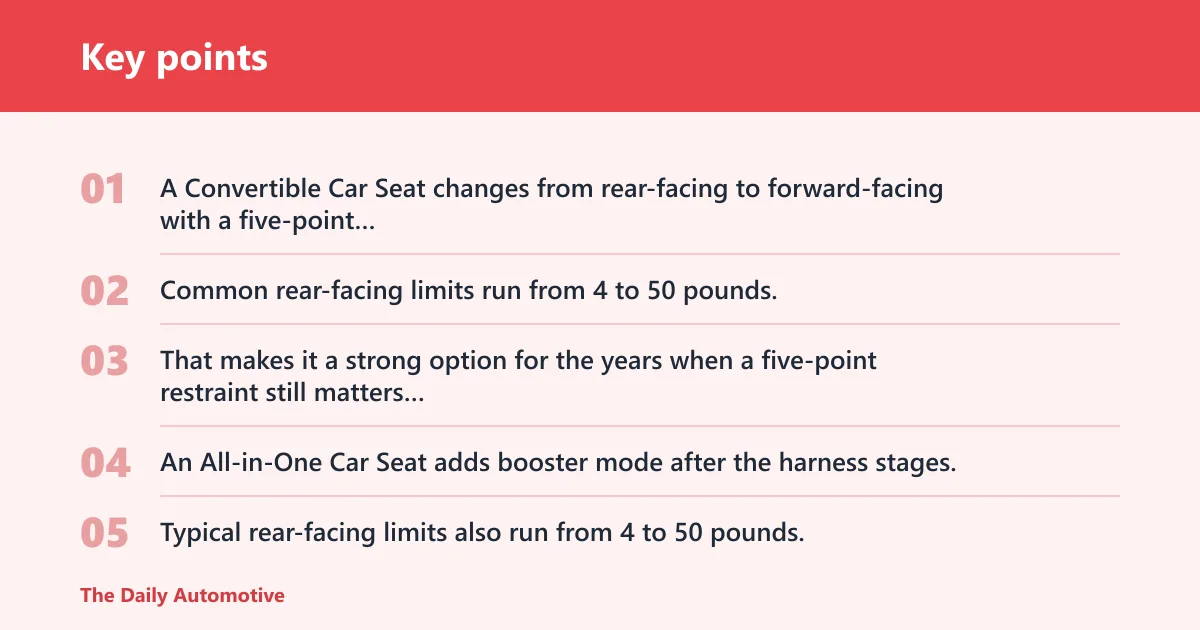
A Convertible Car Seat changes from rear-facing to forward-facing with a five-point restraint. Common rear-facing limits run from 4 to 50 pounds, and common forward-facing limits run from 26.5 to 65 pounds. That makes it a strong option for the years when a five-point restraint still matters most and the vehicle fit needs to stay manageable.
All-in-one seat modes
An All-in-One Car Seat adds booster mode after the harness stages. Typical rear-facing limits also run from 4 to 50 pounds, and typical booster ranges run from 40 to 100 or 120 pounds. That extra range is why many families see an all-in-one as a long-term purchase, even though the shell is often larger.
How expiration dates change the math
Convertible seats often expire 6 to 10 years from the manufacture date, while all-in-one seats are often 10-year seats. That difference can matter if you plan to pass the seat to a younger sibling. A longer expiration window gives you more room to move the seat between children, but only if the child actually fits the seat before it expires.
Which seat lasts longer, convertible or all-in-one?
All-in-One Car Seat usually lasts longer in calendar time because it includes booster mode and often carries a 10-year expiration window. Convertible Car Seat can still last a long time, but it ends at that stage, so you may need another seat later. The longer-lasting choice is not always the better one if the child needs a slimmer shell or the family plans to hand the seat down.
Harness stage versus booster stage
The five-point restraint stage is where the two seat types overlap the most. After that, the all-in-one keeps going. The tradeoff is that many all-in-one boosters are less comfortable than dedicated boosters, so the extra stage does not always mean the best stage.
Hand-me-down use
If the first child uses the seat for years, a younger sibling may inherit a seat with less useful life left. A longer expiration window helps, but a bulky seat that is hard to install may be less practical to pass around than a smaller convertible that moves cleanly between cars.
Car seat fit and installation
Fit and installation usually decide the real-world winner. A Convertible Car Seat is often better for tighter vehicles and for families that need a better shot at three-across installation. An All-in-One Car Seat may replace more gear over time, but the shell can be harder to place cleanly in a cramped rear bench.
- Check your vehicle manual for seating positions, lower anchor limits, and whether a three-across setup is allowed.
- Check the child restraint manual for rear-facing, forward-facing, and booster limits for your exact model.
- Measure the back seat width and the front-seat clearance before you buy.
- If you move the seat between cars often, favor the lighter and narrower option.
- If you want belt installation help, look for a system like ClickTight or another clearly marked belt path.
Suppose your compact sedan has a short rear bench and a tall front passenger seat. A narrower convertible may leave more room for the front passenger and reduce the chance of an awkward install. In that same car, a bulkier all-in-one can work, but the fit may be the bigger issue long before the child outgrows the five-point restraint.
A common first-timer mistake is buying for the label instead of the back seat. A seat that sounds longer-lasting on paper can still be the wrong call if it crowds the front row or blocks a second seat beside it.
Premium install comparator
Britax ClickTight is useful as a benchmark because it turns the belt path into a more guided process. That does not make every seat with a similar idea equal, but it shows why some families value installation clarity as much as longevity. A seat that is easier to install correctly can be worth more than one with a longer mode list.
Car seat decision matrix
This table turns the choice into household scenarios instead of product jargon. Use it with your vehicle layout, your child’s current size, and your likely next purchase. The right pick depends on whether you want one seat for the whole run or a smaller seat now with a separate booster later.
| Family scenario | What matters most | Recommended choice |
|---|---|---|
| One child, no booster plan | Longest single-seat use and fewer later purchases. | All-in-One Car Seat |
| One child, wants a smaller fit now | Compact shell and easier placement in the car. | Convertible Car Seat |
| Small car or frequent transfers | Easy handling, smaller footprint, less bulk. | Convertible Car Seat |
| Sibling hand-me-downs | Expiration window and remaining useful life. | All-in-One Car Seat |
| Need for three-across | Narrower fit and fewer installation headaches. | Convertible Car Seat |
One child, no booster plan
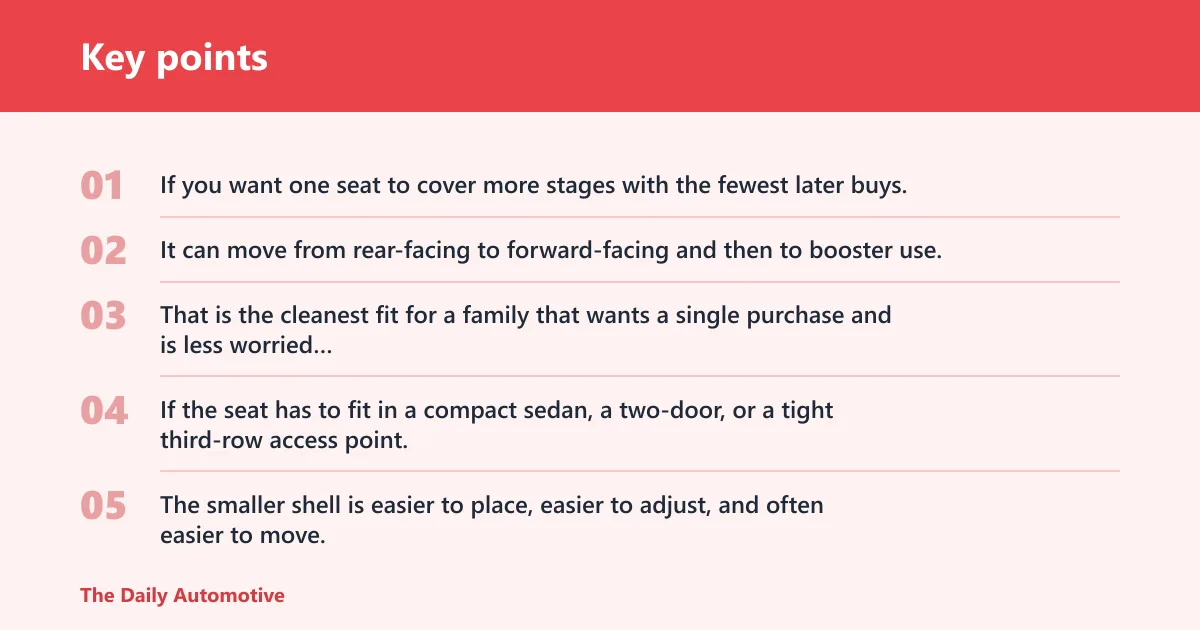
If you want one seat to cover more stages with the fewest later buys, the all-in-one makes the most sense. It can move from rear-facing to forward-facing and then to booster use, so the seat can stay useful longer. That is the cleanest fit for a family that wants a single purchase and is less worried about bulk.
Small car or frequent transfers
If the seat has to fit in a compact sedan, a two-door, or a tight third-row access point, the convertible usually wins. The smaller shell is easier to place, easier to adjust, and often easier to move. That matters more than the extra booster stage if the seat simply does not fit well.
Sibling hand-me-downs
If a younger child may inherit the seat, the expiration date becomes part of the value. A 10-year all-in-one may leave more time for a second child, but only if the first child does not use up the useful life too quickly. A convertible can still be the better buy if it fits better now and will be replaced by a dedicated booster later.
Choose Convertible Car Seat if… / Choose All-in-One Car Seat if…
Choose Convertible Car Seat if you want a smaller seat, better odds in a tight rear bench, or a cleaner path through three-across installation. Choose All-in-One Car Seat if you want one seat to carry a child through rear-facing, forward-facing, and booster use, and you can live with more bulk.
Choose Convertible Car Seat if…
Choose Convertible Car Seat if your vehicle is small, if you swap seats between cars often, or if you care more about easy fit than avoiding a later booster buy. It also makes sense if you want a strong rear-facing benchmark like the Graco Extend2Fit Convertible, which has a rear-facing limit of 4 to 50 pounds, a forward-facing limit of 26.5 to 65 pounds, 5 inches of extra rear-facing legroom, and LATCH use up to 45 pounds.
Choose all-in-One Car seat if…
Choose All-in-One Car Seat if you want one purchase to stretch across more stages and you are comfortable with a larger shell. The Graco Extend2Fit 3-in-1 is a long-term example with rear-facing up to 50 pounds, and that kind of model can reduce the need to buy a separate booster later. It is the better answer when lifespan matters more than compact fit. (Consumerreports)

Frequently asked questions
Convertible car seat vs all-in-one car seat: which is better?
Neither is better in every household. Convertible Car Seat is better for tighter cars, three-across setups, and families that plan to buy a booster later. All-in-One Car Seat is better if you want one seat to carry a child through booster use and you can accept a larger footprint.
What is the difference between a convertible car seat and an all-in-one car seat?
A Convertible Car Seat changes from rear-facing to forward-facing with a five-point restraint. An All-in-One Car Seat adds booster mode, so it can keep working after the harness stage. The difference matters most when you are deciding whether to buy a booster later or fold that stage into the same seat.
Which car seat lasts longer, convertible or all-in-one?
All-in-One Car Seat usually lasts longer because it includes booster mode and often carries a 10-year expiration window. Convertible Car Seat usually ends at the forward-facing stage, so you may need another seat later. The longer calendar life is useful, but only if the seat still fits your vehicle and child well.
Do convertible car seats rear-face longer than all-in-one seats?
Not usually. Many convertible and all-in-one seats share rear-facing limits around 4 to 50 pounds, so the category alone does not decide rear-facing time. The model’s listed rear-facing limit matters most, because the AAP says children should stay rear-facing as long as the seat allows.
Should I buy a convertible seat or a booster-seating all-in-one?
Buy the convertible if you want a smaller fit now and do not mind buying a separate booster later. Buy the all-in-one if you want one purchase to cover booster use too. The better value depends on whether your main problem is space in the car or the cost of another seat later.
Which car seat is better for a small car, convertible or all-in-one?
Convertible Car Seat is usually better for a small car. It is typically more compact, and that often matters more than the extra booster mode on an all-in-one. A smaller shell can make the difference between a clean installation and a back seat that feels crowded.
What is a convertible car seat?
A Convertible Car Seat is a child safety seat that moves from rear-facing to forward-facing with a five-point restraint. Common rear-facing limits run from 4 to 50 pounds, and common forward-facing limits run from 26.5 to 65 pounds. It is often the better pick when fit and simplicity matter most.
What is an all-in-one car seat?
An All-in-One Car Seat is a seat that covers rear-facing, forward-facing, and booster use. It often lasts longer, but the tradeoff is a bulkier seat.
Products related to this article
Sponsored / affiliate links. As an Amazon Associate I earn from qualifying purchases. I may earn additional commission from eligible campaigns.