Car Repair Insurance Cost
Car repair insurance cost usually means your deductible plus any premium jump after a claim. If the repair costs less than your deductible, insurance often pays nothing. That tradeoff can leave you paying for small damage yourself, or paying more in premiums for a claim that barely helps. This guide breaks down which repair bills comprehensive, collision, warranty, and mechanical breakdown coverage actually pay, and when self-pay is cheaper.
Insurance versus warranty for car repairs
For most drivers, car repair insurance cost is not one fixed price. It is the monthly premium for the coverage you keep, plus the deductible you may owe when a claim is approved, plus any later rate change after a loss. The real question is whether that total is lower than the repair risk you are buying down.
Repair coverage versus warranty coverage
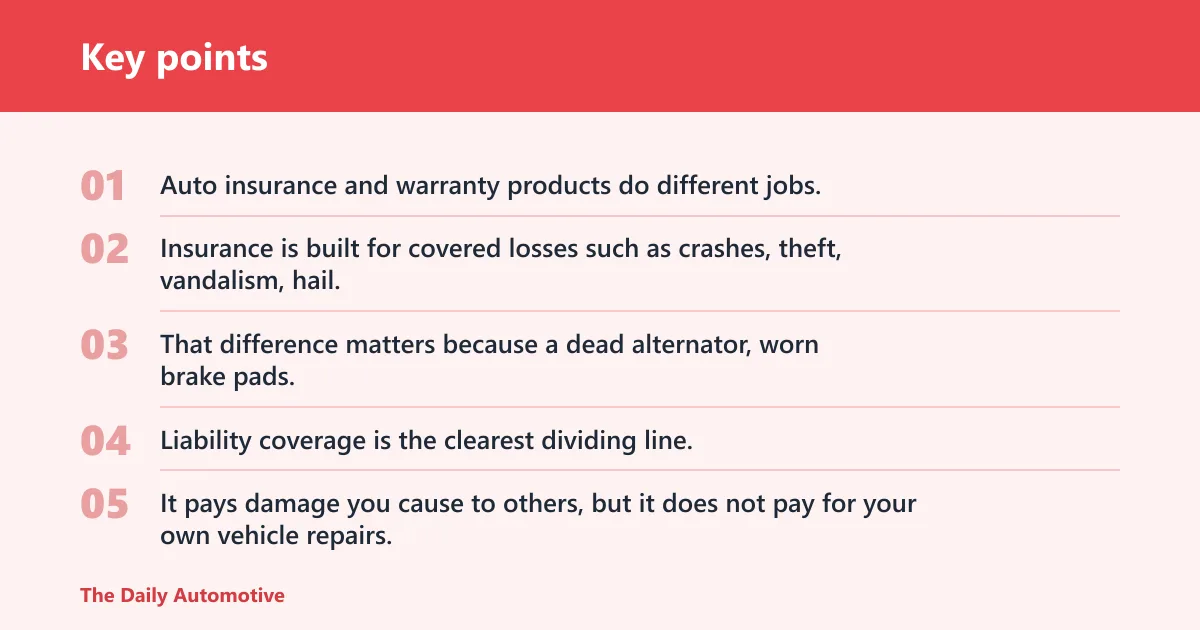
Auto insurance and warranty products do different jobs. Insurance is built for covered losses such as crashes, theft, vandalism, hail, or broken glass, while warranty or service-contract products are aimed at mechanical problems. That difference matters because a dead alternator, worn brake pads, or a failed water pump is usually a repair bill, not an auto insurance claim.
Liability coverage is the clearest dividing line. It pays damage you cause to others, but it does not pay for your own vehicle repairs. If you want insurance to help fix your car after a covered crash, you usually need collision coverage, comprehensive coverage, or both.
Why the same policy can cost less than one repair or more than several
A policy can look cheap until you compare it with the deductible and the likely claim size. A windshield chip that costs less to repair than your deductible does not need a claim. A bent bumper on a newer car may justify filing one. The value is in matching the coverage to the size and type of repair risk.
Does car insurance cover repair costs?
Sometimes. Car insurance covers repair costs only when the loss fits a covered claim type. Liability pays the other party, collision pays for many accident-related repairs to your own car, and comprehensive pays for non-collision damage outside your control. Routine breakdowns and wear and tear are outside standard auto insurance.
When liability stops at the other driver
Liability coverage pays for damage you cause to someone else’s vehicle or property, not your own. If you back into a pole, hit a guardrail, or get rear-ended and the other driver is at fault, liability may pay the other claim. Your own repair bill depends on whether you carry collision or comprehensive coverage and whether the damage fits those terms.
When collision coverage pays for your own car
Collision coverage can help pay for auto repairs after an accident. It can apply even if you hit an object like a tree, and it can also cover a single-car accident. It usually requires a deductible, so the insurer pays only the amount above that threshold, up to the car’s actual cash value if the damage is severe enough.
When comprehensive coverage applies outside a crash
Comprehensive coverage applies to damage outside a vehicle-to-vehicle crash. It can cover vandalism and a falling object, along with other non-collision losses that are outside the driver’s control. It also usually requires a deductible. If damage is severe enough, the claim can move from repair payment to a total-loss settlement based on market value after the deductible.
Repair claims decision table
Use this table to separate the claim type from the bill you may face. The label on the policy matters less than the damage pattern, the deductible, and whether the loss is covered at all.
| Scenario | Likely coverage | Typical out-of-pocket driver cost logic | Why it is covered or excluded |
|---|---|---|---|
| Collision: you slide into a pole and bend the front bumper | Collision coverage, if carried | You usually pay the deductible first; insurance pays the remaining covered repair cost up to the car’s value | Collision can help pay for auto repairs after an accident, including when you hit an object like a tree or have a single-car accident |
| Comprehensive: a branch falls on the hood while the car is parked | Comprehensive coverage, if carried | You usually pay the deductible first; the insurer pays the rest of the covered repair or total-loss amount | Comprehensive applies to damage outside a vehicle-to-vehicle crash and can cover a falling object |
| Breakdown and wear-and-tear: the alternator fails on an older sedan | Usually no auto insurance coverage | You generally pay the full repair bill yourself | Normal wear and tear is not covered by auto insurance |
| Windshield damage: a rock chips the glass and the crack can be sealed with resin | Often comprehensive, depending on policy and state terms | Many policies cover windshield repair at no cost to the customer when the damage can be repaired with resin | Glass damage is commonly handled as a covered comprehensive loss, and repair is often economical |
How deductibles change your bill
The deductible is the amount you pay before insurance responds. It lowers the insurer’s payout on repair claims, which is why the same repair can feel cheap under one policy and expensive under another. A deductible of about $500 can make a repair around $600 a poor claim choice, while a repair around $3,000 may justify filing.
The out-of-pocket amount before insurance pays
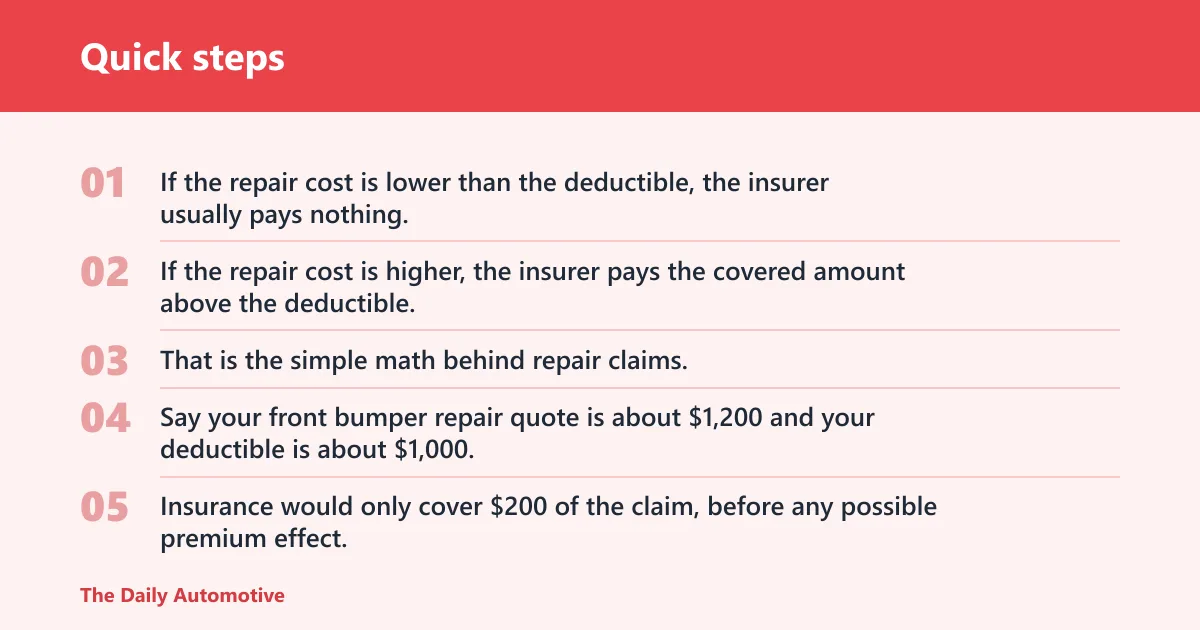
If the repair cost is lower than the deductible, the insurer usually pays nothing. If the repair cost is higher, the insurer pays the covered amount above the deductible, subject to policy limits and the car’s value. That is the simple math behind repair claims.
Say your front bumper repair quote is about $1,200 and your deductible is about $1,000. Insurance would only cover $200 of the claim, before any possible premium effect. In that case, a driver may decide the claim is not worth filing.
Why a small repair may not be worth a claim
Small claims can be a bad deal because the deductible eats most of the payment. A chipped windshield, scraped mirror, or scuffed fender may cost less than the deductible or only slightly more. Filing a claim for a small amount can turn a minor repair into a more expensive insurance decision.
How deductibles affect total loss payouts
Deductibles also matter when damage is severe. If a vehicle is totaled, the insurer pays market value after the deductible. That is not a repair bill. It is a payout based on the car’s value, and once the numbers cross that line, the repair estimate no longer controls the claim outcome.
Will your policy pay for a car repair?
It will if the damage fits the coverage you bought. Accident damage, including many at-fault crashes, is typically handled by collision coverage. Non-collision damage such as theft, hail, or vandalism is usually handled by comprehensive coverage. Mechanical failure and aging parts usually are not covered by either.
Accident damage and at-fault crashes
Collision coverage is the part of an auto policy most likely to pay for your own vehicle repairs after a crash. That includes many at-fault accidents. The deductible still applies, so a claim only helps when the repair bill is high enough to justify the out-of-pocket cost and possible premium impact.
Non-collision damage such as theft, hail, or vandalism
Comprehensive coverage is the usual path for losses that are outside a crash. Vandalism and a falling object are clear examples, and theft claims often fall in the same coverage bucket. If the damage is repairable, the claim may pay for the repair. If it is not, the claim may end in a total-loss settlement based on market value after the deductible.
Why older mechanical failures are excluded
Older cars often fail from normal wear and tear, and that is not covered by auto insurance. That is why a failed timing belt, worn suspension part, or oil-starved engine is usually a self-pay repair or a warranty issue if the product applies. As a vehicle ages, the value of broad repair coverage can fall while the chance of routine repairs rises.
What affects the price
Premiums change for many reasons, and car repair insurance cost is tied to more than the deductible you choose. Pricing can depend on ZIP code, marital status, and age. Insurers also use vehicle value, repair costs, and coverage limits, plus factors such as occupation and education in many rating systems.
ZIP code and claim frequency
Where the car is garaged can affect the premium because loss patterns differ by area. Higher theft rates, denser traffic, and more weather-related claims can all change what insurers charge. That is one reason the same driver can see different prices after moving across town.
Age, marital status, occupation, and education
Some insurers price risk using personal factors such as age, marital status, occupation, and education. Those inputs do not pay for repairs by themselves, but they can change the premium enough to matter. The result is that two drivers with the same car may pay different rates for the same coverage.
Vehicle value, repair costs, and coverage limits
A newer or more expensive vehicle can be costlier to repair, which pushes the premium up. Coverage limits matter too, because higher limits usually cost more. On the other side, an older car with low market value may not justify paying for broad coverage if a moderate repair would exceed what the car is worth.
Is it worth paying for repair coverage?
It can be, but only when the premium and deductible are reasonable compared with the repair risk. Full coverage often makes sense on newer cars or vehicles with high repair costs. For older cars with low market value, self-funding minor repairs may be the smarter move, especially if the annual premium is close to the car’s likely repair risk.
When full coverage can make sense
Collision and comprehensive coverage are most useful when the car is expensive to fix or replace. A newer SUV with expensive sensors, cameras, and body panels can justify broader coverage because one claim may exceed years of premiums. The same logic also applies if you could not easily absorb a major repair bill in cash.
When an older car may be better self-funded
Older-car value changes the equation. If a car’s market value is low, a total-loss payout may not be much higher than a single repair bill, and routine mechanical failures are excluded anyway. In that case, paying for broad repair coverage may cost more than setting money aside for repairs yourself.
A common first-timer mistake is keeping broad coverage on a car worth a few thousand dollars while expecting insurance to handle every repair. That setup still leaves deductibles, still excludes wear and tear, and can still end with a payout capped by market value if the vehicle is totaled.
Where rental reimbursement and roadside assistance fit
Rental car coverage, also called rental car reimbursement, can help pay for transportation while the car is in the shop. It is related protection, not repair coverage. Root says rental car coverage can help while your car is in the shop, and Root offers 24/7 roadside assistance for towing and stranded-driver situations. Roadside help is useful, but it is not a substitute for collision or comprehensive coverage.
Windshield repair is another area where the actual bill can be lower than drivers expect. Windshield repair is often covered by insurance at no cost to the customer when the damage can be repaired with resin, depending on state and policy terms. That can make glass claims one of the few repair situations where filing is often straightforward.
Frequently asked questions
How much is car repair insurance cost?
There is no single price for car repair insurance cost because the number depends on the coverage you choose, your car, your state, and your risk profile. The premium can also rise after a claim. In practice, the real cost is premium plus deductible exposure.
What’s the best car repair insurance
The best option depends on the car and the type of risk you want to insure. For crash damage, collision matters most. For theft, vandalism, hail, or falling objects, comprehensive matters more. For breakdowns, a warranty or mechanical breakdown product may be more relevant than auto insurance.
Is car repair insurance worth it?
It is worth it when the premium is low enough compared with the cost of a likely repair or total loss. It is less attractive on older cars with low market value and frequent wear-and-tear issues, because insurance does not cover routine mechanical failure.
How much does endurance car repair insurance cost per month?
That depends on the plan, the vehicle, the term, and what the seller classifies as covered. Endurance is a warranty-style product, so it is not priced like collision or comprehensive insurance. Compare its monthly cost against the repairs it actually covers, not against auto insurance.
Products related to this article
Sponsored / affiliate links. As an Amazon Associate I earn from qualifying purchases. I may earn additional commission from eligible campaigns.