How Much Does It Cost to Rent a Car for a Month?
A 30-day car rental in the U.S. or Canada can often cost about $1,000 to $2,400 all-in. Airport pickups often add roughly $10 to $40 a day in fees and taxes. Ignore those charges and the checkout total can jump by hundreds of dollars. This guide breaks down base rates, taxes, airport fees, insurance, and deposit holds so you can compare true monthly costs.
How monthly car rental pricing works
Monthly rate vs. daily and weekly pricing
Monthly quotes are usually built from a 30-day rate, not 30 separate daily charges. That matters because the per-day price often drops as the rental gets longer, especially once you cross weekly or monthly thresholds. A seven-day quote can look better on paper, yet a 30-day quote may still win on total price.
That said, pricing does not always move in a straight line. Some systems price a month as four weekly blocks, while others reprice the whole rental when you cross 28, 30, or 31 days. A quote that looks cheap for 29 days can jump at 30 or 31 if the rate bucket changes.
When a second booking can cost less
Extending a reservation is often convenient, but it is not always the cheapest move. If the extension pushes the rental into a higher rate tier, or if the company reprices the car class at the new dates, two bookings can sometimes cost less than one long extension. The risk is highest near busy travel periods.
Say your trip starts on a Thursday and ends four weeks later. If a one-day extension falls into a holiday week, the extra day may carry a much higher rate than a fresh reservation starting the next day. That is why you should compare the extension price against a new quote before you agree.
What a month-long rental really costs
The advertised monthly rate is only the starting point. Taxes, insurance, location surcharges, and card holds can change the amount due on day one by a large margin. On many bookings, the checkout total is materially higher than the base quote, even before fuel or tolls enter the picture.
Base rate, taxes, and mandatory fees
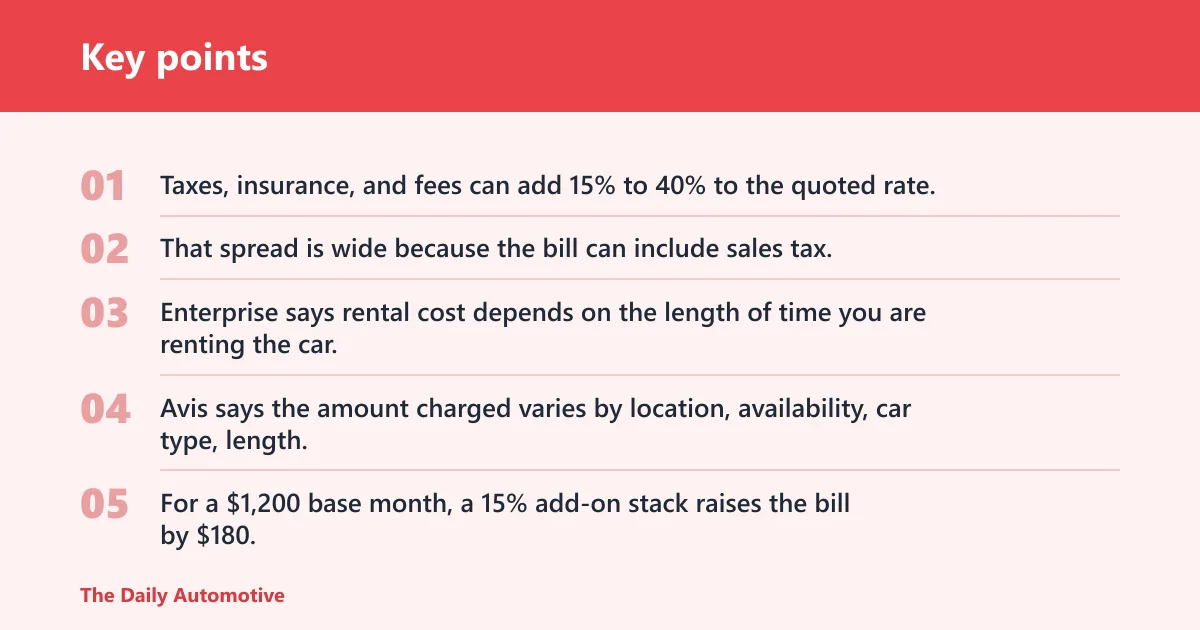
Taxes, insurance, and fees can add 15% to 40% to the quoted rate. That spread is wide because the bill can include sales tax, airport concession recovery fees, facility charges, and local surcharges. Enterprise says rental cost depends on the length of time you are renting the car, the class selected, the location, and added insurance or protection products. Avis says the amount charged varies by location, availability, car type, length, and add-ons.
For a $1,200 base month, a 15% add-on stack raises the bill by $180. At 40%, it adds $480. That is why a quote that looks fine at first glance can become a very different number once checkout taxes and fees are loaded in.
Insurance add-ons and protection products
Collision damage waivers, liability supplements, roadside packages, and similar protection products are usually optional unless your booking channel or local rules require something specific. Monthly plans sometimes bundle protection into the rate, but the bundle still affects the final price. If you already have coverage through a credit card or personal policy, compare the cost of the add-on against what you already carry.
A common first-timer mistake is judging a rental by the base rate alone and then adding protection late in the booking flow. That can add a meaningful daily charge across 30 days. On a month-long rental, even a modest per-day add-on becomes a large line item.
Deposit hold and first-day cash needed
Most companies place a credit card authorization hold or require a debit card deposit policy that is separate from the rental charge. The hold is not a final cost, but it does affect how much cash you need available on day one. The size varies by company, car class, location, and payment method, and it can be larger on premium vehicles.
For budget planning, treat the hold as cash you may not be able to use while the rental is open. If you are using a debit card, ask whether the company requires proof of return travel, a larger deposit, or a different payment method. Those policies often matter as much as the quoted monthly rate.
Monthly rental cost by car class
Car class is one of the biggest drivers of monthly cost. Economy and compact cars are usually the lowest-cost starting point, while SUVs, minivans, and luxury models raise both the base rate and the deposit exposure. If you only need space for two people and carry-on bags, a smaller class often cuts the total bill without much practical downside.
| Car class | Typical daily price | Typical monthly price | Budget note |
|---|---|---|---|
| Economy / compact | $30 to $60 per day | $800 to $1,600 | Lowest base cost; often best for solo travel or light luggage |
| Intermediate / standard | $45 to $75 per day | $1,200 to $2,000 | Often the middle ground for comfort and price |
| Full-size SUV / minivan | $65 to $110 per day | $1,700 to $2,900 | Higher base rate and often a larger hold |
| Luxury / convertible | $90 to $180+ per day | $2,400 to $4,500+ | Highest cost and usually the most sensitive to availability |
Economy and compact
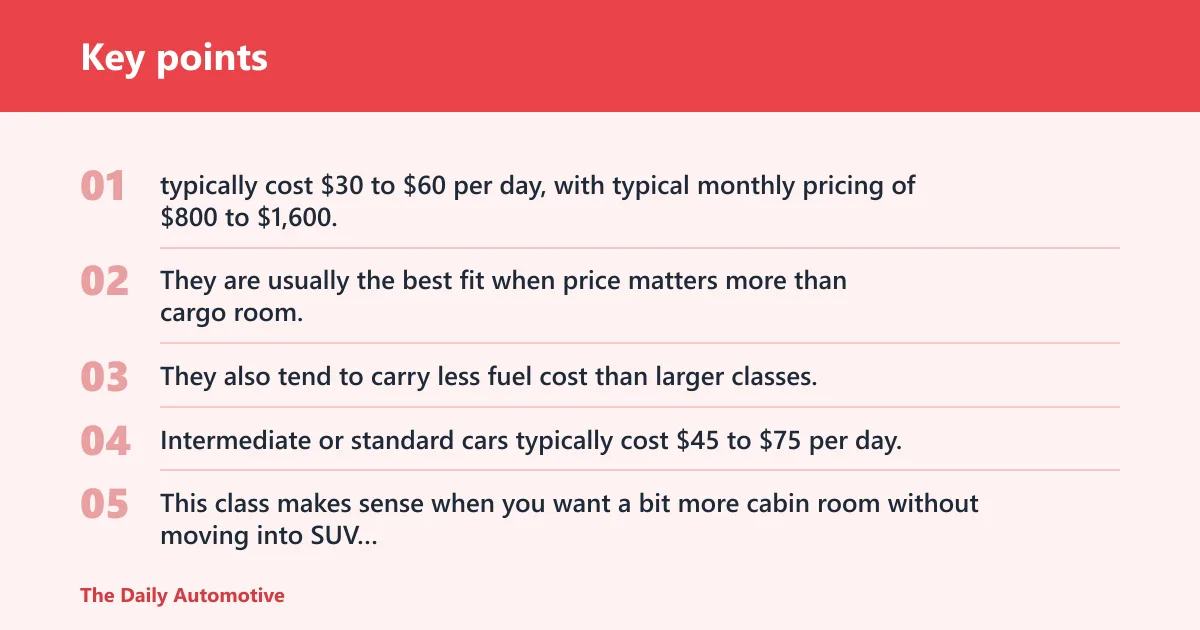
Economy or compact cars in the U.S. typically cost $30 to $60 per day, with typical monthly pricing of $800 to $1,600. They are usually the best fit when price matters more than cargo room. They also tend to carry less fuel cost than larger classes, which helps the total budget over 30 days.
Intermediate and standard
Intermediate or standard cars typically cost $45 to $75 per day, with typical monthly pricing of $1,200 to $2,000. This class makes sense when you want a bit more cabin room without moving into SUV pricing. For many travelers, it is the balance point between comfort and lower checkout risk.
SUVs, minivans, and premium cars
Full-size SUVs and minivans typically cost $65 to $110 per day, with typical monthly pricing of $1,700 to $2,900. Luxury and convertible rentals typically cost $90 to $180+ per day, with typical monthly pricing of $2,400 to $4,500+. These classes can make sense for families, larger groups, or business trips, but they usually carry the highest all-in cash need.
Suppose you choose a compact instead of a full-size SUV for a solo work trip. The base rate can drop by hundreds of dollars over a month, and the deposit hold may be smaller as well. That difference matters more than many travelers expect.
Does pickup location change the price?
Yes. Airport pickups typically cost more than downtown or neighborhood locations, and the gap can be large enough to change the best booking choice. Airport rentals often include concession fees and facility charges, while off-airport locations may avoid some of those add-ons. The savings depend on the city and the rental company.
Airport vs. downtown or neighborhood pickup
Airport desks are convenient, but convenience has a price. Airport pickups typically cost more than downtown or neighborhood locations because the rental company may pass through airport-related fees. If a trip does not require immediate airport pickup, an off-airport location can lower the base quote and the fee stack.
That does not mean airport pickup is always a bad deal. If your taxi or rideshare to an off-airport branch would cost a lot, or if the timing is tight, the airport option may still be the better overall choice. The real test is the full trip cost, not the sticker rate alone.
Concession fees and facility charges
Airport quotes often include concession recovery fees, customer facility charges, and similar surcharges that do not appear in a plain headline rate. These line items can push the advertised price up quickly. On a month-long rental, even a small daily fee becomes significant when multiplied across 30 days.
Regional variation in the U.S. and Canada
Monthly rental prices vary by metro area, state, province, and inventory pressure. California and Florida often see higher demand in peak travel periods. Toronto and other major Canadian markets can be more expensive because of city taxes, airport fees, and local supply conditions. In the UK, rates and taxes follow a different market structure, so do not compare them directly with U.S. quotes.
How much does it cost to rent a car for a month in Los Angeles? Expect the upper end of many U.S. city quotes, especially at the airport and during summer. Downtown pickup can be cheaper, but the city still tends to price above smaller markets when demand is strong.
How much cost rent worksheet
This worksheet shows the first-day cash picture, not just the base quote. Use it to compare classes and pickup points before you book. The estimates below are built from the supplied price ranges and a practical fee structure, so the exact checkout total will still vary by company and market.
| Pickup type | Car class | Base monthly rate | Estimated taxes and fees | Airport surcharge | Insurance add-on | Security deposit or hold | All-in first-day cash needed |
|---|---|---|---|---|---|---|---|
| Airport | Economy / compact | $800 | $120 to $320 | $30 to $120 | $90 to $240 | $250 to $500 | $1,290 to $1,980 |
| Downtown | Economy / compact | $800 | $120 to $280 | $0 | $90 to $240 | $250 to $500 | $1,260 to $1,820 |
| Neighborhood | Economy / compact | $800 | $110 to $260 | $0 | $90 to $240 | $250 to $500 | $1,250 to $1,800 |
| Airport | Intermediate / standard | $1,200 | $180 to $480 | $30 to $120 | $90 to $240 | $300 to $700 | $1,800 to $2,740 |
| Downtown | Intermediate / standard | $1,200 | $180 to $420 | $0 | $90 to $240 | $300 to $700 | $1,770 to $2,560 |
| Neighborhood | Intermediate / standard | $1,200 | $160 to $400 | $0 | $90 to $240 | $300 to $700 | $1,750 to $2,540 |
| Airport | SUV / minivan | $1,700 | $255 to $680 | $40 to $160 | $120 to $300 | $400 to $900 | $2,515 to $3,740 |
| Downtown | SUV / minivan | $1,700 | $255 to $595 | $0 | $120 to $300 | $400 to $900 | $2,475 to $3,495 |
| Neighborhood | SUV / minivan | $1,700 | $230 to $570 | $0 | $120 to $300 | $400 to $900 | $2,450 to $3,470 |
| Airport | Luxury / convertible | $2,400 | $360 to $960 | $50 to $180 | $150 to $450 | $500 to $1,200 | $3,460 to $5,190+ |
| Downtown | Luxury / convertible | $2,400 | $360 to $840 | $0 | $150 to $450 | $500 to $1,200 | $3,410 to $4,890+ |
| Neighborhood | Luxury / convertible | $2,400 | $340 to $820 | $0 | $150 to $450 | $500 to $1,200 | $3,390 to $4,870+ |
The worksheet is intentionally conservative on hold amounts. Some companies use a flat authorization hold, while others use a percentage of the estimated rental total. Premium classes usually expose more cash because the hold can rise with the car value and the length of the rental.
How to lower a one-month rental bill
Book early and compare off-airport quotes first. Monthly inventory changes fast, and summer and holiday spikes can push even ordinary classes upward. If your dates are flexible, midweek pickup and shoulder-season travel often bring better rates than peak weekends.
Choose the right class
Pick the smallest class that actually fits your trip. A compact can sometimes lower both the base rate and the deposit risk compared with an SUV. If cargo needs are modest, that swap usually saves more than trying to trim a few dollars from taxes or fees.
Avoid price jumps from extensions and location changes
Before extending, compare the new total against a fresh quote for the full remaining period. Also check whether changing drop-off location adds a one-way fee or a new tax stack. A small change in route can produce a big change in the bill.
How much does it cost to rent a car for a month from Enterprise? The same source says the price depends on rental length, car class, location, and added protection, so there is no single fixed figure. For budgeting, use the class and pickup point as the starting variables, then add taxes, fees, and any hold.
How much does it cost to rent a car for a month in California? In California, the price can sit above the national average in busy metro areas and airport locations, especially during summer. The safest budget method is to treat the base quote as only part of the total and then add local taxes, airport charges, insurance, and any hold.
Frequently asked questions
How much does it cost to rent a car for a month?
Economy cars can sit near the low end, while SUVs and luxury models move the total much higher once taxes, fees, and holds are added.
How much does it cost to rent a car for a month from Enterprise?
Enterprise does not have one fixed monthly price because cost depends on length, car class, location, and added insurance or protection products. For a planning estimate, use the class-based monthly ranges in this guide, then add taxes, fees, and any security hold that applies to your booking.
How much does it cost to rent a car for a month in California?
California monthly rentals often sit at the higher end of U.S. pricing in large cities and airport locations. A compact may still fit within the lower monthly range, but taxes, airport charges, and strong demand can push the all-in figure well above the base rate.
How much does it cost to rent a car for a month in Florida?
Florida pricing can vary sharply by city, airport, and season. Vacation demand can move rates up fast, especially in winter and holiday periods. If you are renting for a full month, compare airport and off-airport quotes, because the fee gap can be large enough to change the best option.
How much does it cost to rent a car for a month in Canada?
Canada monthly rentals vary by province, city, and airport taxes, so there is no single national number. Toronto and other major markets often price higher than smaller cities. Use the vehicle class, pickup point, and add-ons to build the real total, not just the advertised rate.
What extra fees make a monthly car rental more expensive?
Taxes, airport concession fees, facility charges, insurance add-ons, and location-specific surcharges are the biggest extras. They can add 15% to 40% to the quoted rate. A debit card deposit policy or a larger authorization hold can also make the first-day cash need much higher than expected.
Products related to this article
Sponsored / affiliate links. As an Amazon Associate I earn from qualifying purchases. I may earn additional commission from eligible campaigns.