Dealer Finance vs Bank Loan
Compare dealer and bank offers by total out-of-pocket cost, not APR alone. Pick the one that leaves you paying less after price, rebates, fees, and finance charges. Skip that order, and a lower rate can still cost more if the selling price is higher or the fees are larger. This guide separates price, rebate, fees, and financing so you can compare both offers cleanly.
| Factor | Dealer Finance | Bank Loan | Winner |
|---|---|---|---|
| Total cost clarity | Can bundle vehicle price, rebate, fees, and financing in one desk deal, which makes it easy to miss a markup or add-on. | Gives you a rate benchmark before you shop, so you can separate the vehicle deal from the loan. | Bank Loan |
| Rate risk | Dealer financing can include a dealer reserve, which is a markup on the lender’s buy rate. | Direct lending means no middleman markup on the rate. | Bank Loan |
| Promo pricing | Can include manufacturer promotional APRs, including 0% APR on qualified new models. | Usually competes on standard rates, not captive-promotional APRs tied to one model. | Dealer Finance |
| Negotiating leverage | Convenient, but the final rate may not be known until the dealer submits the application. | Preapproval gives you a ceiling on rate and payment before you enter the showroom. | Bank Loan |
| Best-fit use case | Strong option when a manufacturer promo APR or quick closing matters more than shopping the loan separately. | Strong option when you want a clean benchmark, especially if you are comparing price, fees, and add-ons. | Tie |
Dealer finance vs bank loan: the real trade-off
The real question is not which lender sounds cheaper. It is which full deal leaves you with less cash in hand after the sale price, any rebate, loan fees, add-ons, and the interest that builds over the term. That is why APR matters, but APR alone does not settle the comparison.
Dealer finance vs bank loan at a glance
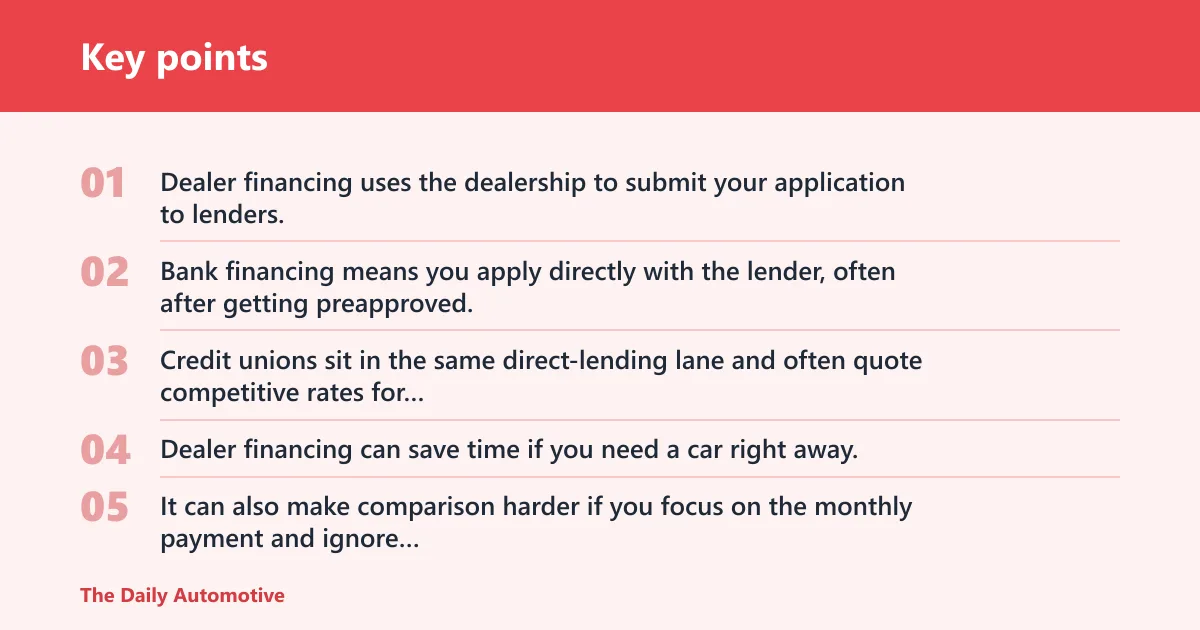
Dealer financing uses the dealership to submit your application to lenders, and it can be a single purchase-and-loan path. Bank financing means you apply directly with the lender, often after getting preapproved. Credit unions sit in the same direct-lending lane and often quote competitive rates for fair to strong credit borrowers.
Convenience and closing speed
Dealer financing can save time if you need a car right away, because the purchase and financing can happen in one visit. That speed is useful. It can also make comparison harder if you focus on the monthly payment and ignore whether the car price, fees, or add-ons changed.
Where rate markup can appear
Dealer reserve is the markup the dealer adds to the lender’s buy rate. In plain terms, the lender may approve one rate and the dealer may sell you a higher one. That difference can raise the total loan cost over the term, even if the monthly payment still looks manageable.
Why rebates and term length change the result
Manufacturer promotional APRs can be a strong deal for qualified buyers, especially on specific new models. But those offers can trade off against cash rebates. A longer term, often around 24 to 84 months, lowers the payment while increasing total interest, so the lowest monthly payment is not always the lowest-cost loan.
Where credit unions fit
Credit unions are member-owned lenders, and they often offer lower standard rates than traditional banks. They also offer preapproval. For many borrowers with fair to strong credit, a credit union quote is the best direct-lending benchmark before you let the dealer arrange anything.
Dealer finance worksheet

This worksheet is for apples-to-apples comparison. Keep the vehicle price, term, amount financed, rebate, fees, and add-ons in the same format for both offers. If one quote hides an accessory package or protection product, add it here before you compare the totals.
| Input | Dealer Finance | Bank Loan |
|---|---|---|
| Vehicle price | Enter the agreed selling price. | Enter the same selling price. |
| Rebate amount | Enter any cash rebate or incentive applied. | Enter any rebate tied to this offer. |
| Doc fees | Enter dealer documentation fees. | Enter lender or dealer-related fees you must pay. |
| Add-on products | Enter warranties, protection plans, or accessories financed in the deal. | Enter the same items if they are financed here. |
| APR | Enter the quoted APR, including any dealer markup. | Enter the quoted APR from the lender. |
| Term | Enter the number of months. | Enter the number of months. |
| Amount financed | Enter the total loan amount after rebate, fees, and add-ons. | Enter the total loan amount after rebate, fees, and add-ons. |
| Estimated total interest | Use the lender’s amortization or payment schedule. | Use the lender’s amortization or payment schedule. |
| Estimated total out-of-pocket cost | Price minus rebate plus fees and add-ons, plus all interest. | Price minus rebate plus fees and add-ons, plus all interest. |
How to compare total out-of-pocket cost
Start with the same vehicle price. Then subtract the rebate, add fees, add any financed products, and compare the total amount you will repay over the term. If the dealer quote uses a shorter term, adjust the bank quote to the same term before deciding which offer is actually cheaper.
How to spot the cheaper offer after rebates and fees
Suppose the dealer quote has a lower APR but no rebate, while the bank quote has a slightly higher APR with a cash rebate and lower fees. The bank can still win on total cost. That is why the selling price, rebate, fees, and term must be aligned before you compare monthly payments.
- Ask for the vehicle price before finance terms are discussed.
- Get the APR, term, and amount financed in writing.
- List every rebate, fee, and add-on on the same worksheet.
- Match both offers to the same term and amount financed.
- Compare total repayment, not the monthly payment alone. (Healthcare)
How dealer financing works
Dealer financing is indirect lending. The dealer collects your information and shops your application to multiple lenders, which can make the process fast and simple. LendEDU describes dealer financing as a dealer-submitted application process, and MoneyMentorDesk says it is arranged through the dealership.
Indirect lending and lender shopping
Because the dealer is between you and the lender, the final quote can include extra spread. That setup is why a dealer can sometimes close a deal quickly while still leaving you with less visibility into the rate you could have received directly. LoanQualifications calls this indirect lending.
Dealer reserve and buy rate versus retail rate
The lender’s buy rate is the rate the lender is willing to extend. The retail rate is the rate you are shown. BeforeYouBuyCar describes dealer reserve as the dealer markup on the rate, and LoanQualifications notes that direct bank loans create no middleman markup on the rate.
Manufacturer promotional APR and rebate trade-offs
Dealer financing can also include manufacturer promotional APRs. Some are 0% APR offers on qualified buyers and specific models. Those promotions can be excellent, but they often come with a choice: take the low APR or take the cash rebate. The better move depends on the size of the rebate and the length of the loan.
Picture a buyer choosing between a promo rate on a new compact SUV and a cash rebate from the same brand. If the promo rate applies only to a short list of trims, the rebate may be the better value on a different trim. The cheaper path is the one with the lower total repayment, not the flashier headline rate.
How bank and credit union financing works
Bank financing is direct lending. You apply directly with the lender, and a credit union works the same way. The same source says a direct bank loan lets you know your rate before shopping, and MoneyMentorDesk recommends getting preapproved by a bank or credit union first.
Direct lending and preapproval
Preapproval gives you a rate, amount, and term before you visit the dealership. That becomes your benchmark. It also keeps the vehicle negotiation separate from the financing discussion, which makes it easier to tell whether the dealer is improving the car deal or merely changing the loan terms.
Why a preapproval sets your benchmark
Bank preapproval gives you negotiating leverage at the dealership. If the dealer can beat your preapproved rate or match it while improving the price, that is a real win. If not, you already have a fallback. That is especially useful when a dealer tries to focus the conversation on the monthly payment alone.
When a credit union may beat a bank rate
Credit unions often offer the lowest standard rates. They are worth checking even if you already have a bank quote. For borrowers with fair to strong credit, a credit union can be the best starting point for a direct loan, especially when the vehicle is used and manufacturer promo APRs are off the table.
Is dealer financing cheaper than a bank loan?
Sometimes, yes. Dealer financing is cheaper when the dealer has a promotional APR you qualify for, or when the lender offer through the dealer is genuinely better than your direct quote. Bank financing is cheaper when the dealer’s markup, fees, or longer term raise the total repayment above the direct loan.
When the dealer wins on promo APR
If you qualify for a manufacturer promotional APR on a specific new model, dealer finance can win on total interest. That is most likely when the promo is subsidized and the dealer is not offsetting it with a worse selling price or extra products. The rebate trade-off still matters.
When the bank wins on fees and total interest
A bank loan can win even with a slightly higher APR if the dealer quote has a markup, more fees, or add-ons that get rolled into the amount financed. A lower monthly payment can hide that difference when the term is stretched. Shorter terms usually reduce total interest, which is why term length must be matched before judging the loan.
Why a longer term can hide the true cost
A longer loan term usually lowers the monthly payment. That does not mean it lowers the total cost. Stretching the term can push more interest into the deal and make a higher-rate loan look harmless on paper. Compare the total repayment, not only the payment size.
Choose Dealer Finance if… / Choose Bank Loan if…

Choose the option that gives you the lower total out-of-pocket cost after rebates, fees, add-ons, and interest are counted. Dealer Finance wins when a promo APR or same-day closing beats the direct loan on total cost. Bank Loan wins when your preapproval gives you a better rate benchmark and cleaner negotiating leverage.
Choose dealer finance if…
- You qualify for a manufacturer promotional APR on the exact vehicle you want.
- You need to close quickly and want the purchase and loan handled in one visit.
- The dealer can match or beat your bank quote without changing the price or adding fees.
- You have compared the same term, same amount financed, and the same add-ons.
Choose bank loan if…
- You want a rate benchmark before you visit the showroom.
- You want to separate the car price from the loan terms.
- You suspect the dealer quote includes reserve, fees, or bundled products you do not want.
- You are comparing used-car financing or a deal with no manufacturer promo APR.
Choose based on borrower type
Thin credit borrowers may need the dealer’s wider lender search, but that is not a reason to skip the worksheet. Buyers with heavy debt-to-income ratios should compare approvals carefully because the dealer may be able to place the loan while still charging more. First-time buyers and used-car shoppers usually benefit from a bank or credit union preapproval because it sets a clear benchmark before the dealer talks payment.
Practical dealership script and document check
Ask for the buy rate, the retail APR, the amount financed, the term, every fee, and every add-on in writing. If the dealer says the quote is final, ask whether the rate includes markup and whether any products were added to the contract. If the numbers change, rebuild the worksheet before you sign.
A common first-timer mistake is agreeing to a monthly payment first and checking the loan math later. That can hide a longer term, a higher rate, or add-ons that were folded into the contract. Keep the conversation on price, rebate, fees, APR, and term in that order.
Frequently asked questions
Is it better to finance through dealer or bank?
Neither is automatically better. Dealer financing can win with a promotional APR or fast closing. Bank financing can win with a lower benchmark rate and clearer separation between price and loan terms. The better option is the one with the lower total out-of-pocket cost after fees, rebates, and interest are included.
Dealer finance vs bank loan
Dealer finance is indirect lending through the dealership, while a bank loan is direct lending from the lender. Dealer finance can be easier at the point of sale, but the dealer may add reserve or extra products. A bank loan gives you a preapproval benchmark, which makes price negotiation cleaner.
Dealer finance vs personal loan
A personal loan can work if you want to buy the vehicle without collateral tied to the car, but it often has different rate and term structure than auto financing. For a car purchase, compare the personal loan against the same vehicle price, fees, and total repayment before deciding. The cheaper loan is the one with the lower total cash cost.
Is car finance easier to get than a loan?
Car finance through a dealer can be easier to arrange because the dealer shops your application to multiple lenders. That does not mean approval is guaranteed or cheap. A direct bank or credit union loan may be easier to judge because you get a preapproval, but the rate still depends on credit, term, and vehicle details.
Is a bank loan better than car finance?
A bank loan is better when you want a direct benchmark, no middleman markup, and more control over the negotiation. Car finance through the dealer is better when a manufacturer promotional APR beats the bank quote or when convenience matters more than shopping the loan separately. Compare the full deal, not the label.
In house car financing vs bank financing philippines
In-house financing usually means the seller or dealer arranges the loan directly, while bank financing means borrowing from a bank or credit union. The same comparison still applies: check the total repayment, the term, the fees, and any add-ons. If an in-house offer is easier to get, that does not make it cheaper.
Products related to this article
Sponsored / affiliate links. As an Amazon Associate I earn from qualifying purchases. I may earn additional commission from eligible campaigns.