Car Registration Renewal Review: Is It Worth It?
Car registration renewal services are worth it only when the convenience fee is lower than your time cost and the vehicle has no hold, lapse, or paperwork problem. Otherwise, renewing directly is cheaper. Paying for the wrong shortcut can add fees, delay your tags, or leave you stuck resolving DMV issues later. This review breaks down total cost, common blockers, and when DIY beats a third party.
Verdict on car registration renewal
Bottom line: when a third-party service is worth paying
Pay for a renewal service when the renewal is clean, the state allows the filing path you need, and the fee buys back enough time to matter. That usually means your insurance is current, your address is correct, the notice is complete, and there are no holds from tickets, tolls, taxes, or emissions problems.
For a driver who wants the paperwork handled and does not want to sort through state forms, a service can make sense. For a driver already dealing with a hold, a failed inspection, or an expired registration, the extra fee rarely fixes the real problem.
Bottom line: when DIY renewal is the better deal
Do it yourself when the DMV renewal is straightforward and the state offers online filing. If the only task is paying the renewal fee and confirming the notice details, the DMV route is usually the cheapest path. That is especially true when your time window is flexible and you do not need anyone to interpret the notice for you.
Pros and cons of using a renewal service
Pros
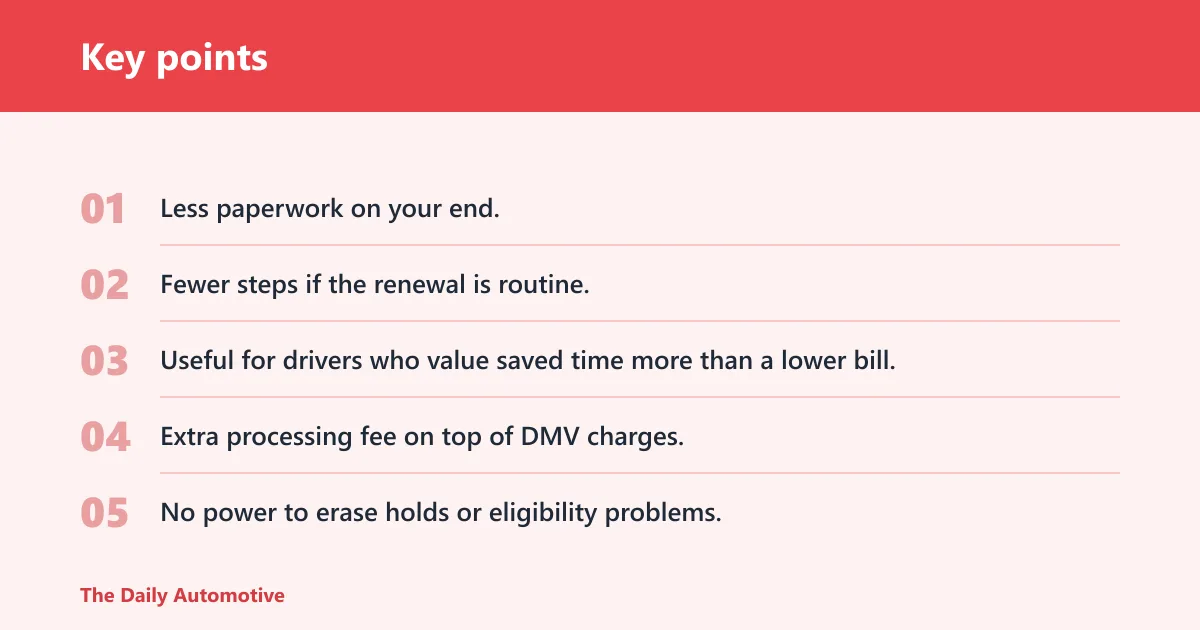
- Less paperwork on your end.
- Fewer steps if the renewal is routine.
- Useful for drivers who value saved time more than a lower bill.
Cons
- Extra processing fee on top of DMV charges.
- No power to erase holds or eligibility problems.
- Can still leave you waiting if the state blocks the renewal.
Who it’s for
This is a good fit for busy drivers with a clean renewal record, current insurance, and a notice that matches their vehicle records. It is also a reasonable fit for people who would otherwise spend an hour or more gathering details and checking eligibility.
It is not a good fit for drivers with unpaid tickets, toll violations, insurance lapses, failed inspections, unpaid local vehicle taxes, or fee sensitivity. If any of those issues exist, the service fee piles onto the real repair work instead of replacing it.
Say your renewal notice is in hand, your insurance is current, and the DMV site only needs a plate number, registration class, last name, and payment. In that case, a third party can save a few steps, but it is still paying for convenience, not a better legal outcome.
For example, a driver may have a recent inspection failure and an expired tag, which is sometimes treated as a repair-first situation. A renewal service may still submit a file, but it cannot make the state overlook the missed inspection or the expired registration clock. That is a repair-first situation, not a shortcut situation.
Registration renewal decision table
The cleanest way to judge value is to split the bill into parts. DMV renewal fees are separate from inspection fees, late fees, and third-party processing fees, which can each cover different parts of the process. A service only makes sense when the time saved is worth the added charge and the renewal is eligible to go through.
| Path | Total cost | Time to complete | Likely blockers | Best-fit driver type | When the extra fee is worth paying |
|---|---|---|---|---|---|
| DIY DMV renewal | DMV fee only, plus any inspection, emissions, or late fee that applies | Usually fastest online when eligibility is clear | Holds, unpaid tickets, tolls, insurance lapse, missed inspection, address mismatch, unpaid local taxes | Drivers who want the lowest cost and can handle the form themselves | Usually not worth paying extra; this is the cheaper default when the record is clean |
| Third-party renewal service | DMV fee plus service fee, plus inspection, emissions, or late fee if needed | Can save time on paperwork, but not on legal blockers | Same DMV blockers, because the service cannot bypass them | Busy drivers with simple, eligible renewals | Worth it only if the saved time matters more than the added fee |
What a renewal service actually does for me
A renewal service usually files the renewal paperwork on your behalf, collects the information needed for the transaction, and submits payment where allowed. It is a convenience layer. It is not the DMV, and it cannot waive state rules or approve an ineligible vehicle.
What gets filed on your behalf
For a standard renewal, the service may gather the plate number, VIN, registration class, notice details, address, and payment information. New York’s online renewal path, for example, needs plate number, registration class, last name, and payment. A renewal notice can also include fees owed and other requirements.
Some states allow renewal online, by mail, or in person. New York does all three, and updated tags are usually mailed after renewal. That means the service may save steps, but the tags still travel on the state’s schedule.
What still depends on DMV eligibility
The service cannot make an ineligible renewal eligible. If your registration is blocked by an unpaid ticket, toll violation, insurance lapse, missed emissions test, or unpaid local vehicle tax, the filing still fails until the underlying issue is fixed.
That matters because many drivers confuse filing help with problem solving. The service can move data. It cannot clear a hold.
What can block renewal even if I try online?
Online renewal is convenient, but it does not bypass legal or paperwork blockers. The most common problems are holds from unpaid tickets, toll violations, insurance lapses, missed emissions tests, unpaid local vehicle taxes, or a mismatch between the notice and the state record. Address errors can also stop a clean renewal.
Holds from tickets, tolls, insurance lapses, or taxes
These are the most common blockers because they usually involve money owed or a record that is not current. They are often easier to identify than to fix, but they still require direct action before the DMV will finish the renewal.
A driver with unpaid parking tickets may need to clear the balance first. Another with a lapsed insurance policy may need proof of current coverage before the renewal can move again. Those fixes matter more than the filing method.
Inspection, emissions, and address problems
Vehicle inspection can be a separate clock from registration. Some states require a safety inspection, some require an emissions inspection, and some require both. New York says renewal may require a safety inspection or emissions inspection first, and DMVCosts says the inspection fee is separate and annual.
Address accuracy matters too. If the DMV notice is sent to an old address, the driver can miss the renewal window, the fee notice, or the inspection reminder. Update the address before renewing whenever the state record is out of date.
Suppose the renewal notice shows the wrong apartment number and the state has already mailed a reminder to the old address. The online file may still ask for the same vehicle data, but a bad address can delay delivery of the updated tags and any follow-up notice.
How much does renewal really cost?
The total cost is usually more than the base registration fee. Add the DMV charge, any inspection or emissions fee, any late fee, and, if you use one, the third-party processing fee. New York’s renewal ranges from $26 to $140 depending on unladen weight, and it also has a $50 MCTD fee in the 12-county metro district.
DMV fee versus service fee versus late fee
The DMV fee is the legal registration charge. The inspection fee is separate. A service fee is an extra charge that is commonly added on top of DMV charges for convenience or processing help. A late fee can apply if the registration has already expired or if the state treats the filing as overdue.
That separation is important because a driver can think a service is “cheaper” until the bill is split into parts. The service did not replace the DMV fee. It only added another line item.
New York DMV fees and state-specific charges
New York is a useful example because the state is specific about timing and extras. Most drivers renew on a two-year cycle. Renewal can be done by mail, in person, or online. New York online renewal needs plate number, registration class, last name, and payment. Updated tags are usually mailed after renewal.
New York also has local charges that can change the total. DMVCosts says the state renewal ranges from $26 to $140 depending on unladen weight, plus a $50 MCTD fee in the 12-county metro district. County or New York City use tax can also apply, so the final bill is not the same for every driver.
How long does registration renewal usually take?
Online renewal is usually the fastest path when the vehicle is eligible and the payment clears. The same source says online renewal can be done with a plate number, registration class, last name, and payment, and DMVCosts says that transaction can take five minutes when insurance is current. Mail and in-person renewal usually take longer because they depend on handling and processing.
Online, mail, and in-person timing
Online filing is best when the notice is accurate and the renewal is straightforward. Mail can take longer because the state has to receive, open, and process the envelope. In-person renewal can be useful when the driver needs face-to-face help, but it still depends on office time and the status of the record.
Why expired registration changes the clock
Once the registration is expired, timing matters more. Late fees can start to matter, and the vehicle may be exposed to tickets for driving with expired tags. Even if the renewal itself is eligible, waiting longer increases the chance that the state adds another charge or asks for more proof.
A common first-timer mistake is assuming that a renewal notice means there is no urgency. If the expiration date has passed, the clock has already changed. The goal then is to renew and clear the status as fast as the state allows.
Frequently asked questions
Is Car Registration Renewal worth it compared with renewing directly through the DMV?
It is worth it only when the service fee buys back enough time to justify the added cost and the renewal is clean. If your record has no holds, your insurance is current, and you can complete the state form yourself, the DMV route is usually cheaper and just as valid.
What does a registration renewal service actually do for me?
It handles the paperwork flow, enters or submits the renewal information, and may process payment for you. It does not change DMV rules, clear tickets, fix an emissions failure, or erase an insurance lapse. Think of it as filing help, not a problem solver.
How much extra do third-party renewal services charge?
Fees vary by provider and state, so there is no universal number that should be treated as standard. The right comparison is the service fee plus the DMV fee, inspection fee, and any late fee. If the added charge is larger than the time you save, DIY is the better deal.
Can I renew my car registration online myself instead of using a service?
Yes, if your state allows online renewal and your record is eligible. New York, for example, allows renewal by mail, in person, or online, and its online process needs the plate number, registration class, last name, and payment. Online is usually the fastest path for a clean file.
What can block a registration renewal even if I try online?
Common blockers include unpaid tickets, toll violations, an insurance lapse, a missed emissions test, unpaid local vehicle taxes, and address errors. A renewal notice can also list extra requirements. If the state record is not clean, the online form usually stops at the same place any other filing would.
Do I still need an inspection or emissions test for renewal?
Sometimes, yes. Inspection and emissions rules are state-specific, and they can be separate from registration. The same source says renewal may require a safety inspection or emissions inspection first, and the inspection fee is separate and annual. Check the state rule before assuming the renewal itself covers it.
What happens if my registration has already expired?
You risk late fees and tickets, and the renewal should be handled as soon as possible. The exact result depends on the state, but expired registration usually means you are no longer in the normal renewal window. If a hold is also present, you must fix that issue before the renewal can finish.
Products related to this article
Sponsored / affiliate links. As an Amazon Associate I earn from qualifying purchases. I may earn additional commission from eligible campaigns.