
How Much to Rent a Car a Month? Cost Breakdown
A monthlong car rental usually runs about $400 to $1,200, and airport pickups plus insurance often push it higher. Miss the fees, and a cheap quote can jump by hundreds at checkout. This guide breaks down real monthly totals by rental type, pickup location, and the charges that move a quote from about $400 to $1,200-plus.
Monthly rental cost calculator
Use these four scenarios as a checkout model, not a promise. The base rate is only part of the bill, and the final total can shift with taxes, airport surcharges, protection products, mileage rules, and the deposit or card hold. The examples below keep the math visible so you can compare quotes line by line.
| Scenario | Base rate | Taxes and surcharges | Insurance | Deposit/hold | Mileage assumption | Estimated final total | When this quote breaks |
|---|---|---|---|---|---|---|---|
| Economy downtown | $850 | $170 | $0 | $150 hold | Unlimited or 1,200 miles included | $1,020 plus a refundable hold | Breaks fast for drivers under 25 if a young-renter fee is added daily; debit cards can trigger a larger hold or payment rejection. |
| Economy airport | $850 | $340 | $0 | $150 hold | Unlimited or 1,200 miles included | $1,190 plus a refundable hold | Breaks for young drivers because the airport surcharge and age fee stack; debit-card renters may also lose the hold-friendly pricing. |
| Standard sedan downtown | $1,200 | $240 | $180 | $200 hold | Unlimited or 1,000 miles included | $1,620 plus a refundable hold | Breaks for under-25 renters and additional-driver users because both fees compound across the month; debit cards can raise the hold or force another payment method. |
| Compact SUV airport | $1,650 | $495 | $240 | $300 hold | Unlimited or 1,000 miles included | $2,385 plus a refundable hold | Breaks for young drivers, debit-card renters, and long-distance use if the contract caps mileage and starts charging overage. |
How much does a monthly car rental cost?

A monthlong rental can land near $800 or climb past $3,500, depending on vehicle class, location, season, and company. Economy cars are the floor, while SUVs and minivans sit much higher. The advertised rate is the starting point, not the checkout total.
Typical U.S. price bands by vehicle class
Economy cars are estimated at $800-$1,400 per month, and they are the usual benchmark for the cheapest segment. Standard sedans are estimated at $1,100-$1,800 per month. Compact SUVs are estimated at $1,300-$2,100 per month, while minivans are estimated at $1,500-$2,500 per month and full-size SUVs at $1,800-$3,000+ per month.
Why the base rate is not the final price
The base rate only tells you what the vehicle costs before the rental company adds mandatory charges and optional products. Taxes and government surcharges are added after the advertised rate. Airport fees can also inflate the total, and LDW or CDW can add a large daily charge if you take it at the counter.
Say your quote shows an economy car at $29 a day and looks cheap enough to book immediately. Once a month of taxes, airport charges, and insurance land on top, that same reservation can move from a bargain into the middle of the market.
When a quote jumps above $1,000
The jump usually happens when three things stack: a higher vehicle class, an airport pickup, and protection or mileage charges. A monthlong quote can move from the low hundreds to four figures very quickly if the driver is under 25, pays with a debit card, or needs unlimited mileage for a long route.
What fees get added at checkout?

Taxes, surcharges, insurance, and deposits can change the bill as much as the base rate itself. Some are mandatory, some are optional, and some are only temporary holds. The key is to read the quoted total line by line before you compare providers.
Taxes and government surcharges
State, county, and city taxes are added after the advertised rate. They vary by location, so the same car class can cost more in one city than another even before you reach the airport counter. That is why two quotes for the same month are rarely equal.
Airport facility charges
Airport locations can cost 40% more on average. Concession fees and facility charges are the main reason. Those amounts are built into airport pricing because the rental desk pays to operate inside the airport system, and the customer covers that cost.
Suppose a downtown economy quote looks manageable at the monthly level. Moving that same booking to the terminal can add enough in facility charges to push the final bill well past the downtown total, even if the base rate stays the same.
Insurance and protection products
LDW or CDW can cost $20-$40 per day, and that can add $600-$1,200 to a monthly rental. That is a major swing. Some renters already have coverage through a credit card or personal auto policy, but those exceptions need to be checked before you decline or buy the counter product.
Security deposits and card holds
Rental car deposits average $60-$300. Some companies place a hold rather than charging a deposit outright, and Enterprise deposit policy can use a hold for 120% of the estimated rental total. Debit cards often make that step harder because the hold can tie up more of your available balance or trigger extra ID checks.
Is airport pickup more expensive than downtown?
Yes, airport pickup is usually more expensive than downtown pickup because of concession fees, facility surcharges, and airport pricing policies. A location near the terminal can materially increase the total, even when the base rate looks similar. Downtown or neighborhood pickup often gives the lower checkout total.
Why airport locations cost more
Airport branches pay to operate on airport property, and that cost reaches the customer through fees. Airport rates also tend to reflect travelers who need same-day pickup, so pricing is often less aggressive than at neighborhood branches. That is why an airport quote can look normal but still end up higher.
When downtown pickup can still be pricier
Downtown is not always the cheapest choice. A neighborhood branch can carry a tighter inventory, a smaller price gap on popular dates, or a weekend rate that rises because of local demand. Even so, airport pickup is still the more common source of the biggest surcharge.
How location changes the monthly total
Location changes the bill in layers. Start with the vehicle class. Then add local taxes. Then add airport surcharges if the pickup is at the terminal. The result can be a quote that looks close at first glance but lands hundreds higher by the time checkout is complete.
Which car class is cheapest for a month?
Economy and compact cars are usually the cheapest monthly option, and they are the best floor for budget renters. Standard sedans sit in the middle. SUVs and minivans cost more because they offer more space, more seating, and a higher base rate.
Economy and compact cars
Economy cars are the low-cost benchmark, and they make sense for solo travel, short urban errands, or a simple commute replacement. If you need the lowest entry price, this is the first class to check. Compact cars often stay close to that floor while offering a little more room.
Standard sedans
Standard sedans are a step up in space and price. They work better for a couple of travelers, airport luggage, or a longer month with fewer comfort tradeoffs. The base rate is higher than an economy car, but the daily difference can be worth it if cargo space matters.
SUVs and minivans
Compact SUVs, full-size SUVs, and minivans cost more each month because they carry more people and more cargo. Minivans are often the better fit for family travel, while SUVs are useful when you need storage room without a van. The price premium is real and can become steep at airport locations.
What mileage rules should you check?
Monthly rentals may include unlimited mileage or a capped allowance. That detail matters for any long-distance trip, relocation, or multi-state drive. If the contract limits miles, overage charges can turn a competitive quote into an expensive one.
Unlimited mileage
Unlimited mileage is the easier option for long trips because you do not have to track every mile. It is often the better fit for a monthlong rental that includes commuting, errands, and travel outside one city. The base rate can be higher, but the risk of surprise mileage charges is lower.
Mileage caps and overage fees
Some contracts include a set mileage allowance and charge for each mile above it. That structure can work for local use, but it becomes risky if you plan airport pickups, road trips, or repeated cross-county driving. Ask whether the quote is unlimited before you compare totals.
Long-distance use cases
A common first-timer mistake is booking the cheapest economy car, then driving it across several states without checking the mileage clause. The quote may look low until the overage bill appears at return. That matters most for relocation trips, contractor travel, and vacation drives that cover a wide area.
How can you lower the total cost?
Start with the pickup location, then compare protection coverage, mileage, and payment rules before you book. The cheapest monthly quote is not always the cheapest final bill. The best savings usually come from avoiding charges that stack every day, not from chasing the lowest advertised rate alone.
Book early and compare locations
Book early if your dates are fixed, and compare airport against downtown or neighborhood branches. The price gap can be large enough to matter across a full month. If airport pickup adds a major surcharge, a short ride to a downtown branch may save more than a small rate cut ever could.
Check insurance before adding LDW or CDW
Before you accept LDW or CDW, check whether your credit card or personal auto policy already applies. That does not mean protection is unnecessary in every case. It means you should verify what is already covered before paying $600-$1,200 over the month for something you may not need.
Avoid surprise driver and payment fees
Additional driver fees and young-renter fees both compound over a month. Under-25 renters can see a daily surcharge that makes a low base rate pointless. Debit-card renters should also confirm the hold amount and payment policy before showing up, since the card rules can change the checkout total or block the reservation.
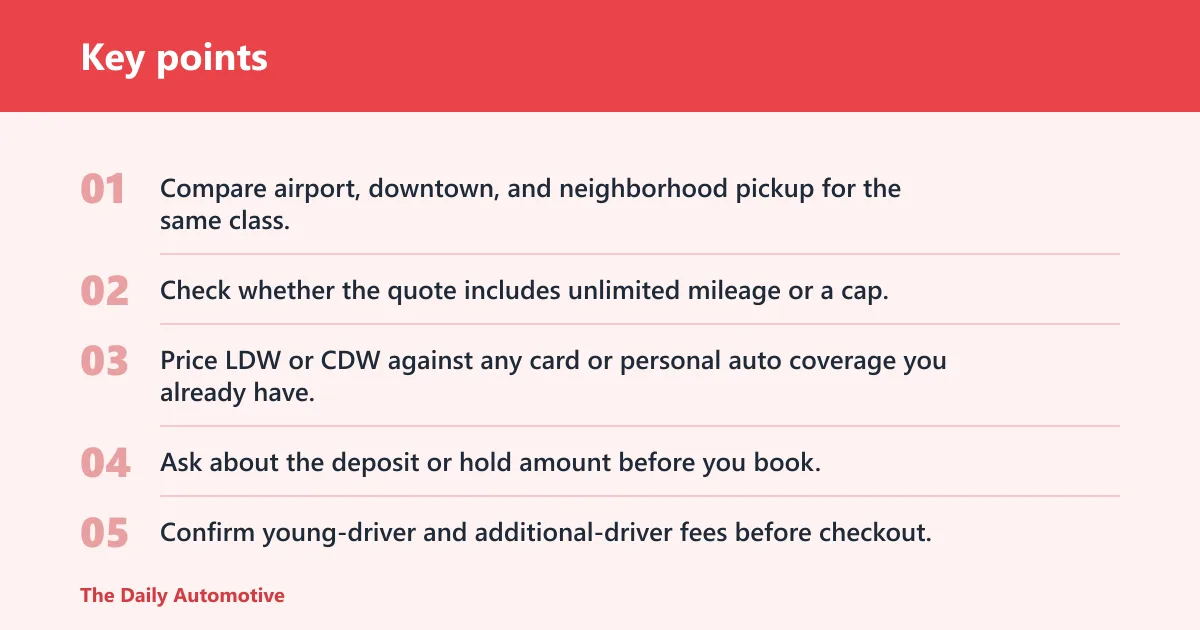
- Compare airport, downtown, and neighborhood pickup for the same class.
- Check whether the quote includes unlimited mileage or a cap.
- Price LDW or CDW against any card or personal auto coverage you already have.
- Ask about the deposit or hold amount before you book.
- Confirm young-driver and additional-driver fees before checkout.
Frequently asked questions
How much does it cost to rent a car for a month?
A monthlong rental usually runs $400 to $1,200 before the biggest add-ons, but the total can go much higher with airport pickup, insurance, and fees. In the U.S., average monthly rental costs can be as low as $800 or exceed $3,500 depending on vehicle class and location.
Is a monthly car rental cheaper than a daily rental?
Usually yes. Monthly pricing is often cheaper than stacking daily rates for the same length of time. That said, the monthly quote is only cheaper if you compare the full out-the-door amount, including taxes, fees, insurance, and any mileage overage.
What fees are added to a monthly car rental?
Common add-ons include taxes, airport facility charges, LDW or CDW, security deposits or card holds, young-renter fees, and additional-driver fees. Some are mandatory, while others are optional or policy-based. The monthly total changes fast once those items are added to the base rate.
How much does insurance add to a monthly car rental?
That is one of the largest single add-ons in the booking flow. Before paying for it, check whether your card or personal auto policy already covers rental damage.
Are airport car rentals more expensive than downtown rentals?
Usually yes. Airport locations can cost 40% more on average because of concession and facility charges. Downtown rentals are often cheaper, though local demand and inventory can narrow the gap. Compare both locations for the same car class before you book.
What is the cheapest car class to rent for a month?
Economy cars are usually the cheapest monthly option, with compact cars close behind. Economy cars are estimated at $800-$1,400 per month, making them the best benchmark for budget renters. If you need more room, a compact car or standard sedan is the next step up.
Do monthly car rentals include mileage limits?
Sometimes they do and sometimes they do not. Some monthly rentals include unlimited mileage, while others cap the number of miles and charge overage fees. If you plan to drive across state lines or cover long daily commutes, confirm the mileage rule before booking.
How can I save money on a month-long car rental?
Compare downtown and airport pickup, book early, and check whether you really need LDW or CDW. Also confirm mileage limits, deposits, and driver fees before checkout. The biggest savings usually come from avoiding daily add-ons that compound across the whole month.
Products related to this article
Sponsored / affiliate links. As an Amazon Associate I earn from qualifying purchases. I may earn additional commission from eligible campaigns.