Car Rental Review Scores Not Matching Customer Complaints
Treat a rental brand’s average star rating as a secondary signal. If recent complaints cluster around hidden fees, long waits, or damage disputes, weigh those patterns more than the score. A mismatch like that can leave you paying more than the quote or losing time at the counter. This guide shows how to audit complaint type, recency, and fee risk before you book.
Why star ratings can miss the real problem
A high average can hide a narrow but expensive failure mode. Many renters leave short praise after a smooth pickup, while the people hit with a billing error, a damage claim, or a deposit hold are far more likely to write detailed complaints. That skews the visible score.
Complaint volume versus complaint severity
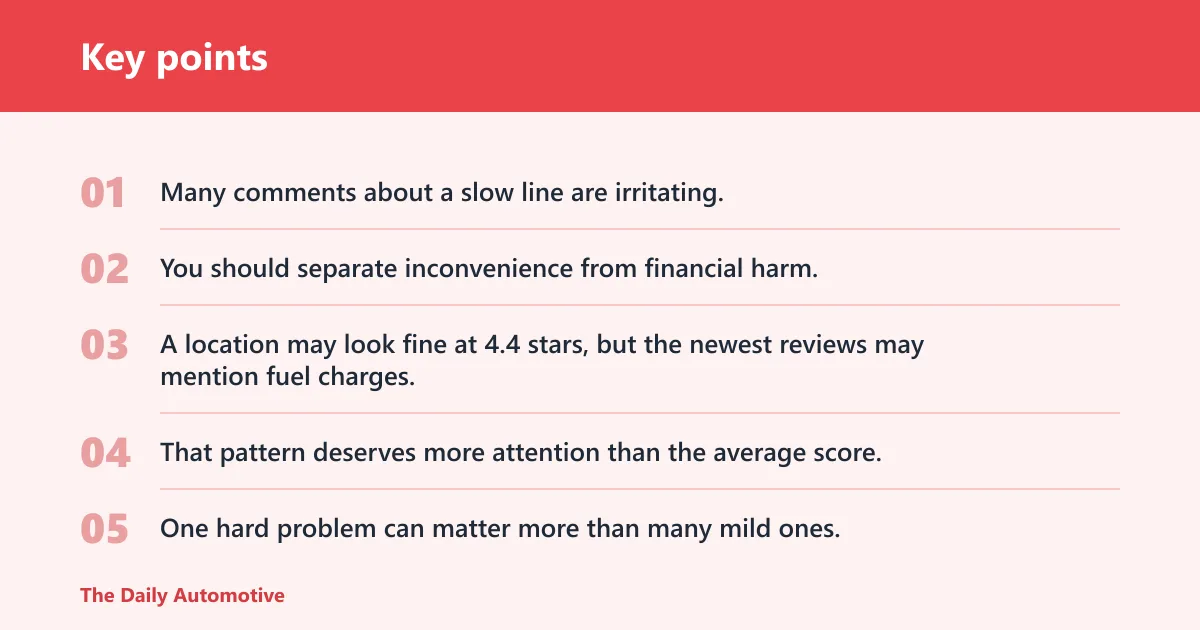
Not every complaint carries the same risk. Many comments about a slow line are irritating, but a few recent billing disputes that mention extra charges after return can be more actionable. You should separate inconvenience from financial harm, then judge the issue that could affect your trip or your card statement.
A location may look fine at 4.4 stars, but the newest reviews may mention fuel charges, add-on fees, and a deposit hold that stayed pending for days. That pattern deserves more attention than the average score. One hard problem can matter more than many mild ones.
How recency changes what a score means
Recent complaints often matter more than older praise because policies, staffing, and local franchise behavior can change. A page full of five-star reviews from last year does not tell you much if this month’s comments point to no cars, long waits, or a disputed damage charge after drop-off.
Volume matters too. A company with thousands of reviews and a steady trickle of the same complaint gives you more usable signal than a small page with a few glowing comments and one angry thread. The goal is pattern recognition, not score worship.
How to read review sources before you book
Read Google reviews, airport forums, app-store comments, and travel sites side by side before you trust the average. Those sources attract different customers and different failure points, so a single number can hide whether the pain comes from counter service, billing, or post-return claims.
Check volume, date spread, and source mix
Look for enough volume to see a pattern, a date spread that shows whether the issue is current, and source mix that covers more than one channel. If complaints repeat across several platforms, the signal is stronger than when one site carries all the noise.
Separate airport, city, and one-way feedback
Airport rentals often bring longer lines, stricter timing, and more fees tied to the location. City rentals may have different inventory and staff pressure. One-way bookings can trigger different pricing and vehicle availability issues, so do not mix those comments into a single judgment.
Spot repeat themes across platforms
Focus on repeated themes, not repeated adjectives. If multiple sources mention surprise charges after return, you are likely looking at a billing pattern. If the same location gets complaints about no cars ready at pickup, that is a service or inventory issue, not a rating quirk.
What do mixed car rental reviews really mean?
Mixed reviews usually mean the company can deliver a normal rental when everything goes right, but one part of the process fails often enough to hurt trust. Separate the failure type first. Billing, damage claims, and service delays are different problems with different consequences.
Billing disputes and surprise charges
Billing complaints may mention charges that were not clear at booking, higher-than-expected totals, or add-ons that appeared at pickup or after return. These are serious because they hit the final cost. If complaints repeat around taxes, fees, fuel charges, or optional coverage, the quote may be too optimistic.
Damage claims and deposit holds
Damage claims and deposit holds are especially important because they can linger after the trip ends. A customer may return the car on time and still face a hold, a claim, or a charge they did not expect. Look for review language about photos, inspection notes, and delayed release of funds.
Wait times, no cars, and class downgrades
Long waits, empty lots, and class downgrades point to operational strain. These complaints do not always raise the final bill, but they can change the trip. A reservation for an SUV that becomes a compact, or a counter line that eats an hour, may matter more than a polished average score.
Car rental review signals that matter most
Some signals are more useful than the rating itself. Complaint clustering, recency, and whether the problem is fixable all tell you more about booking risk than a broad average. A brand with a decent score can still be a poor fit for your trip.
Complaint clustering by issue type
Cluster reviews by issue: billing, damage, pickup delays, deposit holds, vehicle availability, and service. If one category dominates the newest complaints, that is your red flag. A scattered mix of unrelated gripes is less actionable than a tight cluster around the same failure.
Recent complaints versus old noise
Older complaints may reflect a bad patch that has passed. Recent clusters matter more because they show current risk. If the latest month is full of the same story, do not let older praise cancel it out. Timing is part of the signal.
Fixable problems versus repeat failure patterns
Some issues are one-off and fixable, such as a single slow counter. Others point to repeat failure, such as recurring billing disputes or repeated damage claims from the same location. Repeat failure deserves more weight because it is harder to avoid after you book.
Review audit checklist
Use this checklist before you book. Open the reviews and the booking page together, then compare the complaint pattern to the terms in front of you. That is the fastest way to separate noisy averages from booking risk.
| Checklist step | What to look for | What it means | Action |
|---|---|---|---|
| Sort by theme | Billing, damage, deposit, wait time, vehicle availability | Shows the failure type, not just the emotion | Separate finance risk from service risk |
| Check recency | Newest 10 to 20 reviews and the last 30 to 90 days | Shows whether the problem is current | Weight recent complaints more heavily |
| Check repetition | The same issue mentioned across multiple reviews | Shows clustering instead of one-off frustration | Raise concern when the same pattern repeats |
| Check source mix | Google, airport feedback, app comments, travel sites | Shows whether the signal crosses platforms | Trust cross-platform repeats more than one source |
| Check booking type | Airport, city, one-way, prepaid, under-25 | Shows whether the complaint matches your trip | Ignore mismatched scenarios when judging risk |
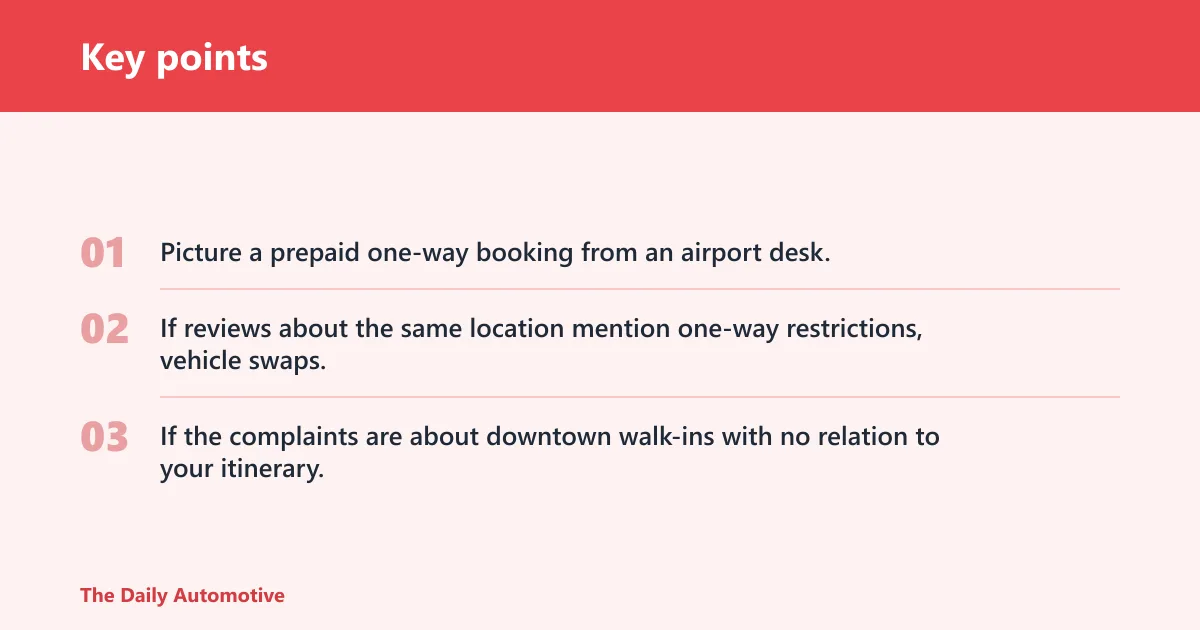
Picture a prepaid one-way booking from an airport desk. If reviews about the same location mention one-way restrictions, vehicle swaps, and extra fees on prepaid reservations, that is directly relevant. If the complaints are about downtown walk-ins with no relation to your itinerary, they matter less.
| Signal | Severity | Recency weight | Fixability | What to do |
|---|---|---|---|---|
| Billing disputes | High | High | Low | Read fee language and exclusions before booking |
| Damage claims | High | High | Low | Photograph the car at pickup and return |
| Deposit holds | Medium to high | High | Medium | Check card availability and hold timing |
| No cars or class downgrades | Medium | High | Low | Confirm inventory risk and timing at pickup |
| Long wait times | Medium | Medium | Medium | Plan buffer time and compare airport feedback |
What fees and rules change the final price?
Car rental policies and fees can be confusing, and the quoted rate is often only part of the total. Rates and promotions have many exclusions, membership may offer better pricing, age restrictions and under-25 surcharges can apply, and availability or vehicle class can change the final price.
Customer facility charges and concession recovery fees
Airport rentals often include customer facility charges and concession recovery fees. These are common add-ons that can change the total even when the daily rate looks strong. Read the booking terms closely, especially if the quote looks much lower than other options.
Fuel charges, LDW, and added surcharges
Fuel charges can be expensive if you return the car without the expected fuel level. Optional LDW can add cost if you choose it, and additional surcharges may appear based on the location, vehicle class, or booking method. The final price can move quickly after those items are added.
Age rules, under-25 fees, and location-based variation
Age restrictions matter. Budget says a daily surcharge may apply to renters under 25, and age rules can vary by location. That means the same booking can price differently depending on the branch, the car class, and the renter’s age.
Can loyalty perks change the review picture?
Yes, but only if you read the limits. Loyalty perks can improve price or convenience, yet they do not erase complaint risk. A better member rate is useful only when the exclusions, minimums, and booking conditions fit your trip.
Budget Car Rental customer care and account access
Budget offers a customer care page for renters who need help. Its best-rate promise requires logging in or creating an account. That matters because account access can affect what you see, what you can claim, and which offers appear during booking.
Best Rate Guarantee and member benefit exclusions
Budget excludes rates from other rental companies from its Best Rate Guarantee. It also excludes package-based car rental rates and rates requiring member login on another website. Those exclusions mean the best-looking deal may not qualify once you compare the fine print.
Free Day and Free Upgrade terms
Budget’s free-day offer requires a minimum three-day rental, and the free-day coupon cannot be used for one-way rentals. Budget also says a Free Upgrade is available when available. That phrase matters: availability is not the same as a guaranteed perk.
How should you compare companies beyond Google reviews?
Use reviews as one input, then compare the booking terms. A company with mixed comments but clear, readable fee rules may be easier to manage than a higher-rated brand with vague exclusions. Cross-check the specific booking path you plan to use, not the general homepage promise.
Cross-check review patterns with policy pages
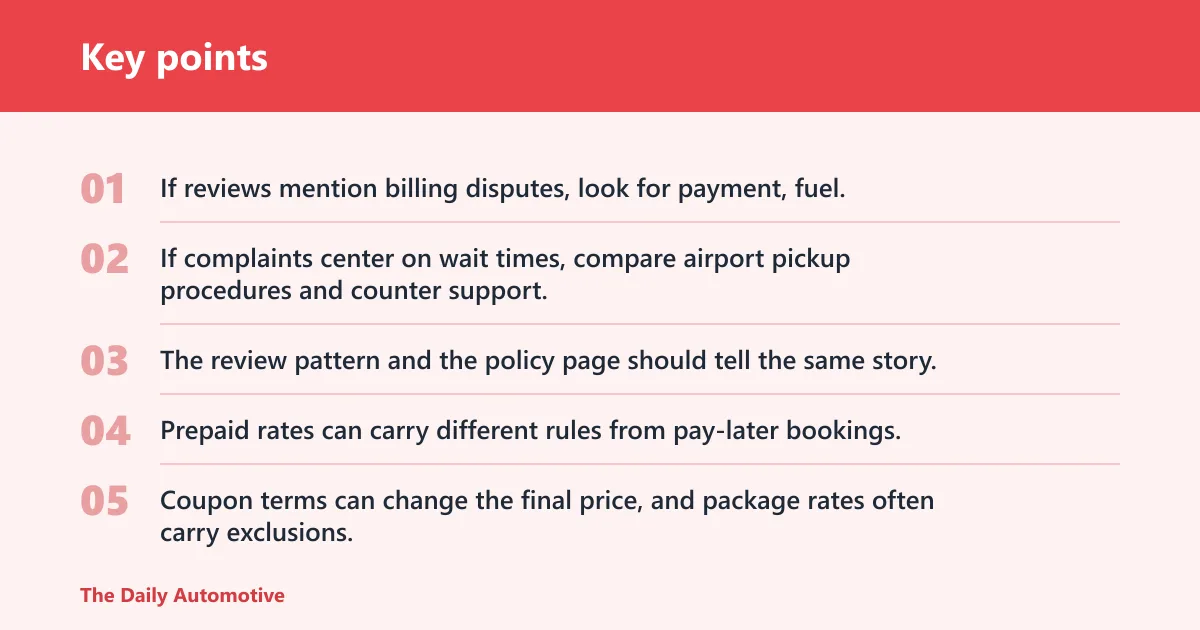
If reviews mention billing disputes, look for payment, fuel, and deposit language in the policy page. If complaints center on wait times, compare airport pickup procedures and counter support. The review pattern and the policy page should tell the same story.
Compare prepaid, coupon, and package-rate exclusions
Prepaid rates can carry different rules from pay-later bookings. Coupon terms can change the final price, and package rates often carry exclusions. Budget excludes package-based car rental rates, coupon and pre-negotiated rates, and member-login-only rates on other websites from its Best Rate Guarantee, so those details can affect any price comparison.
Use booking terms to test fee exposure before checkout
Before you hit pay, ask three questions: What fees are added at the location? What happens if the car class changes? Which offers disappear if the booking is prepaid, one-way, or tied to a member account? Those answers often matter more than the rating.
Frequently asked questions
How can I compare car rental companies beyond Google reviews?
Compare the review pattern with the policy page, then check whether your booking type triggers exclusions. Prepaid, coupon, package, and one-way bookings can change both price and eligibility. If the same problem appears on multiple platforms, treat it as a stronger warning sign.
How do loyalty programs affect rental review scores?
Loyalty programs can improve price or pickup experience for some renters, but only within the program rules. Member-login requirements, rate exclusions, and offer minimums can limit the savings. A loyalty perk is helpful, but it does not cancel recurring billing or claims complaints.
Frequently asked questions
Why do car rental review scores not match customer complaints?
Because ratings compress many different experiences into one number, while complaints show the type of failure. A few serious billing or damage problems can sit beside many routine pickups and still leave the score looking acceptable. Read the newest complaint themes first.
Can a rental company have high ratings and lots of complaints?
Yes. A high average can coexist with a steady complaint stream when most trips are ordinary but a smaller set runs into fees, delays, or claims. The score tells you about the average; the complaint pattern tells you where risk concentrates.
What should I check before booking a car rental company with mixed reviews?
Check the newest reviews, the repeated complaint type, and whether the problem matches your booking style. Then review the fee terms, the age rules, and any one-way or prepaid limits. If the same issue repeats across platforms, treat it as material.
How do I tell if complaints are about pricing, damage claims, or service?
Pricing complaints center on totals, fees, fuel, deposits, or unexpected add-ons. Damage complaints mention inspection, photos, or charges after return. Service complaints mention wait times, no cars, or downgrades. Sorting by language makes the pattern much easier to read.
Which car rental review signals matter more than star ratings?
Recent complaint clusters, repeated themes, and cross-platform consistency matter more than the average score. Severity also matters: billing disputes and damage claims deserve more weight than simple inconvenience. A current, repeated financial issue is more useful than an older praise wave.
What are the most common hidden fees in car rentals?
Common extra costs include customer facility charges, concession recovery fees, fuel charges, optional LDW, additional surcharges, taxes, and age-based fees. Airport rentals often add more location-related charges, so the headline rate may look lower than the actual total.
Products related to this article
Sponsored / affiliate links. As an Amazon Associate I earn from qualifying purchases. I may earn additional commission from eligible campaigns.