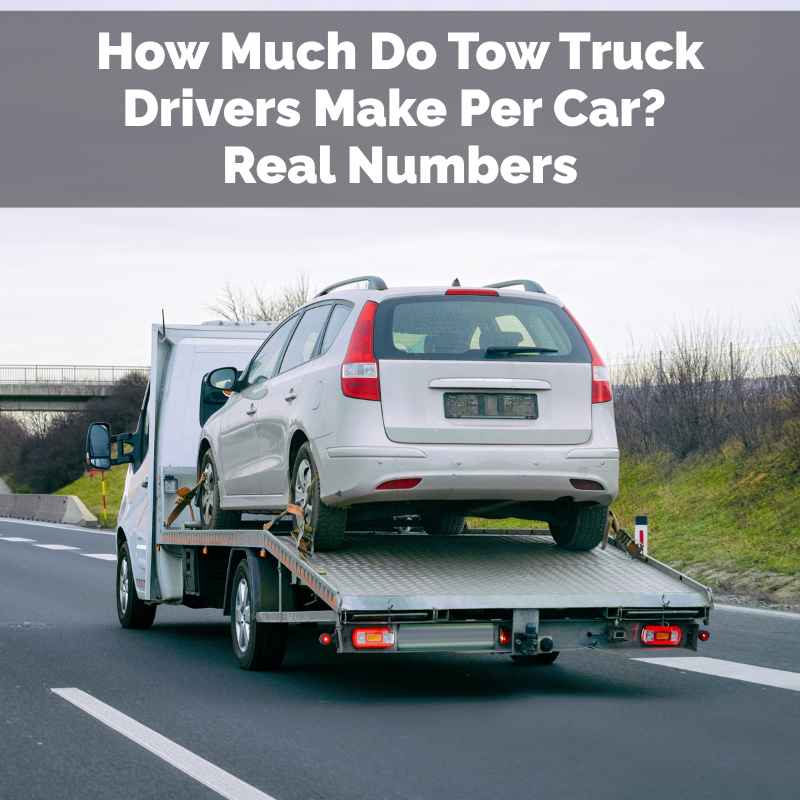
How Much Do Tow Truck Drivers Make Per Car? Real Numbers
Tow truck drivers’ earnings per car vary greatly. They don’t typically get paid a flat rate per vehicle. Instead, their income depends on hourly wages, company policies, commission structures, the type of tow, distance, and geographic location.
Many also rely on tips and bonuses. Understanding these different pay models is key to knowing how much a tow truck driver can make.
Understanding Tow Truck Driver Pay
When you ask how much a tow truck driver makes per car, it’s like asking how much a plumber makes per faucet. There are many things that change the final number. Let’s get into the details of how these drivers get paid.
Most tow truck drivers work for a company. This company might be a small local shop or a larger towing service. Some drivers own their own trucks and operate as independent contractors.
This makes a big difference in how they earn money.
For company drivers, pay usually comes in a few main ways. It could be a set hourly wage. This means they get paid for every hour they are on duty, no matter how many cars they tow.
Another common method is a commission. This is a percentage of the money the towing job brings in.
Some companies use a combination of both. They might offer a base hourly rate plus a commission for each tow. This gives drivers a safety net while also rewarding them for being productive.
The type of truck they drive also plays a role. A heavy-duty wrecker might have different earning potential than a light-duty flatbed.
Location matters a lot too. Towing in a busy city with lots of traffic and accidents will often mean more calls than in a quiet rural area. So, drivers in high-demand areas tend to earn more.
The cost of living in that area also plays a part.

The Many Factors Affecting Earnings
Let’s dig deeper into what makes that per-car earning number jump or dip. It’s not just one thing, but a mix of many influences.
Company Pay Structures
The company a driver works for sets the rules. Some companies pay a fixed hourly rate, like $15 to $25 per hour. This gives a steady income.
Other companies focus more on commission. This might be 20% to 50% of the tow fee.
A company might have a system where drivers get a small base pay plus a bonus for each tow. This can encourage drivers to take more calls. Some companies also offer incentives for good service or for working on holidays.
It’s really up to the owner of the towing business.
Type of Tow and Service
Not all tows are the same. A simple lockout or jump-start is quick and easy. It might bring in $75 to $150.
A long-distance tow, maybe 50 miles, will cost much more. This could be $250 to $500 or even higher.
Heavy-duty towing, like for big trucks or buses, pays the most. These jobs require special equipment and a lot of skill. A single heavy-duty tow could earn the company hundreds or even thousands of dollars.
The driver then gets a cut of that.
Special services like accident recovery or winching a vehicle out of a ditch also command higher fees. These are often emergency situations and require more time and effort from the driver. The complexity of the job directly impacts the price.
Distance and Time
How far the vehicle needs to be towed is a major factor. Most towing companies charge a hook-up fee plus a per-mile rate. This rate can range from $2 to $5 per mile.
So, a 30-mile tow will cost more than a 5-mile tow.
The time of day or night also affects pricing. Many companies have higher rates for after-hours service, weekends, and holidays. This is because it’s harder to find drivers available during these times.
It’s common to see a significant price difference for a 2 AM tow versus a 2 PM tow.
Geographic Location
Where the driver works makes a huge impact. Towing services in major metropolitan areas like New York City or Los Angeles tend to have higher call volumes and higher rates. This is due to more traffic, more accidents, and a higher cost of living.
In contrast, drivers in small towns or rural areas might have fewer calls but could still make a decent living if rates are set appropriately for the area. The competition among towing companies in a region also plays a role in pricing and driver earnings.
Tips and Bonuses
Just like in other service industries, tow truck drivers can earn tips. This is especially true if they go above and beyond to help a customer. A driver who is friendly, efficient, and reassuring can often receive a nice tip.
This adds directly to their per-car income.
Some companies also offer performance bonuses. These might be for the number of tows completed in a month, for maintaining a good safety record, or for positive customer reviews. These bonuses can significantly boost a driver’s overall pay.
Key Earning Factors at a Glance
Hourly Wage vs. Commission: Some drivers get a fixed hourly pay. Others earn a percentage of each tow fee.
Many get a mix of both.
Job Type: Simple services like jump-starts pay less. Complex jobs like accident recovery pay much more.
Distance: Longer tows mean higher costs for the customer and more pay for the driver.
Time of Service: After-hours, weekend, and holiday tows often have premium pricing.
Location: Big cities usually mean more calls and higher potential earnings than rural areas.
Tips: Good service can lead to unexpected income from grateful customers.
A Day in the Life: Real-World Scenarios
Let’s paint a picture of what a tow truck driver might experience on a typical day. This helps understand how pay per car actually works out.
Scenario 1: The Busy City Driver
Maria works for a large towing company in Chicago. Her shift starts at 7 AM. She gets paid $20 an hour, plus 10% commission on each tow.
Her company charges a $75 hook-up fee, $4 per mile, and a $50 after-hours fee if applicable.
Her first call is a simple jump-start for a car in a parking garage. This is a quick $80 job. Maria gets her hourly pay for the time spent, plus 10% of $80, which is $8.
The car owner is happy and gives her a $20 tip. So, for this quick job, her earnings are boosted.
Later that day, she gets a call for a car accident on I-90. It’s rush hour. This involves securing the scene, using her specialized equipment to lift the car, and towing it to a local repair shop, about 15 miles away.
The total bill might be around $400 ($75 hook-up + 15 miles * $4/mile + $50 accident scene fee). Maria earns 10% of $400, which is $40. The tow company also pays her hourly for the 2 hours spent on this call.
By the end of her 10-hour shift, Maria might have handled 5-7 calls. Some are quick, some are long. Her hourly earnings for the day are $200.
Her commission could be anywhere from $50 to $150, depending on the total value of the tows. Add in any tips she receives, and her daily earnings can vary significantly.
Scenario 2: The Rural Responder
David operates his own towing business in a more rural part of Montana. He owns one flatbed truck. He charges a $100 hook-up fee and $5 per mile.
He also has a $75 after-hours fee.
His calls are less frequent. Today, he gets a call around noon to tow a vehicle 30 miles to the nearest mechanic. The total cost for the customer is $250 ($100 hook-up + 30 miles * $5/mile).
David keeps all of this money, but he has to pay for his truck’s fuel, maintenance, insurance, and business license out of this amount.
Later, he gets a call at 9 PM. A farmer’s truck is stuck in a muddy field. This requires using his winch, which he charges an extra $100 for.
The tow is only 5 miles. The customer pays $325 ($100 hook-up + 5 miles * $5/mile + $100 winch fee). Again, David keeps this, but his overhead is high.
He might not get a tip for a muddy farm recovery.
David’s income is directly tied to the number of jobs he gets and the price he can charge. He has to factor in all his business expenses when calculating his personal earnings. His pay per car might look high upfront, but his net profit needs careful tracking.
Independent vs. Company Driver Earnings
Company Driver:
- Pros: Steady hourly pay, often no direct responsibility for truck maintenance, fuel, or insurance. Less risk.
- Cons: Lower earning potential per tow compared to an owner. Company sets rates and policies.
Owner-Operator:
- Pros: Keep all revenue (minus expenses). Can set own rates and choose services. Higher earning potential if successful.
-
Cons: Responsible for all costs (truck, fuel, insurance, maintenance, licensing).
Income can be very unpredictable. Higher risk.
Average Earnings and Income Ranges
So, what’s the overall picture? How much can a tow truck driver actually expect to earn in a year?
According to data from sources like the Bureau of Labor Statistics (BLS) and salary aggregators, the average annual salary for a tow truck driver in the U.S. can range widely. Many sources place the median annual wage somewhere between $35,000 and $50,000.
However, this is just an average. Some drivers, especially those in high-demand areas working for well-paying companies or as successful owner-operators, can earn significantly more. We’re talking $60,000, $70,000, or even upwards of $80,000 per year.
This often involves working long hours and being available during peak times.
On the lower end, drivers might make closer to $25,000 to $30,000 per year. This could happen if they work in areas with very low call volumes, for companies that offer minimal pay, or if they are just starting out and have fewer years of experience.
Let’s break down how this might look per car. If a driver earns $40,000 a year and works about 2,000 hours (40 hours/week for 50 weeks), that’s $20 per hour on average. If they handle 4 tows per shift, and each tow averages $100 in revenue that they get a cut from, that’s $400 per day.
If they work 250 days a year, that’s $100,000 in total revenue generated. If their commission rate is 30%, they earn $30,000 from commission. Add their hourly wage of $20,000 (40 hours 50 weeks $10/hour base if base is lower), and you get $50,000.
This simple example shows how the different pay components add up.
It’s also important to remember that taxes and expenses (for owner-operators) come out of these figures. So, the “take-home” pay is always less than the gross earnings.
Quick Income Snapshot (Estimates)
Entry-Level Driver (Low Call Volume Area): $25,000 – $35,000 / year
Average Driver (Moderate Area, Company Employed): $35,000 – $50,000 / year
Experienced Driver (High Demand Area, Good Company/Owner-Op): $50,000 – $70,000+ / year
Top Performers / Successful Owner-Operators: $70,000 – $90,000+ / year
Real-World Earning Per Car: A Closer Look
Let’s try to put a number on “per car” earnings, while keeping in mind it’s an estimate. Imagine a driver who gets paid 25% commission on the tow fee. The average tow fee might be around $150.
So, for that $150 tow, the driver earns 25% of $150. That’s $37.50. If they also get a $10 tip, that’s $47.50 for that specific job.
This seems like a good amount for one tow.
However, this driver also has to consider their hourly wage. If they only made that $47.50 for a job that took 2 hours, their effective hourly rate for that job was only $23.75. This might be lower than their base hourly wage, meaning the commission is really what makes the difference on more profitable jobs.
Now, think about a very quick job, like a lockout that costs $75. The driver’s 25% commission is $18.75. If they also get a $5 tip, that’s $23.75 for that job.
This job might have only taken 30 minutes. So, for that half-hour, they earned $23.75, which is equivalent to $47.50 per hour. This shows how job efficiency and type greatly affect the per-car earning.
For an owner-operator, the calculation is different. If they charge $150 for a tow, and their expenses for that tow (fuel, wear and tear) are $30, their gross profit is $120. They then need to make sure this profit is enough to cover their insurance, truck payments, licensing, and still leave them with a good personal income.
The “per car” figure is more of a revenue-generating number for the company. The driver’s take-home from that car is a portion of that, influenced by their specific pay structure.
Myth vs. Reality: Tow Truck Driver Pay
Myth: Tow truck drivers make a huge profit for every single car they tow.
Reality: While individual tows can be profitable, the driver’s share is often a percentage. They must also consider their base pay and the overall volume of calls to make a good living. Owner-operators have significant overhead costs.
Myth: All tow truck drivers earn the same amount.
Reality: Pay varies dramatically based on location, company, experience, and whether they are employed or self-employed.
Myth: Towing is just about hooking up a car and driving it.
Reality: It involves problem-solving, safety procedures, customer service, and often working in difficult conditions (weather, traffic, time of day).
What This Means for You
So, what’s the takeaway from all this? Whether you’re considering this career or just want to understand the service better, here’s what you should know.
When Earnings Are Normal
It’s normal for tow truck drivers to have varied daily earnings. Some days will be slow, with fewer calls. Other days will be very busy with back-to-back jobs.
This fluctuation is part of the job.
It’s also normal for earnings to be higher in areas with more traffic and more accidents. Drivers who work nights, weekends, and holidays often earn more due to premium rates and increased demand.
For company drivers, a consistent hourly wage provides a baseline. Commission and tips are bonuses that add to their income.
When to Look Closer (or Worry)
If a driver is consistently working long hours but their income is very low, it might be a sign of an unfavorable pay structure or low call volume. This could be a company that pays very little commission or has low rates.
For owner-operators, if the revenue from tows isn’t covering their high operating costs (fuel, insurance, maintenance), they may be losing money, not earning it. This is a serious concern.
If a driver seems to be constantly struggling financially despite their hard work, it’s worth examining the details of their pay, the market they work in, and their business expenses.
Simple Checks for Understanding Income
If you’re a driver or considering it: Ask detailed questions about the pay structure. Get it in writing. Understand the commission rates, bonuses, and any deductions.
If you’re hiring a tow: Be aware that pricing can vary. Get a clear estimate upfront, including all fees. This helps manage expectations for yourself and supports fair practices for the driver.
Quick Tips for Tow Truck Drivers (and Those Who Hire Them)
Here are some practical points that can influence earnings and satisfaction in this field.
- For Drivers: Always be polite and professional. Good customer service can lead to better tips and repeat business.
- For Drivers: Know your truck and your equipment. Efficiently handling jobs saves time and can lead to more tows per shift.
- For Drivers: Keep accurate records of your income and expenses, especially if you’re an owner-operator. This is crucial for taxes and for knowing your actual profit.
- For Drivers: Stay updated on safety training and regulations. This not only keeps you safe but also makes you a more valuable employee.
- For Customers: When calling for a tow, have all your details ready. This includes your location, the vehicle’s make and model, and the issue. This speeds up the process.
- For Customers: Ask for a clear price estimate before the tow begins. This helps avoid misunderstandings later.
- For Customers: Consider the time of day and day of the week when estimating costs. Emergency calls at odd hours will naturally cost more.
Frequently Asked Questions about Tow Truck Driver Pay
How much does a tow truck driver make per tow on average?
On average, a driver might see earnings between $20 and $60 per tow from commission and tips, depending on the tow’s price and their commission rate. This doesn’t include their hourly wage or deduct their expenses.
Are tow truck drivers paid hourly or by commission?
Many tow truck drivers are paid a combination of an hourly wage and a commission based on the revenue generated from each tow. Some companies may offer only hourly pay or solely commission-based pay.
Does a tow truck driver make more in a city or a rural area?
Generally, drivers in busy cities tend to make more. This is due to higher call volumes, more accidents, and potentially higher towing rates. Rural areas might have fewer calls but can still be profitable for owner-operators with specific strategies.
What’s the difference in pay between a light-duty and heavy-duty tow truck driver?
Heavy-duty tow truck drivers typically earn more. Their jobs involve larger, more complex vehicles and require specialized equipment and skills, leading to higher fees for the service, and thus a larger cut for the driver.
Can tow truck drivers make a good living?
Yes, many tow truck drivers can make a good living. Experienced drivers, particularly those in high-demand areas, working for reputable companies, or running successful independent businesses, can earn substantial incomes, often exceeding $50,000-$70,000 annually.
Do tow truck drivers get paid extra for working nights and weekends?
Often, yes. Many towing companies charge higher rates for services provided during nights, weekends, and holidays. Drivers may receive a portion of these premium rates or work on a schedule that maximizes these higher-earning periods.
Conclusion: The Earning Potential of Towing
The income of a tow truck driver is a dynamic mix of base pay, commission, tips, and the sheer volume of work. It’s a career that requires skill, patience, and a willingness to work odd hours. While there’s no simple answer to “how much per car,” understanding the various factors involved provides a much clearer financial picture.
Products related to this article
Sponsored / affiliate links. As an Amazon Associate I earn from qualifying purchases. I may earn additional commission from eligible campaigns.