How Much Electricity Does a Block Heater Use?
A typical block heater may cost about 5 to 10 cents per hour in the U.S. Leave it on longer than needed, and you pay for extra heat that does nothing. This guide turns wattage and runtime into per-night, monthly, and seasonal costs by vehicle type.
This guide is part of our Winter Car Care: The Complete Cold-Weather Guide series.
Block heater wattage, runtime, and real-world cost per use
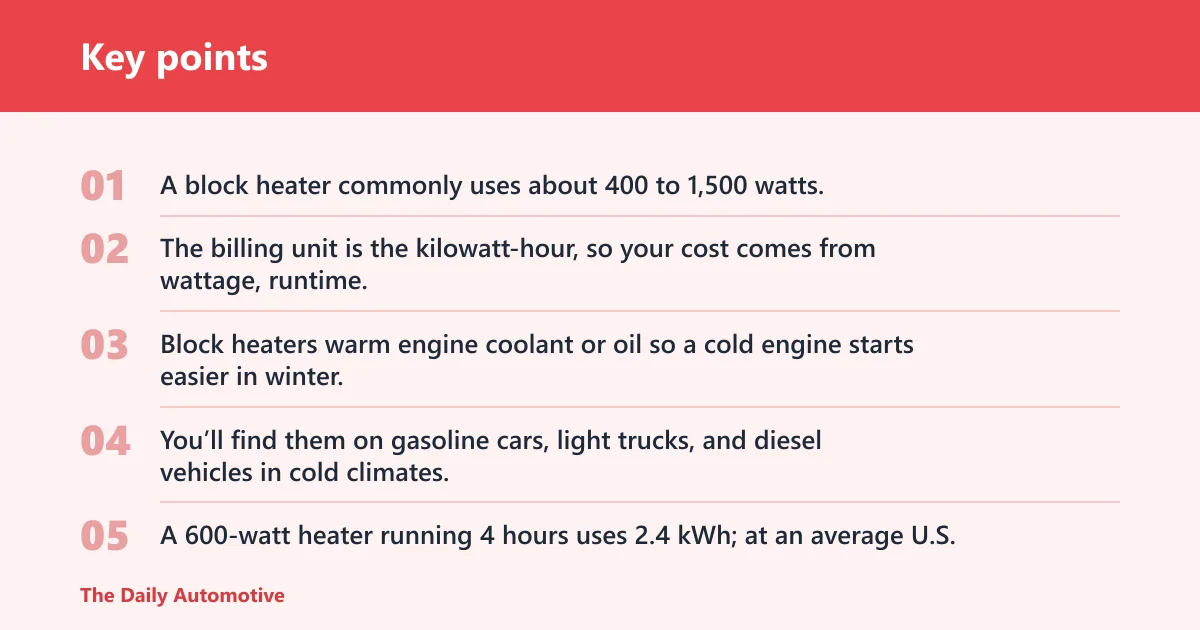


A block heater commonly uses about 400 to 1,500 watts, though the exact draw depends on the heater and how long it is left plugged in. The billing unit is the kilowatt-hour, so your cost comes from wattage, runtime, and your local electricity rate.
What it does in winter
Block heaters warm engine coolant or oil so a cold engine starts easier in winter. You’ll find them on gasoline cars, light trucks, and diesel vehicles in cold climates, and they usually plug into a standard 120V outlet in North America.
Why wattage and runtime decide the bill
The math is watts ÷ 1,000 × hours = kWh. Multiply kWh by your electricity rate. A 600-watt heater running 4 hours uses 2.4 kWh; at an average U.S. price of $0.163 per kWh, that is about 39 cents.
How diesel, gasoline, cars, and trucks differ
Compact gasoline cars often use lower-watt heaters than larger diesel engines, while light trucks and heavy-duty diesels often need more output to hold heat in larger blocks. In practice, the heater label matters more than the vehicle badge.
Say your gasoline sedan uses a 400-watt heater and you plug it in for 3 hours before work. That is 1.2 kWh per morning. At a local rate of 16 cents per kWh, the cost is about 19 cents for that start.
Block heater cost table
The table below turns common wattages into kWh and dollar estimates. It uses the same formula for every row, then shows monthly cost at three common electricity rates so you can compare a cheap utility bill with a higher-cost area.
| Heater wattage | 2 hours per night | 4 hours per night | 8 hours per night | 30-night monthly cost at $0.12 / $0.16 / $0.24 per kWh |
|---|---|---|---|---|
| 300 W | 0.6 kWh / $0.07 at $0.12 | 1.2 kWh / $0.14 at $0.12 | 2.4 kWh / $0.29 at $0.12 | $1.30 / $1.73 / $2.59 |
| 600 W | 1.2 kWh / $0.14 at $0.12 | 2.4 kWh / $0.29 at $0.12 | 4.8 kWh / $0.58 at $0.12 | $2.59 / $3.46 / $5.18 |
| 800 W | 1.6 kWh / $0.19 at $0.12 | 3.2 kWh / $0.38 at $0.12 | 6.4 kWh / $0.77 at $0.12 | $3.46 / $4.61 / $6.91 |
| 1,000 W | 2.0 kWh / $0.24 at $0.12 | 4.0 kWh / $0.48 at $0.12 | 8.0 kWh / $0.96 at $0.12 | $4.32 / $5.76 / $8.64 |
| 1,500 W | 3.0 kWh / $0.36 at $0.12 | 6.0 kWh / $0.72 at $0.12 | 12.0 kWh / $1.44 at $0.12 | $6.48 / $8.64 / $12.96 |
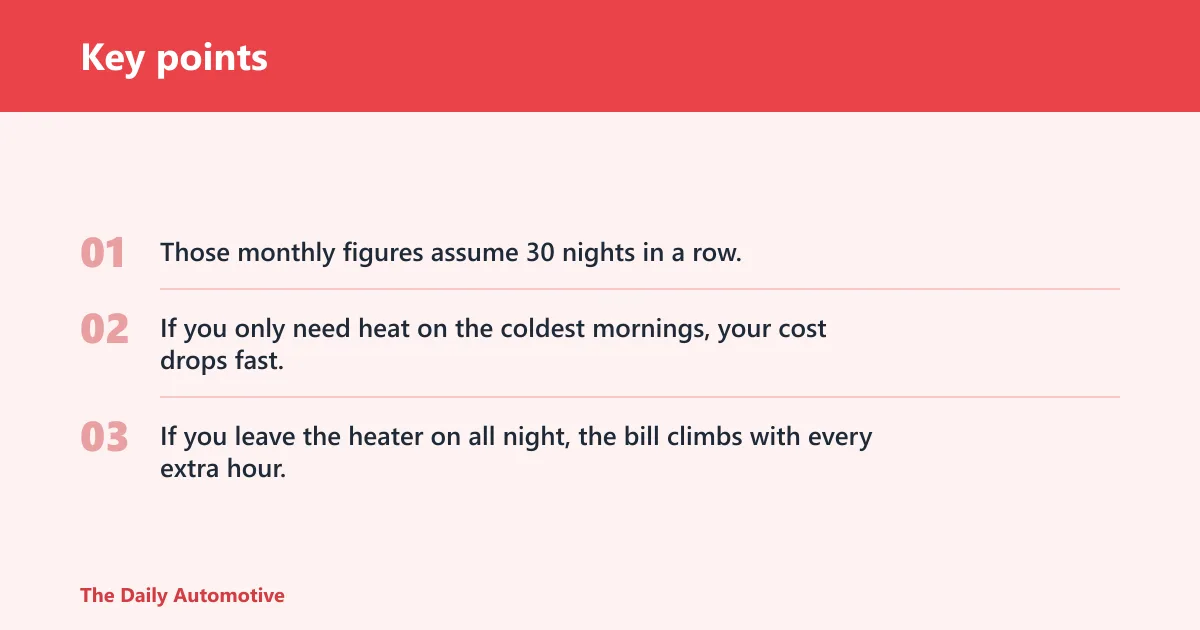
Those monthly figures assume 30 nights in a row. If you only need heat on the coldest mornings, your cost drops fast. If you leave the heater on all night, the bill climbs with every extra hour.
How do you calculate block heater electricity use?
Use watts times hours divided by 1,000 to get kWh, then multiply by your utility rate. That is the clean way to turn a heater label into dollars. Electricity bills are based on kilowatt-hours, not amps.
The watts-to-kWh formula
The energy-use formula is watts times hours divided by 1,000. A 1,000-watt heater running 4 hours uses 4 kWh. A 1,500-watt heater running 8 hours uses 12 kWh.
How to turn kWh into dollars
Multiply the kWh figure by the rate on your electricity bill. Using the cited U.S. average of $0.163 per kWh, a 1,500-watt heater running 4 hours costs about 98 cents a day. That lines up with the common rule of thumb that this size heater can run near a dollar per day at that runtime.
A sample calculation you can copy
Suppose your block heater is 600 watts, and you use a timer for 3 hours before startup. The math is 600 ÷ 1,000 × 3 = 1.8 kWh. At $0.163 per kWh, the cost is about 29 cents for that day.
- Find the heater wattage on the label or in the manual.
- Choose the number of hours it will run.
- Multiply watts by hours, then divide by 1,000.
- Multiply the result by your electricity rate per kWh.
How much electricity does a block heater use per hour?
Per hour, a block heater uses exactly its wattage converted to kWh. A 300-watt unit uses 0.3 kWh in one hour, a 600-watt unit uses 0.6 kWh, and a 1,500-watt unit uses 1.5 kWh. Cost depends on your rate, but energy use does not.
Per-hour use for common wattages
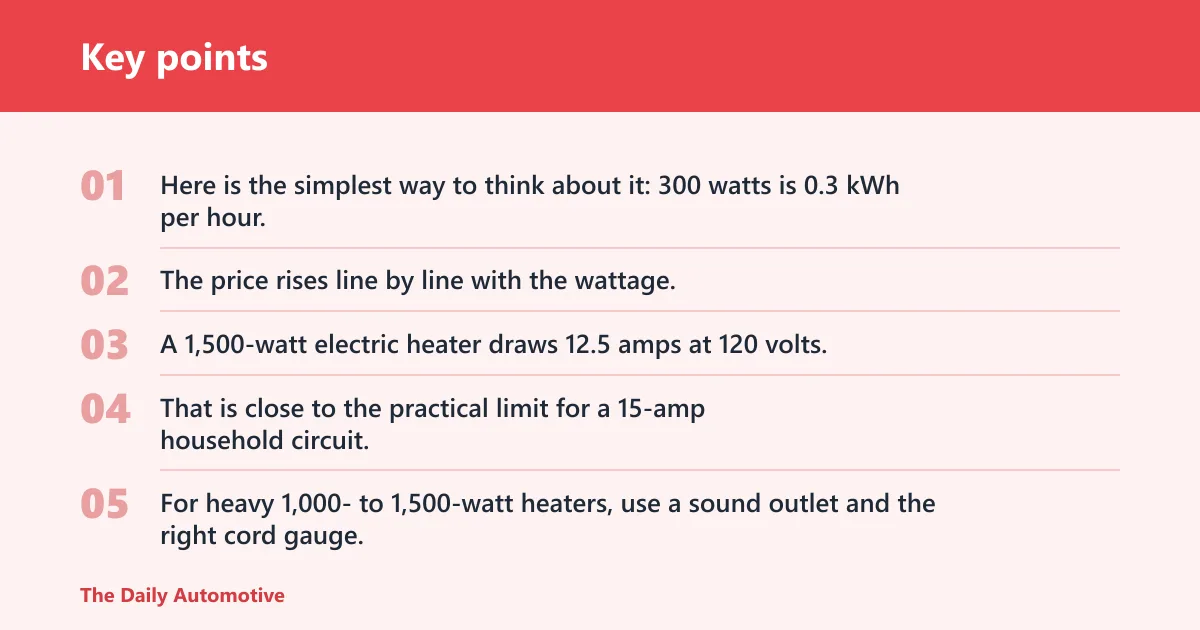
Here is the simplest way to think about it: 300 watts is 0.3 kWh per hour, 600 watts is 0.6 kWh, 800 watts is 0.8 kWh, 1,000 watts is 1.0 kWh, and 1,500 watts is 1.5 kWh. The price rises line by line with the wattage.
Why 1,500 watts is the upper practical edge on a 15-amp circuit
A 1,500-watt electric heater draws 12.5 amps at 120 volts. That is close to the practical limit for a 15-amp household circuit, especially when other loads share the same outlet or branch. For heavy 1,000- to 1,500-watt heaters, use a sound outlet and the right cord gauge.
12-gauge cord is the safer choice for longer runs. Fourteen-gauge cord is generally acceptable up to 25 feet. Undersized cords increase voltage drop, which can reduce heater performance and add stress to the setup.
What a timer changes
A timer does not change the heater’s wattage, but it cuts runtime. That is the easiest way to lower electricity use without guessing when to unplug. Mechanical and digital timers both work if they are rated for the heater load and used according to the manual.
How long should you plug in a block heater?
Many drivers need about 1 to 4 hours before startup, rather than an all-night run. A shorter pre-start window often gives enough heat for easier cranking and cabin warm-up, while longer runtime mainly adds cost. In very cold weather, some engines may need the upper end of that range.
When a shorter run is enough
If the overnight low is only mildly below freezing, 1 to 2 hours may be enough for many cars and light trucks. That is where a timer pays off quickly. You still get the cold-start benefit without paying for extra idle hours.
When extended runtime wastes power
Leaving a heater on for 8 hours when 3 hours would do the job is the fastest way to overpay. A common first-timer mistake is setting the heater for the entire night because it feels safer. That usually costs more without improving the next start much.
Picture a diesel pickup on a 20°F morning with a 1,000-watt heater. If the owner plugs it in for 2 hours before departure, the cost is about 33 cents at the average U.S. rate. If the same truck runs it for 8 hours, the cost rises to about $1.30.
How do you find your block heater wattage?
Start with the label on the heater cord, block-heater body, or packaging, then confirm it in the owner or service manual. If the paperwork is missing, a Kill-A-Watt meter can help verify actual draw. Guessing at wattage makes cost estimates shaky.
Check the label or owner documentation
Most manufacturers list heater wattage on the product tag or in vehicle documentation. That is the best place to start, because the wattage drives both cost and circuit planning. If the label says 600 watts, use 600 watts in the formula, not a round guess.
Use a Kill-A-Watt meter to verify draw
A Kill-A-Watt meter measures what the heater actually pulls from the outlet. That helps if an older heater has no clear label, or if you want to check whether the draw matches the stated rating. It is especially useful when comparing an old replacement cord with the factory part.
When to replace guesswork with a measurement
If you are comparing several heaters, or if the outlet and cord run are long, measuring the draw gives you a better cost estimate. It also helps spot problems like a heater that is drawing less than expected because of a fault.
Frequently asked questions
How much electricity does a block heater use?
Most block heaters fall in the 400- to 1,500-watt range, so their use depends on the rating and how long they run. The formula is watts times hours divided by 1,000, then multiplied by your local rate. That is why two heaters can cost very different amounts.
How much electricity does a block heater use per month?
For a 30-night month, multiply the nightly kWh by 30 and then by your rate. A 600-watt heater used 4 hours a night consumes about 72 kWh in a month. At $0.163 per kWh, that is about $11.74.
How much power does a block heater use?
Power use is the heater’s wattage, and block heaters commonly sit between 400 and 1,500 watts. A smaller car heater may be near the low end, while a large diesel application may be near the high end. Check the label rather than assuming the size.
How much electricity does a diesel block heater use?
Diesel block heaters often use more power than small gasoline-car heaters because they are warming larger engines or more stubborn cold-start systems. Many diesel setups land in the mid-to-high end of the wattage range, so runtime matters even more. Use the label to calculate the exact cost.
How much electricity does a truck block heater use?
Light trucks often use heater ratings similar to passenger cars or slightly higher, while heavy-duty trucks can use much more. The cost depends on both the heater size and how long the truck sits plugged in. A timer is the easiest way to trim that bill.
How do I find my block heater’s wattage?
Check the heater label, the vehicle manual, or the heater packaging first. If that information is missing or unclear, use a Kill-A-Watt meter to measure the draw from the outlet. That gives you a better cost estimate than a guess.
Does using a timer lower block heater electricity use?
Yes. A timer lowers electricity use by cutting unnecessary runtime, which is the main thing that drives cost. The heater still draws the same watts while it runs, but a 2-hour schedule costs less than an 8-hour one. That is why timers are worth using.
How much electricity does a block heater use: it depends?
It depends on wattage, hours plugged in, and your local electricity rate. Use watts ÷ 1,000 × hours to get kWh, then multiply by the rate on your bill. For most drivers, the practical answer is best expressed as a per-hour and per-night cost.
How much electricity does a block heater use per hour: per hour, a block heater?
Per hour, a block heater uses wattage ÷ 1,000 kWh. Convert that to dollars with your utility rate.
Products related to this article
Sponsored / affiliate links. As an Amazon Associate I earn from qualifying purchases. I may earn additional commission from eligible campaigns.