Can You Jump Start a Frozen Car Battery?
Do not jump-start a frozen car battery if the case is icy, cracked, bulging, or the electrolyte may be frozen; wait until it warms above freezing and looks intact. Forcing a charge can split the case, vent acid, or damage the charging system. This guide explains the warning signs, when to stop immediately, and the safer roadside next steps.
Frozen battery signs
A battery that is merely cold can sometimes recover. A battery that is frozen, swollen, cracked, or leaking should be treated as unsafe and left alone until it can be inspected. That difference matters because a 12-volt automotive battery can fail from a low state of charge in winter, but visible case damage points to a more serious problem.
Swelling, cracks, and seepage
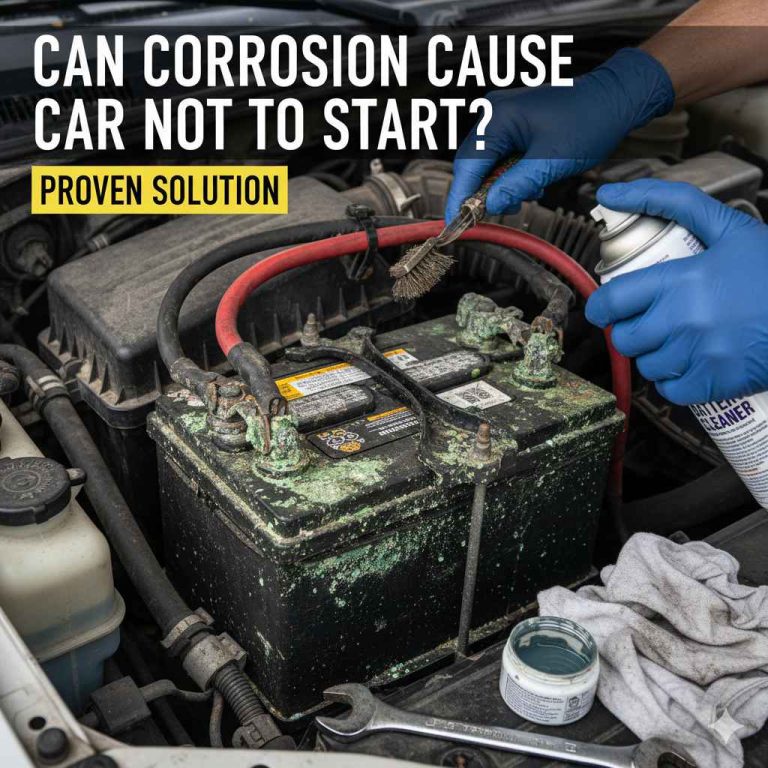
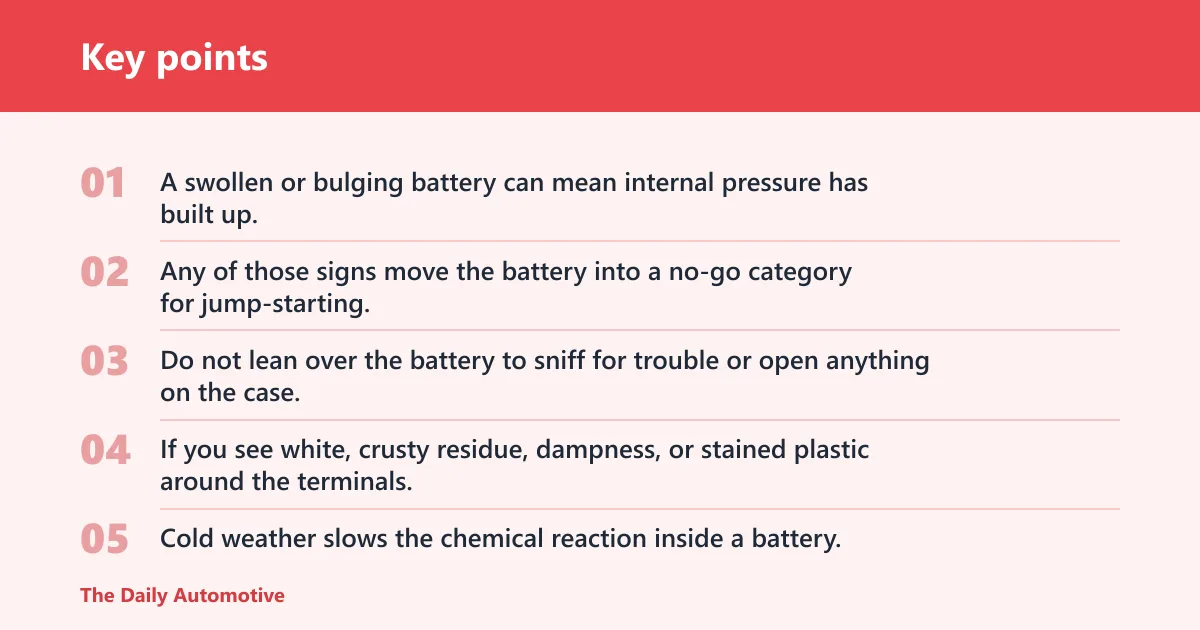
Look at the case before you touch cables. A swollen or bulging battery can mean internal pressure has built up, while cracks or wet residue around the seams suggest electrolyte leakage. Any of those signs move the battery into a no-go category for jump-starting.
Do not lean over the battery to sniff for trouble or open anything on the case. If you see white, crusty residue, dampness, or stained plastic around the terminals, stop and get roadside help or a shop inspection.
Cold battery versus frozen battery
Cold weather slows the chemical reaction inside a battery, so a weak battery may seem dead even when it is not frozen. A frozen battery is different: the electrolyte may have turned to ice, especially after long exposure in subzero temperatures with a very low state of charge. That is when jump-starting becomes a bad idea.
If the battery has been outside in severe cold, treat it as frozen until the case has warmed and still looks normal. A battery that feels very cold is not automatically frozen, but you should not force a start if the case is damaged or the battery shows visible distortion.
When the case looks normal but the battery is still unsafe
Some batteries look intact and still should not be jumped. If the battery has been sitting in extreme cold, will not hold charge, or the vehicle shows repeated no-starts after short charging attempts, the battery may be internally damaged. In that case, a jump may only hide the problem for a few minutes.
Say your sedan sat at -10°F for two nights and now cranks once before going silent. If the battery case is flat, dry, and uncracked, the problem may be low charge rather than freeze damage. If the same battery is swollen at the top, stop there and do not try to force it.
📊 AAA says battery-related roadside service calls remain above 5.7 million in 2024. Source: Consumerreports.
Can you jump start it?
A cold battery may sometimes take a jump if the case is intact, dry, and not distorted. A battery that is frozen, swollen, cracked, or leaking should not be touched with jumper cables or a jump starter. The safest decision is to separate “cold and discharged” from “possibly frozen or damaged” before you connect anything.
When a cold battery may still take a jump
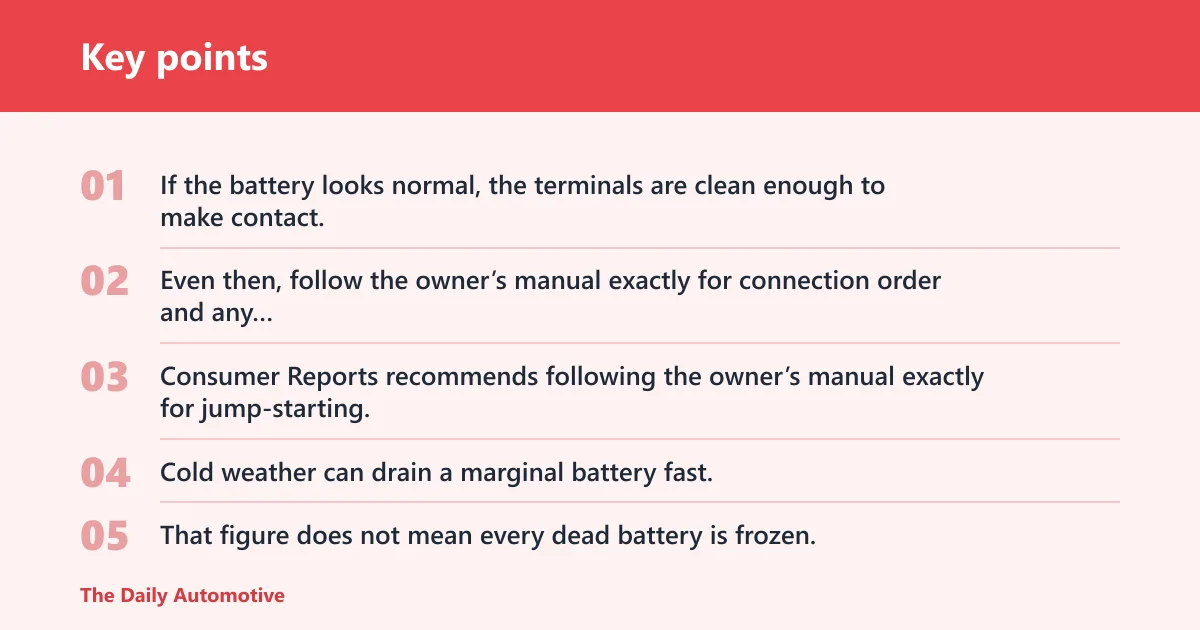
If the battery looks normal, the terminals are clean enough to make contact, and there are no signs of leakage, a jump may be reasonable. Even then, follow the owner’s manual exactly for connection order and any vehicle-specific warnings. Consumer Reports recommends following the owner’s manual exactly for jump-starting.
Cold weather can drain a marginal battery fast, and AAA says battery-related roadside service calls remain above 5.7 million in 2024. That figure does not mean every dead battery is frozen. It does mean winter battery trouble is common enough that you should slow down and check the battery before acting.
When a frozen battery should not be touched
Do not jump-start a battery if you suspect the electrolyte is frozen. Consumer Reports warns that jump-starting a frozen battery can cause major damage. The risk is not limited to the battery case. A damaged battery can vent acid, split, or send bad voltage through vehicle electronics.
If the case is bulging or you can see a crack, leave it alone. If there is visible seepage, park the vehicle safely and call roadside assistance. Jump cables are for a battery that can safely accept current, not one that is physically compromised.
What happens if you try anyway
Forcing a charge into a frozen battery can create pressure inside the case. That pressure can split the plastic, expose acid, and damage surrounding parts. It can also leave you with a vehicle that still will not start, plus a battery that now needs replacement for safety, not just performance.
A common first-timer mistake is to assume a silent battery is only weak because the lights were left on. If the battery sat through a hard freeze and the case looks odd, the better move is warming and inspection, not a hurried rescue attempt.
Winter go/no-go checklist
Use this checklist before you touch jumper cables. It separates a cold but usable battery from one that should be left for inspection or roadside help. If any red-flag action applies, stop the jump-start attempt.
| Symptom | Safe action | Red-flag action |
|---|---|---|
| Case looks flat and normal | Check the owner’s manual, then consider a charger or jump if the battery is otherwise intact | Do not assume it is safe if other warning signs are present |
| Swelling or bulging | Stop using the battery and arrange roadside help | Do not jump-start or charge it |
| Cracks in the case | Move away from the battery area and call for service | Do not connect cables or a charger |
| Electrolyte leakage or damp residue | Keep clear, ventilate the area, and get professional help | Do not touch leakage or attempt a jump |
| Battery very cold after subzero exposure | Wait for warming above freezing and recheck the case before any action | Do not jump if the battery may be frozen |
| Battery is cold but intact | Use a charger or a jump starter only if the manual allows it and the case is normal | Do not force repeated jump attempts |
| Repeated no-starts after charging attempts | Plan for battery testing or replacement | Do not keep cycling the starter |
If you are unsure, choose the safer branch: wait, warm the battery area indirectly, and inspect again. When in doubt about damage, call roadside help rather than test the battery with a jump.
When to wait, charge, or call roadside help
If the battery is cold but intact, a charger or maintainer is often the better choice than an emergency jump. That gives the battery time to recover without the stress of a high-current start. If the battery is frozen, cracked, swollen, or leaking, call for help instead of charging it.
Do not expect a charger to rescue obvious damage. It is a recovery tool for a sound battery, not a fix for physical failure. If the battery has warmed and still cannot hold a charge, replacement may be the right next step.
How to jump safely
Start with the owner’s manual, not the cables. Jump-starting and battery work follow the manual’s connection order, and some vehicles have special reset or electronics concerns that change the procedure. The safest approach is to verify that the battery is not frozen or damaged, then follow the manufacturer’s steps exactly.
Owner’s manual first
The same source recommends following the owner’s manual exactly for jump-starting. That matters because some vehicles place the positive post in a different location, require a remote ground point, or warn against jump-starting at the battery itself. The manual may also note memory settings or module resets after power loss.
If the manual says not to jump the battery under certain conditions, follow that direction. No generic sequence should override the vehicle maker’s instructions.
Jumper cable condition and connection order
Inspect the cables before use. The clamps should open and close firmly, the insulation should not be cracked, and the cable gauge should be suitable for the job. Electronics Hub says jumper leads should not exceed 6 gauge, which is a useful upper limit when choosing heavy-duty winter cables.
Park the vehicles close together but not touching. The same source says the donor car should run at least 10 minutes with the leads connected, and the engine block is a safe ground point. Keep the clamps from touching each other, connect the leads in the sequence shown in the manual, and avoid any sparks near the battery.
Using a second vehicle only if the manual allows it
A donor car is not always the best option. In winter, a portable jump starter can be safer because it avoids two vehicles nose-to-nose in slippery conditions. It also removes the risk of charging-system differences between vehicles, which matters on cars with sensitive electronics.
Still, a portable unit only helps when the battery is safe to jump. If the battery is swollen, cracked, or leaking, a jump starter does not make it acceptable to proceed.
Is a jump starter better?
For winter roadside use, a portable jump starter is often the cleaner option when the battery is cold but not damaged. It does not need a second car, and it can be easier to use in a parking lot or on a narrow shoulder. It is not safer for a frozen battery, though, because the battery condition matters more than the power source.
Peak amps and cold-weather storage
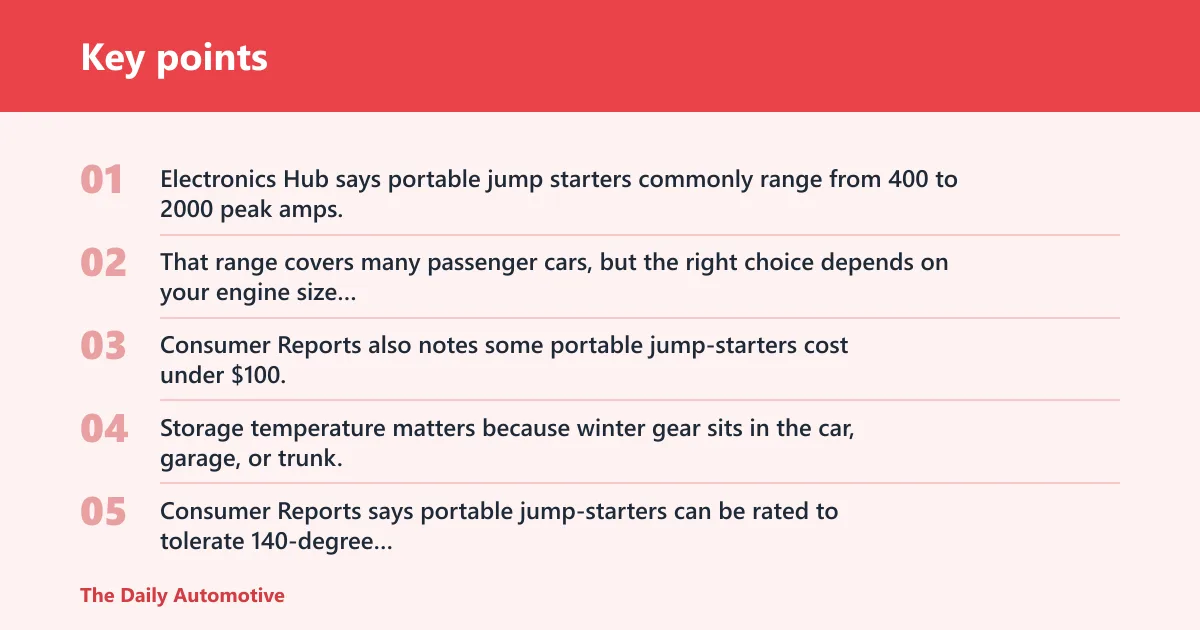
The same source says portable jump starters commonly range from 400 to 2000 peak amps. That range covers many passenger cars, but the right choice depends on your engine size and the maker’s recommendations. Consumer Reports also notes some portable jump-starters cost under $100.
Storage temperature matters because winter gear sits in the car, garage, or trunk. The same source says portable jump-starters can be rated to tolerate 140-degree temperatures, but you should still check the unit’s own storage limits before leaving it in a vehicle through summer and winter swings.
Built-in safety features to look
Look for reverse-polarity protection, spark protection, and clear status lights. Those features help reduce user error during a cold-weather start. A well-designed unit should also have clamps that fit securely and a case that keeps the leads from shorting in storage.
Read the jump starter’s manual before the emergency happens. Some units must be charged regularly, and some work better after being warmed to a usable temperature. A dead jump pack in freezing weather is not a backup plan.
When a charger is the better choice
If the battery is intact but low from cold weather, a battery charger or maintainer is often better than a jump. It restores state of charge more gently and can help identify a battery that is too weak to keep. That is especially useful for vehicles that sit outside or only get short trips.
Picture a crossover that cranks slowly after a night at 5°F but has a flat, undamaged case. A charger is the better first choice if you have time and a safe outlet. If the same battery is domed at the top, charging is the wrong move.
What cold does to batteries
Cold weather makes a dead battery harder to revive because chemical activity slows down and available power drops. A battery that seems marginal in warm weather can fail completely in freezing temperatures. That does not mean it is frozen, only that its reserve is lower and its weakness shows up faster.
State of charge drops in freezing weather
A 12-volt battery needs adequate state of charge to start the engine. When temperature falls, the battery’s output and the engine’s starting demands work against each other. A battery that was already weak may not have enough power left for another start, especially after sitting outside overnight.
That is why winter battery care starts with prevention, not cables. A maintainer can help keep a vehicle ready for the next cold morning, while repeated emergency starts only address the symptom.
Why the alternator is not a repair
The alternator recharges the battery after the engine starts. It is not a fix for a damaged battery, and it cannot repair a frozen or cracked case. If the battery is failing, the alternator may only keep the vehicle alive temporarily before the next no-start.
Do not mistake a running engine for a healthy battery. If the car starts only with outside help and then dies again, the charging system and the battery both need attention.
When replacement makes more sense
Replace the battery instead of repeating jump attempts when it will not hold charge, has visible damage, or keeps failing after a proper recharge. Older lead-acid batteries are especially likely to reach that point after repeated cold-weather strain. A battery that cannot reliably start the vehicle is not a dependable winter part.
Repeated jump starts can waste time and leave you stranded again in worse conditions. If the battery shows swelling, cracking, or leakage, replacement is the safer path than another try.
Frequently asked questions
Can you jump start a frozen car battery?
No. If the battery is frozen or may be frozen, do not jump-start it. Wait until it warms above freezing and inspect the case for swelling, cracking, or leakage first. If any of those signs are present, call roadside help instead of connecting cables or a jump starter.
How do you know if a car battery is frozen?
Look for a battery that has been exposed to subzero temperatures and now shows bulging, cracking, unusual ice around the case, or seepage. A very cold battery is not automatically frozen, but a battery with visible damage or wet residue should be treated as unsafe until inspected.
Should you try to jump a battery that looks swollen or cracked?
No. Swelling or cracking means the battery may be under internal pressure or already damaged. Jump-starting can worsen the damage and may release acid or split the case. The safe move is to stop and get professional help or roadside service.
How long should a car battery warm up before jump-starting it?
There is no universal time rule. Warm it until it is above freezing and the case looks normal, then recheck for swelling, cracks, or leakage. If the battery still looks questionable, do not jump it. Follow the owner’s manual and choose a charger or service call if needed.
What happens if you jump-start a frozen battery?
Forcing a jump can damage the battery case, vent acid, or harm vehicle electronics. Consumer Reports warns that jump-starting a frozen battery can cause major damage. If the battery is frozen or suspected to be frozen, the right move is to stop and let it warm safely first.
Is a portable jump starter safer than another car in winter?
Often yes, because it avoids running two vehicles together on a cold shoulder and removes one more moving part from the process. But it is only a better choice when the battery is safe to jump. A frozen, cracked, swollen, or leaking battery should not be connected to anything.
What gauge jumper cables should you use in winter?
Choose heavy-duty cables, and do not exceed 6 gauge. Heavier cables are more suitable for cold-weather starting than thin, bargain cords. Also check that the clamps are clean, tight, and undamaged, because poor connections make winter starts harder.
How long should the donor car run before trying the start?
The same source says the donor car should run at least 10 minutes with the leads connected. That gives the weak battery some time to absorb charge before the start attempt. If the battery is damaged or frozen, though, waiting longer does not make it safe.
When should you replace a battery instead of jump-starting it?
Replace it when it will not hold charge, keeps failing after recharge, or shows swelling, cracking, or leakage. Repeated jump attempts on an older battery are a sign that the battery is at the end of its useful life. A reliable winter start is worth more than one more risky attempt.
Does cold weather make a dead battery harder to revive?
Yes. Cold slows the battery’s chemistry and reduces its effective output, so a weak battery can seem worse in winter than in mild weather. That does not mean it is frozen, but it does mean you should check the battery condition carefully before trying to jump it.
Products related to this article
Sponsored / affiliate links. As an Amazon Associate I earn from qualifying purchases. I may earn additional commission from eligible campaigns.