How Much Should I Pay for a Car? Budget Rule Guide
A prudent car budget is often kept to about 10% to 15% of take-home pay for all car costs, with a walk-away price based on the full out-the-door total rather than the monthly payment alone. Ignore that rule and the car will squeeze cash flow every month while depreciation keeps moving ahead of your budget. This guide turns salary, taxes, fees, insurance, fuel, and maintenance into a real ceiling before shopping.
How much should I pay for a car?
Start with take-home pay, then check it against gross monthly income. A payment that looks fine on paper can still be too high once insurance, fuel, maintenance, and registration are added. The answer is not a sticker price. It is the most you can pay out the door and still keep the rest of your budget intact.
Start with take-home pay, then check gross income
Budgeting starts with take-home pay because that is the money left for bills. Lenders often look at gross monthly income when they judge affordability, so a buyer can qualify for more car than makes sense. That gap causes trouble. A loan approval is not the same thing as a safe purchase.
The calculator inputs matter because the full picture matters: annual income, monthly debt, down payment, trade-in, APR, term, sales tax, and budget rule. Those inputs change both the monthly payment and the real ceiling. A car that fits the lender may still be too expensive once insurance and fuel are included.
Use a payment cap, then add total ownership costs
NerdWallet advises keeping a car payment under 10% of monthly take-home pay if possible, and total car costs under 20% of take-home pay. That split is useful. The payment cap covers principal and interest only. The broader ownership cap covers the payment plus insurance, fuel or charging, maintenance, and registration.
That distinction matters because a buyer with a low payment can still be over budget if the vehicle is expensive to insure or maintain. A compact car with a modest loan can cost more per month than a cheaper-to-finance sedan once everything else is counted. Monthly payment alone is too narrow.
Convert the answer into an out-the-door price
Sticker price is not the final number. Out-the-door price includes purchase price, sales tax, dealer fees, title, and registration. The sample sales tax rate is 7.0%, and the sample calculation uses a 60-month term with a 6.5% APR. That mix can move a car from “affordable” to “too tight” fast.
One example uses a 10% gross-salary payment rule. That is a starting point, not a finish line. If the buyer is already carrying high rent, student loans, or childcare, the safe ceiling should be lower than the simple rule suggests.
How much should I pay for a car based on my salary?
A practical salary rule is to aim for a car payment around 10% of gross monthly income and total car costs near 20% of take-home pay. Lower salaries need more caution because insurance and repairs take a bigger bite. Higher salaries still need a ceiling, because overspending on transportation crowds out savings and emergencies.
A practical salary-to-payment rule
Gross monthly income is useful for setting the lender-facing payment budget. Take-home pay is better for the real-world budget. If the payment looks comfortable only because the term is long, the car may still be too expensive. A 72-month loan can reduce the monthly number while increasing total interest.
FinanceCalculator.us lists 36, 48, 60, and 72 month loan terms. FinanceCalculator.us also frames 20/4/10 as 20% down, 4 years financing, and 10% of take-home pay. That is a solid filter for buyers who do not want to stretch too far.
What changes at lower, middle, and higher incomes
Lower-income buyers usually need a stricter payment cap because fixed costs leave less room for surprises. Middle-income buyers can often support a reasonable used-car payment, but they still need room for insurance and routine service. Higher-income buyers can qualify for more car than they should buy, especially if they chase trim levels instead of utility.
The failure case is common: a buyer qualifies for a larger loan, then buys right up to the edge. That leaves little room for tires, brakes, and registration. The safer move is leaving room in the budget before signing.
When household bills make the safe number smaller
Debt-to-income ratio, or DTI, matters because it measures total debt burden. FinanceCalculator.us cites 36% total DTI as a common target and 43% as a practical limit. If rent, student loans, credit cards, or child support already push the ratio up, the car budget needs to shrink. The approval limit is not the spending limit.
That is why a household budget should override a payment calculator. The car payment may fit under a lender’s ceiling, but the combined debt load may still be too tight. The smartest buyers leave slack for repairs and life.
What monthly car payment can I afford?
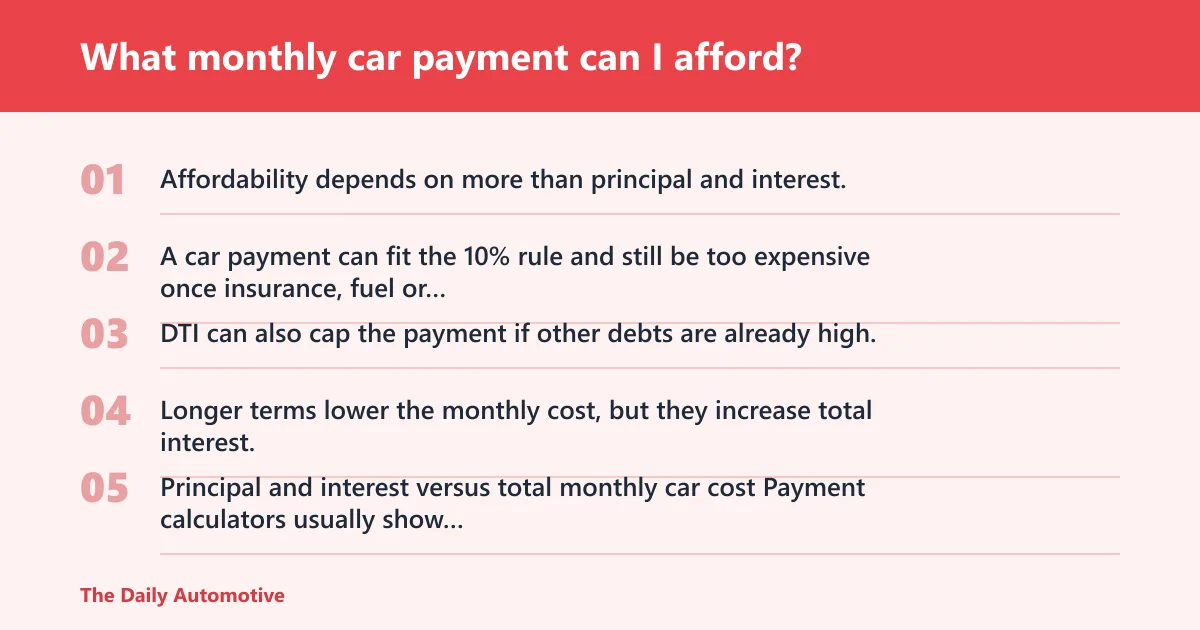
Affordability depends on more than principal and interest. A car payment can fit the 10% rule and still be too expensive once insurance, fuel or charging, maintenance, and registration are added. DTI can also cap the payment if other debts are already high. Longer terms lower the monthly cost, but they increase total interest.
Principal and interest versus total monthly car cost
Payment calculators usually show principal and interest only. That is not the whole monthly car cost. Insurance can swing sharply based on age, location, driving record, and vehicle type. Fuel or charging costs vary just as much. Maintenance and registration are not optional, and neither is a repair reserve on older vehicles.
A buyer who only budgets for the loan payment can get blindsided within the first month. A better plan is to treat the loan payment as one line in a broader transportation budget, not the whole budget.
How DTI changes the ceiling
DTI compares monthly debt payments to gross income. At 36% total DTI, many buyers still have room. At 43%, the budget is already stressed. Add a car payment on top of rent and existing loans, and the number that looks affordable on paper can become fragile in practice.
That is why a lender’s approval should be treated as a ceiling, not a target. The buyer should often stay below it. A smaller loan with a shorter term can be easier to live with than the biggest payment a bank will allow.
Why a longer loan term is not free money
Longer loan terms lower the monthly payment, but they usually increase total interest. NerdWallet says a good loan term target is 60 months or less for new cars and 36 months or less for used cars. Stretching to 72 months can make the number look nicer while keeping the buyer in the loan longer and underwater longer.
That matters when resale value falls faster than the balance. A buyer can owe more than the car is worth for years if the term is too long and the down payment is too small.
Build your walk-away price: the buyer worksheet
The cleanest method is to set a walk-away out-the-door price before visiting the lot. Start with the maximum monthly ownership budget, subtract insurance, fuel, maintenance, and registration, then translate the remaining amount into a payment and loan amount. After that, back into the most you can pay for the car itself, including tax and fees.
Buyer worksheet with three scenarios
| Scenario | Income basis | Monthly ownership reserve | Payment cap | Down payment / trade-in | Walk-away out-the-door price |
|---|---|---|---|---|---|
| Cash purchase | $5,000 take-home | $500 total car costs | $0 loan payment | $6,000 cash, no trade | $18,000 |
| Financed purchase | $7,500 gross / $5,800 take-home | $700 total car costs | $580 principal and interest | $4,000 down payment | $28,500 |
| High-mileage used car | $4,200 take-home | $420 total car costs | $280 principal and interest | $3,000 down payment | $14,000 |
These are worksheet examples, not universal targets. The point is the structure. The cash buyer still needs room for tax, title, registration, insurance, fuel, and maintenance. The financed buyer needs a payment that fits both gross and take-home income. The high-mileage buyer needs extra reserve for repairs.
- Set the monthly ownership budget from take-home pay.
- Subtract insurance, fuel or charging, maintenance, and registration.
- Use the remainder as the maximum loan payment or cash-car reserve.
- Apply down payment and trade-in value, net of any remaining payoff.
- Back into the largest out-the-door price you can tolerate.
What should I include besides the sticker price?
Include sales tax, title, registration, and dealer fees first. Then add insurance, fuel or charging, and maintenance. Trade-in value also matters, but only after subtracting any remaining payoff. A vehicle that looks cheap on the window sticker can be expensive once the full out-the-door total and monthly ownership costs are counted.
Sales tax, title, registration, and dealer fees
Sales tax is applied to the purchase price and varies by state and locality. Title and registration are separate line items. Dealer fees can be small or aggressive, and they belong in the out-the-door total. Buyers who skip these numbers end up comparing fake prices instead of real ones.
If a listed car is near the budget ceiling already, these add-ons can push it out of reach. That is why the walk-away price should be an out-the-door number from the start.
Insurance, fuel or charging, and maintenance
Ownership costs do not stop at delivery. Insurance is often the biggest surprise. Fuel or charging can vary depending on commute and vehicle type. Maintenance includes oil changes, tires, brakes, filters, and the odd repair that never fits neatly into a monthly spreadsheet.
Those costs should reduce the payment ceiling, not be treated as afterthoughts. A buyer who spends the entire car budget on the loan payment has no cushion left for real ownership.
Trade-in value and remaining payoff
Trade-in value reduces what must be financed, but only the net amount matters if there is still a loan balance on the old car. A trade with negative equity can erase part of the benefit and raise the new payment. The true number is not the headline trade offer. It is the trade offer minus the payoff.
That is one more reason to shop using out-the-door pricing. It keeps the focus on the full transaction, not the most flattering line in the deal sheet.
How much should I pay for a car with 100k miles?
A 100k-mile car should usually cost less than a cleaner, lower-mileage alternative because repair reserve matters more. The cheaper sticker can be the more expensive ownership decision if the vehicle needs tires, suspension work, cooling-system service, or a transmission repair soon after purchase. The ceiling should come down before negotiations begin.
Why repair reserve matters more on older cars
Older, high-mileage cars need a dedicated repair reserve because age and wear stack up fast. Even a well-kept example can demand more maintenance than a newer one. That reserve should come out of the purchase budget, not the grocery budget later. A cheaper purchase price is only cheaper if the repair curve stays calm.
A buyer who ignores reserve often ends up paying twice: once at purchase, then again at the repair shop. That is the main reason high-mileage cars need a lower walk-away number.
What to subtract from the price ceiling
For a high-mileage used car, subtract a repair reserve before setting the top price. Then subtract insurance, registration, and routine service. If the car has expensive tires, overdue maintenance, or a questionable history, the ceiling should drop again. A clean car with solid records can cost more upfront and still be cheaper over a year.
That is the part many buyers miss. The least expensive car on day one is not always the least expensive car after twelve months.
When a cleaner car costs less in the long run
A cleaner car often wins when it needs fewer surprise repairs and holds value better. The buyer pays more up front, but may save through lower repair reserve, lower downtime, and fewer emergency fixes. For many households, that trade is worth it. A cheap car that keeps visiting the shop is not cheap.
What should I do before I shop?
Get pre-approved and compare APRs before setting foot on the lot. Then set the walk-away price in writing and use it to screen listings fast. Do not test-drive first and budget later. A clear ceiling keeps emotion from driving the deal.
Get pre-approved and compare APRs
APR changes the monthly payment and the total interest paid. A small APR difference can matter a lot over 60 months or longer. Pre-approval gives a realistic rate range and keeps the shopper from assuming the dealer’s first offer is the only one available.
Lower APR is helpful, but it does not fix an oversized purchase. Rate shopping is useful only after the buyer has set a sane ceiling.
Set your walk-away price before the test drive
A walk-away price is the maximum out-the-door number you will accept. It should already include taxes, fees, down payment, and a reserve for ownership costs. Once that number is set, the buyer can walk away from anything above it without second-guessing the math.
This is where many buyers save real money. The number is decided in advance, not negotiated in the heat of a sales office.
Use the ceiling to screen listings fast
Compare listings against the out-the-door ceiling, not the advertised sticker price. If a car is already too close to the cap before tax and fees, it is the wrong car. That rule also helps with high-mileage cars, where the repair reserve should push the ceiling lower still.
The simple test is this: if the car only works with a stretched term, a tiny down payment, or no repair reserve, it is too expensive.
Frequently asked questions
How much should I pay for a car monthly?
A practical monthly target is to keep the car payment under 10% of monthly take-home pay if possible, with total car costs under 20%. That means the payment is only one piece. Insurance, fuel or charging, maintenance, and registration still need room in the budget.
How much should I pay for a car in cash?
Cash buyers should still set a walk-away out-the-door price that leaves money for tax, title, registration, insurance, and repairs. Cash can cut interest cost, but it does not erase ownership costs. A cash purchase is safer when it does not empty the emergency fund.
How much should I down payment on a car?
A down payment of 10% to 20% is a common target because it lowers the amount financed and can improve affordability. Bigger down payments help more on longer loans and on vehicles that lose value quickly. The point is to reduce risk, not just shrink the monthly payment.
How much do I need to make to afford a car?
There is no single income number, because debt load, insurance cost, and local taxes all change the answer. A buyer should start with take-home pay and DTI, then work back to a payment and out-the-door ceiling. Two people making the same salary can have very different safe budgets.
If you pay cash for a car how much cheaper is it?
Cash can be cheaper because it removes interest charges, origination fees, and some financing friction. But the savings only matter if the buyer still respects ownership costs and keeps a repair reserve. A cash deal can be expensive if it drains savings and forces new debt later.
How much should I pay for a car battery?
A battery should be priced as a maintenance item, not a reason to buy more car. If a used car needs a battery soon, that cost belongs in the purchase math along with tires, brakes, and fluids. On an older car, little items add up fast and should lower the ceiling.
Products related to this article
Sponsored / affiliate links. As an Amazon Associate I earn from qualifying purchases. I may earn additional commission from eligible campaigns.