Hot Wheels Car Culture Cost: What to Expect at Retail
Hot Wheels Car Culture usually retails for about $6.49 to $7.99 per car, while sought-after castings, chase variants, or sealed sets can sometimes climb to roughly $15 or more on the secondary market. Miss the going rate, and you overpay for common singles or pass on a fair price before the listing disappears. This guide breaks down retail pricing, resale ranges, and the listing details that justify a premium.
What Hot Wheels car Culture
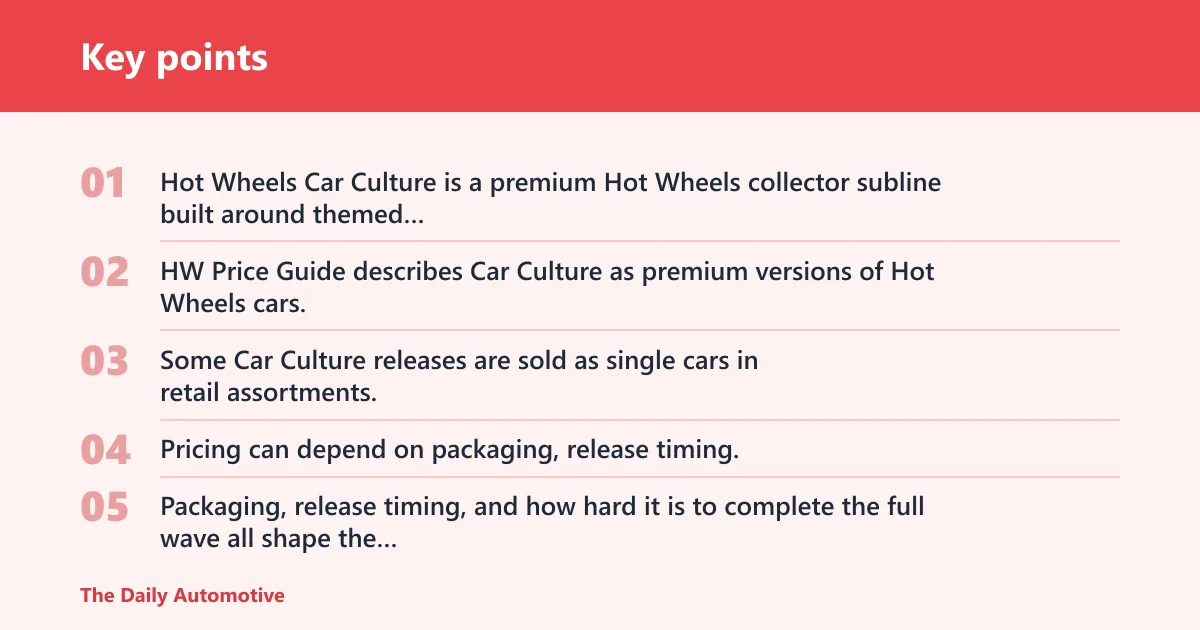


Hot Wheels Car Culture is a premium Hot Wheels collector subline built around themed releases, higher detail, and a price above the basic mainline car. HW Price Guide describes Car Culture as premium versions of Hot Wheels cars, made to a higher quality and sold in themed sets that usually arrive several times a year.
Single cars versus set releases
Some Car Culture releases are sold as single cars in retail assortments, while others are judged as part of a themed wave or set. Pricing can depend on Packaging, release timing, and how hard it is to complete the full wave all shape the number.
For buyers, the first question is simple: are you pricing one loose carded car, or a full sealed run from a specific series? A single car may be fair at retail even when a complete set pulls a higher total, because sealed grouping adds convenience and scarcity pressure.
How Car Culture differs from mainline pricing
Car Culture sits above regular Hot Wheels in finish and price. The same source says these cars are a little more expensive than regular cars, and that gap reflects the premium tier rather than a random markup. The difference shows up in the packaging, the castings chosen, and the collector audience.
The contrast is easy to see in a simpler premium example. CNET reported that the Zoom In Hot Wheels car sold for the same price as a basic Hot Wheels car, with a listed price of $1.09, even though the GoPro camera sold separately for $200 and the compatible GoPro models were the Session and Hero5 Session. That example shows a themed car can keep a low price even when the tie-in product is far costlier.
How much does Hot Wheels Car Culture cost?
Hot Wheels Car Culture usually lands around $6.49 to $7.99 at retail for a single car, but the real price depends on where you buy it and how complete the listing is. Full sets cost more in total, and after release, popular castings or sealed boxes can move well beyond retail on the collector market.
Retail MSRP benchmark for singles
The cleanest benchmark for a single Car Culture car is retail MSRP. Store-to-store pricing can vary, but the expected band is still the best starting point for judging a listing. If a common single is priced far above that band and nothing about it is rare, the seller is asking for a collector premium without a good reason.
Retail also shifts by channel. Big-box stores may price close to MSRP, hobby shops may sit a little higher, and online retailers can swing either way depending on stock. Sale pricing can dip below MSRP for slower waves, but that does not change the benchmark.
Typical set pricing and car count
A Car Culture wave typically includes about five cars, though the exact mix can vary by release. That is the number buyers should use when checking a sealed set listing, because a four-car lot, a five-car wave, and a mixed assortment are not priced the same way.
If each car is priced near retail, a five-car sealed set should usually cost close to five times the single-car MSRP, before shipping and taxes. If a listing asks far more than that and offers no chase piece, no sealed box, or no harder-to-find wave name, skip it.
When store pricing is above or below MSRP
Store pricing above MSRP usually comes from channel markup, import costs, or a shop that knows the wave moved quickly. Below-MSRP pricing usually means a sale, a slow-moving series, or a store clearing older stock. Neither one automatically makes the listing bad; the question is whether the price matches the condition and demand.
Picture a sealed five-car wave at a local hobby shop priced a little above expected retail because the store only received one case. That can still be fair. Now picture the same wave on a marketplace site with shipping added and no rare piece included. That total may push it into overpriced territory fast.
Why Car Culture costs more than mainline Hot Wheels
Car Culture costs more than mainline Hot Wheels because it is built and sold as a premium collector line. The same source notes higher quality, themed sets, and several yearly releases, all of which support the price gap. Buyers pay for detail, presentation, and the chance that a specific casting will matter to collectors later.
Packaging and finish differences
Premium packaging is part of the cost. Car Culture cards, graphics, and finish quality are aimed at collectors, not a quick basket buy. That is different from a basic mainline release, where the focus is volume and broad appeal. The package is part of the product’s value, especially to carded collectors.
Collector-focused tooling and detail
Hot Wheels Premium Car Culture cars are made to a higher quality than regular cars, and that detail is one reason buyers accept the higher price. More detailed wheels, paint treatment, and licensed subjects make the line more appealing to collectors who want a specific theme, brand, or casting.
That collector focus also affects demand. A licensed model with strong real-car appeal will usually hold attention better than a generic subject. When demand stays steady and supply is short, the secondary market reacts quickly.
Car Culture price factors
The final price of a Car Culture car after release depends on three things: the wave name, the condition, and the level of collector demand. A common casting in a quiet wave may stay near retail. A well-known licensed model from a sought-after series can move much higher once stores sell through.
Release wave and series name
Series-by-series variation matters. HW Price Guide tracks Car Culture by year and release group because some waves become more desirable than others. A popular theme, a recognizable brand partnership, or a specific year tied to a collector favorite can pull prices upward even when the car itself is not rare in the strictest sense.
Carded, loose, and sealed-set condition
Condition changes value fast. Carded cars usually bring more than loose cars because collectors pay for mint packaging and display appeal. Loose cars can still be worth strong money if the casting is sought after, but the card back, blisters, and factory state are no longer part of the sale.
Sealed sets often command the strongest premium per listing because they combine condition, completeness, and convenience. If a buyer wants every car from one wave and does not want to assemble it piece by piece, a sealed set may be worth the extra cost. If not, the set premium can be wasted money.
Popular castings, licensed models, and scarcity
Scarcity-driven premium is the simplest resale force. Short-run releases, popular castings, and licensed models all increase the chance of a higher asking price after release. If a wave sells out quickly, a seller can price above retail because replacement stock is harder to find.
A common first-timer mistake is paying a sealed-set price for a mostly ordinary wave just because the listing looks complete. Completeness alone is not rarity. The question is whether the wave contains a casting or license that buyers are already chasing.
Car Culture cost by channel
Car Culture pricing changes by channel. Big-box retail usually sets the cleanest benchmark, hobby shops may price a little higher, online retail can move with stock, and the secondary market can be all over the map. Imported listings add another layer because shipping, taxes, and currency conversion change the total.
| Channel | Typical price behavior | What to check |
|---|---|---|
| Big-box retail | Closest to MSRP for singles | Match the shelf price to the current wave and condition |
| Hobby shop | Often above MSRP, especially for hot waves | Ask whether the markup reflects limited stock or a premium assortment |
| Online retail | Can be below or above retail depending on stock | Include shipping before comparing to MSRP |
| Secondary market | Driven by demand, scarcity, and condition | Check card quality, sealed status, and sold comps if available |
| Imported listing | Pricing may look low before shipping and taxes | Convert to your local currency and add all fees |
Regional pricing differences
Does Hot Wheels Car Culture cost the same in every country? No. Country-specific pricing can change because of taxes, import fees, local distribution, and retailer strategy. A price that looks normal in one market can be expensive in another once you include shipping and conversion.
Imported listings need extra care. A car that looks cheap overseas can turn into a weak buy after postage and duties. Compare landed cost, not just the sticker price.
Hot wheels car culture checklist
Use this checklist to judge whether a listing is fairly priced. Start with the retail anchor, then decide whether the added premium is tied to scarcity, condition, or a harder-to-find release. If none of those are present, the asking price is probably too high.
| Price anchor | What it includes | When to skip the listing |
|---|---|---|
| $6.49 to $7.99 per single car | Normal retail MSRP for a common single at or near shelf price | Skip if the car is common and the seller asks far above retail without a rare variant |
| Five-car wave total | Typical sealed set pricing based on a full assortment | Skip if the total is well above five times single MSRP and no chase or rare piece is included |
| Typical aftermarket premium trigger | Short-run release, popular casting, licensed model, or fast sellout | Skip if the listing claims “rare” but shows no special casting, condition edge, or sealed completeness |
| Carded premium | Mint card, clean blister, display-ready packaging | Skip if the card is bent, cracked, or heavily worn but priced like mint stock |
| Loose-car discount | Loose vehicle with no packaging premium | Skip if the loose price is close to a mint carded example unless the casting is especially scarce |
Fair-price rule for singles: buy near MSRP when the car is common, and accept a modest premium only when the release is sought after or sold out. Fair-price rule for sets: divide the asking price by the car count, compare that per-car number to the single MSRP, and skip if the result is obviously higher without a chase or sought-after wave.
Which Car Culture releases usually cost more?
The Car Culture releases that usually cost more are the ones with strong license appeal, a popular casting, or a shorter supply window. Yearly waves can vary a lot, so the expensive release is not always the newest one. It is often the one that collectors wanted first and stores sold through fastest.
Series and wave desirability
Some series pull higher prices because the theme resonates with collectors, especially if the lineup includes recognizable road cars or a well-known manufacturer. A stronger series name can matter as much as the individual car, because buyers often chase the whole wave instead of one loose piece.
Limited availability and short-run pressure
Short-run releases create pressure the moment retail stock dries up. Once a wave is gone from shelves, buyers move online, and the asking price can rise quickly. That is why two Car Culture cars with similar retail prices can split apart sharply after release.
License appeal and collector demand
Licensed models often outperform generic themes because the real-world car name has built-in recognition. Collector demand then decides whether the premium sticks. If the casting has a following, the market keeps paying. If not, the price can settle back toward retail.
Frequently asked questions
What is hot wheels car culture?
Hot Wheels Car Culture is a premium Hot Wheels collector subline built around themed releases and higher-quality finish. The same source describes it as premium versions of Hot Wheels cars, made to a higher quality and sold in themed sets that are usually released several times each year.
What is the retail price of Hot Wheels Car Culture?
The retail price benchmark for a single Car Culture car is about $6.49 to $7.99. Store pricing can vary by retailer, country, and sale timing, so treat that range as the reference point rather than a fixed law. Always compare the full landed cost before buying.
Why are Hot Wheels Car Culture cars more expensive than mainline Hot Wheels?
They cost more because they are positioned as premium collector cars, not basic mainline stock. The line uses higher-quality presentation, themed assortment planning, and collector-focused demand. Those factors justify a higher shelf price and give some releases room to rise after they sell out.
How much is hot Wheels Premium Car Culture?
Hot Wheels Premium Car Culture usually sits above regular Hot Wheels and below the most inflated secondary-market listings. For a common single, expect retail around $6.49 to $7.99. For a hot casting or sealed set, the price can move well above that depending on condition and demand.
Does Hot Wheels Car Culture cost the same in every country?
No. Prices vary by market because of taxes, import fees, shipping, retailer markup, and exchange rates. A listing that looks cheap overseas can end up expensive once landed cost is added. Compare the final total, not the headline number, before deciding whether it is fair.
What affects the price of a Hot Wheels Car Culture car after release?
After release, price is driven by scarcity, collector demand, casting popularity, licensed appeal, and condition. Carded examples usually cost more than loose ones, and sealed sets can command a premium if buyers want the full wave. A sold-out series with a strong license usually climbs fastest.
Are Hot Wheels Car Culture sets worth the extra cost?
They are worth the extra cost when you want the entire wave, care about mint packaging, or are buying a release that has already moved out of stores. If you only want one car from the set, the bundle premium is often wasted money unless the seller is pricing it close to the single total.
Which Hot Wheels Car Culture series usually costs more?
The series that usually costs more is the one with the strongest collector pull, not always the newest one. Popular castings, licensed models, and quickly sold-out waves tend to rise first. A theme with broad fan appeal and tight supply usually outruns a slower, less desirable wave.
How do I tell if a Hot Wheels Car Culture car is priced fairly?
Start with retail MSRP, then add only the premium that the listing actually earns through condition, scarcity, or a sought-after wave. If a common single is far above $6.49 to $7.99 with no special factor, skip it. If a sealed set is priced as if it were loose stock, it may be a fair buy.
Products related to this article
Sponsored / affiliate links. As an Amazon Associate I earn from qualifying purchases. I may earn additional commission from eligible campaigns.