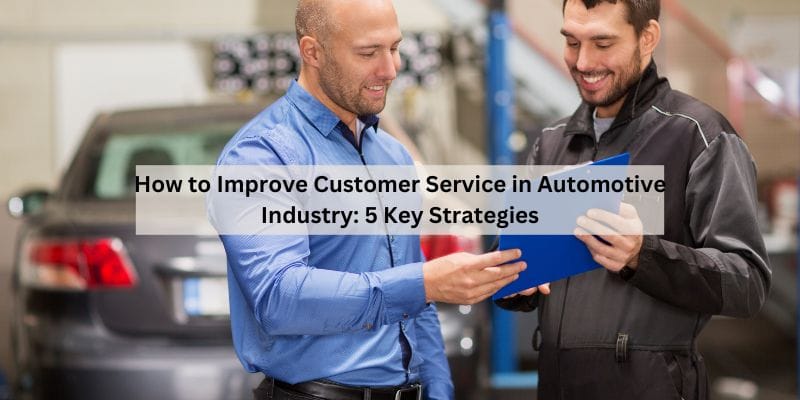
Automotive Customer Service Strategies That Actually Keep Buyers Coming Back
You know the feeling. A customer buys a car from you, drives off the lot happy, then never comes back for service. Six months later they take their car to a competitor down the street because the service advisor there remembered their name and sent a text when the oil change was due. That small loss compounds into thousands of dollars in missed service revenue and no chance at selling them their next vehicle.
Most dealerships focus on the sales floor and forget the service lane is where loyalty is actually built. The average customer visits the service department 3 to 4 times per year versus once every 3 to 5 years for a new car purchase. That makes fixed ops the real engine of customer retention.

SKLENICE
50 Sets Vehicle Purchase Agreement Forms 8.5"…
- 【Standard Letter Size — 8.5" x 11" for Easy Filing】Each form measures 8.5" x 11" — fits perfectly in standard filing cabinets, bin…
- 【2-Part Carbonless System with Consecutive Numbering】50 sets of white original + yellow duplicate. Copies instantly without carbon…
- 【Sturdy Chipboard Backing + Clean Tear-Off Perforation】A heavy-duty chipboard backing gives you a firm writing surface anywhere —…
This article walks through seven specific automotive customer service strategies you can implement starting this week. You’ll get concrete steps, real numbers, and a few opinions from someone who has spent years in the trenches. No fluff, just what works.
One small tool that helps keep the paperwork side of service and sales organized is a vehicle purchase agreement book. It’s a 50-set carbonless form that tracks every transaction with consecutive numbering, so you never lose a deal record or face a dispute without proof. For under $20, it saves you the headache of relying on memory or messy digital notes.
Why Traditional Automotive Customer Service Fails in 2026
The old playbook was simple: be polite, smile, and hope the customer doesn’t complain. That worked when customers had few options. Now they have Google reviews, social media, and a dozen competing dealerships within a 20-mile radius.
Traditional service fails for three reasons. First, it’s reactive. You wait for the customer to call, then you scramble to find a loaner or squeeze them into the schedule. Second, it’s generic. Every customer gets the same scripted greeting, the same upsell for a cabin filter, and the same vague explanation of what’s wrong with their car. Third, it treats the service department as a cost center, not a relationship builder.
Customers can feel that indifference. A 2026 J.D. Power study found that CSI (Customer Satisfaction Index) scores drop sharply when service advisors don’t explain the repair process clearly. The fix isn’t a new script. It’s a fundamental shift in how you approach every interaction.
The New Customer Journey: From Digital Showroom to Service Bay
Today’s car buyer starts online. They research models, compare prices, and read reviews before they ever step foot in your dealership. That digital journey continues after the sale. They expect text reminders for oil changes, online scheduling, and transparent digital estimates.
If your service department still operates like it’s 2026, you’re losing customers to the dealership across town that sends a text when their car is ready.
Mapping the Post-Purchase Service Experience
Draw a line from the moment a customer drives off the lot to the moment they come back for their first service. What happens in between? Most dealerships have a black hole here. The salesperson hands over the keys, says goodbye, and the customer is left to fend for themselves.
You need to map every touchpoint: the thank-you email, the 30-day check-in call, the first service reminder, the appointment scheduling process, the service visit itself, and the follow-up survey. Each one is a chance to build trust or lose it.
For example, a simple text reminder 48 hours before an appointment cuts no-shows by up to 30%. A follow-up call two days after service to ask “how’s the car running?” increases return visits by nearly 20%. These are small actions with big returns.
Strategy 1: Unify the Omnichannel Experience (Sales & Fixed Ops)
Your sales team and service team often operate in separate silos. Sales has its own CRM, service has its own scheduling system, and neither talks to the other. That’s a disaster for customer experience.
A customer who bought a car from you expects the service department to know their name, their vehicle, and their purchase history. When they call and get asked “what year is your car?” after you sold it to them six months ago, they feel like just another number.
Integrate your systems. Use a shared CRM that tracks both sales and service interactions. Train service advisors to acknowledge the customer’s purchase: “I see you bought the Camry from us in March. How are you liking it?” That one sentence builds more trust than any scripted greeting.
Also, make scheduling easy across channels. A customer should be able to book a service appointment online, via text, or by phone, and get the same confirmation. If your website doesn’t offer online scheduling, you’re behind.
Strategy 2: Leverage Data for Hyper-Personalization
You have data on every customer: their vehicle, their service history, their preferred communication method, their last visit. Use it.
Personalization means more than addressing the customer by name in an email. It means knowing that Mrs. Johnson always brings her car in on Tuesdays, prefers text updates, and has a dog that sheds in the back seat (so you vacuum it without being asked).
Use your CRM to segment customers by vehicle age, mileage, and service history. Send targeted reminders: “Your 2026 Civic is due for a brake inspection at 45,000 miles. We can do it on Thursday at 10 AM.” That’s specific, relevant, and shows you’re paying attention.
One caution: don’t overdo it. A customer who gets three texts and two emails about an oil change will start ignoring you. Find the right frequency—usually one reminder and one follow-up is enough.
Strategy 3: Proactive Communication Over Reactive Support
Proactive service is the opposite of waiting for problems. Instead of reacting to a check engine light, you’re scheduling maintenance before a breakdown happens.
Here’s how to implement it:
- Set up automated service reminders based on mileage or time since last visit.
- Monitor vehicle health data if your customers have connected cars (with their permission).
- Reach out when you see a pattern—like a recall or a known issue with a specific model.
- Send a personal follow-up after every service visit, not just a survey link.
For example, if you know a certain model has a battery issue at 3 years, proactively offer a free battery test at the 2.5-year mark. That prevents a roadside breakdown and builds immense goodwill.
Proactive communication also means transparency. If a repair will take longer than estimated, tell the customer immediately. Don’t make them wait until they call you. That honesty is what earns repeat business.
Strategy 4: Empower Service Advisors with Soft Skills & Authority
Service advisors are the face of your service department. They set expectations, explain repairs, and handle complaints. Their performance directly impacts CSI scores and retention.
Most advisors are trained on the technical side but not on communication. They can diagnose a bad alternator but can’t explain it to a customer without sounding like a robot. That’s a problem.
Start with role-playing exercises. Have advisors practice handling angry customers—the ones who think they’re being ripped off. Teach them to listen first, apologize sincerely, and offer a solution. For example:
Customer: “You quoted me $400 for brakes and now it’s $600. This is a scam.”
Advisor: “I understand why you’re upset. The original quote covered pads and rotors, but when we got in there, we found the calipers were sticking. That’s an extra $200. I should have called you before we did the work. I apologize. I can discount the labor 10% to make it right.”
That response acknowledges the mistake, explains the reason, and offers a concession. It doesn’t argue or get defensive.
Also, give advisors authority to make small decisions without manager approval. If a customer is unhappy, let the advisor waive a fee or throw in a free oil change. When the customer sees the advisor has power, they feel respected.
Strategy 5: Streamline the Service Lane with Digital Tools
The service lane is where customers form lasting impressions. Long waits, confusing paperwork, and unclear communication send them running.
Digital tools can fix this. Use a digital inspection system that shows customers photos and videos of worn parts. Instead of a vague “your brakes are bad,” they see a picture of the thin pad and understand why it needs replacement. This transparency builds trust and increases approval rates.
Implement automated text updates at each stage: “Your car is in the bay,” “The technician found an issue,” “Your car is ready for pickup.” Customers appreciate knowing what’s happening without having to call.
Also, consider integrating an AI chatbot on your website for after-hours service scheduling and basic questions. A customer who wants to book an appointment at 9 PM can do it without waiting for your service department to open. The chatbot can also provide status updates and answer FAQs.
Strategy 6: Managing Online Reviews and Reputation in Real-Time
Online reviews are the new word-of-mouth. A single negative review can cost you dozens of potential customers. But ignoring reviews is just as bad.
Set up alerts for new reviews on Google, Yelp, and Facebook. Respond to every review—positive or negative—within 24 hours. Thank the positive ones, and for negative ones, apologize publicly and offer a private resolution.
For example: “We’re sorry your service visit didn’t meet expectations. Please contact our service manager at [phone] so we can make it right.” That shows other readers you care about fixing problems.
Don’t get defensive. Even if the review is unfair, your response is for the audience, not the reviewer. Stay professional and offer a path forward.
Also, ask happy customers for reviews. After a successful service visit, send a text with a link to your Google review page. A small incentive—like a free car wash—can boost review volume significantly.
Strategy 7: Building an EV-Ready Customer Service Protocol
Electric vehicles are no longer a niche market. They’re a growing segment of your service bay, and they come with unique challenges.
EV owners worry about range and charging. They don’t want to be stranded. Your service team needs to address that anxiety directly.
Train your technicians on EV-specific maintenance: battery health checks, software updates, and thermal management systems. These aren’t the same as oil changes and belt replacements.
Also, offer charging station access for customers waiting on service. If you have a DC fast charger on site, let them top up while they wait. That’s a small perk that builds loyalty.
Software updates are another touchpoint. Many EVs receive over-the-air updates that fix bugs and improve performance. Your service department should be the one to notify customers when an update is available, not Tesla or Ford. That keeps you top-of-mind and positions you as the expert.
Measuring Success: KPIs That Actually Matter (CSI, NPS, Retention)
You can’t improve what you don’t measure. Here are the four metrics that tell you if your automotive customer service strategies are working:
| Metric | What It Measures | Why It Matters | Benchmark |
|---|---|---|---|
| CSI (Customer Satisfaction Index) | Overall satisfaction with the service visit | Directly tied to loyalty and repeat business | Above 90% is good |
| NPS (Net Promoter Score) | Likelihood to recommend your dealership | Predicts word-of-mouth and growth | Above 50 is excellent |
| Service Retention Rate | % of customers who return for a second service | Shows if your service experience builds loyalty | Aim for 60% or higher |
| First-Visit Return Rate | % of new customers who come back within 12 months | Measures the effectiveness of your onboarding | Target 40%+ |
Track these monthly and review them with your team. If CSI is low, look at your advisor communication. If retention is down, check your follow-up process.
Also, implement a Voice of the Customer (VoC) program. Send a short survey after every service visit, and actually read the responses. Look for patterns—like “wait time too long” or “advisor didn’t explain the charge.” Then fix the root cause, not just the symptom.
Putting It All Together: Turning Service from a Cost Center into a Profit Center
Service departments are often seen as overhead. But with the right strategies, they become the most profitable part of your dealership.
Here are the key moves to make:
- Map the full customer journey from sale to service, and fill the gaps.
- Unify your sales and service data so every interaction feels personal.
- Set up proactive reminders and follow-ups using your CRM.
- Train advisors on soft skills and give them authority to resolve issues.
- Use digital inspection tools and text updates to build transparency.
- Respond to every online review within 24 hours.
- Prepare your team for EVs with specific training and charging amenities.
- Track CSI, NPS, and retention rates monthly, and act on the data.
One more thing: don’t forget the paperwork. A disorganized service lane loses documents, which leads to disputes and unhappy customers. A simple service best practices guide can help, but having a reliable car bill of sale form on hand ensures every transaction is documented cleanly, from the initial sale to used car trades.
You’ll also want to check out service advisor roles to make sure your team is set up for success.
These strategies aren’t complicated. They just require consistent execution. Start with one—maybe the proactive communication piece—and build from there. Your customers will notice the difference, and your bottom line will too.
Products related to this article
Sponsored / affiliate links. As an Amazon Associate I earn from qualifying purchases. I may earn additional commission from eligible campaigns.