Torque Converter Review: What to Check Before Buying
A torque converter may need replacement when you notice shudder under light throttle, RPM flare, stalling at a stop, or metal in the fluid; otherwise, it is usually worth checking the fluid, solenoids, and valve body first. Skipping that order can send you after the wrong part and waste hundreds, or let debris spread through the transmission. This guide shows how to judge reliability by symptom, decide whether repair is worth it, and compare replacement paths.
This guide is part of our Transmission problems and fixes series.
What does a torque converter do in an automatic?
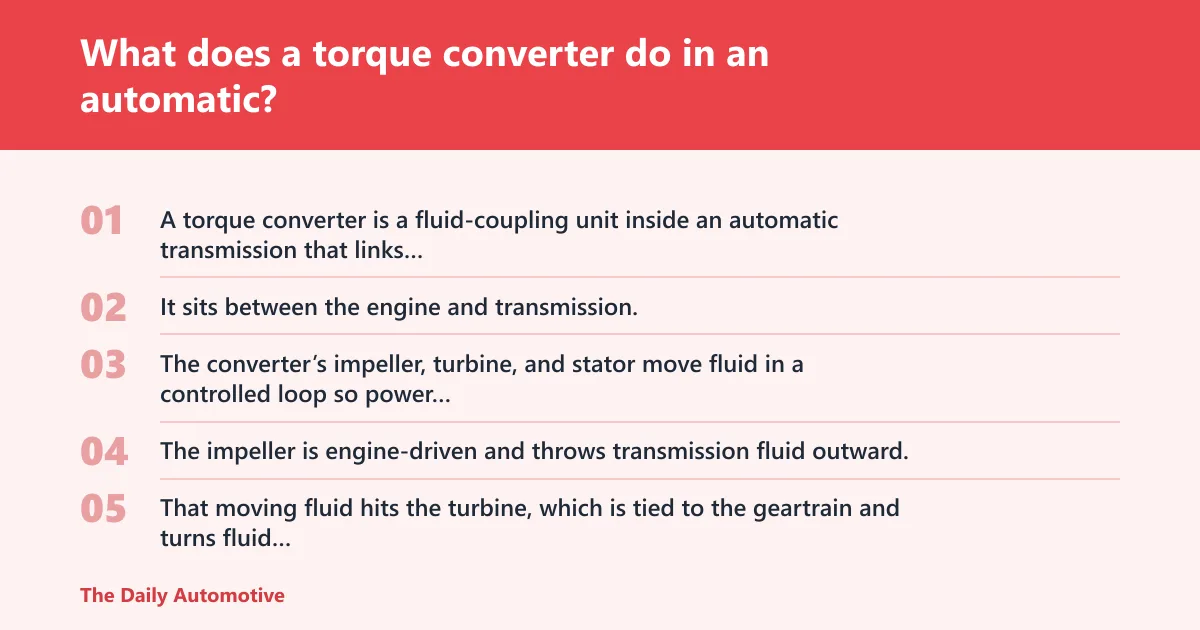


A torque converter is a fluid-coupling unit inside an automatic transmission that links the engine to the gearbox through transmission fluid. It sits between the engine and transmission, keeps the engine running when the car stops in gear, and lets the car move without a manual clutch. The converter’s impeller, turbine, and stator move fluid in a controlled loop so power can reach the transmission without direct mechanical contact.
How the impeller, turbine, and stator work together
The impeller is engine-driven and throws transmission fluid outward. That moving fluid hits the turbine, which is tied to the geartrain and turns fluid motion into gearbox rotation. The stator sits in the center and redirects fluid so it does not fight the impeller. That improves efficiency and helps transmit more engine torque.
This is why the torque converter is a fluid coupling, not a fixed mechanical link. Torque can be described as the rotational correspondent of linear force, written as τ = r × F, with the SI unit N·m. In simple terms, the converter swaps direct contact for hydrodynamic motion through fluid. (en.wikipedia.org)
Why transmission fluid matters to coupling and torque multiplication
Transmission fluid fills the converter and carries motion through hydrodynamics. Its viscosity changes coupling behavior, which is why the wrong fluid or degraded fluid can create shudder, slip, or lazy engagement. Torque multiplication also helps the car get moving from very low revs, which matters in traffic and slow-speed driving.
At low speed, that multiplication supports smooth creep when the brake is released. A torque converter gearbox is automatic, but not all automatics are torque converters; some are CVTs or dual-clutch units. Modern automatic calibration often relies on software-controlled shift behavior, which can reduce some of the older drawbacks people associate with earlier automatics.
How do you know if a torque converter is reliable?
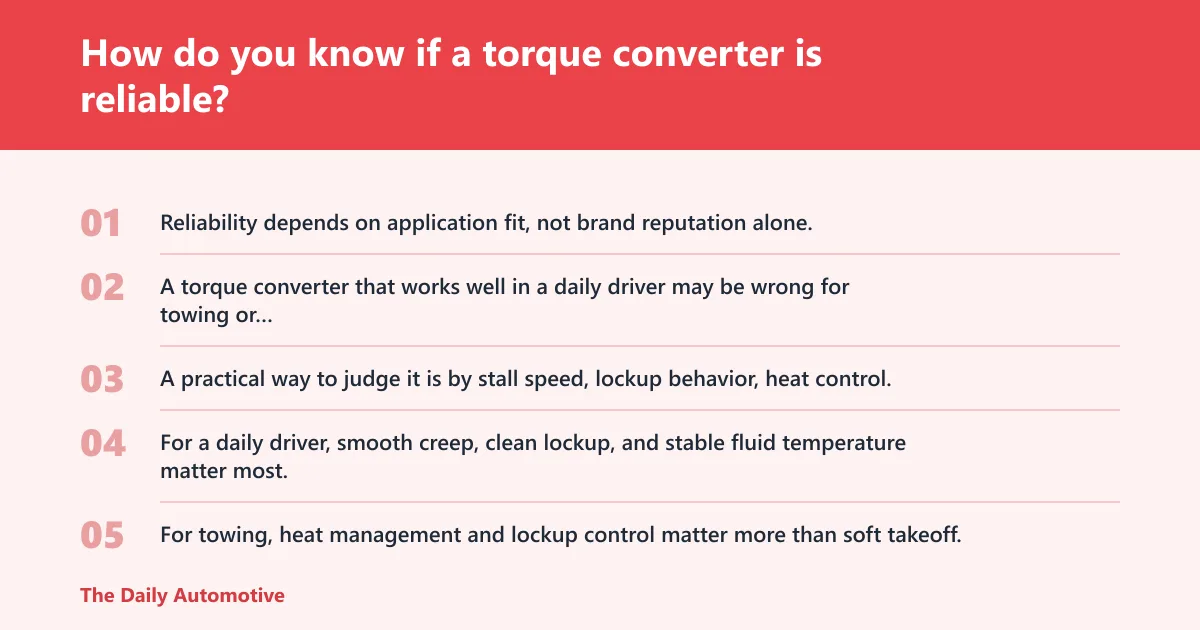
Reliability depends on application fit, not brand reputation alone. A torque converter that works well in a daily driver may be wrong for towing or performance use, and a converter that survives light commuting may overheat or slip in a heavier-duty setup. A practical way to judge it is by stall speed, lockup behavior, heat control, and the symptoms it shows in service.
Daily driver, towing, performance, and heavy-duty expectations
For a daily driver, smooth creep, clean lockup, and stable fluid temperature matter most. For towing, heat management and lockup control matter more than soft takeoff. For performance builds, stall speed and lockup strategy need to match camshaft, gearing, and tire size. Heavy-duty use asks for the most conservative match because heat and load rise fast.
Suppose a pickup used for weekend towing gets a converter with too high a stall speed. It may feel lively empty, then run hotter on grades because the engine spends more time above efficient coupling points. The problem is not the name on the box. It is the mismatch between converter behavior and use case.
What modern automatic calibration changed in 8- and 10-speed units
Modern torque converter autos can be far better at shift control than older units. Software-controlled calibration lets the transmission command lockup sooner, hold it more steadily, and manage shift timing with much less delay. Ford offers a ten-speed torque converter in its Mustang, which shows how far this layout has moved from the old slow-shifting reputation.
Older torque converters were poor at transferring engine power at higher speeds, but modern units are described as great at just about everything when calibration and cooling are right. That does not mean every converter is good. It means the whole system, especially fluid and control logic, matters more than a generic verdict.
What are the signs of a bad torque converter?
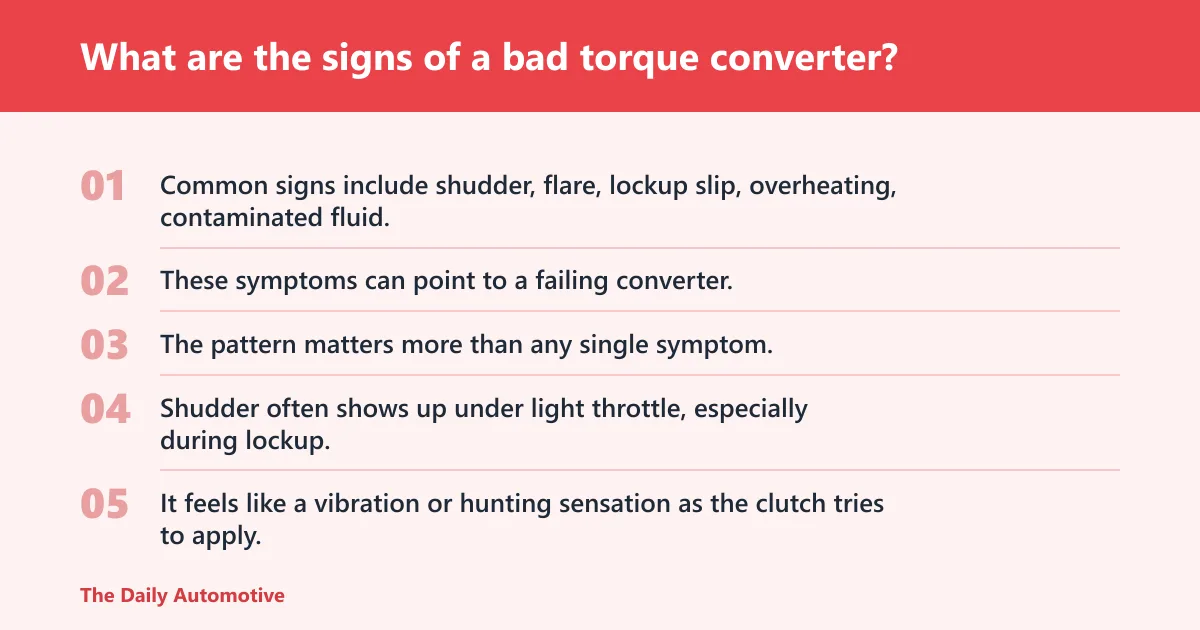
Common signs include shudder, flare, lockup slip, overheating, contaminated fluid, poor creep, and delayed engagement. These symptoms can point to a failing converter, but they can also come from fluid problems, solenoids, a valve body fault, or calibration issues. The pattern matters more than any single symptom.
Shudder, flare, and lockup slip
Shudder often shows up under light throttle, especially during lockup. It feels like a vibration or hunting sensation as the clutch tries to apply. Flare is a rise in engine speed without a matching road-speed increase, and lockup slip means the clutch is not holding as it should. Those three signs often travel together.
What causes torque converter clutch shudder is usually a mix of worn clutch material, incorrect fluid, heat, or a calibration that commands lockup in a way the converter no longer likes. A converter can cause shudder, but so can contaminated fluid or a control problem that makes the clutch cycle too often.
Overheating, contaminated fluid, and delayed engagement
Overheating can cook the fluid, glaze clutch surfaces, and spread debris through the cooler. Contaminated fluid may look dark, smell burned, or carry metallic material. Delayed engagement can mean the converter is not filling or coupling properly, but it can also point to low fluid level, internal seal wear, or a transmission-side issue.
A common first-time mistake is to replace the converter after one shudder complaint and skip the cooler inspection. If debris is still in the cooler and lines, the replacement can fail early or bring the same symptom back within a short time.
When the symptom points to the converter and when it does not
If the symptom appears mainly during lockup, at light throttle, and improves when lockup is disabled, the converter rises on the suspect list. If the symptom happens during all shifts, in all gears, or only when fluid is low, the fault may sit in the transmission controls instead. That distinction saves time and money.
Is a remanufactured torque converter any good?
A remanufactured torque converter can be a good buy when the core is properly cleaned, inspected, and rebuilt to the right spec for the application. It is often the practical middle ground between reused and new. The key is not the label; it is whether the converter is matched to the vehicle and the failure that caused removal.
When remanufactured makes sense
Remanufactured units make sense for common daily drivers, older automatics, and many repair jobs where budget matters and the application is stock. They can also be the right path when the converter is widely supported and the rebuild process includes proper balancing, clutch work, and debris removal. Used units are a much bigger gamble.
When new is the safer choice
New is safer when the vehicle is used for towing, heavy loads, or performance work, or when the old converter failed after severe heat or contamination. New is also the better choice when the original failure is unclear and you want the fewest unknowns in the repair path. If the transmission has scattered debris, fresh hardware may be worth the cost.
What to verify before you buy
Check converter stall speed, lockup type, spline count, bolt pattern, and any application notes tied to the transmission code. Also confirm whether the unit is calibrated for the engine’s torque curve and the vehicle’s intended use. A remanufactured converter that looks right but matches the wrong shift strategy can still drive badly.
- Verify transmission family and exact application.
- Match stall speed to engine output and gearing.
- Confirm lockup clutch type and control strategy.
- Ask whether the unit was flushed, balanced, and tested.
- Plan for cooler inspection if the old unit failed badly.
How should you choose the right torque converter for your car?
Choose by stall speed, lockup behavior, heat handling, and the way the car is used. A converter that fits the engine but not the driving pattern can feel lazy, run hot, or shudder under cruise. The right choice aligns launch feel, highway lockup, and fluid temperature with the job the vehicle actually does.
Stall speed and application fit
Stall speed controls how easily the engine revs before the converter fully couples. Too low, and a modified engine may feel bogged down. Too high, and the car can feel soft off the line and generate more heat. For a stock commuter, stock-like stall usually makes the most sense.
Lockup clutch behavior and calibration match
Lockup behavior matters because it changes cruise feel, fuel use, and heat. A converter that locks too early or too often can shudder if the clutch, fluid, or calibration is unhappy. A converter that locks too late can waste fuel and run warmer. Modern calibration can improve both shift timing and lockup control, but only if the parts match the software’s expectations.
Heat management, towing load, and fluid condition
Heat is the enemy of converter life. If the vehicle tows, sits in traffic, or works in stop-and-go traffic, cooler condition matters as much as the converter itself. Fluid age matters too, because viscosity affects coupling behavior and clutch control. When in doubt, inspect the cooler and the lines before installing the replacement.
Decision checklist: score the converter before you buy
Use this checklist to judge whether a torque converter fits the job. Score each area on a small scale, then act on the total. A high score does not mean perfect. It means the converter is likely matched to the vehicle, the symptoms, and the workload.
| Check | 0 points | 1 point | 2 points | Next action |
|---|---|---|---|---|
| Application fit | Wrong transmission or use case | General fit, but not ideal | Exact match for vehicle and duty | Do not buy until fit is confirmed |
| Stall-speed match | Far from engine and gearing needs | Close, but one step off | Matched to engine, gears, and tires | Recheck engine torque curve and axle ratio |
| Lockup behavior | Unknown or wrong clutch type | Works, but calibration may be marginal | Correct clutch style and control strategy | Confirm TCM behavior before install |
| Heat management | Weak cooler setup or heavy-duty use | Average cooling margin | Cooler path and fluid plan are solid | Inspect cooler, lines, and fluid service needs |
| Failure symptoms | Metal, shudder, flare, or slip unresolved | One symptom, not fully explained | Symptoms point clearly to converter | Replace only after related faults are ruled out |
How to read the score
A high score usually points to a sensible purchase path, assuming the transmission itself is otherwise healthy. A mid-range score suggests the converter may work, but one or more details still need confirmation. A very low score suggests the part may be a poor fit or the diagnosis may be incomplete.
What should you replace with the torque converter?
At minimum, inspect the cooler, fluid, and contamination path before installing a new converter. If the old unit failed with shudder, slip, or burned fluid, the replacement should not go in beside dirty lines and a clogged cooler. Labor overlap is real, because the transmission often has to come out for the converter anyway.
Cooler inspection and flush decisions
If metal, clutch dust, or burned debris is present, inspect the cooler carefully. Some setups need replacement of the cooler rather than a simple flush, especially after severe failure. A weak flush leaves material behind and can send it straight into the new converter. That is how a fresh repair gets damaged fast.
Fluid replacement and contamination cleanup
Use the correct fluid for the transmission and convert it to clean service before road use. Old fluid can hide clutch debris and worsen lockup behavior. If the transmission pan, valve body, or cooler circuit shows contamination, clean the system thoroughly before confirming the repair. Fluid condition is part of converter life, not an afterthought.
Labor overlap with transmission removal
Because the converter sits inside the bellhousing area, converter replacement often overlaps with transmission removal. That makes sense to combine with related repairs such as seals, fluid service, or cooler work. If the transmission already has to come out, verify the whole system now rather than repeating the labor later.
Picture a sedan with 8-speed automatic behavior that shudders only during light-throttle lockup at around 40 mph. A shop that replaces the converter without checking the cooler may fix the symptom briefly, then see it return when debris in the old cooler reaches the new clutch. That is preventable.
Frequently asked questions
is torque converter reliable
A torque converter is reliable when it matches the vehicle, the stall speed, the lockup strategy, and the heat load. Reliability is not a blanket yes or no. A commuter in stock trim can live a long time, while a towing setup with the wrong converter can fail early from heat or clutch stress.
are remanufactured torque converters any good
Yes, if the remanufacturing process is sound and the unit matches the exact application. Remanufactured converters can be a strong value for daily drivers and common automatic transmissions. They are less attractive when the vehicle has severe contamination, heavy towing duty, or a modified engine that needs exact calibration.
what is the best torque converter
The best torque converter is the one that fits the engine, transmission, gearing, and duty cycle. For a stock commuter, that may mean a near-stock stall and tight lockup control. For towing or performance, the best choice is the one that manages heat and coupling in the rpm range the vehicle actually uses.
is torque converter good
Yes, for an automatic transmission, it is a good solution because it allows smooth launch, creep, and idle-with-gear behavior without a manual clutch. The tradeoff is that it depends on fluid condition, heat control, and calibration. Modern units have narrowed the old drawbacks a lot.
how does a torque converter work
It works by moving transmission fluid between an engine-driven impeller, a turbine connected to the gearbox, and a stator that redirects flow. That fluid motion transfers torque, multiplies it at low speed, and lets the engine keep running at a stop. Lockup clutches in many modern units reduce slip at cruise.
what are the signs of a bad torque converter
Look for shudder, flare, lockup slip, overheating, dark or contaminated fluid, delayed engagement, and weak creep. One symptom alone is not enough for a verdict. The repair decision improves when you compare the symptom pattern with fluid condition, scan data, and whether the problem appears mainly during lockup.
Products related to this article
Sponsored / affiliate links. As an Amazon Associate I earn from qualifying purchases. I may earn additional commission from eligible campaigns.