Driveshaft Support Bearing Review: What to Check First
Replace a driveshaft support bearing when the rubber isolator is cracked, the bearing has play or noise with the shaft supported, or the yoke sits misaligned. Otherwise, check U-joints and balance first. Ignoring the fault can send floor vibration through the cabin, wear out U-joints, and turn a low-cost support part into a larger driveline repair. This guide shows how to separate bearing failure from imbalance or mount collapse and choose the correct center support assembly.
What does a driveshaft support bearing do?

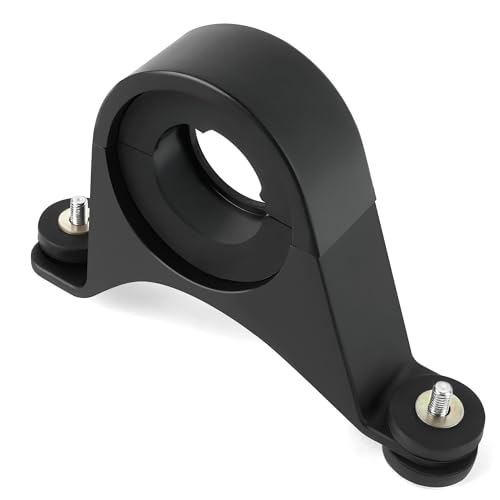

A driveshaft support bearing, also called a center support bearing, holds the driveshaft at mid-span so the shaft stays aligned under load and does not whip at speed. A driveshaft transmits mechanical power, torque, and rotation, and it is subject to torsion and shear stress. Mid-span support cuts vibration and deflection.
How the center support bearing carries mid-span load
On a two-piece shaft, the center support carries the section that would otherwise sag between the transmission and rear axle. That support keeps the shaft angle steadier, which matters because even a small alignment change can show up as floor vibration or a low-speed rumble from the driveline. Many units are paired with a rubber carrier or mount.
Why vibration control depends on support and alignment
The bearing is only one part of the system. Driveshafts often incorporate one or more universal joints, and some designs also use a splined joint or prismatic joint. Depending on the vehicle, rag joints or jaw couplings may appear in related driveline layouts. Any looseness in the support, joints, or balance can trigger the same complaint.
📊 DriveShaft Store advertises up to 36 months unlimited miles warranty. Source: Driveshaft Sales and Parts.
How do you know if the support bearing is bad?
A bad support bearing usually makes noise or vibration that changes with speed, and it often leaves visible rubber damage around the carrier. If the shaft feels smooth with the car safely supported but shakes under load, the bearing is only one suspect. U-joints, imbalance, and a collapsed mount can create similar symptoms.
Speed-specific vibration clues
Center support problems can show up as a vibration that starts at a certain road speed and increases as shaft speed rises. If the vibration is strongest during takeoff, the rubber carrier or mount may be sagging. If it appears at cruise and fades on decel, shaft balance or angle becomes more likely.
Noise clues: howl, rumble, chirp, or clunk
A worn bearing may howl or rumble when it is loaded. A chirp can point to a dry or failing bearing seal area, while a clunk often suggests movement in the carrier, bracket, or nearby U-joint. A single noise rarely proves the diagnosis, so inspect the shaft and supports together.
Visible checks for torn rubber, sagging carrier, and heat damage
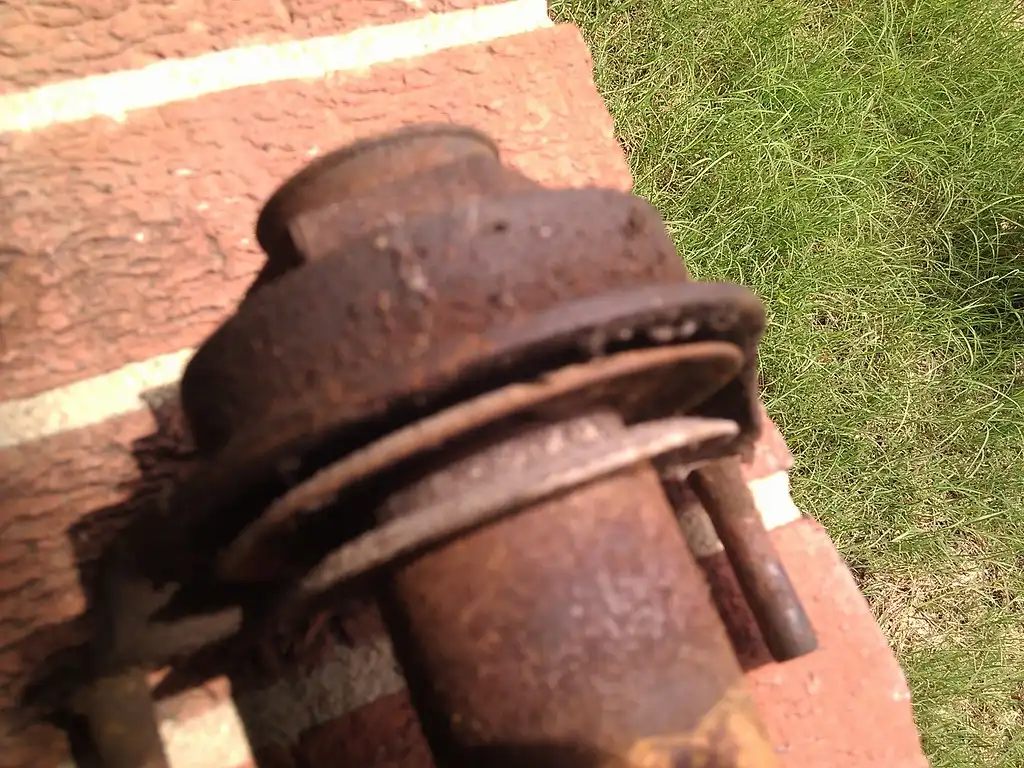
Look for cracked rubber, missing chunks, shiny heat marks, or a carrier that hangs lower than the shaft centerline. If the yoke sits visibly off-center, the bearing may no longer hold the shaft square. A seized bearing can also force the rubber to twist, then tear.
| Driving symptom | Most likely cause | What to inspect first |
|---|---|---|
| Vibration at takeoff | Carrier/mount collapse or U-joint wear | Rubber isolator, bracket position, joint play |
| Vibration at a narrow cruise-speed band | Shaft imbalance or misalignment | Missing balance weights, shaft runout, mounting angle |
| Rumble or howl that changes with load | Support bearing wear | Bearing noise with shaft supported, rough rotation |
| Clunk on throttle tip-in or shift | U-joint looseness or carrier movement | Joint lash, carrier bolt torque, rubber tear |
| Visible sag or heat-damaged rubber | Center support assembly failure | Carrier alignment, rubber condition, shaft centering |
Can you replace just the bearing, or should you buy the full assembly?
Sometimes a bearing-only repair is fine, but many driveline catalogs sell a complete center support assembly because the bearing, carrier, and rubber isolator wear together. If the mount is torn or the bracket is bent, replacing only the bearing can leave the real problem in place. Fitment also becomes safer when the full assembly matches the application.
When a bearing-only repair makes sense
Choose bearing-only replacement when the carrier is straight, the rubber remains intact, and the bearing itself is the only worn part. That approach can work when the shaft design allows the bearing to be pressed out cleanly and the replacement size matches exactly. It is best when the rest of the support hardware checks out.
When the carrier, rubber mount, or bracket should be replaced too
If the rubber is cracked, the carrier is sagging, or the bracket has heat damage or corrosion, a full center support assembly is the safer buy. Some replacement catalogs list complete assemblies with branded bearings, which can matter when you want the bearing and support matched as one unit. That reduces guesswork during installation.
How aftermarket catalogs package complete center support assemblies
Aftermarket listings often package the bearing, carrier, and rubber support together because those pieces affect alignment as much as the bearing itself. DriveShaft Store says its center support replacement uses SKF and NTN bearings, and it also says it carries brand new complete front and rear driveshaft assemblies. That matters when the old shaft is beyond a simple repair.
Pros and cons
The best choice depends on how much of the support system has worn. A cheap bearing can be the right fix. So can a complete assembly. The decision should follow the inspection, not the listing price.
Pros of bearing-only replacement
- Lower parts cost when the carrier is reusable.
- Good option if the bearing is the only failed piece.
- Can preserve an otherwise correct OEM fitment.
Pros of full center support assembly replacement
- Replaces the bearing, carrier, and rubber together.
- Reduces the risk of reusing a tired mount.
- Often simplifies fitment on vehicle-specific aftermarket catalogs.
Tradeoffs in cost, labor, and fitment risk
Bearing-only replacement can save money up front, but it raises labor risk if the old carrier is not square or the rubber is already soft. A full assembly costs more, yet it usually lowers the chance of a second teardown. If the shaft is already out, this is often the point to inspect balance and U-joints too.
Say your SUV develops a 45 mph rumble after a winter salt season. If the support rubber is cracked and the carrier hangs low, a full assembly is usually the cleaner choice. Say a sedan only has a rough bearing with no rubber tear and the bracket is straight; a bearing-only repair may be enough.
Who is this best for?
This fits DIY owners chasing vibration, rumble, or clunking from a two-piece shaft, and shoppers who need an OEM-fit part for a specific year, make, model, and application. It is less useful for buyers who only want the cheapest driveshaft listing and do not plan to verify dimensions first.
DIY owners chasing vibration or noise
If you are diagnosing a floor vibration, a takeoff clunk, or a load-dependent howl, start here. The center support bearing is often blamed too late or too early. A careful check can keep you from buying a part that will not fix the problem.
Shoppers matching OEM fitment on a specific application
OEM fitment matters because aftermarket support assemblies are often vehicle-specific. Year, make, model, shaft length, carrier style, and bolt pattern all affect the result. Matching those details is more important than choosing the most expensive listing.
Performance buyers comparing stock-style and upgraded driveline parts
Performance buyers should look at the whole driveline package, not just the bearing. The Driveshaft Shop says it has over 30 years of drivetrain experience, offers shafts in steel, aluminum, and carbon fiber, and uses computerized two-plane balancers. Denny’s advertises high speed high RPM balanced steel and aluminum drive shafts.
What should you check before ordering a replacement?
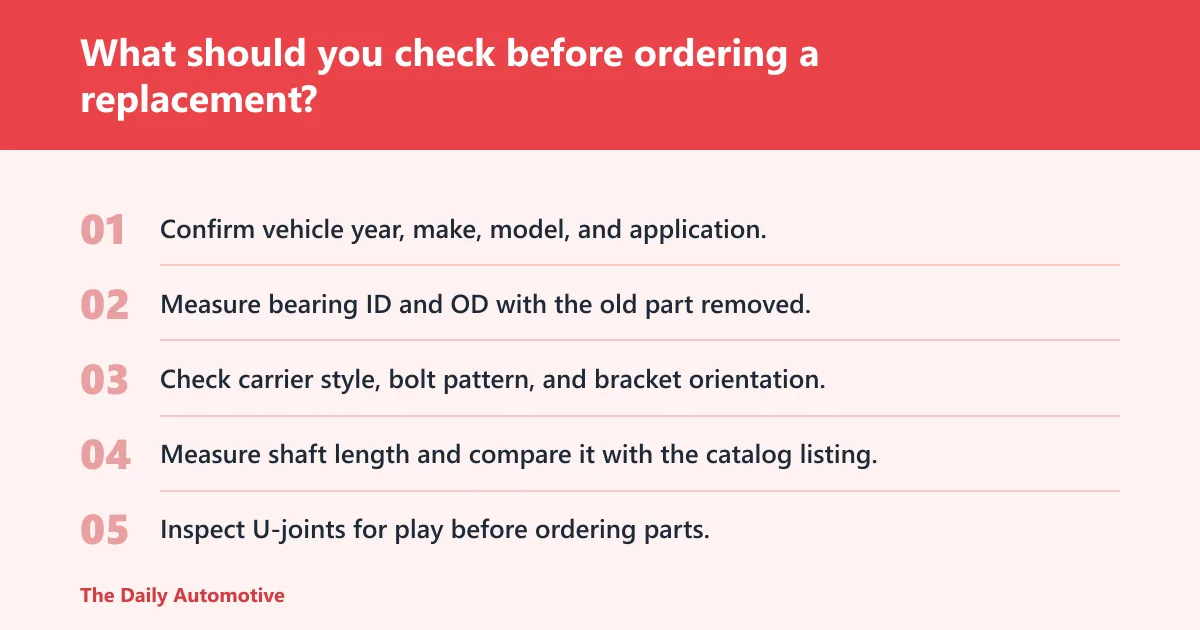
Before ordering, confirm the bearing sizes, carrier style, shaft length, and the application. Also check whether the assembly includes a replaceable bearing or a complete support. If the shaft was repaired before, ask whether it was balanced again, because vibration often returns after a bad match or poor alignment.
Bearing ID and OD
Measure the inner diameter and outer diameter of the bearing itself, not just the carrier. Those numbers must match the shaft and support design. A bearing that is close but not exact can create noise, fit tension, or early failure.
Carrier style and bolt pattern
Look closely at the mount shape, bolt spacing, and bracket orientation. A visually similar support can still be wrong if the carrier centers the shaft differently or the holes land in a different place. Photograph the old part before removal so you can compare the layout.
Shaft length, application, and OEM fitment
Measure shaft length as installed and compare the application against the catalog listing. OEM-fit replacement parts must match the year, make, model, and driveline layout. That is especially important on vehicles with different wheelbases or transmission combinations.
Balancing, warranty, and whether the assembly includes replaceable U-joints
Balancing matters after any driveshaft repair. The Driveshaft Shop says it uses computerized two-plane balancers, and Denny’s advertises high speed high RPM balanced steel and aluminum drive shafts. Warranty also matters: DriveShaft Store advertises up to 36 months unlimited miles warranty and Denny’s says it offers a lifetime warranty.
- Confirm vehicle year, make, model, and application.
- Measure bearing ID and OD with the old part removed.
- Check carrier style, bolt pattern, and bracket orientation.
- Measure shaft length and compare it with the catalog listing.
- Inspect U-joints for play before ordering parts.
- Ask whether the replacement is a bearing-only piece or a complete center support assembly.
- Verify whether the shaft needs balancing after installation.
Are replaceable center support bearings available on aftermarket driveshafts?
Yes. Some aftermarket driveshafts use a serviceable center support, while others are sold as complete assemblies with the bearing already installed. DriveShaft Store says it carries brand new complete front and rear driveshaft assemblies, and replacement driveline catalogs often bundle the support with the shaft when fitment or balance is easier that way.
Brand-new complete assemblies versus repair parts
A replacement driveline can be a brand-new complete assembly rather than a rebuild. That route makes sense when the old shaft has multiple issues, including imbalance, worn joints, and a failed support bearing. It also reduces the chance that one repaired part hides another weak point.
When a complete replacement is the safer buy
If the shaft is bent, the tube is damaged, or the joints and support have both worn out, complete replacement is safer than stacking parts on a tired core. Some suppliers test and balance before shipment, which matters when the original shaft has already shown speed-specific vibration.
Do high-performance driveshafts use stronger support bearings than stock units?
Sometimes they use different support hardware, but the stronger part is usually the whole shaft system, not just the bearing alone. High-performance shafts may pair upgraded tubes, better balancing, and more durable support components. The actual bearing still has to fit the OEM application unless the driveline was redesigned for the vehicle.
What changes on performance or custom shafts
Performance shafts can use different materials and assembly methods. The Driveshaft Shop says it offers steel, aluminum, and carbon fiber shafts, and it mentions custom applications for a wide range of makes. That does not automatically mean a larger bearing; it often means tighter balance control and a purpose-built assembly.
What to expect from upgraded support hardware
Upgraded support hardware may include a stronger carrier, better rubber compound, or a more carefully balanced complete assembly. The gain comes from the package: shaft construction, U-joint quality, and balance process. A stronger bearing by itself cannot fix an out-of-balance shaft.
Frequently asked questions
What is a driveshaft support bearing and what does it do?
The driveshaft support bearing, or center support bearing, holds the shaft at mid-span and limits deflection as the shaft turns. It helps reduce vibration, keeps alignment steadier, and supports the shaft alongside the U-joints. On many vehicles it is mounted in a rubber carrier that also controls movement.
How do I know if my driveshaft support bearing is bad?
Look for speed-related vibration, a howl or rumble that changes with load, and visible rubber cracks or sagging at the carrier. If the shaft feels rough or noisy when supported, the bearing is suspect. If the rubber is torn or the bracket sits crooked, replace the support assembly.
Can I replace a center support bearing without replacing the whole driveshaft?
Yes, if the carrier and rubber mount are still sound and the bearing is the only failed piece. That said, many vehicles use a complete center support assembly because it is easier to match fitment and alignment. If the rubber is damaged, a full assembly is usually the better buy.
What symptoms point to a failing driveshaft support bearing versus a U-joint?
A failing support bearing usually creates mid-speed vibration, rumble, or sagging at the carrier. A worn U-joint more often causes clunking, lash on throttle changes, or a rhythmic knock as the shaft turns. Because the symptoms overlap, inspect both parts before ordering anything.
What tools or measurements do I need to choose the right support bearing?
You need the vehicle application, bearing ID, bearing OD, carrier style, bolt pattern, and shaft length. A ruler or caliper helps, and photos of the old part are useful when comparing catalogs. If the shaft has been serviced before, confirm whether balancing was done after repair.
How much should a driveshaft support bearing or center support assembly cost?
Prices vary by vehicle-specific fitment, whether you buy a bearing only or a full assembly, and whether the shaft is OEM-style or performance oriented. A complete center support assembly usually costs more than the bearing alone, but it can reduce repeat labor and fitment mistakes.
Products related to this article
Sponsored / affiliate links. As an Amazon Associate I earn from qualifying purchases. I may earn additional commission from eligible campaigns.