How to Live Without a Car in the Suburbs: Survival Guide
You can live car-free in the suburbs only if daily transit or rideshare is a short walk away, groceries are walkable, and school or work trips are manageable; otherwise, go hybrid or keep a car. Skip that check and you will pay for backup rides, delivery fees, and missed commutes that wipe out the savings. This guide walks suburb by suburb through transit, sidewalks, groceries, school runs, weather, and commuting so you can choose fully car-free, hybrid, or stay with a car.
How car-dependent is your suburb, really?


The best odds are in inner-ring suburbs with frequent buses, continuous sidewalks, and daily errands close together. Outer-ring suburbs can work with a hybrid setup. Exurbs and low-transit areas usually need a car unless your trips are rare and you can live with long waits, high backup costs, and weak first-mile access.
Inner-ring suburbs: the best odds for going car-free
Inner-ring suburbs often have older street grids, grocery stores within a short ride, and bus routes that arrive every 10 to 30 minutes on core corridors. If your home sits within a short walk of a stop, your work or school is under 3 miles away, and sidewalks run continuously, car-free living can pencil out.
Outer-ring suburbs: where a hybrid setup often works
Outer-ring areas usually have thinner transit. A bus may exist, but service gaps, school runs, and grocery trips can push you back into rideshare or car-share too often. In these places, a car-light setup with an e-bike, delivery, and occasional car use is often more realistic than full removal.
Exurbs and low-transit areas: when keeping a car is the safer call
Exurbs usually fail the basic test: buses come infrequently, sidewalks disappear, and groceries, jobs, and medical care sit far apart. If your nearest bus is infrequent, or the stop is not easy to reach safely on foot after dark, keep a car unless you can change housing first.
Map your trips before you give up the car
Write down every recurring trip before you make a decision. Distance is only part of it. Frequency, timing, weather, and whether the trip can be bundled matter too. A car-free plan works when the route map matches your week, not your ideal week.
Work and school routes
Check commute time in both directions, plus early starts and late finishes. School runs are harder because they repeat on a fixed clock and often involve bags, instruments, sports gear, or more than one stop. If a route breaks when transit ends, that is a real failure case, not a small inconvenience.
Grocery, pharmacy, and medical trips
Food and prescriptions decide most suburban car-free plans. If the grocery store is walkable or reachable by bus, you can manage weekly shopping with a backpack, panniers, or delivery. If medical care needs transfers or rideshare every time, budget for backup costs before you sell anything.
Weekend, airport, and late-night trips
Weekend social trips and airport runs are often where the math changes. Late-night returns are expensive because transit frequency drops and rideshare pricing can jump. A suburb-by-suburb audit should include those edge cases, not just the work commute.
Can you live car-free in the suburbs with kids?
Sometimes, yes, but only in suburbs with short school routes, sidewalks that stay continuous, and backup help for sick days and pickups. Families need more cargo room, more schedule flexibility, and more weather tolerance than solo adults. If school and activities are spread out, hybrid usually wins.
School runs and activity schedules
A child’s school route may look simple on a map and still fail in practice. Morning drop-off, after-school pickup, and evening activities can sit in different parts of town. If transit cannot cover those windows, the family needs another layer: rideshare, car-share, or a second adult with a car.
Cargo, strollers, and emergency pickups
Kids add weight and volume. A stroller, snack bag, backpack, coat, and sports gear can turn a short walk into a load-management problem. A cargo bike or e-bike can help, but only if your streets are safe enough and your child count, hills, and weather fit that setup.
When a second adult or backup ride matters
Say your 7-year-old gets sent home from school at noon with a fever. If the home is 25 minutes from school by bus and the stop is a 12-minute walk, the plan fails unless another adult can pivot. That is the real test for families: not routine days, but disruption days.
Use transit as the backbone when it exists
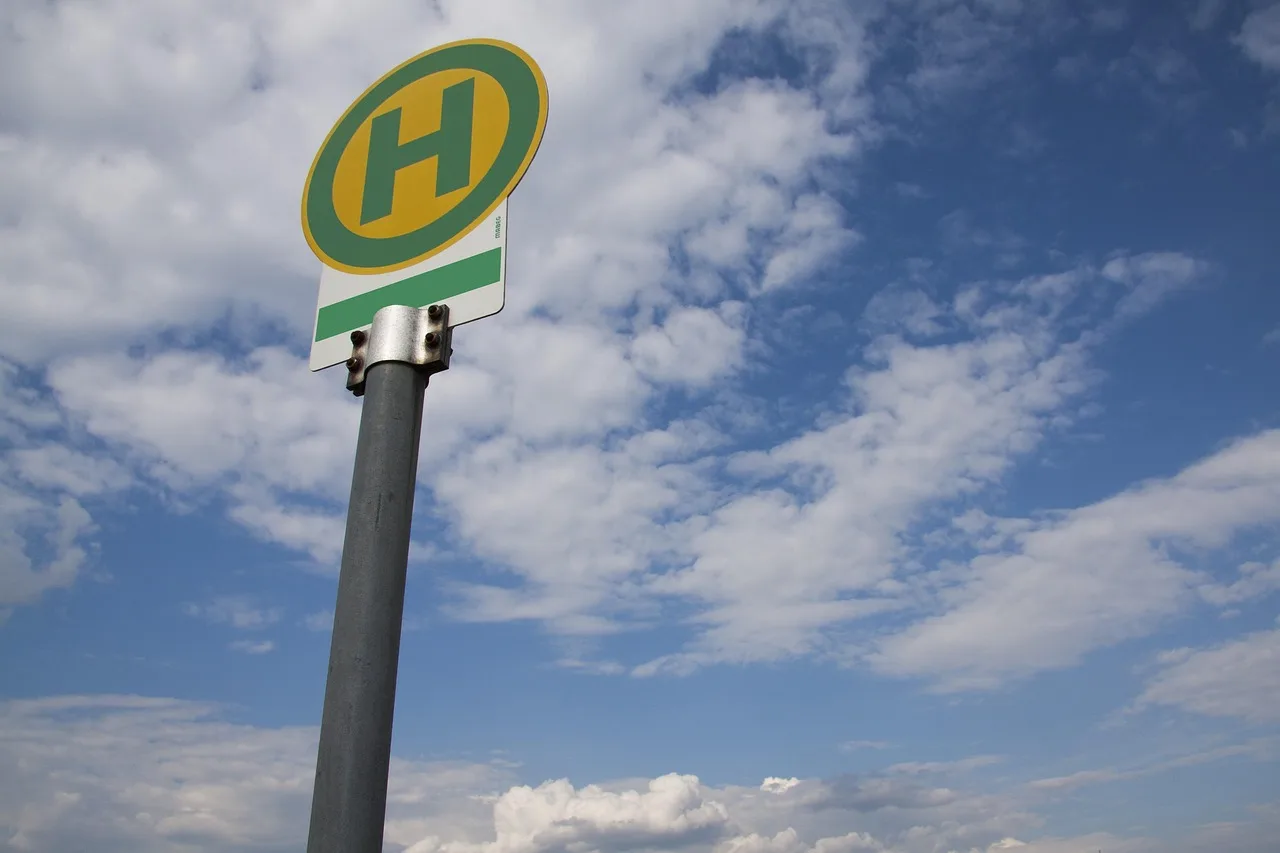
Transit works as the backbone when bus routes run often, stops sit close, and first-mile access is safe. Monthly passes can beat pay-per-ride for daily use, but only if the service is reliable enough to replace a private car on your main trips. Gaps force expensive backups.
Bus routes, frequency, and first-mile access
Look for route frequency, not just route presence. Every 10 to 15 minutes on a main corridor is far easier to live with than hourly service. Also check first-mile access: sidewalk continuity, crossing safety, lighting, snow clearance, and whether you can reach the stop without crossing fast traffic.
Monthly pass versus pay-per-ride
A monthly pass works best for daily riders and for people making transfer-heavy trips. Pay-per-ride can be cheaper for low-use households, but it becomes expensive if service gaps force repeated transfers or if you add occasional bus-plus-rideshare trips. Total monthly transport spend matters more than the fare alone.
How service gaps change the plan
If buses stop early, run infrequently, or skip weekend service, your suburb is not transit-backed; it is transit-assisted. That means you need rideshare, delivery, or car-share in reserve. Without that backup, one missed connection can turn into a missed shift or a missed appointment.
What replaces short drives: walking, biking, or an e-bike?
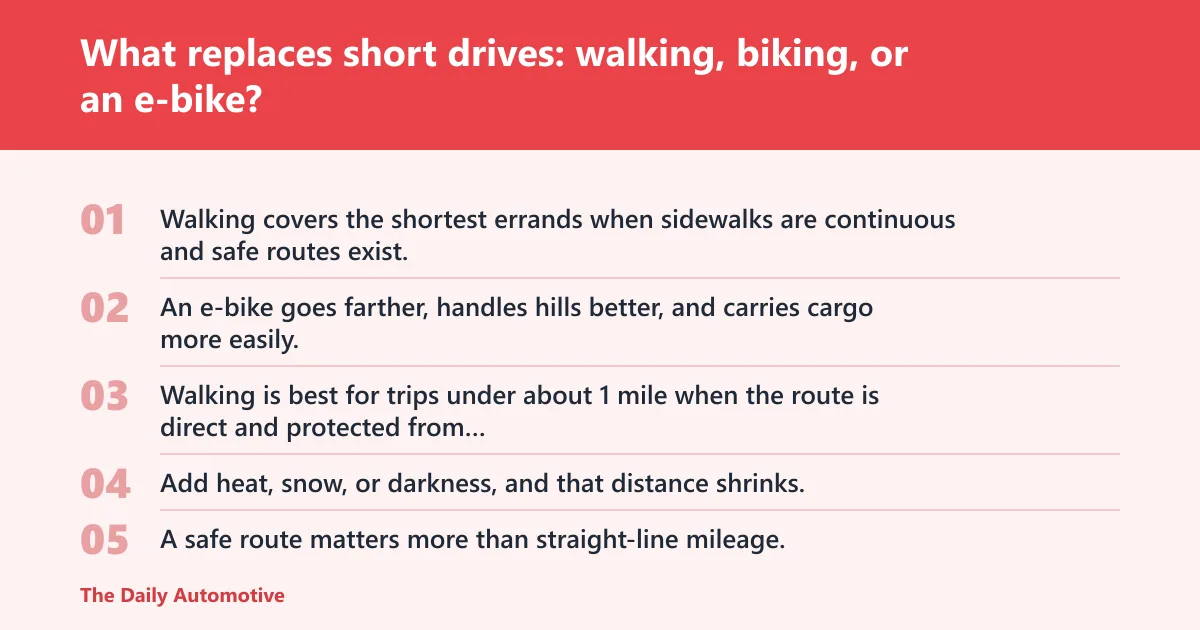
Walking covers the shortest errands when sidewalks are continuous and safe routes exist. Biking expands the workable radius. An e-bike goes farther, handles hills better, and carries cargo more easily, which is why many suburban setups depend on it when trips stretch beyond basic walking range.
Walking distance and route quality
Walking is best for trips under about 1 mile when the route is direct and protected from traffic. Add heat, snow, or darkness, and that distance shrinks. A safe route matters more than straight-line mileage. A short trip on a bad road can be a no-go.
Bike range, cargo limits, and security
A regular bike can handle errands in the 2 to 5 mile range for many riders, but groceries and bulky items strain the setup. Panniers help more than a backpack because they keep weight off your shoulders. You also need a strong lock, a visible parking spot, and a place to store the bike indoors when possible.
E-bike range, charging, hills, and local rules
Most manufacturers list e-bike ranges that vary widely by assist level, battery size, hills, rider weight, and weather. A common practical rule is to assume less than the advertised number. E-bikes help on hills, with cargo, and on longer suburb errands. Check local legality for class and speed limits before buying.
How do you grocery shop without a car?
You grocery shop without a car by combining delivery, curbside pickup, smaller top-up trips, and better load management. Heavy dry goods and water cases are the usual troublemakers. Fresh food is easier if you buy more often or live close enough to shop on foot or by bike.
Delivery fees, minimums, and memberships
Grocery delivery usually adds delivery fees, service fees, membership fees, and minimum-order thresholds. Those charges can be cheaper than owning a car if you only use them for bulky orders. They get expensive if you depend on delivery for every basket, especially for fresh items several times per week.
Curbside pickup for heavy orders
Curbside pickup helps when you want the store’s selection without carrying cases of food home. It is especially useful for households that live near a store but not close enough to walk with bags. The tradeoff is that you still need a pickup trip by bike, transit, rideshare, or car-share.
Packing, storage, and load management
Use panniers for heavy groceries, a backpack for light items, and a folding cart for apartments or multi-bag trips. Keep a home storage plan for deliveries so boxes do not block your entryway. Packages, frozen items, and produce all travel better when the route home is short and predictable.
What backup options cover the trips a bike cannot?
Rideshare and car-share are the main backups when transit fails, loads are heavy, or the destination is awkward. Rideshare works for one-off trips and late returns. Car-share works better for planned errands, airport runs, and multi-stop days when hourly or daily pricing is still cheaper than owning.
Rideshare for peak pricing, airport runs, and late nights
Rideshare can solve the last 10% of trips, but peak pricing is the catch. Late-night rides, storms, and airport departures often cost more. Build a backup rule: use rideshare for safety, time pressure, or rare trip failures, not as your default commute plan.
Car-share pricing, insurance, and reservation timing
Car-share services often bill hourly or daily, and many include insurance in the listed price, though coverage details vary. Availability radius matters as much as price. In some suburbs, you must reserve a car a day or more ahead, which limits spontaneous use and weakens the backup value.
Trip bundling to cut extra costs
Bundle errands. One car-share trip for pharmacy, hardware, and grocery pickup usually costs less than three separate rideshare trips. The same rule applies to transit and e-bike use: combine destinations when the route and weather allow it.
The real monthly cost of going car-free
Car-free living saves money only when you replace a full car budget, not when you replace one expense with four smaller ones. Compare transit passes, rideshare, delivery, bike upkeep, and occasional car-share against loan or lease payments, insurance, fuel, parking, maintenance, registration, and replacement costs.
| Cost category | Car ownership | Car-free or car-light |
|---|---|---|
| Fixed monthly cost | Loan or lease, insurance, parking | Transit pass or no fixed cost |
| Variable monthly cost | Fuel, maintenance, repairs, registration | Rideshare, delivery, bike repairs, car-share |
| Emergency fund | Repair surprise, tire, battery, tow | Backup rides, winter gear, replacement bike parts |
| Large one-time cost | Down payment, replacement vehicle | E-bike, bike lock, cargo setup, transit card |
Include emergency funds and replacement costs
Do not skip the backup fund. A car-free household still needs money for sudden rides, weather gear, bike replacement, or a short-term car-share spike. If you are replacing a paid-off car, the monthly savings may be smaller than if you are dropping a financed vehicle with full coverage and parking fees.
When the savings are large and when they are not
Savings are usually biggest when the alternative is a financed car with high insurance, paid parking, and long commutes. Savings shrink when you need frequent rideshare, school transport, or delivery. The math depends on your current car costs, not a generic suburban average.
Printable suburb mobility scorecard
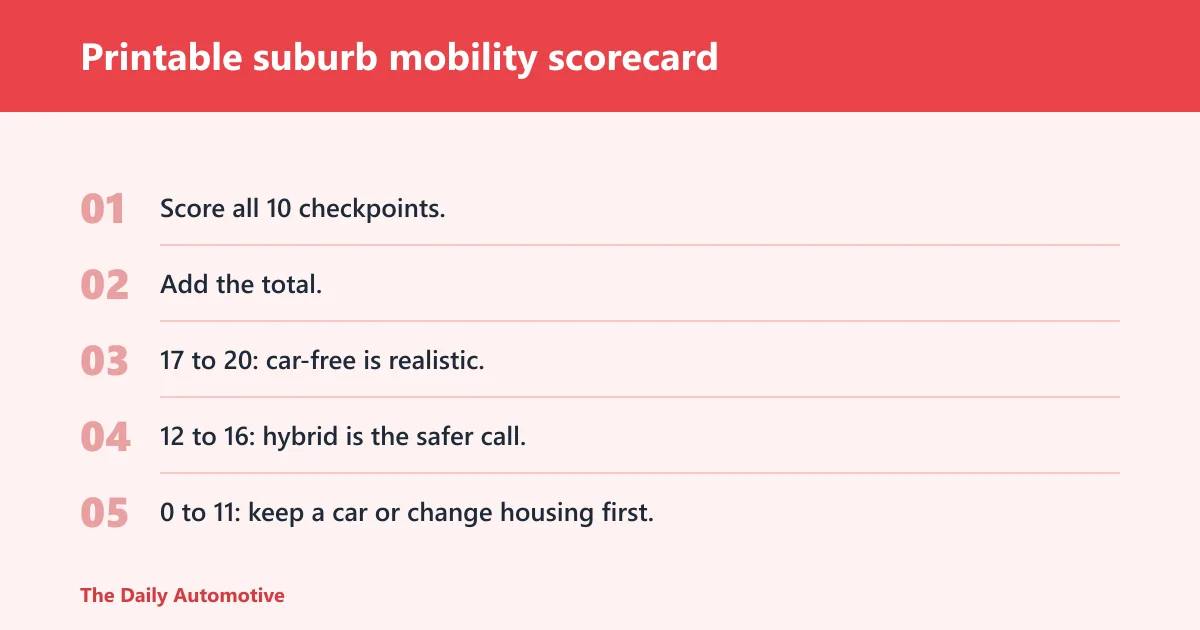
Score each item from 0 to 2. Zero means fail, one means workable with friction, and two means strong fit. Add the total and use the threshold below for a clear decision. If you score high but fail on school runs or weather, treat that as a warning sign, not a footnote.
| Checkpoint | 0 points | 1 point | 2 points |
|---|---|---|---|
| Transit frequency | Hourly or worse | 20 to 30 minutes | 10 to 15 minutes |
| Sidewalk continuity | Missing links | Some gaps | Continuous and safe |
| Grocery access | Over 2 miles or unsafe | Walkable by bike or bus | Under 1 mile or easy delivery |
| Work commute | Long, irregular, or shift work | Possible with backup | Direct and predictable |
| School run | Complex or frequent pickups | Some backup needed | Simple or unnecessary |
| Climate | Harsh heat, ice, or darkness | Seasonal friction | Mild and manageable |
| Cargo needs | Heavy or bulky often | Sometimes bulky | Light loads only |
| Safety | Unsafe roads or crossings | Mixed conditions | Low-stress routes |
| Rideshare cost | Too expensive for backups | Manageable sometimes | Affordable for edge cases |
| Car-share availability | None nearby | Limited or booked out | Nearby and reservable |
- Score all 10 checkpoints.
- Add the total.
- 17 to 20: car-free is realistic.
- 12 to 16: hybrid is the safer call.
- 0 to 11: keep a car or change housing first.
Test the actual routes before selling the vehicle. Try the work commute, one grocery run, one medical appointment, and one late return. Picture a 2.5-mile trip with no sidewalk for half the route and a grocery bag in each hand; that is the kind of detail that decides the outcome.
Frequently asked questions
How can you live in the suburbs without a car?
You can live without a car by building a transport stack: walking for short trips, biking or an e-bike for medium errands, transit for repeat trips, and rideshare or car-share for gaps. It works best when groceries, work, and school are all within practical reach.
What is the cheapest way to get around the suburbs without owning a car?
The cheapest setup is usually walking plus transit, with a bike for errands and very limited rideshare. A monthly pass can beat pay-per-ride if you travel often. Costs stay low only if you avoid frequent delivery, airport rides, and repeated car-share bookings.
Is it realistic to live car-free in the suburbs with kids?
It can be realistic in inner-ring suburbs with safe sidewalks, nearby schools, and flexible schedules. It becomes harder with multiple activities, long school runs, or frequent emergency pickups. Families often need at least one backup ride option even when daily trips work well.
How do you grocery shop without a car in the suburbs?
Use a mix of delivery, curbside pickup, and smaller in-person trips by bike, e-bike, or transit. Keep the heavy items limited, and use panniers or a folding cart. If the store is far away or sidewalks are poor, delivery may be the better choice.
What should I do if there is no bus service near my house?
If there is no bus service nearby, treat that as a major warning sign. Check whether you can still walk or bike safely to a line within 10 minutes. If not, the realistic options are car-share, rideshare, an e-bike, or keeping a car.
How much money can you save living without a car?
Savings depend on what you are replacing. If you are dropping a financed car with insurance, fuel, maintenance, and parking, the savings can be large. If you still need frequent rideshare, delivery, or car-share, the savings shrink quickly. The only honest answer is to total your own monthly costs.
Products related to this article
Sponsored / affiliate links. As an Amazon Associate I earn from qualifying purchases. I may earn additional commission from eligible campaigns.